
Listen to this Post
Introduction:
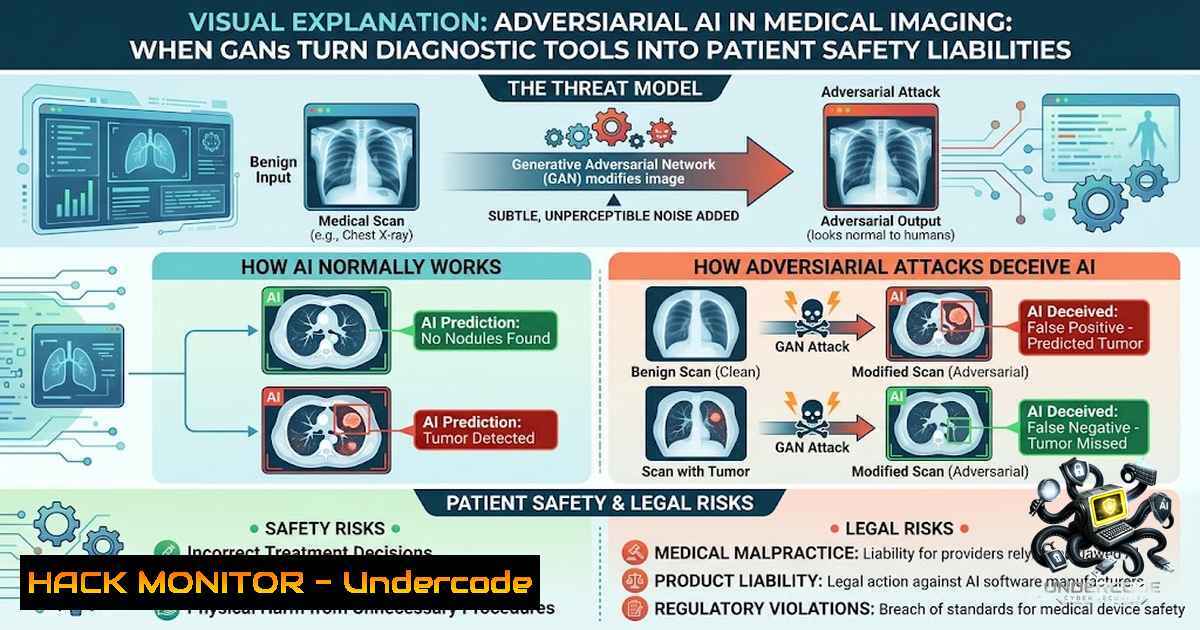
The convergence of artificial intelligence and medical imaging has ushered in an era of unprecedented diagnostic potential—but it has also introduced a vulnerability that the healthcare industry is only beginning to grasp. In 2026, ECRI named “navigating the AI diagnostic dilemma” the top patient safety concern, a designation that underscores how unchecked dependence on AI tools can increase diagnostic errors, perpetuate bias, and erode critical thinking skills. A landmark 2021 study published in Nature Communications demonstrated that Generative Adversarial Networks (GANs) could subtly manipulate mammogram images—inserting or removing cancerous-looking tissue with imperceptible precision—fooling an AI-CAD model into wrong diagnoses 69.1% of the time. Even more concerning, five breast imaging radiologists who were asked to spot the fakes achieved accuracy ranging from just 29% to 71%. This isn’t a theoretical concern—the failure mode is real, demonstrated, and documented. The image pipeline, from acquisition to storage to AI interpretation, is now part of diagnostic integrity, not merely an IT security problem.
Learning Objectives & Secrets:
- Objective 1: Understand the GAN-based adversarial threat model in medical imaging — Learn how Generative Adversarial Networks can manipulate mammogram and other radiological images with enough subtlety to evade both AI detection and human visual inspection, and why this represents a systemic patient safety risk rather than a narrow cybersecurity issue.
-
Objective 2 Secret Tip: Map the entire imaging pipeline for access control gaps — Most healthcare organizations treat PACS security and AI model validation as separate domains. The secret is to map every touchpoint from image acquisition (X-ray, CT, mammography machine) to storage to AI ingestion, then enforce role-based access controls (RBAC) at each layer. Attackers don’t need to compromise the AI model itself—they only need access to the image before the AI reads it.
-
Objective 3 Secret Tip: Implement cryptographic image provenance at capture — Digital watermarking and DICOM digital signatures embedded at the exact moment of image creation provide a tamper-evident chain of custody. If a single pixel is modified, the signature breaks, immediately flagging the image as compromised. This shifts security left—from detection after the fact to prevention at the source.
You Should Know:
- The Attack Vector: How GANs Exploit Medical Imaging AI
The attack works because deep learning models, including those used in computer-aided diagnosis (CAD), are vulnerable to adversarial inputs—carefully crafted perturbations that are imperceptible to the human eye but catastrophic to model outputs. Researchers built a GAN that made intentional modifications to diagnosis-sensitive contents of mammogram images. The GAN-generated fake images successfully fooled the AI-CAD model—which had been over 80% accurate on real cases—into outputting a wrong diagnosis on 69.1% of cases that were initially correctly classified.
What makes this attack particularly insidious is that the manipulation doesn’t look like obvious tampering. The GAN subtly inserts or removes cancerous-looking tissue, just enough to shift what the image shows. When the same manipulated images were shown to five breast imaging radiologists, their ability to spot the fakes ranged from 29% to 71%. Even the better performers only achieved their accuracy by second-guessing real images too—meaning the “human backup plan” most departments assume they have turned out to be far less reliable than it sounds.
Step‑by‑step guide to understanding the threat:
- Recognize the vulnerable surface: Any AI model that ingests medical images is potentially susceptible—not just mammography CAD, but also chest X-ray AI, CT-based diagnostic tools, and pathology slide analysis systems.
-
Understand the GAN mechanism: GANs consist of two neural networks—a generator that creates fake images and a discriminator that tries to detect them. Through adversarial training, the generator learns to produce images that are virtually indistinguishable from real ones while containing targeted modifications.
-
Assess your current validation: Ask your imaging AI vendor whether their model has been evaluated against adversarial or GAN-manipulated inputs specifically—not just standard accuracy benchmarks. Most vendor validation studies do not cover this scenario.
-
Consider the cascade effect: A single manipulated image can lead to a wrong diagnosis, unnecessary biopsy, missed cancer detection, or delayed treatment—all with cascading consequences for patient safety and institutional liability.
-
Securing the Imaging Pipeline: From Acquisition to AI Ingestion
The image pipeline—from the moment a mammogram, CT, or X-ray is captured to the point an AI model reads it—is now part of your diagnostic integrity. This means access controls on that pipeline matter as much as access controls on the EHR. Yet in most healthcare organizations, imaging security doesn’t receive the same scrutiny.
Step‑by‑step guide to hardening the pipeline:
- Map who can touch an image between acquisition and the point the AI reads it. This includes technologists, PACS administrators, network devices, storage systems, and any intermediate processing nodes.
-
Implement end‑to‑end encryption at the source — encrypting data directly inside the X-ray, CT, or mammography machine so it cannot be intercepted or modified while traveling to the hospital database. DICOM-compliant encryption schemes now exist that integrate with PACS workflows without breaking compatibility.
-
Deploy role‑based access control (RBAC) across the PACS environment. Use modern authentication and authorization technologies such as OpenID and OAuth to manage which users have access to the DICOM system.
-
Enable comprehensive audit logging for every image access, modification, and transfer. If an image is tampered with, you need to know who did it, when, and from where.
-
Regularly review access logs for anomalies—unusual access patterns, off-hours activity, or accesses from unexpected locations.
3. Digital Watermarking and Cryptographic Provenance
Digital watermarking and cryptographic signatures provide a tamper-evident chain of custody that can detect even single-pixel modifications. By embedding unique, unalterable digital signatures into the image metadata at the exact moment of capture, you create a forensic trail that immediately flags any compromised image.
Step‑by‑step guide to implementing image provenance:
- Enable DICOM digital signatures at image creation. The DICOM standard supports digital signature profiles that serve as lifetime data integrity checks.
-
Consider advanced watermarking techniques — recent research has achieved real‑time inference (44 ms per 512×512 image) with tamper localization IoU of 83.2% using proactive forensic fragile watermarking.
-
Verify signatures upon AI ingestion — before any image is fed into an AI model, validate its cryptographic signature. If the signature is broken, flag the image as potentially compromised and route it for manual review.
-
Extend provenance to metadata — embed image identification, timestamp, operator signature, and metadata summary into the watermark payload.
-
Integrate with your incident response plan — define clear procedures for what happens when a compromised image is detected, including notification of clinicians, patient safety committees, and potentially regulatory bodies.
4. Adversarial Training and Model Hardening
While securing the pipeline prevents tampering, you also need models that are robust against adversarial inputs they might encounter. Adversarial training—exposing models to adversarial examples during training—can improve resilience.
Step‑by‑step guide to hardening AI models:
- Include adversarial examples in your validation datasets — not just for standard accuracy benchmarks, but specifically to test model behavior under manipulation.
-
Implement adversarial training — train models on both clean and adversarially perturbed images so they learn to recognize and resist manipulation.
-
Deploy ensemble methods — use multiple models with different architectures and training data; if one model is fooled but others aren’t, flag the discrepancy for review.
-
Monitor model drift — if a model’s performance on certain image types suddenly changes, it could indicate that someone is feeding it adversarial inputs.
-
Reference established frameworks — use NIST’s AI Risk Management Framework as your operating framework for risk and trustworthiness, and treat ISO 42001 as a maturity and audit-readiness target.
5. Governance, Training, and the Human Factor
ECRI’s 2026 report emphasizes that diagnostic AI risk is a systems-level patient safety issue, not a narrow software problem. It points to organizational factors linked with safer use of diagnostic AI, including governance and oversight, clinician training that emphasizes understanding AI capabilities and limitations, clear usage policies, and documentation when AI informs diagnostic decisions.
Step‑by‑step guide to building governance:
- Establish AI governance policies, roles, and oversight structures. This should include a cross-functional team with representation from radiology, IT security, compliance, and patient safety.
-
Train staff on appropriate AI use and its limitations. Radiologists need to know that manipulated images are genuinely hard to catch visually, even for specialists.
-
Require documentation of AI use in diagnostic decisions. If an AI contributed to a diagnosis, that should be recorded in the patient record.
-
Reinforce clinician judgment and second opinions alongside AI. AI should be treated as support, not as a substitute for judgment.
-
Bring this into your patient safety committee alongside the ECRI report. It’s a stronger, more concrete example of the “AI diagnostic dilemma” than most of what tends to be discussed at that level.
What Undercode Say:
-
Key Takeaway 1: The GAN-based image manipulation demonstrated in the Nature Communications study is not a theoretical vulnerability—it’s a proven attack vector that fooled both AI models (69.1% of the time) and experienced radiologists (29%–71% accuracy). The failure mode is real, and the healthcare industry must treat it as an active threat rather than a future concern.
-
Key Takeaway 2: Securing medical imaging AI requires a multi-layered approach that spans the entire pipeline—from acquisition to storage to AI ingestion. End‑to‑end encryption, digital watermarking, role‑based access controls, and adversarial training are all essential components. No single control is sufficient; defense in depth is the only viable strategy.
-
Key Takeaway 3: Governance and training are as important as technical controls. ECRI’s designation of the “AI diagnostic dilemma” as the 1 patient safety concern for 2026 underscores that this is a systems-level issue requiring organizational commitment, clear policies, and continuous education. Radiologists need to understand both the capabilities and the limitations of the AI tools they rely on—and they need to know that a manipulated image is genuinely hard to catch, even for specialists.
-
Key Takeaway 4: The imaging pipeline is now part of diagnostic integrity, not just IT security. This means security teams, radiology departments, and patient safety committees must work together—not in silos—to address the threat. Access controls on the imaging pipeline matter as much as access controls on the EHR, yet they don’t always receive the same scrutiny.
-
Key Takeaway 5: Organizations should start by asking their imaging AI vendors whether their models have been evaluated against adversarial inputs. Most vendor validation studies don’t cover this scenario, and the absence of such testing is a gap that needs to be addressed—either by vendors or through independent validation.
Prediction:
-
+1 Organizations that proactively implement end‑to‑end encryption, digital watermarking, and adversarial validation will gain a significant competitive advantage in patient safety and regulatory compliance. As AI diagnostic tools become more pervasive, the ability to demonstrate robust security will become a differentiator in healthcare quality ratings and liability protection.
-
+1 Advances in cryptographic provenance and real‑time tamper detection (such as the 44 ms inference watermarking techniques) will make it feasible to verify image integrity at scale, enabling routine forensic checks on every image before AI analysis.
-
-1 Healthcare organizations that fail to address this vulnerability will face increasing liability exposure. A single successful GAN-based attack leading to a misdiagnosis could result in catastrophic patient harm, massive litigation, and regulatory sanctions—particularly as plaintiffs’ attorneys become aware of this attack vector.
-
-1 The “human backup plan” assumption—that a radiologist will catch what the AI misses—has been empirically disproven. Organizations that continue to rely on this assumption without implementing technical safeguards are placing patients at unnecessary risk. ECRI’s warning about overreliance on AI tools eroding critical thinking skills is not hyperbole; it’s a documented phenomenon.
-
-1 As GAN technology becomes more accessible and easier to train, the barrier to executing these attacks will continue to fall. What required sophisticated research in 2021 may soon be achievable with open‑source tools and public datasets, dramatically expanding the threat surface.
▶️ Related Video (80% Match):
https://www.youtube.com/watch?v=-YnkWGDFRrE
🎯Let’s Practice For Free:
🎓 Live Courses & Certifications:
Join Undercode Academy for Verified Certifications
🚀 Request a Custom Project:
Secure, high-velocity infrastructure and disruptive technological engineering. Contact our engineering team for high-tier development and proprietary systems:
[email protected]
💎 Smart Architecture | 🛡️ Secure by Design | ⭐ Trusted by Thousands
IT/Security Reporter URL:
Reported By: https://lnkd.in/p/e2GFvYDS – Hackers Feeds
Extra Hub: Undercode MoN
Basic Verification: Pass ✅


