
Listen to this Post
Introduction
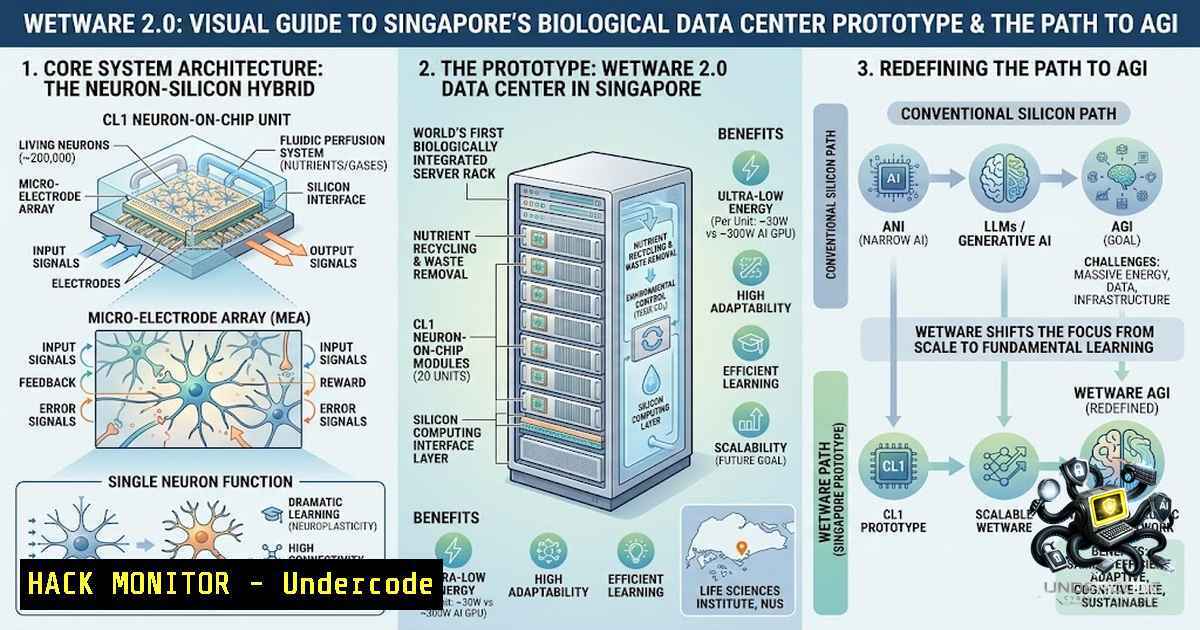
For decades, the pursuit of artificial intelligence has advanced along two well-charted vectors: more sophisticated algorithms and exponentially more powerful silicon chips. That binary framework is now fracturing. In August 2026, Singapore’s National University of Medicine (NUS Medicine), data center developer DayOne, and Australian biological computing startup Cortical Labs activated a 20-unit CL1 biological computing rack—the world’s first independently operated biologically integrated server rack. Instead of relying solely on transistors, this system processes information using living human neurons derived from stem cells, cultivated on silicon chips and integrated through a microelectrode interface. The prototype shifts the conversation from theoretical biocomputing to applied infrastructure, testing whether biological “wetware” can complement—or in some cases surpass—conventional AI hardware in domains where adaptability, sample efficiency, and energy constraints matter most.
Learning Objectives & Secrets
- Objective 1: Understand the architecture of biological-digital hybrid computing. Grasp how lab-cultivated neurons, grown from stem cells and sustained by an internal life support system, interface with silicon via microelectrode arrays to form programmable Biological Neural Networks (BNNs). The CL1’s Biological Intelligence Operating System (biOS) creates a simulated environment, sends information directly to the neurons, and translates their electrical impulses into computational outputs.
-
Objective 2 Secret Tip: Exploit neural plasticity for adaptive learning. Unlike static silicon models, living neural networks receive stimuli, respond, and rewire themselves in real time. Cortical Labs’ earlier DishBrain prototype taught itself to play Pong, and the CL1 has since navigated complex games like Doom. The secret: closed-loop feedback systems that stimulate specific electrodes when the network deviates from a desired state, forcing adaptation without traditional gradient-based training.
-
Objective 3 Secret Tip: Leverage sample efficiency for sparse-data domains. Unpublished research indicates biological neurons are approximately 5,000 times more sample-efficient than GPUs in reinforcement learning tasks. The secret lies in the neurons’ inherent ability to generalize from limited stimuli—a property Cortical Labs is targeting for cybersecurity anomaly detection, fraud identification, and drug discovery, where labeled data is scarce.
You Should Know
- Biological Computing System Architecture: From Stem Cells to Server Rack
The CL1 biological computing unit is a self-contained system priced at approximately $35,000. Each unit houses roughly 800,000 neurons grown in a lab from human stem cells, cultivated across a silicon chip that sends and receives electrical impulses through a multielectrode array. The neurons are sustained by a nutrient-rich solution within an internal life support system that regulates temperature, gas mixture, and waste filtration, keeping them viable for up to six months. The CL1 requires no external computer to operate; all recordings, applications, and life support functions reside on the device.
The 20-unit rack deployed in Singapore draws approximately 850 to 1,000 watts per unit, totaling up to 20 kilowatts. By comparison, a single high-end Nvidia H100 GPU can consume up to 700 watts under load, with multi-chip servers exceeding 10,000 watts. However, the efficiency claim is nuanced: the rack’s power draw is ordinary for a conventional data center rack because much of the energy goes toward keeping cells alive rather than computation. The true efficiency belongs to the neurons themselves, not yet to the infrastructure surrounding them.
Step‑by‑step guide to understanding the CL1’s operational workflow:
- Neuron cultivation: Stem cells are differentiated into neurons and cultured on a silicon chip with a microelectrode array.
- Life support activation: The CL1’s internal system maintains temperature, gas composition, and nutrient flow.
- biOS environment creation: The Biological Intelligence Operating System runs a simulated digital world and sends environmental information directly to the neurons.
- Stimulation and recording: Electrical impulses are sent through the microelectrode array; neuronal responses are recorded in real time.
- Closed-loop adaptation: The system detects spikes and adjusts stimulation patterns, enabling the network to learn and adapt.
-
Programming Biological Neural Networks: The Cortical Labs API
Cortical Labs provides a Python SDK—the CL API—for interacting with BNNs on the CL1 platform. The API supports recording, stimulation, and real-time closed-loop algorithms with microsecond latency. Developers can deploy code directly to the neurons, either locally on a CL1 unit or remotely via the Cortical Cloud, a Wetware-as-a-Service platform priced at approximately $300 per unit per week.
Step‑by‑step guide to deploying code on a CL1:
- Installation: The CL API comes pre-installed on every CL1 device. For local development without hardware access, use the CL SDK Simulator, which is a drop-in replacement for the physical system.
- Import and connection: Import the `cl` module and open a neuron connection:
import cl
with cl.open() as neurons:
Your code here
-
Recording neural activity: Capture spikes, stimulation events, and raw electrode samples:
recording = neurons.record()
Place application code here
time.sleep(3)
recording.stop()
Recordings are saved as HDF5 files in the `/data/recordings/` directory.
- Closed‑loop spike detection: React to neural activity in real time:
for tick in neurons.loop(ticks_per_second=1000, stop_after_seconds=5):
for spike in tick.analysis.spikes:
print(spike)  Spike(timestamp=..., channel=...)
The loop iterates at up to 25 kHz, exposing detected spikes via
tick.analysis.spikes. -
Stimulation: Use the API to send electrical impulses back to specific electrode channels, creating a feedback loop that drives learning.
-
Energy Efficiency vs. Infrastructure Overhead: The Real Cost of Wetware
The CL1’s per-unit power consumption of approximately 30 watts is dramatically lower than traditional AI chips. However, the 20-unit rack consumes up to 20 kilowatts—comparable to a conventional data center rack—because the life support systems (temperature control, nutrient circulation, waste filtration) dominate the power budget. This distinction is critical: the neurons themselves compute with extraordinary efficiency, but the infrastructure required to keep them alive offsets much of the gain at rack scale.
Switzerland’s FinalSpark, which operates a remote platform of 16 brain organoids, claims its biological processors use approximately one million times less energy than digital chips—but those claims describe the cells doing the computing, not the incubators and pumps keeping them alive. The practical metric that will determine commercial viability is watts per useful task, and no independent benchmarks have yet been published for the CL1.
Linux command to monitor system-level power consumption (for conventional GPU infrastructure comparison):
 Monitor NVIDIA GPU power draw in real time
nvidia-smi --query-gpu=power.draw --format=csv,noheader,nounits

Log power consumption over time
watch -1 1 'nvidia-smi --query-gpu=power.draw,utilization.gpu --format=csv'
Windows PowerShell equivalent:
 Get NVIDIA GPU power metrics via nvidia-smi (if installed)
nvidia-smi --query-gpu=power.draw --format=csv,noheader,nounits

Monitor with repeating interval
while ($true) { nvidia-smi --query-gpu=power.draw,utilization.gpu --format=csv; Start-Sleep -Seconds 1 }
4. Security and Ethical Implications of Biological Computing
The integration of living human neurons into computational infrastructure introduces novel security and ethical vectors that traditional cybersecurity frameworks do not address. Cortical Labs positions the CL1 as an ethically superior alternative to animal testing, enabling medical and research labs to test how real neurons process information using human-derived data. However, the biological component introduces vulnerabilities that silicon-based systems do not face:
- Biological attack surface: Could an adversary introduce contaminants, temperature fluctuations, or nutrient imbalances to degrade or manipulate neural processing?
- Data exfiltration via neural response: Unlike silicon, biological systems produce analog, non-deterministic outputs that may be difficult to audit or encrypt.
- Ethical governance: Who owns the “processing” performed by human-derived neurons? What consent frameworks apply when stem cells are commercialized as compute infrastructure?
DARPA’s O-CIRCUIT program is actively exploring “unconventional biological processing units” for low-power AI training and inference at the Edge, signaling that U.S. defense and intelligence communities are taking biological computing seriously. Notably, Cortical Labs’ investors include In-Q-Tel, the CIA’s venture capital arm.
Step‑by‑step guide to hardening a biological computing API endpoint (general principles):
- Network segmentation: Isolate CL1 units and the Cortical Cloud API behind dedicated VLANs with strict ingress/egress filtering.
- API authentication: Implement OAuth 2.0 or API key rotation for all `cl.open()` connections.
- Audit logging: Record all stimulation and recording sessions, including timestamp, user identity, and electrode channels accessed.
- Physical security: Restrict access to the biological life support systems—temperature, gas mixture, and nutrient supply are now critical infrastructure.
- Incident response: Develop protocols for biological contamination, power failure, and life support system degradation—events that have no analog in traditional data centers.
-
Synthetic Biological Intelligence: A Third Path to AGI
Cortical Labs describes its platform as Synthetic Biological Intelligence (SBI)—an engineered intelligence that is not built from silicon alone. The strategic interpretation of the Singapore prototype is that we may be testing a third path toward general intelligence: software + silicon + living intelligence. Biological neural networks possess plasticity—the ability to receive stimuli, respond, adapt, and change behavior over time—a property silicon is still struggling to reproduce.
This does not mean GPUs are about to disappear. Rather, the future may become even more hybrid: GPUs will continue handling massive computation, storage, training, and inference at scale, while biological modules take on tasks where adaptive learning, pattern recognition, and energy efficiency create greater value. Cortical Labs has identified cybersecurity, fraud detection, drug discovery, humanoid robotics, and neurological disease research as priority application areas.
Step‑by‑step guide to evaluating biological vs. silicon performance (conceptual framework):
- Define the task: Identify whether the workload requires massive parallel computation (GPU) or adaptive learning from sparse data (biological).
- Measure sample efficiency: For reinforcement learning tasks, compare the number of training episodes required for convergence.
- Benchmark power consumption: Measure watts per inference or watts per learning iteration, accounting for life support overhead.
- Assess latency: Biological systems operate at millisecond timescales; silicon operates at nanosecond timescales. Determine which matters for your application.
- Evaluate maintainability: Biological systems require feeding every three days and have a six-month lifespan. Silicon runs indefinitely with power and cooling.
What Undercode Say
- Key Takeaway 1: The Singapore prototype is a proof of concept, not a production system. Independent benchmarks for performance, stability, and efficiency across comparable workloads are still needed. The 20-unit rack is a research environment, not a replacement for GPU clusters.
-
Key Takeaway 2: The true innovation is architectural, not merely energetic. Wetware computing introduces a fundamentally different computational paradigm—one based on biological plasticity and adaptation rather than deterministic transistor switching. The question is no longer whether we can build better computers, but whether we are beginning to build a new category of intelligence.
The shift from “artificial intelligence” to “synthetic intelligence” is more than semantic. When part of the processing happens inside living human neurons connected to machines, we are dealing with something that is no longer entirely artificial. The Singapore rack is a research prototype, but the signal is difficult to ignore: for decades, we tried to teach machines to imitate the brain; now we are beginning to place neural tissue itself inside the machine. Whether this path leads to AGI remains unproven, but the hybrid architecture—software, silicon, and living intelligence—represents the most significant departure from conventional computing since the invention of the transistor.
Prediction
- +1 Biological computing will carve out a niche in drug discovery and neurological research within 3–5 years, where the ability to observe real human neurons responding to compounds provides value that silicon cannot replicate.
-
+1 The Cortical Cloud’s Wetware-as-a-Service model will democratize access to biological computing, enabling thousands of researchers to experiment with BNNs without owning hardware.
-
-1 Power efficiency at rack scale remains unproven; the life support overhead may limit biological computing to specialized use cases rather than general-purpose AI infrastructure.
-
-1 Ethical and regulatory frameworks will lag behind the technology, creating governance gaps around the use of human-derived neurons in commercial compute infrastructure.
-
+1 The hybrid intelligence paradigm—orchestrating specialized intelligences, some digital and others biological—will redefine how we think about AGI, moving us away from monolithic systems toward distributed, heterogeneous architectures.
-
-1 The six-month viability window for CL1 neurons introduces a maintenance overhead that silicon-based systems do not face, potentially limiting adoption in enterprise environments where uptime is measured in years.
References:
- Cortical Labs CL1 official product page: https://corticallabs.com/cl1
- Cortical Labs API Developer Guide: https://docs.corticallabs.com
- NUS Medicine Biological Data Center announcement: https://medicine.nus.edu.sg/news/nus-medicine-dayone-and-cortical-labs-unveil-biological-data-center-prototype-in-singapore
- DayOne press release: https://en.antaranews.com/news/427727/dayone-launches-singapores-first-biological-data-center-prototype-with-cortical-labs-and-1us-medicine
- Data Center Dynamics coverage: https://www.datacenterdynamics.com/en/news/australian-startup-cortical-labs-unveils-biological-data-center-prototype
- TechRepublic coverage: https://www.techrepublic.com/article/news-biological-computing-rack-apac-singapore
- Notebookcheck technical overview: https://www.notebookcheck.net/CL1-wetware-computer-plays-Doom-as-its-living-brain-cells-form-data-centers-that-sip-power-unlike-1vidia-GPUs.1246944.0.html
- The Next Web analysis: https://thenextweb.com/news/singapore-biological-data-centre-cortical-labs-1eurons
▶️ Related Video (74% Match):
https://www.youtube.com/watch?v=3Z3Vx5cJmo4
🎯Let’s Practice For Free:
🎓 Live Courses & Certifications:
Join Undercode Academy for Verified Certifications
🚀 Request a Custom Project:
Secure, high-velocity infrastructure and disruptive technological engineering. Contact our engineering team for high-tier development and proprietary systems:
[email protected]
💎 Smart Architecture | 🛡️ Secure by Design | ⭐ Trusted by Thousands
IT/Security Reporter URL:
Reported By: https://lnkd.in/p/e4J6ZGCV – Hackers Feeds
Extra Hub: Undercode MoN
Basic Verification: Pass ✅


