
Listen to this Post
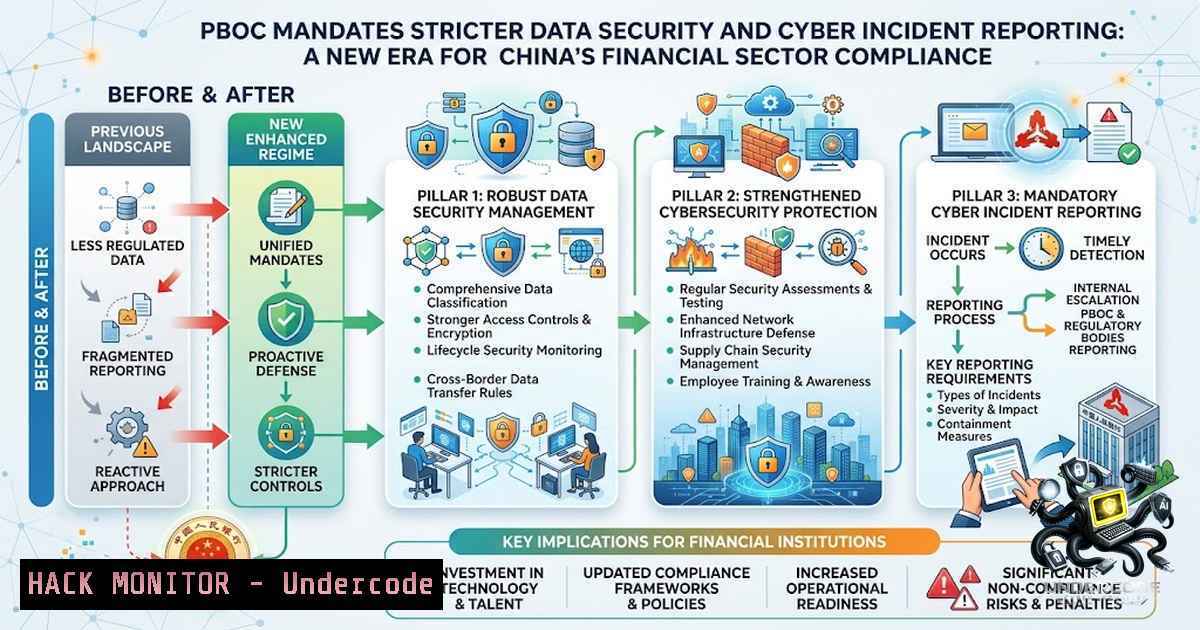
Introduction:
The People’s Bank of China (PBOC) has enacted two landmark regulations—the Data Security Measures (effective June 30, 2025) and the Cybersecurity Incident Reporting Measures (effective August 1, 2025). These rules translate China’s foundational Cybersecurity Law, Data Security Law, and Personal Information Protection Law (PIPL) into concrete, operational mandates for financial institutions. By shifting from broad principles to specific, actionable requirements, the PBOC is establishing a new, stringent benchmark for data governance and cybersecurity across China’s financial sector.
Learning Objectives & Secrets:
- Objective 1: Master the Four-Tier Incident Classification. Understand the PBOC’s mandatory classification of cybersecurity incidents into “Special Major,” “Major,” “Large,” and “General” levels. Secret Tip: Focus on the specific quantitative thresholds—such as “directly serving 50 million or more natural persons” for Special Major incidents—to accurately prioritize your response.
- Objective 2: Implement a Zero-Trust Data Lifecycle Framework. Move beyond perimeter security to protect data throughout its lifecycle. Secret Tip: Adopt a “who manages the business, who manages the business data, who manages data security” principle. This requires embedding security controls directly into business processes, not treating it as an afterthought.
- Objective 3: Build a “Golden Hour” Incident Response Protocol. The 1-hour reporting requirement for major incidents is a game-changer. Secret Tip: Pre-stage your incident response (IR) playbooks, automate log collection, and conduct regular tabletop exercises to ensure your team can reliably detect, triage, and report within this critical window.
You Should Know:
- Data Classification & Inventory: The Foundation of Compliance
The PBOC Data Security Measures mandate that all financial institutions establish a comprehensive data classification system. This is not a one-time task but an ongoing process requiring annual reviews and updates. The regulation splits data into three primary categories: General Data, Important Data, and Core Data. Critically, institutions must create a Business Data Resource Directory that tags every data item for its sensitivity (e.g., marking sensitive personal information as “high-sensitivity”) and its availability requirements (e.g., defining Recovery Point Objectives (RPOs)). This granular approach forces banks and fintechs to truly understand their data estate.
Step‑by‑step guide:
- Inventory Discovery: Use automated data discovery tools to scan your environment. For a Linux environment, you can start by locating potential sensitive files using `find` and `grep` to search for patterns like ID numbers.
Find files containing potential ID card patterns (simplified) find /data -type f -exec grep -l '[1-9]\d{5}(18|19|20)?\d{2}(0[1-9]|1[0-2])(0[1-9]|[bash]\d|3[bash])\d{3}[\dXx]' {} \; - Classification & Tagging: Once identified, classify the data. In a Windows environment with Active Directory, you can use File Server Resource Manager (FSRM) to create classification properties and apply them to folders containing sensitive data, tagging them as “High Sensitivity” or “Confidential.”
- Resource Directory Creation: Compile these findings into a centralized inventory. Document the data’s location, owner, classification, and associated business process. This directory becomes your single source of truth for compliance.
2. Implementing Mandatory Data Transmission Security
The PBOC mandates specific technical controls for data in transit. Institutions are required to prioritize the use of dedicated lines or Virtual Private Networks (VPNs) for transmitting business data. Furthermore, high-sensitivity data must be encrypted during transmission to other data processors or data centers. This pushes financial firms to adopt robust encryption standards for all critical internal and external data flows.
Step‑by‑step guide:
- Enforce Encryption in Transit: Ensure all data transmissions use TLS 1.2 or higher. For web servers (e.g., Apache on Linux), enforce this by modifying the SSL configuration:
In /etc/apache2/sites-available/default-ssl.conf
SSLProtocol all -SSLv3 -TLSv1 -TLSv1.1
SSLCipherSuite HIGH:!aNULL:!MD5
- VPN Configuration: For site-to-site connections, configure a VPN using strong encryption like IPsec with AES-256. On a Linux gateway, you might use `strongSwan` to establish a secure tunnel. Test the connection using `ipsec statusall` to ensure the tunnel is active and encrypted.
- Access Control: Combine encryption with strict access controls. On a Windows Server, configure Windows Firewall with Advanced Security to only allow specific IP addresses and ports for sensitive data transfers, and use Active Directory groups to restrict which user accounts can initiate these transfers.
3. The 1-Hour Incident Reporting Drill
The Cybersecurity Incident Reporting Measures require financial institutions to report “Large” or higher-level incidents within 1 hour of confirmation. This necessitates a highly automated and rehearsed incident response capability. The regulation defines an incident broadly, covering “human causes, cyberattacks, vulnerabilities, hardware/software defects or failures, and force majeure”. This means your SOC (Security Operations Center) must be able to detect a wide array of anomalies and rapidly assess their business impact.
Step‑by‑step guide:
- Automated Log Aggregation: Deploy a SIEM (Security Information and Event Management) solution. On Linux, you can use `rsyslog` to forward all critical logs to a central server.
In /etc/rsyslog.conf, forward logs to a central SIEM
. @@192.168.1.100:514
- Incident Triage Playbook: Develop a runbook that specifically addresses the PBOC classification criteria. Your playbook should include steps for assessing the number of affected users, the duration of the outage, and the type of data compromised. This pre-defined process is crucial for meeting the 1-hour deadline.
- Tabletop Exercise: Simulate a ransomware attack on a core banking application. Practice the entire workflow: detection, initial triage, internal escalation, and drafting the initial incident report to the PBOC. Time the exercise to ensure you can complete the initial report within the 1-hour window.
4. Strengthening the API Security Perimeter
Modern financial services rely heavily on APIs. The PBOC mandates that institutions “dynamically maintain the list of front-end gateways and application programming interfaces (APIs)” that provide business data. This requires continuous monitoring and security assessment of all API endpoints to prevent them from becoming a vector for data breaches.
Step‑by‑step guide:
- API Discovery & Inventory: Use tools to automatically discover and map all your internal and external APIs. On a Linux server, you can use `nmap` to scan for common API ports (e.g., 443, 8080) and `curl` to probe for endpoints.
- Implement API Gateways: Deploy an API gateway to act as a single entry point for all API calls. This allows you to enforce authentication, rate limiting, and input validation centrally.
- Harden API Authentication: Enforce OAuth 2.0 or mutual TLS (mTLS) for all sensitive APIs. On a Linux server hosting an API, ensure your web server (like Nginx) is configured to verify client certificates for mTLS, adding an extra layer of identity verification.
5. Navigating Overlapping Regulatory Frameworks
Financial institutions in China often face overlapping compliance requirements from multiple regulators (e.g., NFRA, CSRC). The new PBOC rules add another layer. Institutions must now harmonize their data governance and cybersecurity programs to satisfy the PBOC’s detailed technical mandates while also meeting the requirements of other financial regulators. A unified, enterprise-wide approach to data security is no longer optional.
Step‑by‑step guide:
- Conduct a Gap Analysis: Map your current controls against the PBOC Data Security Measures and Incident Reporting Measures. Identify where your current practices fall short.
- Unified Compliance Framework: Instead of managing separate compliance efforts, create a single, centralized framework that addresses the requirements of all applicable regulators. This often involves consolidating policies, standards, and procedures.
- Automate Reporting: Where possible, automate the collection of compliance evidence. For example, on Windows, use PowerShell to script the collection of security logs, patch levels, and user access reviews, generating a report that can be used to demonstrate compliance to multiple auditors.
What Undercode Say:
- Key Takeaway 1: The PBOC is moving from principle-based to rule-based enforcement. The new regulations provide clear, numeric thresholds for incident classification and specific technical mandates for data protection, leaving little room for interpretation.
- Key Takeaway 2: Compliance is now a technical exercise as much as a legal one. Success depends on the ability to inventory data, enforce encryption, automate logging, and orchestrate a rapid, coordinated incident response—all of which require significant investment in cybersecurity tooling and skilled personnel.
Prediction:
- +1 A surge in demand for specialized data classification, encryption, and SIEM solutions tailored for the Chinese financial sector, creating new market opportunities for cybersecurity vendors.
- -1 Smaller financial institutions with limited IT budgets will struggle to meet the stringent technical requirements, potentially leading to market consolidation as they seek partnerships or are acquired by larger, more capable entities.
- +1 The PBOC’s proactive stance will likely influence other Asian regulators to issue similarly detailed and enforceable mandates, raising the overall standard of data protection across the region.
- -1 A likely increase in administrative penalties and enforcement actions in the short term as regulators actively test the new frameworks and seek to make examples of non-compliant institutions.
- +1 Financial institutions that successfully implement these measures will gain a significant competitive advantage, building greater trust with customers and partners through demonstrable data security and resilience.
▶️ Related Video (74% Match):
🎯Let’s Practice For Free:
🎓 Live Courses & Certifications:
Join Undercode Academy for Verified Certifications
🚀 Request a Custom Project:
Secure, high-velocity infrastructure and disruptive technological engineering. Contact our engineering team for high-tier development and proprietary systems:
[email protected]
💎 Smart Architecture | 🛡️ Secure by Design | ⭐ Trusted by Thousands
IT/Security Reporter URL:
Reported By: https://lnkd.in/p/eefESztS – Hackers Feeds
Extra Hub: Undercode MoN
Basic Verification: Pass ✅


