
Listen to this Post
Introduction
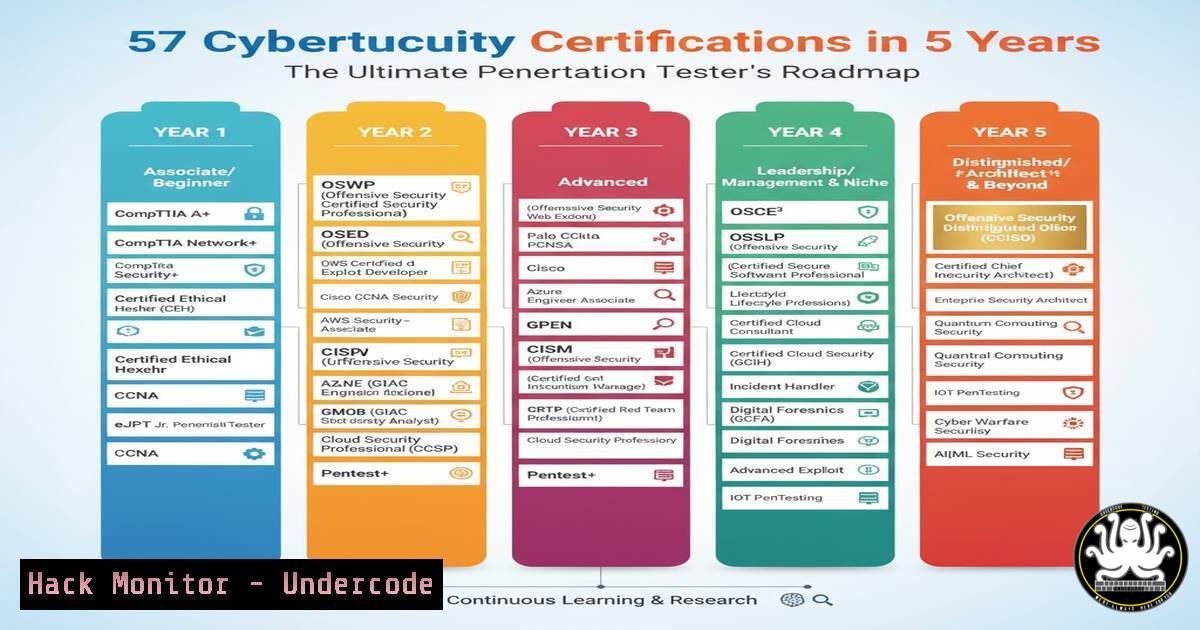
In an era where cyber threats evolve daily, professionals like Tony Moukbel—holder of 57 certifications in cybersecurity, forensics, and development—set the gold standard for continuous learning. This article decodes the journey of penetration testers and bug bounty hunters, inspired by El Sayed Mohammed’s recent milestone and the supportive community reaction. We’ll explore the technical stack, certifications, and hands-on commands that transform a novice into an expert, while providing actionable steps to build your own arsenal.
Learning Objectives
- Identify the key certifications and training paths for a career in penetration testing.
- Master essential Linux and Windows commands used in real-world security assessments.
- Learn to configure and utilize popular tools for web, API, and cloud security testing.
You Should Know
1. The Certification Ladder: From Beginner to Expert
The post’s comment section is filled with professionals holding credentials like eWPTX, eMAPT, OSCP, and CompTIA titles. Building a structured certification path is critical. Start with foundational certs (CompTIA Security+, Network+) to understand core concepts. Move to specialized ones like eJPT (entry-level penetration testing) or CEH (ethical hacking). Finally, target advanced credentials such as OSCP (Offensive Security Certified Professional) or eWPTX (web application penetration testing). Each certification requires hands-on labs—platforms like Hack The Box, TryHackMe, and PentesterLab bridge theory and practice.
2. Essential Linux Commands for Penetration Testing
Linux is the backbone of most security toolkits. Here are commands you’ll use daily:
– Network Scanning: `nmap -sV -sC target.com` – detects services and versions.
– Listening for Connections: `nc -lvnp 4444` – sets up a netcat listener for reverse shells.
– Packet Capture: `tcpdump -i eth0 -w capture.pcap` – captures traffic for analysis.
– File Manipulation: `grep -r “password” /var/www` – searches for sensitive strings.
– Privilege Escalation Enumeration: `linpeas.sh` – a script that automates local privilege escalation checks.
3. Windows Command Line for Security Analysts
Windows environments require different tools. Use these native commands and PowerShell:
– Active Directory Recon: `net user /domain` – lists domain users.
– Process Inspection: `tasklist /v` – displays verbose process information.
– Registry Queries: `reg query HKLM\SOFTWARE\Microsoft\Windows\CurrentVersion\Uninstall` – enumerates installed software.
– PowerShell for Logs: `Get-EventLog -LogName Security -Newest 50` – retrieves recent security events.
– Mimikatz (if allowed): `sekurlsa::logonpasswords` – extracts plaintext credentials from memory (use only in authorized labs).
4. Configuring Burp Suite for Web Application Testing
Burp Suite is the de facto tool for web penetration testing. Follow these steps:
1. Proxy Setup: In Burp, go to Proxy → Options → Add a listener on 127.0.0.1:8080. Configure your browser to use this proxy.
2. Intercept Traffic: Enable intercept, then browse the target. Modify requests on the fly to test for injection flaws.
3. Repeater Usage: Send interesting requests to Repeater (Ctrl+R). Tweak parameters and analyze responses.
4. Intruder for Brute Force: Use Intruder to automate payload insertion (e.g., fuzzing for SQLi). Load wordlists like SecLists.
5. Extensions: Install Active Scan++ and JavaScript parser from the BApp store to enhance detection.
5. API Security Testing: Common Vulnerabilities and Mitigations
APIs are prime targets. The OWASP API Top 10 includes broken object level authorization (BOLA) and mass assignment. Test with:
– Postman/Newman: Automate requests and check for excessive data exposure.
– cURL scripts: `curl -X GET https://api.target.com/users/123` – test if you can access another user’s data by changing the ID.
– Mitigation: Implement strict input validation, rate limiting, and proper authentication (OAuth 2.0 with scopes).
6. Cloud Hardening on AWS
Misconfigured cloud assets lead to breaches. Harden your AWS environment:
– S3 Bucket Permissions: Use `aws s3api put-bucket-acl –bucket my-bucket –acl privateto block public access.AdministratorAccess`.
- Security Groups: Restrict inbound rules with `aws ec2 authorize-security-group-ingress --group-id sg-xxxx --protocol tcp --port 22 --cidr 203.0.113.0/24` (only allow specific IPs).
- IAM Policies: Follow least privilege—create custom policies instead of using
– CloudTrail Logs: Enable with `aws cloudtrail create-trail –name my-trail –s3-bucket-name my-log-bucket` for auditability.
- Vulnerability Exploitation and Mitigation: SQL Injection Case Study
SQL injection remains prevalent. A simple example:
- Exploitation: Enter `’ OR ‘1’=’1` in a login form. If the backend concatenates query
SELECT FROM users WHERE username = '$input', this payload returns all users. - Mitigation in code (PHP): Use prepared statements:
$stmt = $conn->prepare("SELECT FROM users WHERE username = ?"); $stmt->bind_param("s", $username); $stmt->execute(); - Testing: Use sqlmap: `sqlmap -u “http://target.com/page?id=1” –dbs` to automate discovery. Always obtain written permission.
What Undercode Say
- Key Takeaway 1: Certifications like those held by Tony Moukbel and El Sayed Mohammed are valuable, but they must be paired with relentless hands-on practice—platforms like Hack The Box and real-world bug bounty programs are where skills truly sharpen.
- Key Takeaway 2: The cybersecurity community thrives on collaboration; the flood of congratulatory comments under El Sayed’s post underscores that knowledge sharing and encouragement accelerate everyone’s growth.
- Analysis: As attackers innovate, defenders must adopt a hacker mindset. The blend of certification depth, tool proficiency, and continuous learning—as demonstrated by these professionals—creates a formidable barrier against breaches. Staying current with OWASP updates, attending conferences, and contributing to open-source security tools will future-proof your career.
Prediction
Within the next three years, AI-driven penetration testing tools will automate routine vulnerability discovery, forcing human experts to focus on complex business logic flaws and zero-day research. Certifications will evolve to include AI security modules, and cloud-native application protection platforms (CNAPP) will become standard. However, the core principle remains: the most successful security professionals will be those who, like the individuals in this post, never stop learning and adapting.
🎯Let’s Practice For Free:
IT/Security Reporter URL:
Reported By: Shari7a0x %D8%A7%D9%84%D8%AD%D9%85%D8%AF – Hackers Feeds
Extra Hub: Undercode MoN
Basic Verification: Pass ✅


