Listen to this Post
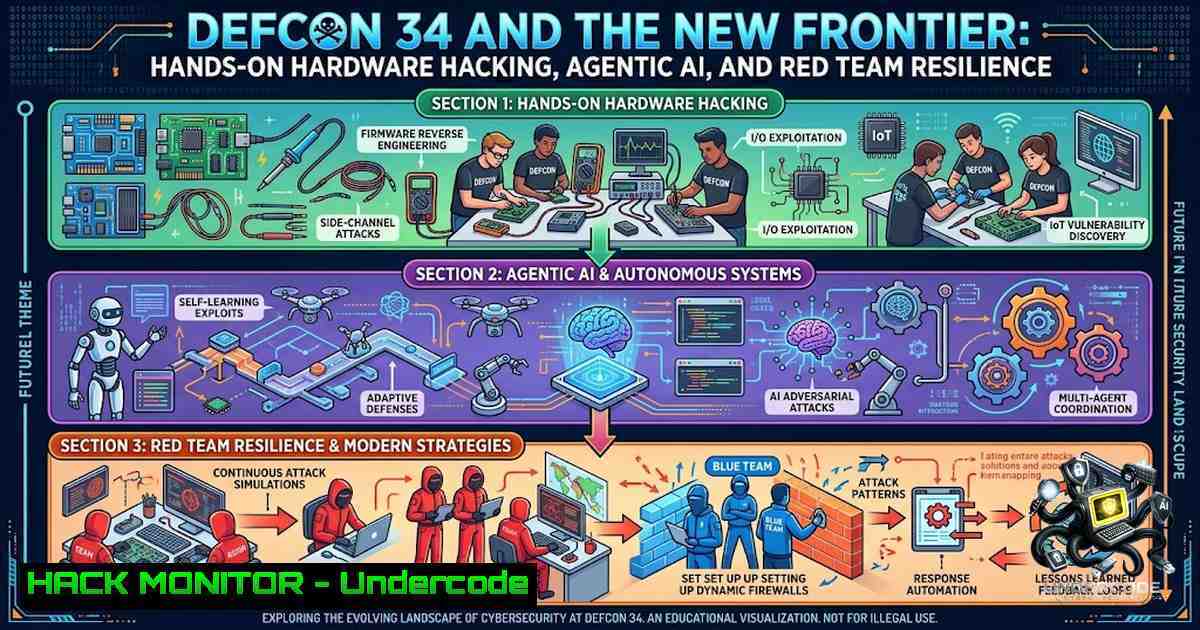
Introduction:
The annual DEFCON security conference has long been the epicenter of cybersecurity culture, but DEFCON 34 marked a significant paradigm shift. While the event was saturated with theoretical AI security talks, the most profound takeaways stemmed from tangible, hands-on experiences—from soldering an EMF explorer badge to building Agentic AI for security investigations. This article distills those experiences, offering a technical deep-dive into the tools, techniques, and collaborative spirit that define modern cybersecurity, moving beyond theory to execution.
Learning Objectives:
- Understand the foundational hardware hacking skills required to build and debug a physical EMF explorer device.
- Learn how to leverage the Flipper Zero for RFID cloning and brute-force attacks, and implement countermeasures to protect against them.
- Master the integration of Large Language Models (LLMs) as “Agentic AI” to automate security investigations and log analysis.
- Acquire the essential Linux and Windows commands for system hardening and vulnerability exploitation.
You Should Know:
- From Transparency to Technology: The Power of Live Demos
In a world of sleek digital slides, Cliff Stoll’s overhead-projector presentation stood as a metaphor for the gritty reality of cybersecurity. The core lesson is that vulnerability exists at the physical layer. For security engineers, this highlights the importance of electromagnetic (EMF) side-channel analysis.
Step-by-step: Capturing and Visualizing EMF Data on Linux
To replicate the spirit of the EMF explorer badge, you can use a software-defined radio (SDR) to capture raw radio frequency data.
1. Install necessary packages: sudo apt-get update && sudo apt-get install gnuradio gqrx-sdr.
2. Connect your RTL-SDR dongle and launch GQRX to identify a target frequency.
3. Use a Python script with the `rtlsdr` library to capture I/Q samples: from rtlsdr import RtlSdr; sdr = RtlSdr(); sdr.sample_rate = 2.048e6.
4. Analyze the frequency domain using `matplotlib` to visualize potential spurious emissions.
5. This practice mimics the badge’s intent: understanding how devices emit unintentional signals that can be exploited.
- Hacking RFID with Flipper Zero and Hardening Windows
The Flipper Zero is a multi-tool for pentesting physical access controls. At DEFCON, it was used to hack RFID cards, specifically targeting low-frequency 125kHz systems (like HID Prox) and high-frequency 13.56MHz Mifare Classic cards.
Step-by-step: RFID Cloning and Mitigation
- Reading a Card: On the Flipper, navigate to
125kHz RFID -> Read. Hold the card against the antenna to capture the ID. - Emulating the Card: Select `Saved` -> Choose the card ->
Emulate. Use it to unlock a door. - Brute-Force Attack: Go to `Extra Actions -> Unlock` to brute-force default 26-bit Wiegand formats.
- Windows Hardening Countermeasure (AD/Group Policy): To mitigate this attack, restrict physical access and enforce logical access controls. Use the `net localgroup` command to audit domain users with physical access permissions.
- Command: `net localgroup “Security Guards” /add [bash]\[bash]` to ensure proper groups, but more importantly, use `gpupdate /force` to enforce smart-card-required policies for sensitive areas.
3. Agentic AI for Security Investigation
Building “Agentic AI” involves creating autonomous agents that can interact with tools, parse data, and make decisions. The workshop likely focused on using frameworks like LangChain or AutoGPT to triage alerts.
Step-by-step: Building a Log Analysis Agent in Python
- Environment Setup: Install LangChain and OpenAI libraries:
pip install langchain openai pandas. - Load Data: Read a `.csv` firewall log.
import pandas as pd; df = pd.read_csv("firewall_logs.csv"). - Define Tools: Create a Python function that queries the DataFrame. The agent uses this to fetch specific data points (e.g., “Show all Denied IPs”).
- Prompt Design: Define a prompt like: “You are a SOC analyst. Review the logs for brute-force patterns (SSH or RDP) and provide a threat score.”
- Execution: The agent will generate code, execute it, and return a summary, significantly reducing Mean Time to Respond (MTTR).
-
Windows Commands for Red Team and Blue Team CTF
The OWASP CTF and Red Team Village CTF required rapid exploitation and patching on Windows systems. Here are the critical commands used to gain advantage.
Step-by-step: Lateral Movement and Persistence
- Reconnaissance: `nslookup [bash]` and `ipconfig /all` to map the network.
- Credential Dumping (NTDS.dit): Use `mimikatz` via `sekurlsa::logonpasswords` to extract hashes from LSASS memory.
- Persistence (Schedule Task):
schtasks /create /tn "Update" /tr "C:\Windows\Temp\payload.exe" /sc onidle /i 5. - Defensive Countermeasure (Blue Team): To clean up and harden, use
auditpol /set /subcategory:"Credential Validation" /success:enable /failure:enable. Also, use `wmic process get name,parentprocessid,processid` to look for suspicious parent-child processes (e.g., Word spawning PowerShell).
5. Linux Security Hardening in Cloud Environments
Cloud hardening was a key focus. The DEFCON community emphasizes securing containerized environments and Kubernetes clusters.
Step-by-step: Securing a Linux Server (Ubuntu)
- SSH Hardening: Edit
/etc/ssh/sshd_config. Set `PasswordAuthentication no` andPermitRootLogin no. - File Integrity: Install AIDE (
sudo apt install aide) and initialize the database:sudo aideinit. - Linux Security Modules (AppArmor): Enforce profiles: `sudo aa-status` to check; `sudo aa-enforce /etc/apparmor.d/usr.sbin.nginx` to enforce.
- Audit Daemon: Track file access via
auditctl -w /etc/passwd -p wa -k passwd_changes. This ensures visibility during a breach.
6. API Security and The OWASP Top 10
The OWASP CTF heavily featured API vulnerabilities (specifically Broken Object Level Authorization—BOLA).
Step-by-step: Testing for BOLA
- Intercept Traffic: Use Burp Suite to catch API requests.
2. Parameter Tampering: Change the `user_id=123` to `user_id=124`.
- Linux Command (JSON Processing):
curl -X GET "https://api.example.com/user/124" -H "Authorization: Bearer [bash]" | jq '.'. - Mitigation: In your code, always use server-side session attributes. On the server, run: `netstat -tulpn | grep :443` to ensure TLS 1.3 is enforced.
7. The Social Engineering Vector: Networking and Linecon
While technical skills win CTFs, the “Linecon” (waiting in line) is where intelligence is shared. This highlights the human OS as the weakest link.
Step-by-step: Identifying Phishing Threats
- Analyze Headers: On Linux, check email headers via `grep -E “Received: from|Return-Path” email.txt` to identify spoofed origins.
- DNS Recon: Use `dig -x [IP Address]` to map origin.
- Windows Firewall Rule: Block malicious IPs via
netsh advfirewall firewall add rule name="BlockMalicious" dir=in action=block remoteip=192.168.1.100.
What Undercode Say:
- Collaboration is the Ultimate Vulnerability: The DEFCON experience underscores that security is a social craft. The best detection rules come from shared “Linecon” stories, not just automated SIEM alerts.
- Hardware Resurgence: Tools like the Flipper Zero and EMF badges bridge the gap between cyber and physical security, reminding us that air-gaps are a myth. Engineers must now be fluent in Radio Frequency (RF) and system hardening simultaneously.
- Automation vs. Autonomy: Agentic AI is not a replacement for SOC analysts but a force multiplier. The CTF showcased that AI performs best when augmented by human intuition, emphasizing the need for engineers to understand prompt engineering and tool-calling architectures as a core competency.
Prediction:
- +1: The integration of hardware hacking into mainstream security curricula will produce a generation of engineers capable of defending Internet-of-Things (IoT) ecosystems.
- -1: As Agentic AI becomes more accessible, the barrier to executing sophisticated automated phishing and credential-harvesting campaigns will lower, leading to an uptick in “smart” malware.
- +1: Open-source projects and frameworks for EMF analysis will mature, enabling smaller startups to afford high-end RF testing capabilities.
- -1: The human element will remain the primary attack vector, as attackers pivot to exploit community trust fostered at events like DEFCON.
- +1: The emphasis on CTFs ensures a pipeline of skilled talent, but organizations must invest in creating “purple team” environments where these red team skills are immediately applicable to blue team defense.
▶️ Related Video (78% Match):
🎯Let’s Practice For Free:
🎓 Live Courses & Certifications:
Join Undercode Academy for Verified Certifications
🚀 Request a Custom Project:
Secure, high-velocity infrastructure and disruptive technological engineering. Contact our engineering team for high-tier development and proprietary systems:
[email protected]
💎 Smart Architecture | 🛡️ Secure by Design | ⭐ Trusted by Thousands
IT/Security Reporter URL:
Reported By: https://lnkd.in/p/eyYidQcM – Hackers Feeds
Extra Hub: Undercode MoN
Basic Verification: Pass ✅


