Listen to this Post
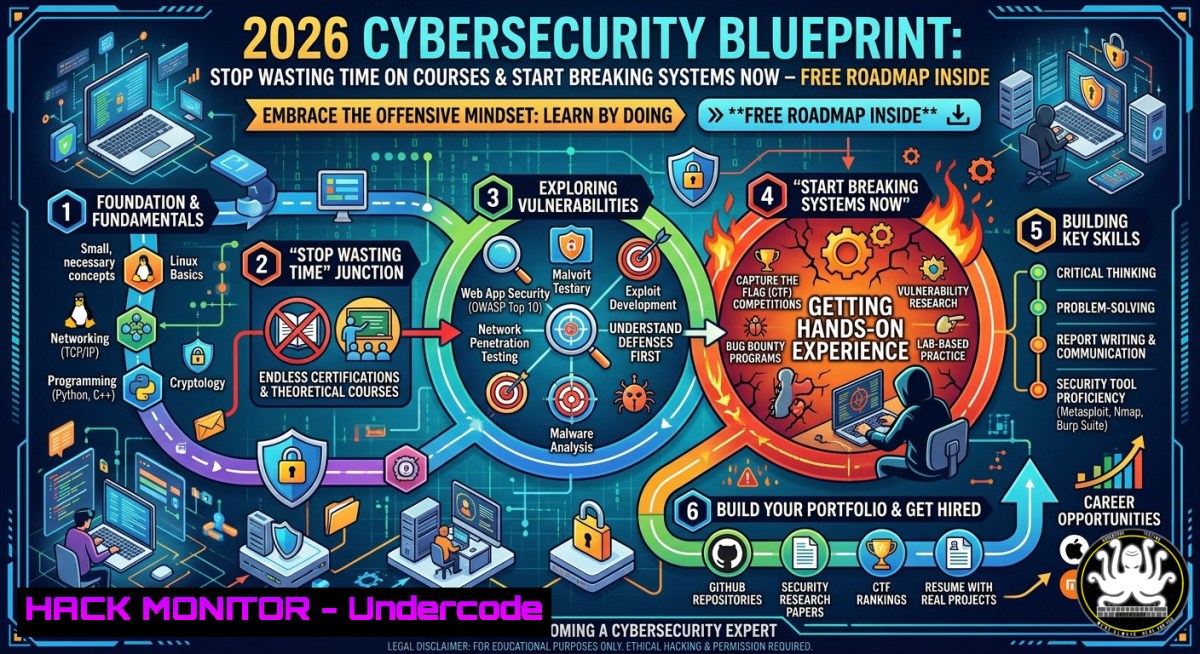
Introduction:
Most aspiring cybersecurity professionals fall into the trap of passive learning—binge-watching tutorials, collecting certificates, and never solving real-world problems. This article extracts a proven, no-fluff roadmap from industry expert Dharamveer prasad, emphasizing structured hands-on practice over content consumption, and provides step-by-step technical guides to transform you from a consumer into a practitioner.
Learning Objectives:
- Objective 1: Establish core IT and networking fundamentals using free, verified resources.
- Objective 2: Gain practical offensive and defensive skills through CTFs, labs, and real-world simulations.
- Objective 3: Choose and specialize in a cybersecurity path (pentesting, bug bounty, malware analysis, or DFIR) with tool-specific tutorials.
You Should Know:
1. Building Your Foundation with Free Resources
Start with cybersecurityguide.org and hacker101.com to understand basic concepts like CIA triad, risk management, and HTTP/S. Do not skip this phase—weak fundamentals break advanced skills.
Step‑by‑step:
- Visit cybersecurityguide.org → read “Getting Started” and “Networking Basics”.
- On hacker101.com, watch the “Intro to Web Security” video series.
- Then, on your Linux terminal (or WSL on Windows), practice basic reconnaissance:
ping -c 4 example.com
traceroute example.com
netstat -tulpn  List open ports on your own machine
- For Windows (PowerShell as Admin):
Test-NetConnection example.com -Port 80
Get-NetTCPConnection | Where-Object {$_.State -eq 'Listen'}
2. Non‑Negotiable Hands‑On Labs with TryHackMe
TryHackMe.com provides guided rooms that teach by doing. Skip the “watch only” mentality—type every command.
Step‑by‑step:
- Create a free account at tryhackme.com.
- Join the “Pre Security” learning path.
- Install OpenVPN: download your configuration file from the site.
sudo apt update && sudo apt install openvpn -y
sudo openvpn --config your-file.ovpn
- On Windows, use the OpenVPN GUI client.
- Complete room “Linux Fundamentals” – practice
ls,cd,grep,chmod, andfind. - Verify your connection by pinging the TryHackMe machine IP.
3. Mastering Networking Through Cisco Learning
Networking is a game changer. Cisco’s free learning platform (cisco.com/learning) offers Packet Tracer and basic networking courses.
Step‑by‑step:
- Enroll in “Networking Basics” and “Introduction to Packet Tracer”.
- Download Packet Tracer (free after registration).
- Build a simple network: two PCs connected to a switch. Assign IPs 192.168.1.1/24 and 192.168.1.2/24.
- On each PC’s command line (simulated), run:
ipconfig  Windows
ifconfig  Linux
arp -a  View ARP table
- Use `ping` to test connectivity, then capture packets to understand ARP requests and replies.
- Web Security Deep Dive with PortSwigger & OWASP
Web security is the most in‑demand skill. PortSwigger’s Web Security Academy (portswigger.net) and OWASP (owasp.org) provide free labs and cheat sheets.
Step‑by‑step:
- Install Burp Suite Community Edition from portswigger.net.
- Set up your browser to proxy traffic to Burp (127.0.0.1:8080) and install Burp’s CA certificate.
- Navigate to OWASP’s Juice Shop (owasp.org/juice-shop) – deploy locally via Docker:
docker pull bkimminich/juice-shop
docker run -d -p 3000:3000 bkimminich/juice-shop
- Perform a SQL injection: enter `’ OR ‘1’=’1` in the login form.
- Use `curl` to automate:
curl -X POST http://localhost:3000/rest/user/login -d '{"email":"[email protected]","password":"' OR '1'='1"}' -H "Content-Type: application/json" - Mitigation: Use parameterized queries and WAF rules (e.g., ModSecurity).
5. CTF Progression with OverTheWire – Bandit Walkthrough
OverTheWire.org’s Bandit wargame teaches Linux command-line skills through real CTF challenges.
Step‑by‑step:
- Connect via SSH to bandit.labs.overthewire.org on port 2220:
ssh [email protected] -p 2220
password: bandit0
- Level 0 → 1: Find password in `readme` file – use `ls` and
cat readme. - Level 1 → 2: File named `-` – read with
cat ./-. - Level 2 → 3: Filename with spaces – use
cat "spaces in filename". - Pro tip: Create a script to automate level solutions, but manual practice builds muscle memory.
- For Windows, use PuTTY or WSL’s ssh client.
- Choosing Your Path: Pentesting, Bug Bounty, or DFIR
Don’t try everything. Specialize using free resources:
- Pentesting: pentesterlab.com – learn Metasploit basics.
msfconsole
use exploit/multi/handler
set PAYLOAD windows/meterpreter/reverse_tcp
set LHOST your-ip
exploit
- Bug Bounty: bugcrowd.com – read disclosed reports and practice on vulnerable apps like DVWA.
- Malware Analysis: malwareunicorn.org – use REMnux and Volatility.
volatility -f memory.dump imageinfo
volatility -f memory.dump --profile=Win10x86 pslist
- DFIR: dfir.training – practice with SIFT Workstation.
sudo add-apt-repository ppa:sift/stable && sudo apt update && sudo apt install sift-cli
Then use `log2timeline` and `plaso` for timeline analysis.
- Practicing Like It’s Real: Hack The Box & VulnHub
HackTheBox.com and VulnHub.com offer realistic, vulnerable machines. Treat each machine as a live penetration test.
Step‑by‑step:
- On HackTheBox, start with “Starting Point” machines.
- Use `nmap` to scan:
nmap -sV -sC -O 10.10.10.x
- Enumerate directories with `gobuster` (Linux) or
dirb:gobuster dir -u http://target-ip -w /usr/share/wordlists/dirb/common.txt
- For Windows, use `Invoke-WebRequest` or `dirb` via WSL.
- On VulnHub, download a VM (e.g., Mr-Robot) and import into VirtualBox. Set network to Host-Only or NAT.
- After exploitation, write a report covering root cause, impact, and mitigation (e.g., patch version, disable unnecessary services).
What Undercode Say:
- Key Takeaway 1: Certificates and course completions hold zero value if you cannot enumerate a target, exploit a vulnerability, or analyze a log. Hiring managers prioritize demonstrated skill over paper.
- Key Takeaway 2: Consistency with 1–2 hours of daily hands‑on labs (TryHackMe, OverTheWire) produces more competence than months of passive video consumption. The roadmap’s strength lies in forcing active recall and problem‑solving.
Analysis (10 lines): The post correctly identifies the primary failure mode of self‑taught cybersecurity students: mistaking consumption for skill acquisition. By listing free, actionable resources instead of paid courses, Dharamveer democratizes access. The structured progression—foundations → hands‑on labs → CTFs → networking → web security → specialization → real‑world practice—mirrors how professional penetration testers are trained. Importantly, the roadmap avoids tool‑chasing; it forces learners to understand systems (Linux, networking, HTTP) before picking up exploit frameworks. The inclusion of DFIR and malware analysis ensures balanced defense and offense. The English communication class add‑on, while seemingly tangential, addresses the soft‑skill gap that often prevents technical experts from writing effective reports or explaining findings to stakeholders. The lack of expensive certification gatekeeping is refreshing—anyone with a laptop and internet can start today. However, the roadmap implicitly assumes self‑discipline; without a community or mentor, beginners might still feel lost. Pairing these resources with a study group or accountability partner would maximize completion rates.
Expected Output:
This article delivers a complete, vendor‑agnostic cybersecurity learning plan for 2026, transforming abstract advice into concrete, copy‑paste commands and step‑by‑step lab guides. By following the extracted roadmap and practicing the included tutorials, readers will move from passive learner to active security practitioner—able to enumerate networks, exploit web vulnerabilities, analyze malware, and respond to incidents without relying on paid courses.
Prediction:
By 2026, the cybersecurity hiring landscape will shift decisively away from certification count and toward verifiable, performance‑based assessments (e.g., live CTF scores, bug bounty rankings, GitHub lab write‑ups). AI‑driven adaptive labs will personalize learning paths, but the core requirement—understanding how systems actually break—will remain human‑centric. Free, community‑driven platforms like those listed will erode the monopoly of expensive bootcamps, forcing even traditional certifications to incorporate mandatory hands‑on proctored exams. Meanwhile, the integration of English communication training into technical roadmaps will become standard, as globalization demands that Indian and Asian cybersecurity professionals articulate findings to Western clients. The winners will be those who start breaking systems today, not those who wait for the next paid course.
▶️ Related Video (74% Match):
🎯Let’s Practice For Free:
IT/Security Reporter URL:
Reported By: Dharamveer Prasad – Hackers Feeds
Extra Hub: Undercode MoN
Basic Verification: Pass ✅


