
Listen to this Post
Introduction:
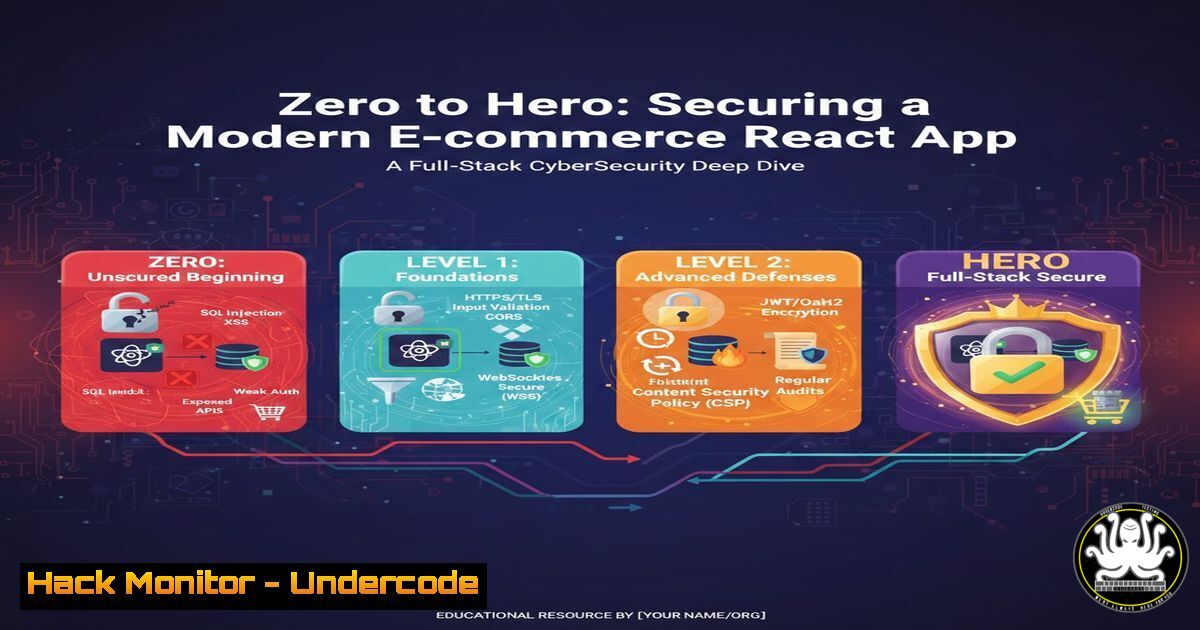
Modern e‑commerce platforms are no longer just about smooth UI and fast load times; they are prime targets for cyber attacks. This article dissects the security posture of a contemporary React‑based e‑commerce site—like the “ZAGEL Gift & Candy” project—by examining its frontend stack (Vite, React, Framer Motion) and mapping it to real‑world attack surfaces. We will explore how developers can integrate security from the first commit, covering API hardening, dependency audits, and client‑side defence mechanisms.
Learning Objectives:
- Understand the security risks inherent in modern React/Vite e‑commerce applications.
- Learn to audit and secure third‑party dependencies and build tools.
- Implement client‑side security controls (CSP, input validation) to mitigate XSS and data leakage.
- Harden API interactions to prevent injection, broken access control, and excessive data exposure.
- Apply cloud security best practices for deployment and asset protection.
You Should Know:
- Securing the Build Pipeline: Vite, npm, and Dependency Hygiene
Modern frontend tooling like Vite speeds up development but introduces supply chain risks. Every `npm install` pulls dozens of packages that could contain malicious code or known vulnerabilities.
Step‑by‑step guide to auditing dependencies:
- Run `npm audit` to get a report of known vulnerabilities in your project.
- Use `npm audit fix` to automatically apply safe updates.
- For more control, manually review critical packages:
npm outdated
npm update <package-name>
- Integrate Snyk or GitHub Dependabot into your CI/CD to catch new vulnerabilities daily.
- For production builds, use `npm ci` instead of `npm install` to ensure a deterministic, locked dependency tree.
- Enable integrity checking by using lockfiles (
package-lock.json) and Subresource Integrity (SRI) for any external scripts.
- Hardening React Components Against XSS and Data Leakage
The “floating candies” and “glowing buttons” are created with JavaScript and CSS—but any user‑supplied data rendered dangerously can open the door to Cross‑Site Scripting (XSS).
Step‑by‑step guide to secure component design:
- Never use `dangerouslySetInnerHTML` with unsanitised input. If you must render HTML, sanitise it with a library like DOMPurify:
import DOMPurify from 'dompurify';
const safeHTML = DOMPurify.sanitize(userInput);
- Validate and encode all data coming from APIs before displaying it. React automatically escapes strings in JSX, but attributes like `href` can still be abused:
// Bad <a href={userProvidedLink}>Click</a> // Good – validate protocol const safeLink = userProvidedLink.startsWith('https://') ? userProvidedLink : ''; - Use Content Security Policy (CSP) headers to restrict script sources. For a Vite build, configure your server to send:
Content-Security-Policy: default-src 'self'; script-src 'self' https://trusted-cdn.com; style-src 'self' 'unsafe-inline';
- Implement Trusted Types (where supported) to lock down dangerous DOM sinks.
- API Security: From Product Filtering to Payment Processing
Real‑time product filtering and dynamic data fetching mean your React app communicates with backend APIs. These endpoints are the crown jewels for attackers.
Step‑by‑step guide to secure API integration:
- Always use HTTPS in production—no exceptions. Redirect all HTTP traffic to HTTPS.
- Implement rate limiting on your API gateway to prevent brute‑force and DoS attacks (e.g., using `express-rate-limit` on Node.js backends).
- Validate and sanitise all parameters sent from the client, especially filter criteria, to prevent NoSQL injection or SQL injection:
// Example for MongoDB – use mongoose schema validation const filter = { category: sanitizeString(req.query.category) }; - Authenticate every request using JWTs stored securely (HttpOnly, Secure, SameSite cookies) and validate them on the server.
- Apply the principle of least privilege—ensure that API endpoints return only the data the client needs, not entire database objects.
- For sensitive operations (checkout, account changes), require CSRF tokens if using cookie‑based authentication.
4. Client‑Side Secrets and Environment Variables
A common mistake is embedding API keys or secrets in frontend code—they are easily extracted from the browser’s developer tools.
Step‑by‑step guide to protect secrets in Vite/React:
- Use environment variables prefixed with `VITE_` (e.g.,
VITE_API_URL). Never store real secrets this way; they are embedded in the build. - Move any sensitive logic (e.g., payment processing) to a secure backend service.
- For third‑party services that require a key (like analytics), use a proxy endpoint on your server to forward requests, keeping the key server‑side.
- Regularly scan your public repository for accidentally committed secrets using tools like truffleHog or GitLeaks.
5. Mobile‑First Optimisation and Secure Local Storage
Mobile devices introduce additional risks—data stored in localStorage or sessionStorage persists and can be accessed by any script running on your domain.
Step‑by‑step guide to secure client‑side storage:
- Avoid storing sensitive information (tokens, personal data) in `localStorage` or
sessionStorage. - Use HttpOnly cookies for authentication tokens—they are inaccessible to JavaScript, mitigating XSS token theft.
- If you must store data client‑side, encrypt it before saving. However, the encryption key must also be stored, which creates a circular dependency—prefer server‑side session management.
- Implement web app manifest with appropriate `scope` to prevent navigation to malicious pages.
6. Performance, SEO, and Security Overlap
Performance checks often involve minimising scripts and optimising images, but they also have security implications.
Step‑by‑step guide to secure performance tuning:
- Minification and obfuscation make it harder for attackers to understand your code—use Vite’s build process to minify (
build.minify). - Lazy‑load components to reduce the attack surface initially—but ensure lazy‑loaded chunks are also served over HTTPS and have integrity checks.
- Implement a robots.txt file to disallow crawling of admin or staging paths.
- Use subresource integrity for any external scripts loaded from CDNs to prevent tampering.
7. Deployment and Cloud Hardening
The final step is deploying the built application to a cloud platform (Vercel, Netlify, AWS S3 + CloudFront). Misconfigurations here can expose source maps, environment variables, or allow unauthorised access.
Step‑by‑step guide to secure deployment:
- Disable source map generation in production (
build.sourcemap: falsein Vite config) to prevent attackers from reverse‑engineering your code. - Set proper CORS headers on your cloud storage—only allow your domain to access assets.
- Enable WAF (Web Application Firewall) rules on your CDN to block common attacks (SQLi, XSS).
- Use AWS IAM roles instead of long‑term access keys if deploying to AWS.
- Regularly audit cloud permissions using tools like Prowler or ScoutSuite.
What Undercode Say:
- Security is not a feature—it’s a foundational layer. Building a beautiful, responsive e‑commerce site must start with threat modelling. Every animation, filter, and API call is a potential entry point.
- Automate what you can, verify what you can’t. Dependency audits and CSP headers are baseline defences. But real security comes from understanding the data flow and rigorously validating it at every boundary—client, server, and database.
- The “ZAGEL Gift & Candy” project exemplifies modern frontend excellence, but without embedding security into its DNA, it risks becoming a “candy store” for attackers. Developers must shift left: treat security with the same creativity and care as UI design.
Prediction:
As e‑commerce platforms increasingly rely on micro‑animations, real‑time filtering, and serverless architectures, we will see a surge in client‑side supply chain attacks and API abuse. Future breaches won’t come from broken encryption, but from overlooked dependencies and over‑permissive APIs. The next wave of cybersecurity training will focus heavily on securing the “last mile”—the frontend‑to‑API handshake—and embedding zero‑trust principles into every React component. Developers who master both the art of UI and the science of security will lead the next generation of digital commerce.
▶️ Related Video (78% Match):
🎯Let’s Practice For Free:
IT/Security Reporter URL:
Reported By: Ezz Mohamed – Hackers Feeds
Extra Hub: Undercode MoN
Basic Verification: Pass ✅


