
Listen to this Post
Introduction:
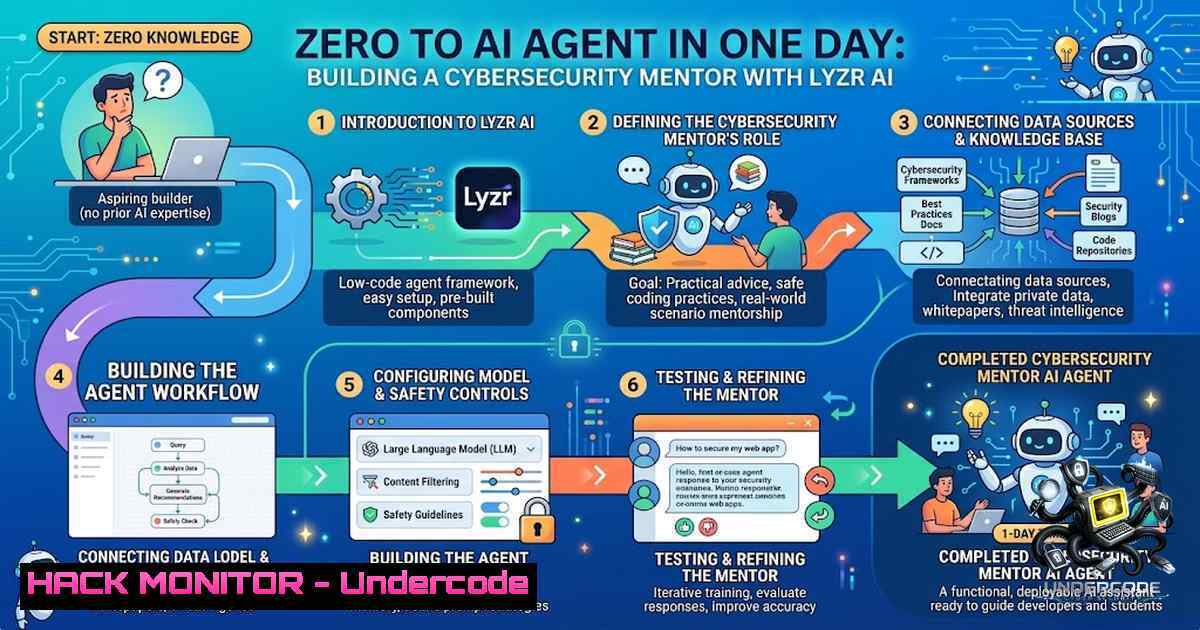
The convergence of artificial intelligence and cybersecurity has reached a pivotal moment where low-code/no-code AI agent frameworks are democratizing the creation of specialized security tools. In a remarkable demonstration of this paradigm shift, a cybersecurity enthusiast built “SEC_AI,” a fully functional mentor agent designed to guide penetration testing fundamentals, bug bounty methodologies, CTF strategies, and CVE literacy within a single day using Lyzr AI’s agent studio. This achievement underscores how agentic AI is transforming cybersecurity education and operational workflows, enabling professionals to rapidly deploy intelligent assistants without deep machine learning expertise. The implications for security training and knowledge management are profound, as organizations can now create customized AI mentors that encapsulate institutional expertise and deliver structured guidance on demand.
Learning Objectives & Secrets:
- Objective 1: Master Agent Creation Workflows – Learn how to architect an AI agent from scratch using Lyzr Agent Studio, including defining system prompts, configuring knowledge bases, and establishing interaction paradigms for security-specific use cases.
- Objective 2 Secret Tip: Optimize Prompt Engineering for Security Contexts – Craft precise system instructions that enforce role-playing as a cybersecurity mentor, embedding principles of ethical hacking, responsible disclosure, and structured reporting into the agent’s response generation.
- Objective 3 Secret Tip: Integrate External Knowledge Sources – Connect the agent to curated cybersecurity knowledge repositories (CVE databases, OWASP guidelines, MITRE ATT&CK framework) to enhance response accuracy and provide contextual references during mentoring sessions.
You Should Know:
- Understanding Lyzr AI Agent Architecture for Security Workloads
Lyzr AI provides a framework for building autonomous agents that can reason, plan, and execute tasks using large language models (LLMs) combined with external tools and data sources. The SEC_AI agent leverages this architecture to simulate a mentorship experience by maintaining conversation history, accessing pre-loaded security curricula, and generating structured outputs such as penetration testing checklists and vulnerability assessment reports. The agent’s core capability lies in its ability to break down complex security concepts into digestible learning modules, adapting its responses based on the user’s stated proficiency level.
Step-by-Step Guide: Building a Basic Mentor Agent with Lyzr
1. Sign up and access Lyzr Agent Studio – Navigate to the Lyzr platform and create a new agent project.
2. Define Agent Persona – In the system prompt section, define the role: “You are a senior cybersecurity mentor with expertise in penetration testing, bug bounty hunting, and vulnerability research. Provide structured, actionable guidance while emphasizing ethical practices.”
3. Configure Knowledge Base – Upload reference documents (e.g., OWASP Top 10 PDFs, NIST guidelines) or connect to external APIs for real-time CVE lookups.
4. Set Output Formats – Define structured response templates for reports, including sections for vulnerability description, impact analysis, remediation steps, and references.
5. Test Interaction Loop – Simulate queries such as “How do I approach a blind SQL injection test?” and refine prompts based on response quality.
6. Deploy and Iterate – Publish the agent and gather feedback from test users to continuously improve its responses and knowledge coverage.
2. Essential Prompt Engineering for Cybersecurity Agents
The effectiveness of a security-focused AI agent hinges on precise prompt design that constrains the model’s behavior within safe and useful boundaries. For SEC_AI, the prompt architecture includes role constraints (“You are an expert mentor, not a tool executor”), ethical guidelines (“Never provide instructions for unauthorized access”), and output structure (“Provide answers with clear headings, bullet points, and actionable steps”). This ensures the agent remains educational and compliant with responsible disclosure principles.
Example Linux Commands for CTF Preparation (for agent to recommend):
 Network reconnaissance
nmap -sV -sC -A -oA scan_report 192.168.1.0/24

Directory enumeration
gobuster dir -u http://target.com -w /usr/share/wordlists/dirbuster/directory-list-2.3-medium.txt -x php,html,txt

Steganography analysis
steghide extract -sf image.jpg

Password cracking with hashcat
hashcat -m 0 -a 0 hash.txt /usr/share/wordlists/rockyou.txt
3. Structured Report Generation and Documentation
One of SEC_AI’s standout features is its ability to generate structured documentation, a critical requirement in professional cybersecurity engagements. The agent can produce vulnerability assessment reports, penetration testing summaries, and learning progress reports by following predefined templates. This automation reduces the overhead of manual documentation and ensures consistency across assessments.
Step-by-Step Guide: Implementing Report Generation
- Define Report Template – Create a Markdown or JSON template with sections: Executive Summary, Scope, Methodology, Findings (with CVSS scores), Remediation Recommendations, and Appendices.
- Configure Agent to Populate Template – Instruct the agent to extract key details from the conversation and format them according to the template.
- Enable Output Export – Set up the agent to export reports as text files or integrate with project management tools (e.g., Notion, Jira).
- Implement Review Workflow – Design a feedback loop where the user can review and correct generated reports before finalization.
- Version Control – Add capability to track changes and maintain historical versions of reports for audit purposes.
4. Integrating CVE Literacy into the Agent’s Knowledge
Modern cybersecurity professionals must stay current with the ever-expanding landscape of Common Vulnerabilities and Exposures (CVEs). SEC_AI addresses this by embedding CVE lookup functionality, allowing users to query specific vulnerabilities and receive explanations of their impact, affected systems, and patch availability. This transforms the agent from a generic mentor into a tactical resource for real-time threat intelligence.
Example API Integration for CVE Lookup (using NVD API):
 Query NIST NVD API for CVE details
curl -X GET "https://services.nvd.nist.gov/rest/json/cves/2.0?cveId=CVE-2024-12345" | jq '.vulnerabilities[bash].cve'

Python snippet for agent to use
import requests
def get_cve_details(cve_id):
url = f"https://services.nvd.nist.gov/rest/json/cves/2.0?cveId={cve_id}"
response = requests.get(url)
return response.json()
5. Bug Bounty Methodology Integration
A critical component of SEC_AI’s curriculum is bug bounty hunting strategy, which requires systematic reconnaissance, vulnerability identification, and responsible reporting. The agent can guide users through phases of target scoping, subdomain enumeration, endpoint discovery, and exploit validation, all while emphasizing coordination with bounty program guidelines. This structured approach transforms ad-hoc hacking attempts into disciplined, repeatable methodologies.
Step-by-Step: Bug Bounty Workflow with the Agent
- Define Target Scope – Input the bug bounty program’s scope (domains, IP ranges, excluded services) into the agent.
- Initiate Reconnaissance – Receive guided instructions on using tools like Amass, Sublist3r, and Shodan.
- Vulnerability Testing – Get scenario-based exercises for common vulnerabilities (XSS, CSRF, IDOR, RCE).
- Validate Findings – Use agent-provided test cases to confirm vulnerability existence and potential impact.
- Draft Report – Leverage the agent’s structured reporting feature to create a professional submission for the bounty platform.
Recommended Linux Commands for Bug Bounty Recon:
 Subdomain enumeration with Amass
amass enum -passive -d target.com

Endpoint discovery with ffuf
ffuf -u https://target.com/FUZZ -w /usr/share/wordlists/seclists/Discovery/Web_Content/big.txt -fc 404

JavaScript file analysis for hidden endpoints
cat script.js | grep -Eo "(https?://[^\"']+|/api/[^\"']+)" | sort -u
6. Cloud Security and API Hardening Guidance
As organizations increasingly adopt cloud infrastructure, the SEC_AI agent incorporates cloud-specific security guidance, covering AWS, Azure, and GCP misconfigurations, IAM policy reviews, and API security best practices. The agent can simulate cloud audit scenarios, providing users with actionable recommendations to harden their cloud environments against common attack vectors.
Example Cloud Hardening Checks:
 AWS S3 bucket permission check
aws s3api get-bucket-acl --bucket my-secure-bucket

Azure role assignment review
az role assignment list --all --output table

GCP IAM policy export
gcloud projects get-iam-policy my-project --format=json
7. Continuous Learning and Adaptation
Beyond immediate query responses, SEC_AI is designed to foster continuous learning by recommending follow-up topics, practice exercises, and relevant certifications. The agent can track a user’s progress over sessions, adjusting difficulty levels and suggesting new areas of focus based on demonstrated competence. This adaptive learning model transforms the agent into a long-term professional development companion.
What Undercode Say:
- Key Takeaway 1: Agentic AI frameworks like Lyzr are lowering the barrier to creating specialized cybersecurity assistants, enabling rapid prototyping and deployment of intelligent tutors that can scale expertise across teams.
- Key Takeaway 2: The integration of structured reporting and CVE literacy into AI mentors bridges the gap between theoretical security knowledge and practical operational execution, enhancing both training outcomes and incident response readiness.
Analysis: The SEC_AI project exemplifies a broader trend where AI agents move from general-purpose chatbots to domain-specific mentors capable of delivering structured, actionable knowledge. This shift holds particular significance in cybersecurity, where the talent gap and constant evolution of threats demand innovative educational solutions. By embedding professional workflows into the agent’s core capabilities, creators like Abhinav Kumar Mishra demonstrate that AI can not only augment human expertise but also accelerate the learning curve for aspiring security professionals. The success of building a functional agent in a single day highlights the maturity of current AI development platforms and hints at a future where personalized AI mentors become standard tools in every security practitioner’s arsenal.
Prediction:
- +1 Organizations will increasingly adopt custom AI agents for internal cybersecurity training, reducing reliance on external courses and enabling just-in-time learning aligned with actual threat landscapes.
- +1 The integration of agentic AI with continuous threat intelligence feeds will produce proactive mentors that alert teams to emerging vulnerabilities before they are widely exploited.
- -1 The ease of building AI agents may lead to a proliferation of poorly designed or unsafe security assistants, potentially disseminating incorrect guidance or encouraging risky practices among inexperienced users.
- +1 As these agents mature, they will evolve into collaborative tools that support security operations center (SOC) analysts by providing rapid contextual knowledge during incident investigations.
- -1 Dependence on AI mentors could inadvertently reduce critical thinking and hands-on experimentation if users over-rely on generated answers rather than engaging in practical problem-solving.
▶️ Related Video (80% Match):
🎯Let’s Practice For Free:
🎓 Live Courses & Certifications:
Join Undercode Academy for Verified Certifications
🚀 Request a Custom Project:
Secure, high-velocity infrastructure and disruptive technological engineering. Contact our engineering team for high-tier development and proprietary systems:
[email protected]
💎 Smart Architecture | 🛡️ Secure by Design | ⭐ Trusted by Thousands
IT/Security Reporter URL:
Reported By: https://lnkd.in/p/eRpcu6dZ – Hackers Feeds
Extra Hub: Undercode MoN
Basic Verification: Pass ✅


