Listen to this Post
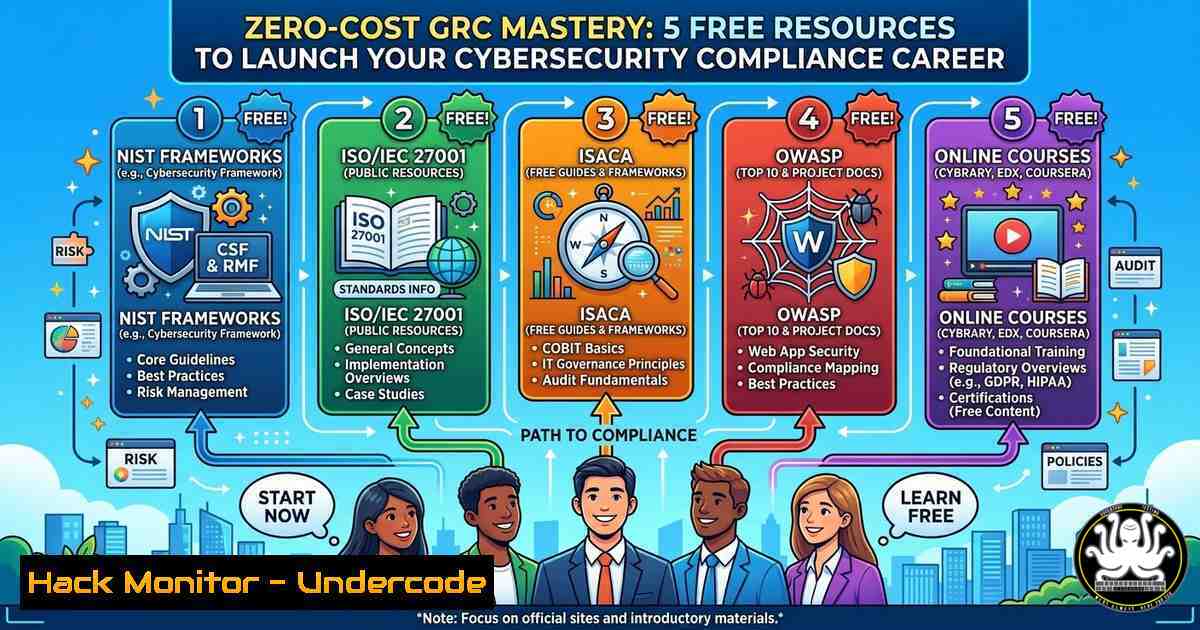
Introduction:
Governance, Risk, and Compliance (GRC) is often misunderstood as a purely administrative sector of cybersecurity, yet it forms the backbone of enterprise security strategy, dictating how data is protected, risks are mitigated, and laws are adhered to. For aspiring professionals, the barrier to entry has traditionally been expensive certifications and niche training, but a wealth of high-quality, no-cost resources now exists to build a robust foundation in frameworks like NIST, ISO 27001, and PCI DSS.
Learning Objectives:
- Identify and utilize free, accredited training modules to build a foundational knowledge of GRC principles.
- Develop a strategic learning path that combines entry-level certifications with specialized compliance frameworks.
- Apply practical configuration and auditing techniques to real-world IT environments using open-source tools.
You Should Know:
- The Free Credential: ISC2 Certified in Cybersecurity (CC)
The (ISC)² Certified in Cybersecurity (CC) credential is a strategic entry point. Unlike theoretical courses, this program offers a free exam voucher alongside official training, providing a globally recognized certification that validates your understanding of security principles, incident response, and access controls—core components of any GRC role.
Step‑by‑step guide explaining what this does and how to use it.
– Step 1: Navigate to the (ISC)² website (linked in the original post) and register for the “One Million Certified in Cybersecurity” initiative.
– Step 2: Complete the self-paced online training course, which covers the five domains: Security Principles, Incident Response, Business Continuity, Access Control, and Network Security.
– Step 3: Upon completion, schedule your free remote proctored exam. Passing this exam immediately adds a recognized credential to your LinkedIn profile, signaling to employers that you have verified baseline security knowledge.
– Step 4: Leverage this certification to gain free access to (ISC)²’s member community and continuing education resources, which often include webinars on evolving compliance regulations.
2. Framework Immersion: Cybrary’s Risk & Compliance Pathway
Cybrary hosts a structured series of courses specifically tailored to GRC. Unlike generic videos, these lessons break down complex frameworks like NIST SP 800-53, ISO 27001 controls, and SOC 2 Type II audits into digestible modules. For a GRC professional, understanding how to map controls across these frameworks is a daily task.
Step‑by‑step guide explaining what this does and how to use it.
– Step 1: Create a free account on Cybrary and navigate to the “Risk & Compliance” learning path.
– Step 2: Start with the “NIST Risk Management Framework (RMF)” course. Focus on the “Categorize, Select, Implement, Assess, Authorize, and Monitor” steps.
– Step 3: Use the platform’s “Virtual Lab” environments (if available in free tier) to practice drafting a System Security Plan (SSP) or a Plan of Action and Milestones (POA&M).
– Step 4: Create a GitHub repository where you store your notes on control mappings (e.g., mapping CIS Controls to NIST 800-53). This serves as a portfolio piece during interviews.
- Practical Technical Auditing: Linux & Windows Compliance Checks
GRC is not just about paperwork; it requires the ability to verify technical controls. To assess if a system is compliant with a security baseline (such as the CIS Benchmarks), you must use command-line tools. Below are verified commands to audit common security configurations on both Linux and Windows.
Linux: Auditing Authentication & Password Policies (STIG Compliance)
To verify if a Linux system meets password complexity requirements (a common PCI DSS and ISO requirement), use the following commands to audit `/etc/login.defs` and pam.d:
 Check password aging policies (PASS_MAX_DAYS should be ≤ 90)
grep -E "^PASS_MAX_DAYS" /etc/login.defs

Check for locked accounts (should return a list of 'L' status users)
sudo passwd -S -a | grep ' L '

Check for the presence of auditd (required for accountability)
systemctl status auditd
Windows: Auditing Security Policies via Command Line
For Windows environments, use `secedit` and `auditpol` to export current security configurations to validate against the organization’s baseline.
 Export the current security policy to a text file for review
secedit /export /cfg C:\security_baseline.inf

Verify audit policy settings (e.g., Logon/Logoff auditing)
auditpol /get /category:"Logon/Logoff"

Check for enabled Windows Firewall profiles (Requirement for network segmentation)
netsh advfirewall show allprofiles
4. Risk Management Training: CISA Free Modules
The Cybersecurity and Infrastructure Security Agency (CISA) offers free modules that focus on risk management frameworks and cyber hygiene. These resources are authoritative and often used by federal agencies, making them a gold standard for understanding government-grade compliance.
Step‑by‑step guide explaining what this does and how to use it.
– Step 1: Visit the CISA “Cybersecurity & Risk Training” link provided in the post. Navigate to the “Risk Management” section.
– Step 2: Download the “Cyber Hygiene Services” guides. These documents provide templates for vulnerability scanning and remediation tracking.
– Step 3: Use the “Ransomware Readiness Assessment” tool to practice conducting a risk assessment. Fill out the spreadsheet as if you were auditing a fictional company.
– Step 4: Incorporate the terminology from these modules (e.g., “Risk Tolerance,” “Residual Risk”) into your professional summary to demonstrate domain expertise.
5. API Security & Cloud Hardening for GRC
Modern GRC extends to cloud environments and APIs. A compliance professional must understand how to verify that cloud resources are configured to prevent data leaks. Using tools like `awscli` or `az cli` allows you to audit configurations against frameworks like the CIS AWS Foundations Benchmark.
API Security Verification (AWS):
To ensure a cloud environment is compliant, you can use the AWS Command Line Interface (CLI) to check for public exposure, which violates most data protection compliance frameworks.
 Check for S3 buckets that have public access (Violation of ISO 27001 control A.8.7)
aws s3api list-buckets --query 'Buckets[?Name!=<code>your-bucket</code>].Name' | xargs -I {} aws s3api get-bucket-acl --bucket {}

List IAM users with unused access keys (Indicates poor identity management)
aws iam list-users --query 'Users[].UserName' --output text | xargs -n1 aws iam list-access-keys --user-name
Cloud Hardening Commands (Azure)
For Azure environments, use the Azure CLI to ensure logging is enabled, which is crucial for incident response and audit trails.
 Ensure Diagnostic Logs are enabled for Network Security Groups
az monitor diagnostic-settings list --resource /subscriptions/{sub-id}/resourceGroups/{rg}/providers/Microsoft.Network/networkSecurityGroups/{nsg-name}
What Undercode Say:
- Key Takeaway 1: The combination of the free (ISC)² CC certification with framework-specific training from Cybrary creates a “certified and skilled” profile that rivals paid bootcamps.
- Key Takeaway 2: True GRC proficiency requires the ability to translate compliance requirements (like password policies) into technical verification using command-line tools (Linux/Windows), bridging the gap between policy and technical implementation.
- Key Takeaway 3: Free resources are abundant, but the discipline to create a portfolio (GitHub) documenting control mappings and audit reports is what distinguishes a candidate in a competitive job market.
Prediction:
As regulatory landscapes tighten globally (with stricter mandates for AI governance and data sovereignty), the demand for GRC professionals who possess both policy acumen and technical auditing skills will outpace supply. Entry-level professionals who leverage these free resources today to build a hybrid skillset—fluent in frameworks like NIST and capable of validating configurations via CLI—will command premium roles in the next 18–24 months, effectively bypassing traditional cost barriers to entry.
▶️ Related Video (84% Match):
🎯Let’s Practice For Free:
IT/Security Reporter URL:
Reported By: Priombiswas Infosec – Hackers Feeds
Extra Hub: Undercode MoN
Basic Verification: Pass ✅


