
Listen to this Post
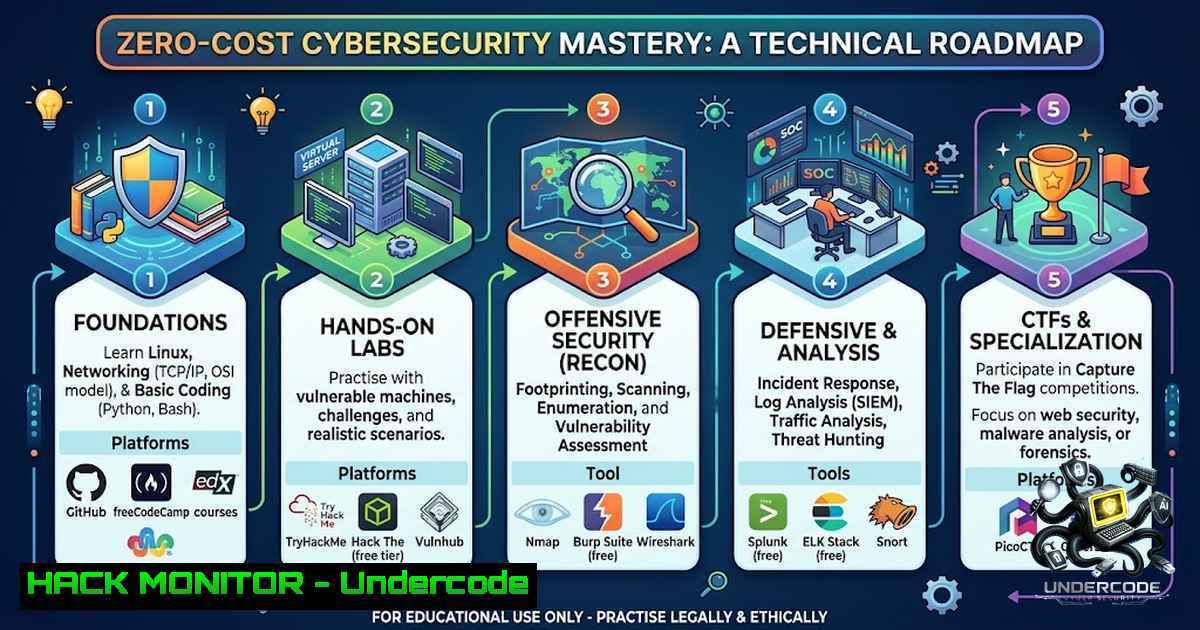
Introduction:
The barrier to entry in cybersecurity has traditionally been defined by expensive certifications and proprietary training programs. However, a paradigm shift is underway, with industry leaders like IBM, Microsoft, and PortSwigger offering comprehensive, free technical training that rivals paid alternatives. This article extracts the core technical curriculum from ten leading free platforms, transforming a list of resources into a structured, hands-on learning path that covers everything from cryptographic fundamentals to advanced API exploitation, complete with verified commands and configuration guides.
Learning Objectives & Secrets:
- Objective 1: Master Web Application Vulnerabilities – Progress from identifying OWASP Top 10 flaws (SQLi, XSS) to exploiting complex race conditions and prototype pollution using Burp Suite’s Repeater and Turbo Intruder.
- Objective 2 Secret Tip: Operationalize Cloud Security – Leverage Microsoft’s SC-900 path to implement Zero Trust architectures and shared responsibility models, moving beyond theory to configure Entra ID conditional access policies.
- Objective 3 Secret Tip: Gamify Skill Validation – Use picoCTF’s capture-the-flag challenges not just for practice, but as a metric for resume-building, treating each solved challenge as a verified competency marker.
You Should Know:
1. Web Application Penetration Testing with PortSwigger Academy
The PortSwigger Web Security Academy is the gold standard for free, practical web security training. It provides browser-based, deliberately vulnerable labs that mirror real-world applications. To begin, download Burp Suite Community Edition, which acts as an intercepting proxy.
Step‑by‑step guide for SQL injection detection:
- Configure your browser to route traffic through Burp Suite (default
127.0.0.1:8080). - Navigate to a lab targeting SQL injection (e.g., “SQL injection UNION attack”).
- In Burp, enable “Intercept” and capture the GET/POST request.
4. Send the request to Repeater (`Ctrl+R`).
- Modify the parameter to include a payload: `’ OR ‘1’=’1` or
' UNION SELECT NULL, username||'~'||password FROM users--. - Analyze the response for database errors or extracted data.
Linux Command for SQLMap (automated tool):
sqlmap -u "http://target.com/page?id=1" --batch --dump
Windows (using PowerShell):
python sqlmap.py -u "http://target.com/page?id=1" --batch --dump
2. Fortinet Network Security Configuration
Fortinet’s NSE training provides a free path to understanding network security appliances. A critical skill is configuring firewall policies to mitigate threats.
Step‑by‑step guide for FortiGate CLI policy configuration:
- Access the FortiGate CLI via SSH or console.
- Create an address object for a trusted subnet:
config firewall address
edit "Trusted_Network"
set subnet 192.168.1.0 255.255.255.0
next
end
- Create a firewall policy to allow traffic from Trusted_Network to the WAN interface:
config firewall policy
edit 0
set srcintf "internal"
set dstintf "wan1"
set srcaddr "Trusted_Network"
set dstaddr "all"
set action accept
set schedule "always"
set service "ALL"
next
end
3. Cloud Security and Identity Management (Microsoft Learn)
Microsoft’s SC-900 learning path covers fundamental security, compliance, and identity concepts. A key takeaway is the implementation of Conditional Access policies in Microsoft Entra ID (formerly Azure AD).
Step‑by‑step guide for configuring Multi-Factor Authentication (MFA) policy:
- Navigate to the Azure portal → Microsoft Entra ID → Security → Conditional Access.
2. Click “New policy”.
- Name the policy (e.g., “Require MFA for all users”).
4. Under “Assignments”, select “All users”.
- Under “Cloud apps or actions”, select “All cloud apps”.
- Under “Conditions”, configure locations to exclude trusted IPs if necessary.
- Under “Grant”, select “Grant access” and check “Require multi-factor authentication”.
8. Enable the policy.
Azure CLI command to list Conditional Access policies:
az rest --method get --url "https://graph.microsoft.com/v1.0/identity/conditionalAccess/policies"
4. Cryptographic Implementation and Hardening (OpenLearn & IBM)
OpenLearn’s network security course explains symmetric vs. asymmetric encryption. Practical implementation involves generating and managing keys.
Step‑by‑step guide for generating an RSA key pair and encrypting a file (Linux):
1. Generate a private key:
openssl genpkey -algorithm RSA -out private_key.pem -pkeyopt rsa_keygen_bits:2048
2. Extract the public key:
openssl rsa -pubout -in private_key.pem -out public_key.pem
3. Encrypt a file using the public key:
openssl pkeyutl -encrypt -inkey public_key.pem -pubin -in secret.txt -out secret.enc
4. Decrypt using the private key:
openssl pkeyutl -decrypt -inkey private_key.pem -in secret.enc -out secret_decrypted.txt
Windows (using OpenSSL for Windows):
openssl genpkey -algorithm RSA -out private_key.pem -pkeyopt rsa_keygen_bits:2048
- Exploiting and Mitigating OWASP Top 10 with WebGoat
OWASP WebGoat is a deliberately insecure application for testing Java-based vulnerabilities. It is essential for understanding the OWASP Top 10.
Step‑by‑step guide for exploiting Command Injection:
- Start WebGoat locally (default `http://localhost:8080/WebGoat`).
2. Navigate to the “Command Injection” lesson.
- In the input field, enter a benign command like
127.0.0.1.
4. Intercept the request with Burp Suite.
- Modify the parameter to include a malicious command: `127.0.0.1 && whoami` (Linux) or `127.0.0.1 & whoami` (Windows).
- Submit the request and observe the system user output in the response.
Mitigation strategy: Always use whitelists for input validation and avoid using system calls with user input.
6. API Security Testing (GraphQL and REST)
PortSwigger’s learning paths cover GraphQL API vulnerabilities and API testing.
Step‑by‑step guide for GraphQL introspection query:
1. Identify a GraphQL endpoint (e.g., `/graphql`, `/api`).
- Send a POST request with the following query to enumerate the schema:
{ "query": "query { __schema { types { name fields { name } } } }" } - Analyze the response for sensitive fields (e.g.,
password,ssn).
Burp Suite extension recommendation: Use the “InQL” extension for automated GraphQL security scanning.
7. Practical Capture-The-Flag (CTF) with picoCTF
picoCTF provides a gamified environment for learning security concepts. A common task is binary exploitation.
Step‑by‑step guide for a simple buffer overflow (assuming a vulnerable C program):
1. Connect to the CTF challenge via SSH or netcat: nc chall.picoctf.org PORT.
2. Identify the offset to overwrite the return address using a cyclic pattern (e.g., `pattern_create` in Metasploit).
3. Craft a payload that overwrites the return address with the address of a “win” function.
4. Use Python to send the payload:
import socket
s = socket.socket(socket.AF_INET, socket.SOCK_STREAM)
s.connect(('chall.picoctf.org', PORT))
payload = b'A'OFFSET + b'\xef\xbe\xad\xde'  Address of win function
s.send(payload)
s.close()
What Undercode Say:
- Key Takeaway 1: The democratization of cybersecurity education means that practical, hands-on skills are now accessible to anyone with an internet connection, bypassing the traditional cost barrier.
- Key Takeaway 2: True mastery comes from a hybrid approach—combining theoretical knowledge from IBM and Microsoft with relentless practical application on platforms like PortSwigger and picoCTF.
- The curated list of free resources represents a complete ecosystem: IBM SkillsBuild for foundational concepts, Microsoft for cloud and identity, PortSwigger for deep-dive web exploitation, Fortinet for network hardening, and OpenLearn for cryptographic principles. This eliminates the need for expensive bootcamps. Furthermore, the inclusion of CTF platforms like picoCTF introduces a competitive, measurable aspect to learning, which is crucial for building a portfolio that stands out to employers. The structured learning paths from PortSwigger, ranging from “Apprentice” to “Practitioner,” provide a clear career progression roadmap.
Prediction:
- +1 The continued expansion of free, high-quality cybersecurity training will accelerate the entry of diverse talent into the field, directly addressing the global cybersecurity workforce shortage.
- +1 Platforms like PortSwigger will increasingly integrate AI-driven lab assistants, providing personalized, real-time feedback and further reducing the need for instructor-led training.
- -1 The proliferation of free, advanced exploitation techniques (e.g., SSRF, prototype pollution) via these platforms may lower the skill barrier for malicious actors, necessitating more robust automated defense mechanisms in enterprise environments.
- -1 As more professionals gain access to advanced training, the baseline competency for entry-level security roles will rise, shifting the focus from certifications to demonstrable practical skills and CTF rankings.
▶️ Related Video (88% Match):
🎯Let’s Practice For Free:
🎓 Live Courses & Certifications:
Join Undercode Academy for Verified Certifications
🚀 Request a Custom Project:
Secure, high-velocity infrastructure and disruptive technological engineering. Contact our engineering team for high-tier development and proprietary systems:
[email protected]
💎 Smart Architecture | 🛡️ Secure by Design | ⭐ Trusted by Thousands
IT/Security Reporter URL:
Reported By: https://lnkd.in/p/e2GTunFu – Hackers Feeds
Extra Hub: Undercode MoN
Basic Verification: Pass ✅


