Listen to this Post
Introduction:
In the realm of cybersecurity, the most sophisticated firewall or intrusion detection system can be rendered useless by a single human decision. This article delves into the technical and psychological underpinnings of “human hacking” or social engineering, where attackers exploit cognitive biases and organizational processes to breach defenses. We move beyond awareness to equip IT and security professionals with actionable knowledge to simulate, detect, and mitigate these non-technical attacks.
Learning Objectives:
- Understand the technical methodologies behind common social engineering attacks like phishing, vishing, and pretexting.
- Learn to use open-source intelligence (OSINT) tools to model an attacker’s reconnaissance phase.
- Implement technical controls and training protocols to harden the human layer of your security architecture.
You Should Know:
- The Phishing Kill Chain: From Recon to Payload Execution
A modern phishing campaign is a technical operation. It begins with reconnaissance, often using OSINT tools to gather employee emails, roles, and interests from platforms like LinkedIn (as seen in the source post’s context). Attackers then craft targeted spear-phishing emails, often leveraging cloned websites and obfuscated payloads.
Step-by-step guide explaining what this does and how to use it.
Reconnaissance with LinkedIn & OSINT: An attacker might use a tool like `theHarvester` to find email addresses associated with a company domain.
 Linux command for initial OSINT email gathering
theHarvester -d target-company.com -b google,linkedin
Crafting the Lure: Using the gathered data (e.g., “Tony Moukbel, UNDERCODE NEWS”), a malicious email is crafted with a sense of urgency or relevance.
Hosting the Payload: A simple Python HTTP server can be used to host a malicious document, mimicking an internal resource.
 Quickly host a directory (containing a fake "Q4_Report.pdf.exe")
python3 -m http.server 8080
Defensive Simulation: Use phishing simulation platforms (like GoPhish, which can be self-hosted) to safely train employees. Analyze click-through rates with commands to parse server logs:
 Check your simulation server logs for access to the tracked link
tail -f /var/log/gophish/access.log | grep "click-tracking-id"
- Pretexting & Vishing: The Art of Technical Deception
Pretexting involves creating a fabricated scenario to obtain information or access. Vishing (voice phishing) adds a real-time social pressure element. Technically, this often involves Spoofing caller ID (using VoIP tools like Asterisk) or impersonating IT support to gain credentials.
Step-by-step guide explaining what this does and how to use it.
Attacker View – Caller ID Spoofing (For Educational Purposes): Tools like `sipp` can be used in lab environments to demonstrate how trivial spoofing can be.
Defender View – Logging & Verification: Implement strict verification protocols. Log all remote access requests. Use PowerShell on Windows endpoints to quickly check recent remote connections.
 Windows command to query recent Windows Remote Management (WinRM) events
Get-WinEvent -FilterHashtable @{LogName='Microsoft-Windows-WinRM/Operational'; ID=91} -MaxEvents 10 | Format-List
Mitigation: Mandate the use of a secondary, out-of-band verification channel (e.g., a separate SMS or internal ticketing system code) for any credential or access reset.
3. Weaponizing OSINT: Building the Attack Profile
The source post itself is a classic example of an OSINT goldmine: a professional’s name, company, and network. Attackers automate the collection of such data to build convincing profiles.
Step-by-step guide explaining what this does and how to use it.
Automated Data Gathering: Use `sherlock` to find usernames across social media.
 Search for a username across platforms
sherlock TonyMoukbel
Metadata Extraction: Documents shared online contain metadata. Use `exiftool` to analyze.
 Extract metadata from a PDF found on a company website
exiftool company_whitepaper.pdf
Defensive OSINT: Regularly conduct OSINT on your own company and key personnel. Use these findings to adjust privacy settings and educate staff on their digital footprint.
4. BEC & Deepfake Audio: The AI-Powered Threat
Business Email Compromise (BEC) is often fueled by social engineering. Now, AI-generated deepfake audio can simulate a CEO’s voice for vishing attacks.
Step-by-step guide explaining what this does and how to use it.
Understanding the Tech: Open-source AI voice cloning tools (like those based on So-VITS-SVC) can create convincing clones from short audio samples.
Defensive Technical Control: Implement positive approval for financial transactions. For high-value transfers, require a live video call or a pre-shared verbal password. Monitor for anomalous email forwarding rules in Office 365 via PowerShell:
 Check inbox rules for a user (requires appropriate Exchange Online permissions)
Get-InboxRule -Mailbox "[email protected]" | Select-Object Name, Description, RedirectTo, ForwardTo
- Hardening the Human Layer: Technical Policies & Continuous Training
The human firewall requires ongoing updates, much like software.
Step-by-step guide explaining what this does and how to use it.
Implement DMARC, DKIM, and SPF: These email authentication protocols are your first technical line against phishing.
 Use dig to check a domain's DMARC record
dig +short TXT _dmarc.target-company.com
Configure Group Policy (Windows) or MDM (Mobile): Restrict execution of files from temporary internet directories and enforce application allow-listing.
Deploy a Simulated Training Platform: Automate regular, randomized phishing tests with tailored content based on department (e.g., a fake “DBA program” phishing email for executives, mirroring the sponsored ad in the source text).
What Undercode Say:
- The Human API is the Most Vulnerable Endpoint. Technical security is futile if the human “API” accepts malicious input without proper validation. Social engineering is the exploitation of this interface.
- Defense Requires Offensive Simulation. You cannot defend against tactics you do not understand. Ethical simulation of social engineering attacks is a non-negotiable component of a mature security program.
Analysis:
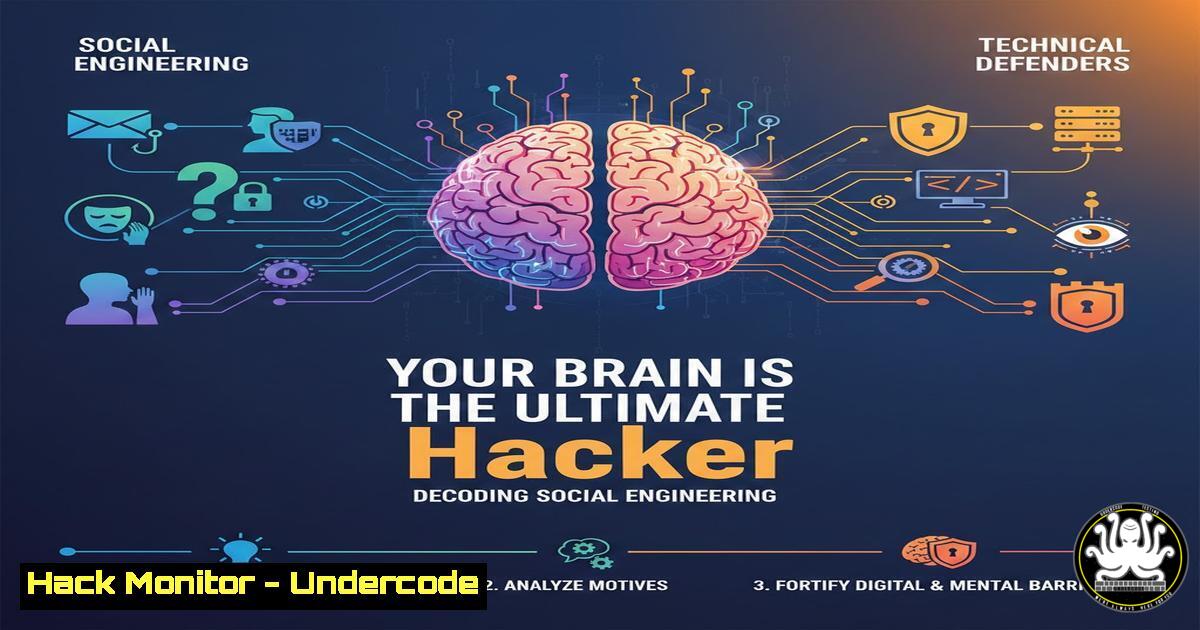
The original post succinctly highlights the core issue: the brain is the ultimate attack vector. The sponsored ad for a “Dr. ” within the same context is a perfect, unintentional case study—a highly targeted lure for a senior professional. This illustrates how seamlessly a malicious actor could weave a credible pretext. The future of cybersecurity is not a binary fight of code versus code, but a complex psychological and technical battle where AI will amplify both attacks (via deepfakes) and defenses (via behavioral analytics). Ignoring the human factor means neglecting the root cause of the majority of security incidents.
Prediction:
In the next 3-5 years, we will see the convergence of AI-driven social engineering and automated exploit delivery, creating hyper-personalized, polymorphic phishing campaigns at scale. Defense will pivot towards AI-powered anomaly detection in human communication patterns (email tone, request timing) and widespread adoption of hardware security keys and passkeys to nullify credential theft. The role of the security professional will evolve to include expertise in behavioral psychology and organizational change management to systematically harden the human layer against manipulation.
▶️ Related Video (84% Match):
🎯Let’s Practice For Free:
IT/Security Reporter URL:
Reported By: Youna Chosse – Hackers Feeds
Extra Hub: Undercode MoN
Basic Verification: Pass ✅


