Listen to this Post
Introduction:
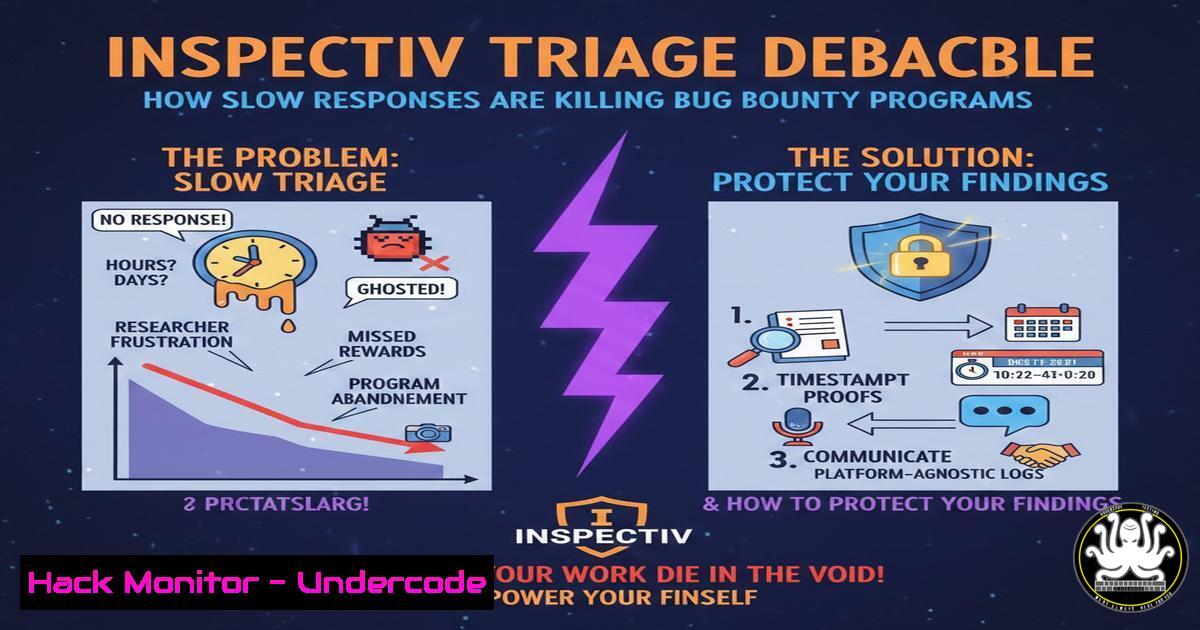
The recent public critique of the bug bounty platform Inspectiv by a seasoned researcher highlights a critical, systemic flaw in the vulnerability disclosure ecosystem: delayed triage. When platforms or companies take weeks to assess reports, dynamic assets can change, leading to valid bugs being wrongfully closed as “unreachable” or “patched,” directly harming researcher compensation and trust. This incident isn’t isolated but symptomatic of a broader challenge in coordinating offensive security research with corporate response timelines, necessitating smarter workflows for hunters.
Learning Objectives:
- Understand the operational risks of delayed bug bounty triage for both researchers and organizations.
- Learn technical methods to document and preserve proof-of-concept (PoC) evidence irrefutably.
- Develop a proactive strategy for selecting bug bounty programs and automating initial outreach.
You Should Know:
1. The Evidence Preservation Imperative: Beyond Simple Screenshots
When you submit a report, you are presenting a case. Just like in digital forensics, the integrity and timeliness of your evidence are paramount. A simple screenshot or a video can be disputed if the asset later changes. You must create a chain of custody for your findings.
Step‑by‑step guide explaining what this does and how to use it.
For Web Application Findings: Use the browser’s built-in developer tools to export a full HAR (HTTP Archive) file. This captures all network requests, responses, headers, and timing data.
Steps: 1) Open DevTools (F12), 2) Go to the Network tab, 3) Reproduce the vulnerability, 4) Right-click any request and select “Save all as HAR with content”.
Command-Line Corroboration: Use `curl` commands to timestamp and document the vulnerability from an independent system.
Linux/macOS Command: `curl -v -X POST “https://target.com/api/leaky-endpoint” -H “Authorization: Bearer
What it does: The `-v` flag gives verbose output (headers), `-X` specifies the method, and `tee` both displays and saves the entire output with a timestamp to a file. Using a proxy like Burp allows for deeper inspection.
Third-Party Archival: Immediately archive the vulnerable page using a public service. While not always ethical for highly sensitive data, for demonstration purposes, you can use:
Command: `curl -s “https://web.archive.org/save/https://vulnerable-target.com/path”` (This is a simplified example; check Archive.org’s actual API).
2. Automating Initial Triage & Follow-ups
Manual follow-up emails are time-consuming. Researchers can use lightweight automation to monitor response portals or manage their disclosure timeline, ensuring they adhere to responsible disclosure deadlines while maintaining a paper trail.
Step‑by‑step guide explaining what this does and how to use it.
Scripted Timeline Tracker: A simple Python script using the `smtplib` and `datetime` libraries can send reminder emails.
 Example Python snippet for logging report dates (simplified)
import csv
from datetime import datetime, timedelta
report_log = []
 Log a new report
report_log.append({
'platform': 'Inspectiv',
'report_id': 'XYZ123',
'submission_date': datetime.now().isoformat(),
'first_response': None,
'status': 'submitted'
})
 Function to check for reports older than 14 days with no response
def check_delayed_reports(log):
for report in log:
sub_date = datetime.fromisoformat(report['submission_date'])
if report['first_response'] is None and (datetime.now() - sub_date) > timedelta(days=14):
print(f"Alert: Report {report['report_id']} on {report['platform']} has no response after 14 days.")
 Write log to CSV
with open('bug_reports.csv', 'w', newline='') as f:
writer = csv.DictWriter(f, fieldnames=report_log[bash].keys())
writer.writeheader()
writer.writerows(report_log)
Browser Automation for Status Checks: Tools like Selenium or Puppeteer can be configured to log into a bug bounty platform portal, check the status of reports, and take screenshots. This is advanced and must comply with the platform’s terms of service.
3. Technical Mitigation: Building a Personal Proof-of-Concept Server
For complex vulnerabilities, especially those involving state or callback URLs (like SSRF, OAUTH flaws, or blind XSS), having a controlled server to capture interactions is invaluable. This provides live, timestamped proof that is external to the target asset.
Step‑by‑step guide explaining what this does and how to use it.
Set up a simple HTTP/S listener with Netcat or Python:
Linux (Netcat): `nc -lvnp 80` or `nc -lvnp 443` (requires root for privileged ports). This listens for incoming connections and logs raw requests.
Python HTTP Server (More Flexible):
from http.server import HTTPServer, BaseHTTPRequestHandler
import logging
logging.basicConfig(level=logging.INFO)
class RequestHandler(BaseHTTPRequestHandler):
def do_GET(self):
logging.info(f"GET request from {self.client_address[bash]} to {self.path}")
self.send_response(200)
self.end_headers()
def do_POST(self):
content_length = int(self.headers['Content-Length'])
post_data = self.rfile.read(content_length)
logging.info(f"POST data from {self.client_address[bash]}: {post_data.decode()}")
self.send_response(200)
self.end_headers()
server = HTTPServer(('0.0.0.0', 8080), RequestHandler)
server.serve_forever()
Use Cloud-Based Canary Tokens: Services like Canarytokens.org let you generate unique URLs, DNS names, or AWS keys that, when interacted with, send you an alert with full forensic details (source IP, time, user-agent). This is excellent for proving exploitability of out-of-band vulnerabilities.
4. Program Selection Criteria: Vetting Before Hunting
Not all bug bounty programs are created equal. Researchers must perform due diligence to avoid platforms or companies with historically poor triage.
Step 1: Check Public Sentiment. Search Twitter, LinkedIn, and platforms like `Bug Bounty World` for mentions of the program’s name alongside keywords like “triage,” “slow,” “response.”
Step 2: Analyze Policy Clarity. A good program has a clear, detailed security policy on a domain like `security.example.com` or on HackerOne/ Bugcrowd. Look for defined response time SLAs, clear in-scope/out-of-scope assets, and fair reward ranges.
Step 3: Start Small. For a new program, first submit a low-severity, well-documented bug. The speed and quality of the triage team’s response to this report is a strong indicator of their overall process health.
- The Corporate Security Angle: Hardening Your Response Pipeline
This issue is a wake-up call for security teams running bounty programs. Slow triage is a security risk.
Step 1: Implement a Dedicated, Triage-Focused Vulnerability Management Tool. Solutions like Jira Service Management with specific workflows for external reports, or dedicated platforms like Bugcrowd’sCrowdstream, can streamline intake.
Step 2: Create an Isolated, Non-Production Staging Environment that mirrors production and is updated with a slight delay. When a researcher reports a bug on a live asset, triagers can immediately attempt to replicate it on the staging environment, which may not have been patched yet.
Step 3: Automate Initial Report Validation. Use simple scripts to check if a submitted URL is live, run a basic vulnerability scanner (like Nuclei) against the endpoint, and parse reports for required elements (title, steps, impact). This prioritizes reports for human triagers.
What Undercode Say:
- Key Takeaway 1: The integrity of a bug bounty ecosystem hinges on timely triage. Delays are not just an operational nuisance but a critical failure that punishes ethical researchers and exposes organizations to risk if researchers abandon responsible disclosure.
- Key Takeaway 2: Modern bug hunting requires a forensic-minded approach to evidence. Researchers must adopt techniques that create immutable, timestamped proof of concept that can withstand the decay of target assets or delayed investigation.
The Inspectiv case study is not merely about one platform’s performance but a stress test for the entire crowdsourced security model. It reveals a fundamental asymmetry: researchers are expected to operate with professional precision and immediacy, while platforms and companies often lack equivalent operational discipline. This erodes trust, the core currency of these programs. For the model to survive and scale, platforms must invest in triage capacity and technology with the same fervor that hunters invest in finding bugs. The future will belong to platforms that offer transparent SLAs, robust evidence-preservation features integrated into their portals, and fair arbitration processes.
Prediction:
In the next 2-3 years, we will see a market correction in the bug bounty platform space. Researchers will increasingly gravitate towards programs with transparent, contractually-backed response time SLAs and integrated evidence logging (like automatic HAR file upload and archival). Platforms that fail to address triage latency will see a decline in report quality and researcher engagement. Furthermore, we will witness the rise of “researcher-centric” tools—perhaps decentralized, blockchain-based timestamping of submissions or smart contracts that automatically release payment upon verification of a PoC, reducing the dependency on slow, centralized human triage. This incident is a catalyst for the professionalization and technological evolution of vulnerability disclosure.
▶️ Related Video (72% Match):
🎯Let’s Practice For Free:
IT/Security Reporter URL:
Reported By: Deepak Saini – Hackers Feeds
Extra Hub: Undercode MoN
Basic Verification: Pass ✅


