Listen to this Post
Introduction:
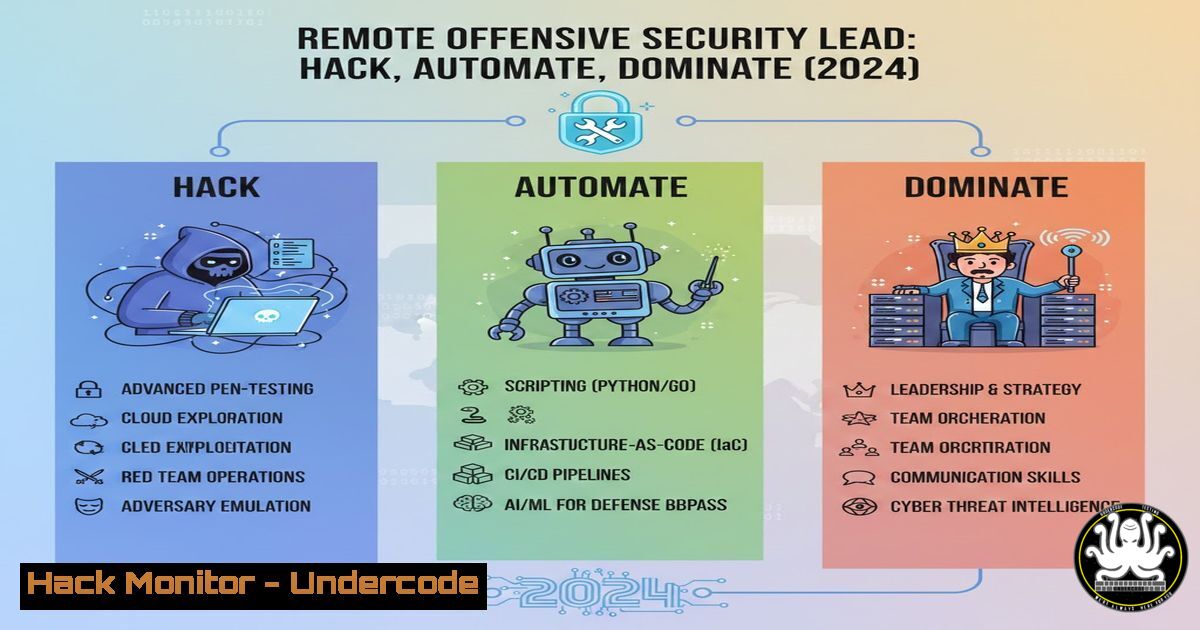
The modern offensive security engineer’s role has evolved far beyond simple penetration testing. Today’s leads are expected to orchestrate full-spectrum adversary simulations, seamlessly blend AI into their tradecraft, and identify risks across the entire attack surface—cyber, physical, and human. This article deconstructs the high-demand skillset showcased in a recent job posting for a US-based Lead Offensive Security Engineer, translating the requirements into actionable technical knowledge and procedures.
Learning Objectives:
- Understand the core components of a full-scope adversary simulation exercise.
- Learn how to leverage AI and automation for offensive security efficiency.
- Develop a methodology for holistic risk identification beyond digital perimeters.
You Should Know:
1. Executing Full-Scope Adversary Simulation
True adversary simulation mirrors a determined human attacker, not just a vulnerability scanner. This involves the full cyber kill chain: reconnaissance, weaponization, delivery, exploitation, command & control (C2), lateral movement, and objective completion.
Step‑by‑step guide:
- Planning & Reconnaissance: Define the campaign’s objectives (e.g., exfiltrate specific data). Conduct passive reconnaissance using tools like `theHarvester` and
Amass.Linux command for domain enumeration amass enum -passive -d target-company.com -o amass_initial.txt
- Initial Compromise: Develop or acquire tailored payloads. Use frameworks like Cobalt Strike or Mythic for C2 infrastructure. Test against email filters (for phishing) or web application firewalls.
- Establish Foothold & Lateral Movement: Once inside, use credential dumping techniques (e.g., Mimikatz on Windows, or `secretsdump.py` from Impacket) to move laterally.
Impacket example for dumping hashes from a Windows target
python3 secretsdump.py 'DOMAIN/USER:PASSWORD@TARGET_IP'
- Persistence & Objective: Establish multiple persistence mechanisms (scheduled tasks, services, WMI subscriptions). Finally, achieve the objective (data exfiltration, etc.) while evading detection.
-
Automating the Manual: Integrating AI into Offensive Workflows
AI can automate reconnaissance, log analysis, and even suggest attack paths. The key is to augment human creativity, not replace it.
Step‑by‑step guide:
- AI-Powered Recon: Use tools like `gpt-engineer` or `ChatGPT` with the Shodan API to write scripts that automatically find and categorize exposed assets with specific vulnerabilities.
Example pseudo-code using OpenAI API to analyze Shodan data import openai, shodan ... Fetch data for "Apache 2.4.49" from Shodan ... prompt = f"Analyze these hosts: {shodan_data}. List the top 5 potential attack vectors." response = openai.ChatCompletion.create(model="gpt-4", messages=[{"role": "user", "content": prompt}]) print(response['choices'][bash]['message']['content']) - Automated Report Generation: Use AI to summarize findings from tools like BloodHound (
bloodhound-python) and Nessus into executive and technical report sections. - Payload Generation & Obfuscation: Leverage local LLMs (like Llama 3) running on your attack infrastructure to generate polymorphic code snippets or social engineering lures.
3. Holistic Risk Identification: Thinking Beyond the Firewall
Threats target people, processes, and physical assets. Offensive engineers must simulate these vectors.
Step‑by‑step guide:
- Human Risk (Social Engineering): Conduct controlled phishing campaigns using platforms like Gophish. Measure click-through rates and credential harvests. Follow up with security awareness training.
- Physical Security Testing: With proper authorization, attempt tailgating, badge cloning (using Proxmark3), or dumpster diving to recover sensitive information.
- Process Exploitation: Analyze public-facing workflows (e.g., password reset, support ticket systems) for logic flaws. For instance, test if a password reset token can be brute-forced or reused.
4. Building and Leading a Global Red Team
Managing a remote, global offensive team requires standardized tooling, secure communication, and synchronized operations.
Step‑by‑step guide:
- Secure Infrastructure: Set up a centralized, secure command and control (C2) infrastructure using redirectors (e.g., Apache mod_rewrite rules or SOCAT relays) to protect your core team servers.
Example SOCAT redirector command (on a compromised VPS)
socat TCP4-LISTEN:80,fork TCP4:C2_SERVER_IP:443
- Knowledge Management: Use a hardened wiki (like DokuWiki or BookStack) for tactics, techniques, and procedures (TTPs), tool documentation, and campaign findings.
- Synchronized Operations: Utilize encrypted communication channels (Keybase, Signal) and hold regular operational synchronization meetings to avoid conflicts during simultaneous testing.
-
Staying Cutting Edge: Research and Custom Tool Development
To bypass modern defenses, you must develop custom capabilities. This often involves analyzing EDRs, writing custom implants, and contributing to the community.
Step‑by‑step guide:
- Research Environment: Set up a isolated lab with VMware ESXi or Proxmox to host security products (CrowdStrike, Defender ATP) for analysis and evasion testing.
- Weaponizing Vulnerabilities: When a new CVE is published, write a proof-of-concept (PoC) exploit. Use `pwntools` for binary exploits or develop custom Python scripts for web CVEs.
- Tool Development: Extend frameworks like Metasploit or Powershell Empire with custom modules. Package your research into tools and share them responsibly on platforms like GitHub.
What Undercode Say:
- Key Takeaway 1: The offensive security pinnacle is no longer just technical exploitation; it’s the orchestration of multi-vector campaigns that accurately simulate a motivated adversary’s holistic approach, blending digital, human, and physical intrusion techniques.
- Key Takeaway 2: AI integration is now a mandatory force multiplier for elite offensive teams, shifting human effort from repetitive tasks to high-level strategy, creative problem-solving, and interpreting complex attack paths.
The job description analyzed here serves as a perfect blueprint for the future of red teaming. It highlights a critical industry shift: the convergence of deep technical prowess, strategic automation, and operational leadership. The offensive engineer of 2024 is a hybrid—a tactician who can write a Python script to automate reconnaissance, a social engineer who can craft a convincing phishing lure, and a leader who can manage a global, remote team during a complex simulation. This role is less about “breaking in” and more about “thinking like an entire adversary organization.” The emphasis on AI and automation signals the end of manual, slow-paced testing. Future offensive operations will be faster, more adaptive, and more comprehensive, conducted by teams who use AI to continuously learn, adapt, and evolve their TTPs in real-time, forcing defensive teams into an ever-accelerating cycle of adaptation.
Prediction:
Within the next 2-3 years, AI agents will autonomously conduct substantial portions of adversary simulations, from initial reconnaissance and vulnerability discovery to weaponization and limited, rule-based lateral movement. Lead Offensive Security Engineers will transition from direct operators to “AI Attack Orchestrators,” designing the rules of engagement, training specialized AI models on proprietary data, and making critical ethical and escalation decisions during fully automated campaign phases. This will exponentially increase the attack surface coverage and speed of security assessments but will also spark intense debate around AI safety, control, and the ethics of autonomous cyber weapons.
▶️ Related Video (74% Match):
🎯Let’s Practice For Free:
IT/Security Reporter URL:
Reported By: Activity 7417595481058574337 – Hackers Feeds
Extra Hub: Undercode MoN
Basic Verification: Pass ✅


