
Listen to this Post
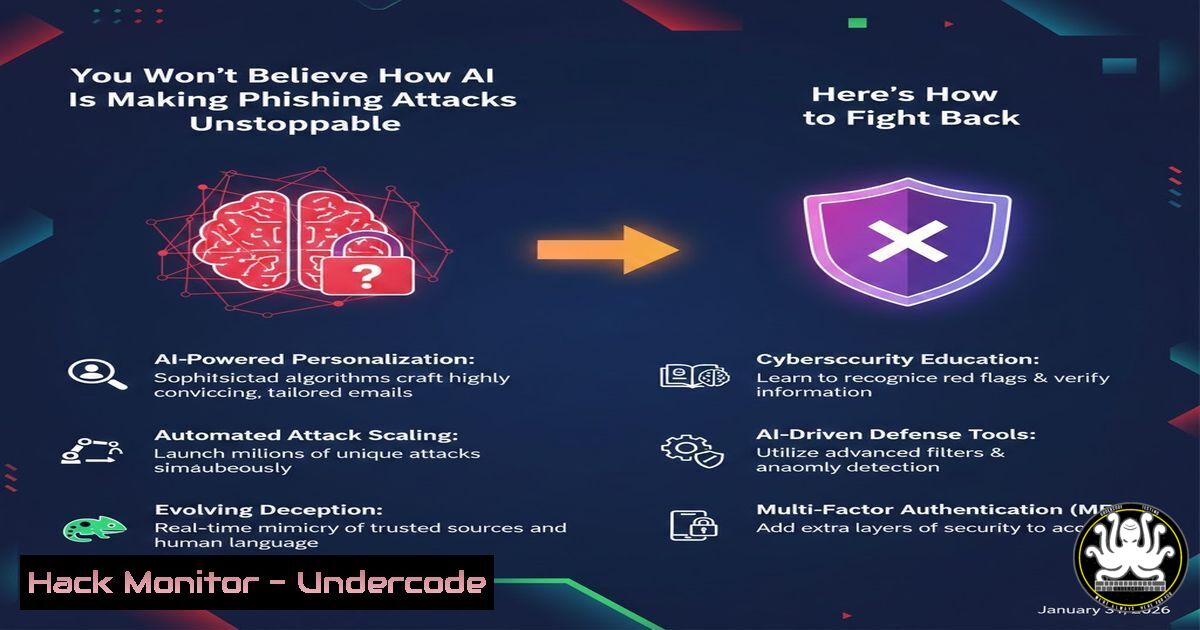
Introduction:
Artificial intelligence is revolutionizing cyber threats, enabling attackers to generate highly personalized and convincing phishing campaigns that evade traditional email filters. This article delves into the technical mechanics of AI-driven phishing and provides actionable steps for IT professionals to bolster defenses. Understanding these advanced tactics is critical for safeguarding organizational assets in an increasingly automated threat landscape.
Learning Objectives:
- Identify the hallmarks of AI-generated phishing content and malicious URLs.
- Implement cross-platform technical controls to detect and mitigate AI-phishing attempts.
- Develop and execute an incident response plan for phishing breaches.
You Should Know:
1. How AI Crafts Convincing Phishing Emails
AI models like GPT can generate fluent, context-aware email text that mimics legitimate communications. To detect anomalies, deploy AI-based email security tools. On Linux, configure `rspamd` with its neural network module for scoring. First, install and enable the service:
sudo apt update && sudo apt install rspamd -y
sudo systemctl start rspamd && sudo systemctl enable rspamd
Edit the configuration file at `/etc/rspamd/local.d/neural.conf` to enable learning from marked spam/ham:
enabled = true;
train {
max_train = 1000;
max_usages = 10;
}
This allows `rspamd` to adaptively classify emails using AI, improving detection over time.
2. Analyzing and Verifying Suspicious URLs
Phishing emails often embed URLs with subtle typos or use URL shorteners. Use Python to extract and examine these links. The script below parses email text, resolves redirects, and checks for known malicious indicators:
import re, requests, whois
from urllib.parse import urlparse
def scan_url(url):
try:
resp = requests.head(url, allow_redirects=True, timeout=5)
final_url = resp.url
domain = urlparse(final_url).netloc
w = whois.whois(domain)
print(f"Final URL: {final_url}, Domain Creation: {w.creation_date}")
except Exception as e:
print(f"Error scanning {url}: {e}")
email_text = "Click here: https://bit.ly/3xYz9aB to update your password."
urls = re.findall(r'https?://\S+', email_text)
for url in urls:
scan_url(url)
Integrate this with threat intelligence APIs like VirusTotal for enhanced analysis.
3. Hardening Windows with Advanced Threat Protection
Windows Defender ATP uses machine learning to detect phishing payloads. Enable advanced features via PowerShell and Group Policy. First, ensure real-time protection is active:
Set-MpPreference -DisableRealtimeMonitoring $false -EnableNetworkProtection Enabled
Then, configure attack surface reduction rules to block Office macros and executable downloads from email:
Add-MpPreference -AttackSurfaceReductionRules_Ids BE9BA2D9-53EA-4CDC-84E5-9B1EEEE46550 -AttackSurfaceReductionRules_Actions Enabled
Audit settings via `gpedit.msc` under Computer Configuration > Windows Components > Microsoft Defender Antivirus.
4. Deploying DNS-Level Filtering on Linux and Windows
DNS filtering blocks access to known phishing domains. On Linux, configure `systemd-resolved` to use Quad9 (9.9.9.9) for secure DNS:
sudo nano /etc/systemd/resolved.conf
Set:
DNS=9.9.9.9 1.1.1.2
DNSOverTLS=yes
Restart: sudo systemctl restart systemd-resolved. On Windows, apply via PowerShell:
Set-DnsClientServerAddress -InterfaceIndex (Get-NetAdapter).ifIndex -ServerAddresses ("9.9.9.9", "1.1.1.2")
This prevents resolution of malicious domains at the network layer.
5. Simulating AI-Phishing Attacks for Training
Use platforms like KnowBe4 or OpenPhish to run simulated campaigns. For in-house testing, set up a controlled environment with tools like Gophish. On a Linux server, deploy Gophish via Docker:
docker run -d -p 3333:3333 -p 80:80 gophish/gophish
Access the admin interface at `https://localhost:3333`, configure email templates, and launch simulations. Analyze click-through rates to identify vulnerable users.
6. Incident Response: Containment and Forensic Collection
If a phishing link is clicked, isolate the affected system immediately. On Windows, use PowerShell to disconnect from the network:
Stop-Process -Name "explorer" -Force; Disable-NetAdapter -Name "Ethernet" -Confirm:$false
On Linux, block outgoing traffic with iptables:
sudo iptables -A OUTPUT -p tcp --dport 80 -j DROP && sudo iptables -A OUTPUT -p tcp --dport 443 -j DROP
Collect artifacts: on Windows, retrieve prefetch files and event logs via `wevtutil qe Security /f:text`. On Linux, examine `/var/log/mail.log` and bash history.
7. Integrating AI Defenses with Cloud Email Services
For cloud-based email like Office 365 or Google Workspace, enable AI-driven security features. In Office 365, use Microsoft Defender for Office 365 to set up anti-phishing policies with impersonation detection. Via PowerShell:
New-AntiPhishPolicy -Name "AI-Phishing Defense" -EnableAntiPhishProtection $true -EnableMailboxIntelligence $true
In Google Workspace, configure Security Center with AI-based alerting to flag anomalies in email routing and attachment types.
What Undercode Say:
- AI-powered phishing is not just an evolution but a paradigm shift, requiring defensive strategies that leverage equally sophisticated AI tools.
- Proactive defense must blend automated technical controls with continuous human-centric training to reduce susceptibility.
Analysis: The democratization of AI tools has lowered the barrier for cybercriminals, enabling hyper-targeted phishing at scale. Defensively, AI can process telemetry data to identify subtle behavioral patterns, such as anomalous login times or unusual email sending patterns. However, over-reliance on AI without human oversight can lead to false positives. Organizations should adopt a layered approach, integrating AI-driven email filters with endpoint detection and response (EDR) platforms. Regular penetration testing and red team exercises that simulate AI-phishing are essential to validate defenses. Ultimately, resilience hinges on adapting security postures as AI tactics evolve.
Prediction:
Within three to five years, AI-phishing will incorporate real-time deepfake voice and video synthesis for vishing attacks, bypassing multi-factor authentication. Defenses will counter with federated learning models that collaboratively improve detection across organizations without sharing sensitive data. Regulatory bodies will impose stricter standards on AI security transparency, and insurance premiums will skyrocket for firms lacking AI-hardened defenses. The arms race will escalate, making AI literacy a core competency for cybersecurity professionals.
▶️ Related Video (76% Match):
🎯Let’s Practice For Free:
IT/Security Reporter URL:
Reported By: Jaswindder Kummar – Hackers Feeds
Extra Hub: Undercode MoN
Basic Verification: Pass ✅


