
Listen to this Post
Introduction:
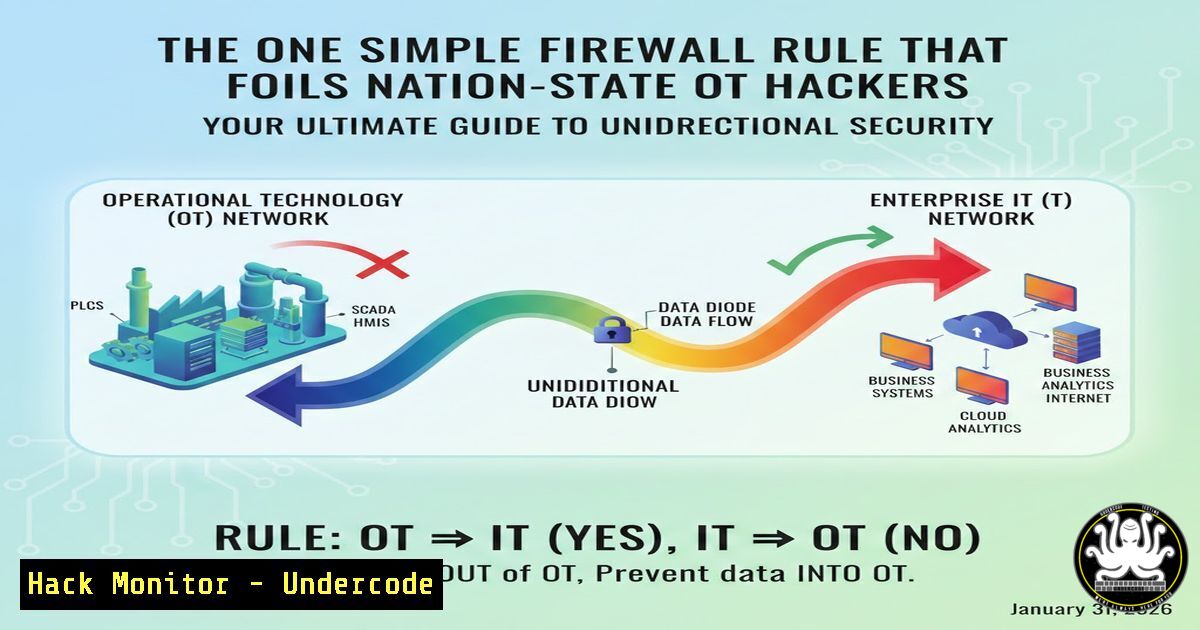
In the high-stakes world of Operational Technology (OT) and Industrial Control Systems (ICS), cybersecurity is not about complexity for its own sake; it’s about implementing definitive, physical barriers against intrusion. The most critical defense, echoed by leading ICS security experts like Rob Lee and Mike Holcomb, is a foundational network architecture principle: strictly controlling the flow of traffic at the IT-OT boundary. This article deconstructs the imperative of unidirectional communication, moving beyond theory to provide actionable configurations and commands to segment your critical industrial networks from IT-borne threats.
Learning Objectives:
- Understand the critical risk of bidirectional IT-OT communication and the principle of data “sneakernet” in reverse.
- Learn how to configure firewall rules on common platforms to enforce a “deny-by-default” posture from IT to OT.
- Implement practical strategies for secure, one-way data transfer, including logical configurations and physical data diode considerations.
You Should Know:
- The Architecture of Compromise: Why Bidirectional Connections Are the Primary Attack Path
The pervasive need for business data from OT networks—production rates, sensor telemetry, efficiency metrics—creates a dangerous temptation: allowing IT systems to reach into OT environments to “fetch” this data. This creates a permanent, authorized pathway. Adversaries, whether deploying ransomware or conducting espionage, do not need to discover a novel zero-day; they simply exploit these existing, trusted channels. Once they compromise the IT network (an accepted eventuality), they ride the permitted connection directly into the heart of industrial operations. The core tenet is this: The connection must never originate from the IT side. Data must be pushed from OT, not pulled by IT.
- Fortifying the Perimeter: Configuring Your “Simple Firewall” for Unidirectional Flow
A firewall is only as good as its rule set. The goal is explicit: allow necessary traffic from OT to specific destinations in IT (e.g., a historian server), and absolutely block all connection attempts originating from the IT zone to the OT zone. This is a “Default Deny” rule for IT-sourced traffic.
Step-by-Step Guide:
Step 1: Define Zones. Clearly label your firewall interfaces: OT_Zone, IT_Zone, `DMZ` (if used).
Step 2: Establish the Critical “Deny” Rule. Create a rule at the top of your IT-to-OT policy set:
Action: `DENY` or `DROP`.
Source Zone: `IT_Zone`.
Destination Zone: `OT_Zone`.
Service/Protocol: `ANY`.
Logging: `ENABLED` (Critical for monitoring attack attempts).
Step 3: Craft the Permissive “Push” Rule. Below the deny rule, create an allowance:
Action: `ALLOW`.
Source Zone: `OT_Zone`.
Source IP: Specific OT data source (e.g., `192.168.1.50` – a PLC or gateway).
Destination Zone: `IT_Zone` or `DMZ`.
Destination IP: A specific IT server (e.g., `10.10.10.100` – a data historian).
Service/Protocol: A specific, narrow port (e.g., `TCP/443` for HTTPS or a dedicated OPC UA port).
Example CLI Snippet (Palo Alto Networks-style):
set rulebase security rules "IT_to_OT_DENY_ALL" action deny
set rulebase security rules "IT_to_OT_DENY_ALL" from IT_Zone
set rulebase security rules "IT_to_OT_DENY_ALL" to OT_Zone
set rulebase security rules "IT_to_OT_DENY_ALL" source any
set rulebase security rules "IT_to_OT_DENY_ALL" destination any
set rulebase security rules "IT_to_OT_DENY_ALL" service any
set rulebase security rules "IT_to_OT_DENY_ALL" log-end yes

set rulebase security rules "OT_to_IT_PUSH_DATA" action allow
set rulebase security rules "OT_to_IT_PUSH_DATA" from OT_Zone
set rulebase security rules "OT_to_IT_PUSH_DATA" to IT_Zone
set rulebase security rules "OT_to_IT_PUSH_DATA" source 192.168.1.50
set rulebase security rules "OT_to_IT_PUSH_DATA" destination 10.10.10.100
set rulebase security rules "OT_to_IT_PUSH_DATA" service application-default-ports
- Beyond Logic: Implementing Physical Unidirectional Gateways and Data Diodes
For the highest security levels (e.g., NERC CIP, nuclear facilities), logical firewall rules may be deemed insufficient. A Data Diode or Unidirectional Gateway provides a physical or hardware-enforced guarantee. These devices typically use a fiber-optic send port with no corresponding receive hardware, or specialized ASICs that strip TCP acknowledgements, making reverse communication physically impossible.
Step-by-Step Guide for Integration:
Step 1: Network Placement. Install the data diode between your OT network and a “Demilitarized Zone” (DMZ) or your IT network. The sending side (TX) connects to OT, the receiving side (RX) to IT/DMZ.
Step 2: Configure OT Sender. Configure your OT data publisher (e.g., an OPC server, syslog forwarder) to send data to the IP address of the diode’s receiving interface on the IT side. The diode will physically transfer the data packets.
Step 3: Configure IT Receiver. Configure your IT-side application (historian, SIEM) to listen for data from the diode’s IT-side interface IP. No return packets can be sent.
Key Command (OT Side – Linux Rsyslog Forwarding Example): This configures an OT system to send logs one-way to a target IP (the diode).
 In /etc/rsyslog.conf on OT host
. @10.10.10.5:514;RSYSLOG_ForwardFormat
 10.10.10.5 is the RX interface of the diode on the OT network.
- Secure Data Transmission Protocols and Patterns for OT-to-IT Push
Choosing the right protocol is vital for reliability and security within the unidirectional model.
OPC UA over TLS (Publisher-Subscriber): OPC UA PubSub can operate over UDP or in a “send-and-forget” manner, ideal for one-way streets. Combine with TLS for encryption on the wire.
MQTT with Authentication: The OT system acts as a publisher to a broker in the DMZ. IT systems subscribe. Use client certificates (mosquitto_pub -t 'ot/data' -m 'payload' --cafile ca.crt --cert client.crt --key client.key) for strong authentication.
SFTP/SCP Push Scripts: Use cron jobs or task schedulers on OT assets to periodically push files to an IT server using key-based authentication with no IT private key stored on OT systems.
 Linux OT host cron job
0     /usr/bin/scp -i /opt/keys/ot_push_key /data/production_logs.csv ot_push_user@dmz-server:/inbound/
 Windows OT host Scheduled Task (using PowerShell)
$sftpSession = New-SFTPSession -ComputerName 'dmz-server' -Credential $otCreds -KeyFile 'C:\keys\ot_key.ppk'
Set-SFTPItem -SessionId $sftpSession.SessionId -Path 'C:\OTData\log.bin' -Destination '/inbound/'
5. Monitoring and Anomaly Detection at the Chokepoint
Your deny rule is a treasure trove of intelligence. Logged deny events are actual attack attempts.
Step 1: Aggregate Firewall Logs. Send all logs from the IT-OT boundary firewall to a SIEM (e.g., Splunk, Elastic) in the IT network.
Step 2: Create Alerting Rules. Trigger alerts for:
Any `ALLOW` rule hit from IT to OT (should be near-zero).
High volume of `DENY` hits from a single IT IP (scanning).
`DENY` hits targeting known ICS protocols (e.g., TCP/44818, UDP/2222).
Example Sigma Rule (for alerting on IT->OT traffic):
title: Connection Attempt from IT Network to OT IP Range
logsource:
product: firewall
detection:
selection:
src_ip:  Your IT subnet
- '10.0.0.0/8'
dst_ip:  Your OT subnet
- '192.168.1.0/24'
condition: selection
What Undercode Say:
- The Simplest Layer is Often the Most Critical. The relentless pursuit of advanced, AI-driven threat detection is futile if the foundational network architecture allows unimpeded bidirectional traffic. The most sophisticated adversary is rendered impotent by a properly configured `DENY` rule.
- Security is a Architectural Discipline, Not Just a Software Feature. True resilience is baked into the design through principles like unidirectional data flow. Retrofitting this into legacy, flat networks is the single most valuable and challenging project an OT security team can undertake.
Analysis: Holcomb’s post cuts through the hype to a fundamental truth recognized by both defenders and “friendly state adversaries.” The OT security community often grapples with the limitations of legacy systems, but this principle remains the north star. The provided URLs for his newsletter (https://lnkd.in/ePTx-Rfw) and free training videos (https://lnkd.in/eif9fkVg) underscore the practitioner-focused dissemination of this core knowledge. The real-world barrier isn’t technical complexity, but organizational inertia and the perceived operational necessity of bidirectional access. Overcoming this requires translating technical risk into business-impact language for owners and engineers, demonstrating that secure, one-way data provisioning supports operations without introducing existential cyber risk.
Prediction:
The increasing frequency and impact of OT-targeting ransomware (like LockerGoga, BlackEnergy) and state-sponsored disruption campaigns will force regulatory bodies and insurance providers to mandate demonstrable network segmentation as a baseline requirement. The future of OT security will see the accelerated adoption of hardware-enforced data diodes for critical infrastructure, moving from a “best practice” to a compliance checkbox. Furthermore, the integration of “default deny” logging into SOAR platforms will enable automated quarantine of IT assets that attempt to probe the OT boundary, creating a dynamic, self-defending perimeter. The “simple firewall” will evolve into an intelligent, policy-enforcing gateway that is the central nervous system for OT cyber defense.
▶️ Related Video (76% Match):
🎯Let’s Practice For Free:
IT/Security Reporter URL:
Reported By: Https: – Hackers Feeds
Extra Hub: Undercode MoN
Basic Verification: Pass ✅


