
Listen to this Post
Introduction:
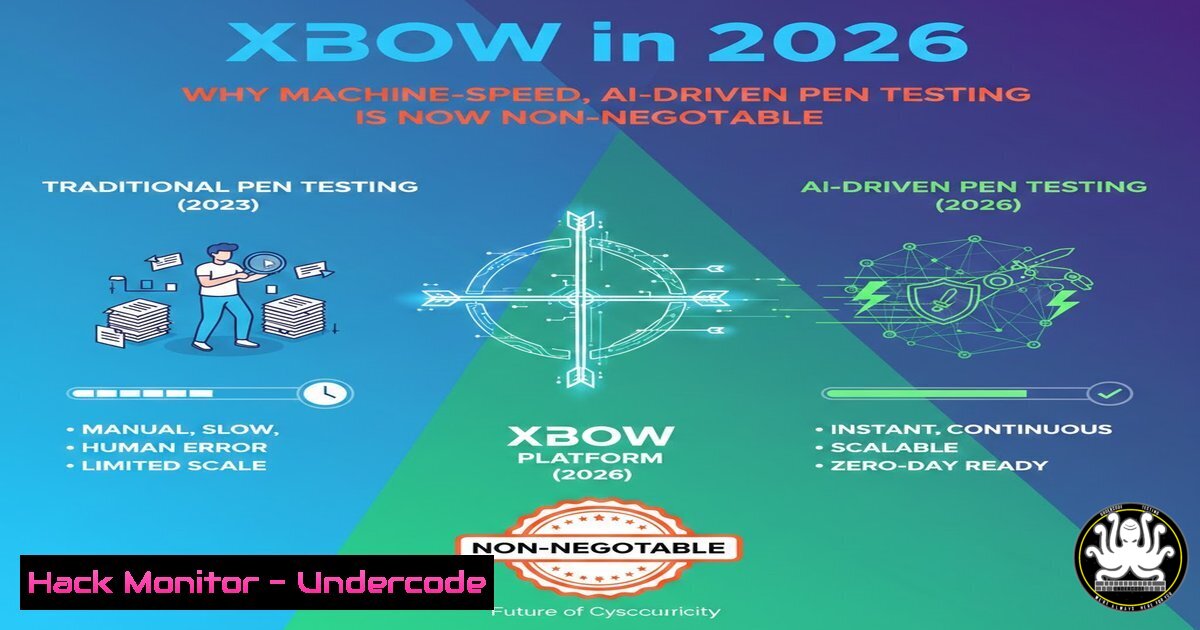
The landscape of offensive security is undergoing a paradigm shift. Traditional penetration testing, often a periodic, manual, and labor-intensive exercise, is struggling to keep pace with the velocity of modern software development and the sophistication of adversarial AI. The emergence of tools like XBOW, highlighted in recent industry roundups, signifies a move toward “machine-speed execution” and “dynamic, goal-oriented reasoning.” This article explores the technical architecture of these next-generation AI penetration testing tools, detailing how they integrate into existing workflows to validate exploits, reduce noise, and harden digital environments at a pace previously unattainable.
Learning Objectives:
- Understand the core mechanics of AI-driven penetration testing tools like XBOW.
- Learn how to automate reconnaissance and vulnerability discovery using AI-powered scripts.
- Identify practical Linux and Windows commands to integrate AI findings into security operations.
- Analyze the shift from signature-based scanning to exploit-validated proof concepts.
- Explore mitigation strategies to defend against autonomous AI red-teaming agents.
You Should Know:
- The Anatomy of AI-Powered Pen Testing: From Static Scans to Dynamic Reasoning
Traditional vulnerability scanners rely on signature matching—comparing software versions against a database of known vulnerabilities (CVEs). However, AI-driven tools like XBOW utilize Large Language Models (LLMs) and reinforcement learning to mimic human penetration testers. They don’t just look for a version number; they understand the logic of the application.
To see this in action, consider a basic network scan versus an AI-assisted probe. A standard Nmap scan identifies open ports, but an AI agent uses that output to formulate a hypothesis.
 Traditional Reconnaissance
nmap -sV -sC -p- targetdomain.com -oN initial_scan.txt

AI-Assisted Command Generation (Hypothetical XBOW CLI)
 xbow recon --input initial_scan.txt --goal "Find misconfigured S3 buckets"
The AI analyzes the initial_scan.txt, recognizes a web server, and autonomously spins up subdomain brute-forcing or directory busting tools (like Gobuster or Feroxbuster) specifically tuned to the technology stack it detected (e.g., React, Apache, or IIS).
2. Automating Exploit Validation with Goal-Oriented Reasoning
One of the key differentiators mentioned is “exploit-validated proof.” In a standard workflow, a scanner might report a “Critical” vulnerability based on version detection (e.g., Log4j), resulting in a high rate of false positives. XBOW, however, attempts to chain the exploit logically.
Step-by-step guide to simulating this behavior manually:
- Identify the vector: Assume the AI finds a potential SQL Injection point in a login form.
- Craft the payload: The AI doesn’t just use generic
' OR 1=1--. It extracts the database fingerprint from server banners.
3. Validate the Proof:
-- Manual test for error-based SQLi on a potential MySQL backend
' AND (SELECT 1 FROM (SELECT COUNT(), CONCAT(database(), FLOOR(RAND(0)2)) x FROM information_schema.tables GROUP BY x) y) -- -
If the server returns a database name error, the AI marks the finding as “Validated.” This automated reasoning saves security teams hours of manual verification.
3. Integrating AI Findings into Windows Defense Mechanisms
For blue teams, the emergence of AI-driven red teams means defenses must also become dynamic. When an AI tool like XBOW identifies a vulnerability on a Windows Server, the response must be immediate and programmatic.
Step-by-step guide to automated mitigation via PowerShell:
- The Alert: XBOW detects that the Windows Firewall rule for RDP (Port 3389) is exposed to the public internet on a non-standard port.
- Automated Response: A SOAR (Security Orchestration, Automation, and Response) playbook triggers a PowerShell script to harden the rule.
Windows PowerShell: Restrict RDP access to a specific management subnet
$rule = Get-NetFirewallRule -DisplayName "RDP Custom" | Get-NetFirewallAddressFilter
if ($rule.RemoteAddress -contains "Any") {
Set-NetFirewallRule -DisplayName "RDP Custom" -RemoteAddress "192.168.1.0/24"
Write-Host "RDP Access restricted to internal subnet based on AI-driven alert."

Optional: Trigger an Event Log entry for audit
Write-EventLog -LogName Application -Source "AutoHardening" -EventId 9001 -Message "RDP exposure mitigated."
}
This moves security from “detect and report” to “detect and contain” at machine speed.
4. Cloud Hardening in Response to AI Reconnaissance
AI agents are exceptionally good at hunting for cloud misconfigurations. They can parse IAM policies at a scale humans cannot. If an XBOW agent identifies an overly permissive role in AWS, it doesn’t just flag it; it demonstrates the blast radius.
Step-by-step guide to auditing the vulnerability the AI found:
1. The Finding: An AWS S3 bucket policy allows `”Principal”:””` (anyone) on "Action":"s3:GetObject".
2. Simulating the AI’s Proof: Using the AWS CLI, you can validate exactly what the AI saw.
 List the contents of the bucket to see if data is exposed
aws s3 ls s3://vulnerable-bucket-name --no-sign-request

Check the bucket policy via CLI
aws s3api get-bucket-policy --bucket vulnerable-bucket-name --query Policy --output text | jq .
3. Hardening: The immediate remediation is to switch the policy to a specific ARN or remove public access blocks.
 Block all public access to the bucket
aws s3api put-public-access-block --bucket vulnerable-bucket-name --public-access-block-configuration BlockPublicAcls=true,IgnorePublicAcls=true,BlockPublicPolicy=true,RestrictPublicBuckets=true
5. API Security: Dynamic Fuzzing with AI Context
Modern web applications rely heavily on APIs. AI tools excel at API fuzzing because they understand the context of parameters (e.g., understanding that `user_id` should be an integer and `callback` should be a URL).
Step-by-step guide to AI-assisted API testing (manual equivalent):
- Intercept the traffic: Using a proxy like Burp Suite or OWASP ZAP, capture an API call to `https://api.target.com/v1/users`.
- Parameter Analysis: The AI notices the `Authorization: Bearer` header.
- Exploit Validation: The AI attempts a Broken Object Level Authorization (BOLA) attack.
Manual BOLA test: Trying to access another user's data by changing the ID
curl -X GET https://api.target.com/v1/users/12345 \
-H "Authorization: Bearer eyJhbGciOiJ..." \
-H "Content-Type: application/json"

If user 12345's data is returned, the AI validates the BOLA vulnerability.
The AI documents the exact cURL command that caused the breach, providing developers with a reproducible test case.
6. Defending Against AI: Adversarial Prompt Injection
As red teams use LLMs, blue teams must learn to confuse them. If an attacker uses an AI to scrape your site for vulnerabilities, you can serve “poisoned” data to the scraper.
Step-by-step guide to mitigating AI scraping:
- Identify AI User-Agents: Block or misdirect bots that identify as AI crawlers in your `robots.txt` or via
.htaccess.Apache .htaccess example to confuse scrapers RewriteEngine On RewriteCond %{HTTP_USER_AGENT} (XBOW|GPTBot|AI-Scraper) [bash] RewriteRule . /honeypot-page.html [bash] - Rate Limiting: Use `iptables` on Linux to rate-limit IPs exhibiting scanning behavior.
Linux iptables: Limit SSH connections to prevent AI brute-forcing
sudo iptables -A INPUT -p tcp --dport 22 -m conntrack --ctstate NEW -m recent --set
sudo iptables -A INPUT -p tcp --dport 22 -m conntrack --ctstate NEW -m recent --update --seconds 60 --hitcount 4 -j DROP
This forces the AI agent to slow down, increasing the cost of the attack.
What Undercode Say:
- The Speed Paradox: The introduction of tools like XBOW creates a new reality where the “window of exposure” shrinks from weeks to minutes. Security teams must adopt Infrastructure as Code (IaC) and immutable deployments to ensure that when a vulnerability is found, the entire vulnerable instance is destroyed and rebuilt, rather than patched manually.
- Human-in-the-Loop is Evolving: The analyst’s role is shifting from running scans to interpreting complex attack chains. The “57 Certifications” mentioned in the profile context are becoming more valuable as professionals need to understand the intersection of development, operations, and AI logic to validate whether the AI’s “validated proof” is actually a business-critical risk or just a logical quirk in the code.
Prediction:
Within the next 12 months, we will see the emergence of “AI Pen Testing as a Service” (AIPTaaS) becoming a standard compliance requirement. Regulatory bodies will likely mandate that financial and critical infrastructure sectors undergo continuous, machine-speed testing rather than annual manual audits. This will bifurcate the market: one side racing to build better attacking AIs, and the other building defensive AIs to catch them, ultimately forcing the cost of cyber exploitation so high that only state-sponsored actors can afford the compute power to find novel zero-days.
▶️ Related Video (86% Match):
🎯Let’s Practice For Free:
IT/Security Reporter URL:
Reported By: Best Ai – Hackers Feeds
Extra Hub: Undercode MoN
Basic Verification: Pass ✅


