Listen to this Post
Introduction:
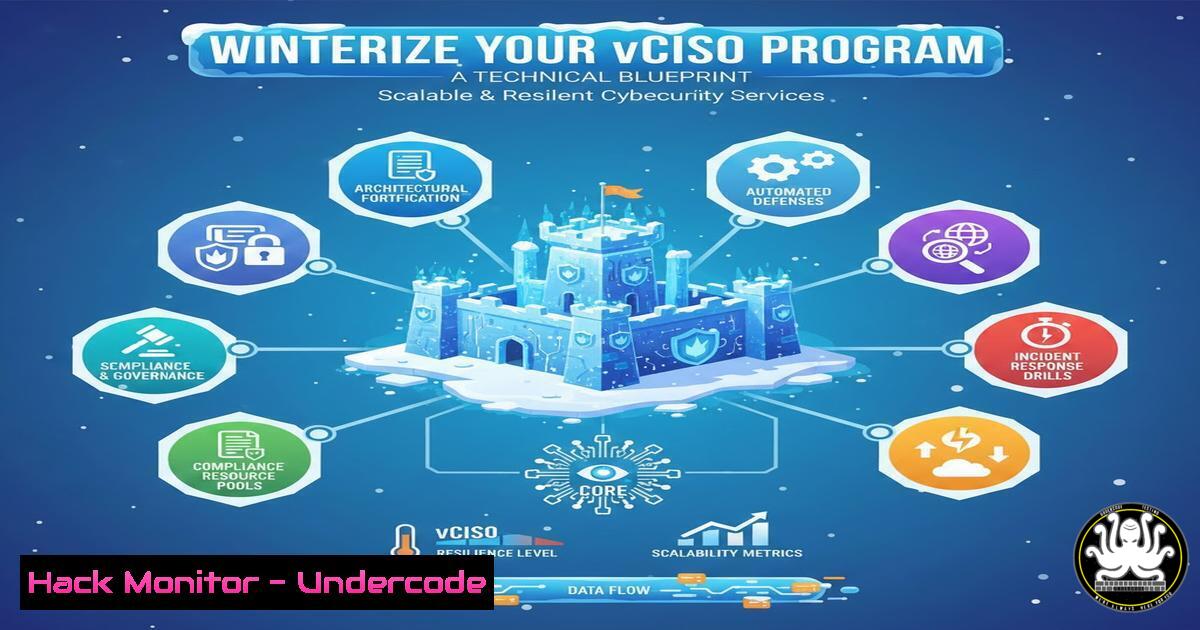
The transition to offering virtual Chief Information Security Officer (vCISO) services represents a significant revenue opportunity for Managed Service Providers (MSPs), but it also introduces complex operational and technical challenges. Just as a farm must be winterized to survive a storm, a vCISO program requires meticulous preparation, robust systems, and defined processes to avoid catastrophic failure during client onboarding and service delivery. This article provides a technical blueprint for building a resilient, scalable, and effective vCISO practice that can withstand the pressures of real-world client engagements.
Learning Objectives:
- Architect a repeatable technical onboarding process for new vCISO clients.
- Implement key security frameworks and tools to establish a baseline security posture.
- Develop automated reporting and continuous monitoring strategies for long-term client success.
You Should Know:
- Architecting Your vCISO Go-To-Market (GTM) and Service Delivery Framework
A successful vCISO service is not just an add-on; it is a structured program. The “first 90 days” with a new client are critical for setting expectations and demonstrating value. This requires a pre-defined, sequenced workflow.
Step-by-step guide:
Step 1: Service Definition & Tooling: Before engaging clients, document your service tiers (e.g., Essential, Business, Enterprise). Define the exact deliverables for each tier, such as a Security Risk Assessment, Policy Suite development, or a Compliance Gap Analysis. Standardize the tooling for each deliverable (e.g., using OpenVAS for vulnerability scanning vs. Tenable/Nessus).
Step 2: Develop the “First 90 Days” Playbook: Create a client-facing project plan. Week 1-2: Kick-off meeting and data collection via a standardized questionnaire. Week 3-6: Conduct technical assessments (e.g., network scans, configuration reviews). Week 7-10: Analyze findings and draft the initial Strategic Security Roadmap. Week 11-13: Present the roadmap and establish a recurring governance meeting cadence.
Step 3: Technical Onboarding – Data Collection: Automate initial data gathering. For clients with existing infrastructure, use secure APIs to pull initial asset inventories.
Example (Linux): Use a script to gather system information and send it to a secure collection point.
!/bin/bash
 Gather basic system info and network connections
echo "=== Hostname ===" > /tmp/initial_audit.txt
hostname >> /tmp/initial_audit.txt
echo "=== OS Version ===" >> /tmp/initial_audit.txt
cat /etc/os-release >> /tmp/initial_audit.txt
echo "=== Network Connections ===" >> /tmp/initial_audit.txt
netstat -tuln >> /tmp/initial_audit.txt
 Securely transfer /tmp/initial_audit.txt to your vCISO platform
Example (Windows/PowerShell): Use a PowerShell script to collect similar data.
 Get System Information and Open Ports
$SystemInfo = Get-ComputerInfo
$NetTCPConnections = Get-NetTCPConnection -State Listen
$AuditData = @{
SystemInfo = $SystemInfo
NetworkConnections = $NetTCPConnections
}
$AuditData | ConvertTo-Json -Depth 3 | Out-File -FilePath "C:\Temp\initial_audit.json"
- Establishing a Baseline Security Posture with Automated Scans
You cannot protect what you do not know. The first technical deliverable is often a comprehensive assessment of the client’s security posture, focusing on vulnerabilities and misconfigurations.
Step-by-step guide:
Step 1: Asset Discovery & Inventory: Use tools to automatically discover assets on the client’s network. Tools like `nmap` can be used for initial reconnaissance.
Command Example (Linux):
 Perform a ping sweep to discover live hosts
nmap -sn 192.168.1.0/24
 Perform a service version detection scan on a target subnet
nmap -sV 192.168.1.0/24 -oG - | grep open
Step 2: Vulnerability Scanning: Integrate a vulnerability scanner into your workflow. For a cost-effective start, use OpenVAS, which can be deployed on-premise or in a cloud container.
Command Example (Docker):
 Pull and run the OpenVAS container (example)
docker run -d -p 443:443 -p 9390:9390 -e PUBLIC_HOSTNAME=your_vciso_server.com --name openvas mikesplain/openvas
Once running, log into the web interface, configure a scan target (the client’s IP range), and launch a full scan. The report generated will form the basis of your vulnerability management program.
Step 3: Secure Configuration Assessment: Use benchmarks from the Center for Internet Security (CIS). The `lynis` tool is excellent for auditing Linux systems against these benchmarks.
Command Example (Linux):
 Install and run Lynis on a target system (requires root)
sudo apt-get install lynis
sudo lynis audit system
3. Hardening Cloud Environments (AWS & Azure)
Most modern clients will have a cloud footprint. A vCISO must be able to identify and remediate common cloud misconfigurations.
Step-by-step guide:
Step 1: Identity and Access Management (IAM) Audit: Enforce the principle of least privilege. Use cloud-native tools to generate credential reports and identify over-privileged users.
AWS CLI Example:
 Generate an IAM credential report
aws iam generate-credential-report
aws iam get-credential-report --output text --query 'Content' | base64 -d > credential_report.csv
Azure PowerShell Example:
 Connect to Azure AD and get users with old MFA methods
Connect-AzureAD
Get-MsolUser -All | Where-Object {$_.StrongAuthenticationMethods -eq $null}
Step 2: Storage Security: Ensure no storage buckets (S3, Blob) are publicly accessible unless explicitly required.
AWS CLI Example (Check for public S3 buckets):
aws s3api list-buckets --query 'Buckets[].Name' --output text | tr '\t' '\n' | while read bucket; do echo "Checking $bucket"; aws s3api get-bucket-acl --bucket "$bucket" --output text; done
Step 3: Enable Logging and Monitoring: Mandate the activation of cloud trail (AWS) or activity log (Azure) and stream these logs to a centralized SIEM (Security Information and Event Management) that you manage for the client.
4. Developing and Implementing the Core Policy Suite
Policies are the foundation of a cybersecurity program. They provide the “rules of the road” and are essential for compliance.
Step-by-step guide:
Step 1: Policy Templating: Create a standard set of policy templates based on frameworks like NIST CSF or ISO 27001. Core policies include: Acceptable Use Policy, Data Classification Policy, Incident Response Plan, and Access Control Policy.
Step 2: Customization Workshop: Conduct a workshop with the client’s leadership to tailor the templates to their specific business processes, regulatory requirements, and risk appetite.
Step 3: Technical Enforcement: Where possible, translate policy statements into technical controls. For example, the Data Classification Policy can be enforced using Data Loss Prevention (DLP) rules in Microsoft 365 or by configuring `fscrypt` for file-level encryption on Linux.
Example (Linux file encryption with fscrypt):
 Install fscrypt and enable it on a filesystem
sudo apt-get install fscrypt
sudo fscrypt setup /
sudo fscrypt encrypt /path/to/sensitive_directory
5. Implementing Continuous Monitoring and Automated Reporting
The vCISO relationship is ongoing. Automated reporting builds trust and demonstrates continuous value.
Step-by-step guide:
Step 1: SIEM Integration: Aggregate logs from key sources (firewalls, endpoints, cloud trails, servers) into a SIEM. Open-source options like the Elastic Stack (ELK) can be a starting point.
Step 2: Alert Tuning: Create high-fidelity alerts for critical events (e.g., failed login bursts, privileged account creation, malware detection). Avoid alert fatigue by focusing on true positives.
Step 3: Automated Executive Dashboard: Use the SIEM’s dashboarding capabilities or a tool like Grafana to create a client-facing dashboard. This dashboard should show metrics like:
Vulnerability count over time.
Security control coverage (e.g., % of endpoints with EDR).
Top security events by severity.
A simple “Security Posture Score.”
What Undercode Say:
- Preparation Precedes Profit: The technical and procedural debt incurred by launching an unprepared vCISO service will inevitably lead to client churn and internal team burnout, eroding any potential ARR.
- Automation is the Antidote to Chaos: Standardizing tooling, assessment processes, and reporting through scripts and APIs is the only way to deliver consistent, high-quality vCISO services at scale.
The metaphor of “winterizing” is technically apt. An unprepared MSP will find its nascent vCISO service frozen by the weight of undefined processes, manual assessments, and unmet expectations. The market is increasingly savvy and will not tolerate amateur-hour security leadership. The MSPs who invest in building a hardened, automated, and process-driven vCISO platform before the sales cycle heats up will be the ones to capture the market, build lasting client trust, and avoid the catastrophic failure that poisons future opportunities. This is not merely a service offering; it is a fundamental test of an MSP’s operational maturity.
Prediction:
The vCISO space will rapidly bifurcate. On one side, MSPs with unprepared, ad-hoc services will face escalating delivery costs, client disputes, and brand damage, causing many to abandon the offering entirely. On the other side, MSPs that have industrialized their vCISO delivery through automation, standardized playbooks, and integrated technology stacks will achieve dominant market positions. They will be able to offer services at a competitive price while maintaining high margins and quality, ultimately consolidating the market. The ability to technically demonstrate a robust and proactive security program will become a non-negotiable table-stake for winning enterprise clients.
🎯Let’s Practice For Free:
IT/Security Reporter URL:
Reported By: Secopswarrior Cybersecfarmers – Hackers Feeds
Extra Hub: Undercode MoN
Basic Verification: Pass ✅


