Listen to this Post
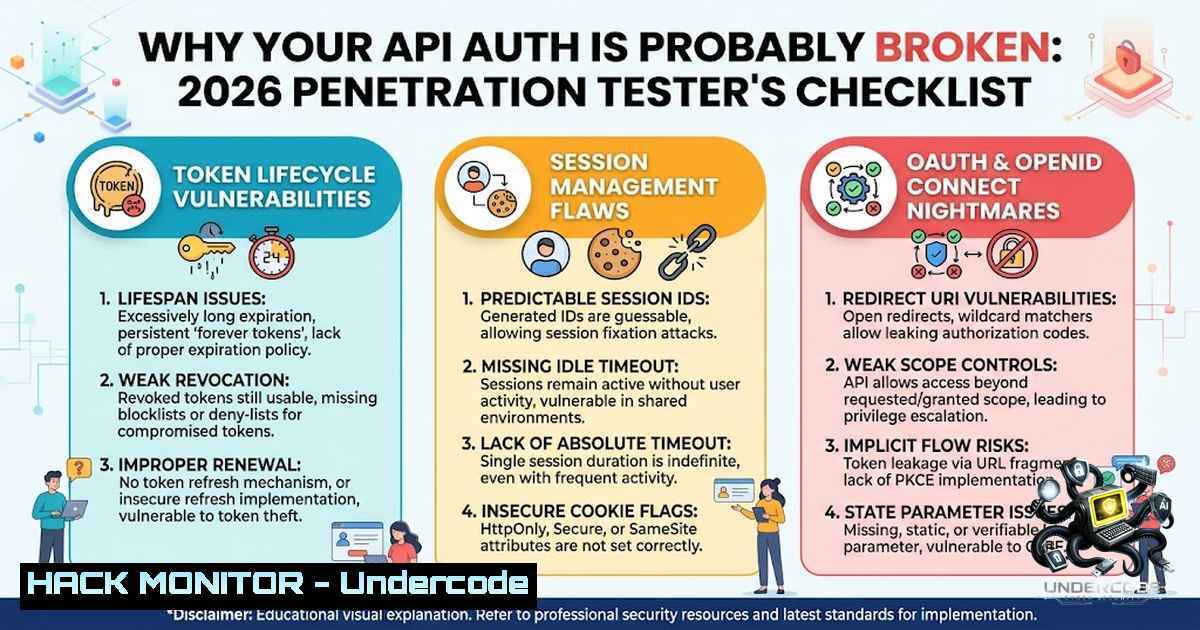
Introduction:
Application Programming Interfaces (APIs) are the backbone of modern digital infrastructure, yet they remain the primary attack vector for data breaches. The OWASP API Security Top 10 consistently highlights Broken Object Level Authorization (BOLA) and Broken Authentication as critical vulnerabilities. However, many security assessments stop at verifying that a user can log in, neglecting the complex and often fragile authentication machinery that operates behind the scenes. True API security testing requires a paradigm shift: stop testing if users can log in, and start testing what happens when authentication breaks. This article provides a comprehensive, technical deep-dive into the critical areas of API authentication testing, offering a practical checklist for security professionals to identify and mitigate vulnerabilities in token lifecycle management, session handling, role-based access control, and OAuth/JWT implementations.
Learning Objectives:
- Master the techniques for rigorously testing JWT and OAuth token lifecycles, including expiration, revocation, and scope enforcement.
- Understand and implement session management tests to identify fixation, timeout, and logout vulnerabilities.
- Learn to detect and exploit privilege escalation flaws, including horizontal and vertical access control bypasses.
- Acquire practical commands and code snippets to automate and execute these tests against live API endpoints.
You Should Know:
1. Token Lifecycle: From Birth to Breach
The lifecycle of an authentication token—from issuance to expiration and revocation—is fraught with potential vulnerabilities. Testing must go beyond simply checking if a valid token grants access. It involves systematically attacking the token at every stage of its existence.
- Expired Token Exploitation: The most fundamental test is to capture a valid token, wait beyond its expiration time (e.g., the `exp` claim in a JWT), and resend the request. The API must respond with a `401 Unauthorized` status and no sensitive information in the error message.
- Refresh Token Abuse: Refresh tokens are long-lived and highly sensitive. A robust test involves using a refresh token before and after the access token expires to obtain a new valid access token. Additionally, test the behavior of attempting to use a refresh token that has been revoked or is past its own expiry.
- Revocation and Reuse: After a user logs out or an administrator revokes a session, the associated tokens must be immediately invalidated. A critical test is to log out, capture the old token, and attempt to reuse it. The API should reject it with a `401` or
403. - Token Scope and Permission Enforcement: A common flaw is the lack of proper scope validation. For example, using a token issued with `read:user` scope to perform a `POST` request that modifies user data. The API must enforce scope boundaries and return a
403 Forbidden. - Concurrent Session Invalidation: Test the behavior when multiple tokens are issued for the same user. Does revoking one token invalidate all others, or does the system maintain them independently? The expected behavior depends on the application’s security policy, but it must be clearly defined and enforced.
Practical Testing Commands (Linux/macOS):
 1. Test Expired Token (using Burp Suite or OWASP ZAP)
 Capture a valid token, wait, then replay the request.
 Using curl with a known expired token:
curl -X GET "https://api.example.com/user/profile" \
-H "Authorization: Bearer <EXPIRED_TOKEN>" \
-v

<ol>
<li>Test Token Revocation
Step 1: Obtain a token
TOKEN=$(curl -s -X POST "https://api.example.com/auth/login" \
-H "Content-Type: application/json" \
-d '{"username":"test","password":"password"}' | jq -r '.access_token')

Step 2: Logout (assuming a logout endpoint)
curl -X POST "https://api.example.com/auth/logout" \
-H "Authorization: Bearer $TOKEN"

Step 3: Attempt to reuse the revoked token
curl -X GET "https://api.example.com/user/profile" \
-H "Authorization: Bearer $TOKEN" \
-v
Expected: 401 Unauthorized</p></li>
<li><p>Test Scope Enforcement
Using a token with limited scope (e.g., 'read') to perform a write operation
READ_TOKEN="<READ_ONLY_TOKEN>"
curl -X POST "https://api.example.com/admin/users" \
-H "Authorization: Bearer $READ_TOKEN" \
-H "Content-Type: application/json" \
-d '{"username":"new_user"}' \
-v
Expected: 403 Forbidden
2. Session Management: The Invisible Attack Surface
While JWTs are stateless, many APIs still rely on traditional server-side sessions. The security of these sessions depends on how they are created, maintained, and destroyed.
- Session Timeout and Idle Termination: Sessions should have a finite lifetime. Test this by logging in, leaving the session idle for the configured timeout period (e.g., 30 minutes), and then sending a request. The API should reject the request and require re-authentication.
- Multi-Device Session Handling: Test the application’s behavior when the same user logs in from two different devices or browsers. Does the system allow both sessions to coexist, or does it terminate the older session? Both are valid strategies, but the logic must be consistent and secure.
- Session Fixation Attacks: This classic attack involves forcing a user to use a known session ID. Test this by obtaining a session ID (e.g., from a cookie), logging in with that session, and verifying that the application issues a new session ID upon successful authentication.
- Logout and Cleanup: A surprisingly common flaw is improper session termination upon logout. After logging out, inspect the response headers (e.g.,
Set-Cookie). The server should clear the session cookie by setting its value to an empty string or a past date and time. Verify that the session is destroyed on the server-side. - Cookie Security Flags: For session cookies, the
Secure,HttpOnly, and `SameSite` flags are non-1egotiable. The `Secure` flag ensures the cookie is only sent over HTTPS, `HttpOnly` prevents client-side JavaScript from accessing it (mitigating XSS), and `SameSite` provides protection against Cross-Site Request Forgery (CSRF).
Practical Testing Commands (Linux/macOS):
 1. Check Cookie Security Flags (using curl)
curl -X POST "https://api.example.com/auth/login" \
-H "Content-Type: application/json" \
-d '{"username":"test","password":"password"}' \
-c cookies.txt -v

Inspect the 'Set-Cookie' header in the response.
 Look for: Secure; HttpOnly; SameSite=Strict (or Lax)

<ol>
<li>Test Session Fixation
Step 1: Get a session cookie (e.g., JSESSIONID) without authentication
curl -X GET "https://api.example.com/" -c cookies.txt -v

Step 2: Use that session cookie to authenticate
curl -X POST "https://api.example.com/auth/login" \
-H "Content-Type: application/json" \
-d '{"username":"test","password":"password"}' \
-b cookies.txt -c cookies_new.txt -v

Step 3: Check if the session ID changed (compare cookies.txt and cookies_new.txt)
The server should have issued a new session ID upon login.</p></li>
<li><p>Test Logout Cleanup
curl -X POST "https://api.example.com/auth/logout" \
-b cookies.txt -v

Inspect the 'Set-Cookie' header. It should contain:
JSESSIONID=; Path=/; Expires=Thu, 01 Jan 1970 00:00:00 GMT
3. Role-Based Access Control: The Privilege Escalation Playground
Broken access control is the most critical API security risk. Testing must cover both horizontal (accessing another user’s data) and vertical (accessing higher-privilege functions) escalation vectors.
- Privilege Escalation (Vertical): As a low-privileged user (e.g., a standard user), attempt to access endpoints intended for administrators (e.g.,
/admin/users,/api/v1/system/config). Every such endpoint must return a403 Forbidden. - Insecure Direct Object References (IDOR) / Horizontal Access: As User A, attempt to access or modify resources belonging to User B by changing a resource identifier in the request (e.g., `GET /api/users/123` vs.
GET /api/users/124). The API must validate that the authenticated user is authorized to access the requested object. - Role Downgrade: Test what happens when a user’s role is changed (e.g., from admin to user) while their session is still active. The API must enforce the new permissions on the very next request.
- Bulk Operations: If the API supports batch requests (e.g., updating multiple items), test with a mix of owned and unowned items. The API should only process the authorized items and return an error or omit the unauthorized ones.
- Default Role Assignment: Upon registration, a new user should be assigned the least-privileged role by default. Verify that no unintended privileges are granted at signup.
Practical Testing Commands (Linux/macOS):
 1. Test Vertical Privilege Escalation
 As a standard user, try to access an admin endpoint
USER_TOKEN="<STANDARD_USER_TOKEN>"
curl -X GET "https://api.example.com/admin/users" \
-H "Authorization: Bearer $USER_TOKEN" \
-v
 Expected: 403 Forbidden

<ol>
<li>Test Horizontal Privilege Escalation (IDOR)
As User A (ID=1), try to access User B's (ID=2) profile
USER_A_TOKEN="<USER_A_TOKEN>"
curl -X GET "https://api.example.com/api/users/2" \
-H "Authorization: Bearer $USER_A_TOKEN" \
-v
Expected: 403 Forbidden or 404 Not Found</p></li>
<li><p>Test Role Downgrade (requires admin privileges to change roles)
This is often tested by logging in as admin, changing a user's role in the database,
and then observing the user's next request.
4. OAuth & JWT: The Cryptographic Minefield
OAuth 2.0 and JWT are complex standards with many implementation pitfalls. Testing here requires a deep understanding of the underlying cryptography and protocol flows.
- JWT Signature Bypass: The most critical JWT test is to modify the payload of a valid token and resend it. The server must reject the token due to a signature mismatch. Tools like `jwt_tool` can automate this.
- Algorithm Confusion: A severe vulnerability where an attacker changes the `alg` header of a JWT from `RS256` (asymmetric) to `HS256` (symmetric). If the server uses the public key as the HMAC secret, the attacker can forge valid signatures. Modern JWT libraries mitigate this by requiring an explicit algorithm to be specified.
- OAuth Redirect URI Validation: In the OAuth authorization code flow, the `redirect_uri` parameter is critical. Test if the server allows an attacker to specify a malicious redirect URI not on the allowlist. This can lead to authorization code interception.
- Authorization Code Reuse: The OAuth specification mandates that authorization codes are single-use. Test this by exchanging an authorization code for an access token, and then attempting to exchange the same code again. The second request must be rejected.
- Token in URL: Access tokens and authorization codes should never appear in URL query parameters, as they can be leaked through browser history, referrer headers, and server logs. Verify that tokens are only transmitted in the `Authorization` header or POST body.
Practical Testing Commands (Linux/macOS):
 1. JWT Signature Bypass (using jwt_tool)
 Install jwt_tool: git clone https://github.com/ticarpi/jwt_tool
python3 jwt_tool.py <JWT_TOKEN> -X a -pb <PUBLIC_KEY.pem>

<ol>
<li>Test Algorithm Confusion (using jwt_tool)
python3 jwt_tool.py <JWT_TOKEN> -X a -alg HS256 -pubkey <PUBLIC_KEY.pem></p></li>
<li><p>OAuth Authorization Code Reuse (using Burp Suite or custom script)
Step 1: Complete the OAuth flow and capture the authorization code.
Step 2: Exchange the code for tokens via the /token endpoint.
Step 3: Attempt to exchange the same code again.
Expected: 400 Bad Request with "invalid_grant"
- Edge Cases and Error Handling: Where Logic Breaks
Beyond the core flows, attackers exploit edge cases and poor error handling to gain information or bypass controls.
- Invalid Token Format: Send a malformed token (e.g., removing characters, changing the type). The API should return a generic `401` error without revealing stack traces or implementation details.
- Missing or Empty Headers: Test requests with missing `Authorization` headers, empty values, or unsupported authentication schemes. The API must consistently reject these with a
401. - Rate Limiting and Brute-Force Protection: While not strictly authentication, rate limiting on login and token refresh endpoints is crucial to prevent brute-force attacks.
- Error Message Enumeration: Error messages should be generic. A response like “Invalid username” vs. “Invalid password” allows an attacker to enumerate valid usernames. Use “Invalid credentials” for both.
- HTTP Method Tampering: Test if an endpoint intended for `GET` requests responds to
POST,PUT, or `DELETE` methods without proper authorization checks.
6. Logging and Monitoring: The Forensic Trail
Proper logging of authentication events is essential for detecting and investigating attacks.
- Failed Login Attempts: Log all failed login attempts, including the timestamp, source IP, and username used.
- Token Usage: Log the usage of refresh tokens and the issuance of new access tokens.
- Suspicious Activity: Implement alerts for anomalous behavior, such as multiple failed logins from a single IP, reuse of revoked tokens, or attempts to access unauthorized resources.
What Undercode Say:
- Key Takeaway 1: API authentication is a multi-layered defense. Focusing solely on the login endpoint is a critical mistake. A comprehensive testing strategy must systematically attack each component of the authentication system, from token issuance to session termination.
- Key Takeaway 2: The greatest risks lie in the implementation details—algorithm confusion in JWT, insecure session flags, and flawed access control logic. These vulnerabilities are often subtle and require a deep understanding of the underlying standards and protocols to identify and exploit.
Analysis: The checklist provided by Rafiul Hoque and Aston Cook is an excellent starting point for any API security assessment. It moves beyond theoretical vulnerabilities to provide actionable, testable items. The focus on “what happens when auth breaks” is a crucial mindset shift. In my experience, the most damaging API breaches—from the Optus data leak to numerous IDOR findings in bug bounty programs—stem from these exact issues. The inclusion of OAuth and JWT-specific tests is particularly valuable, as these are often the most misunderstood and misconfigured components. However, a truly robust testing program must also integrate automated scanning tools (like OWASP ZAP or Burp Suite) with manual, logic-based testing to uncover complex business logic flaws that scanners miss.
Prediction:
- +1: The increasing adoption of OAuth 2.1 and FAPI (Financial-grade API) standards will drive the development of more sophisticated testing tools and frameworks, making it easier to automate the detection of these vulnerabilities.
- -1: As AI-driven code generation becomes more prevalent, we will see a surge in APIs with subtle, hard-to-detect authentication flaws, as LLMs may replicate insecure patterns from their training data, creating a new wave of “synthetic” vulnerabilities.
- +1: The shift towards zero-trust architectures will force a reevaluation of API authentication, pushing for continuous, context-aware authorization checks that go beyond static tokens and roles, potentially mitigating many of the issues outlined in this checklist.
- -1: The complexity of modern API ecosystems, involving microservices, third-party integrations, and distributed sessions, will expand the attack surface, making it increasingly difficult to maintain a consistent and secure authentication posture across all components.
▶️ Related Video (68% Match):
🎯Let’s Practice For Free:
🎓 Live Courses & Certifications:
Join Undercode Academy for Verified Certifications
🚀 Request a Custom Project:
Secure, high-velocity infrastructure and disruptive technological engineering. Contact our engineering team for high-tier development and proprietary systems:
[email protected]
💎 Smart Architecture | 🛡️ Secure by Design | ⭐ Trusted by Thousands
IT/Security Reporter URL:
Reported By: Deepmarketer Api – Hackers Feeds
Extra Hub: Undercode MoN
Basic Verification: Pass ✅


