Listen to this Post
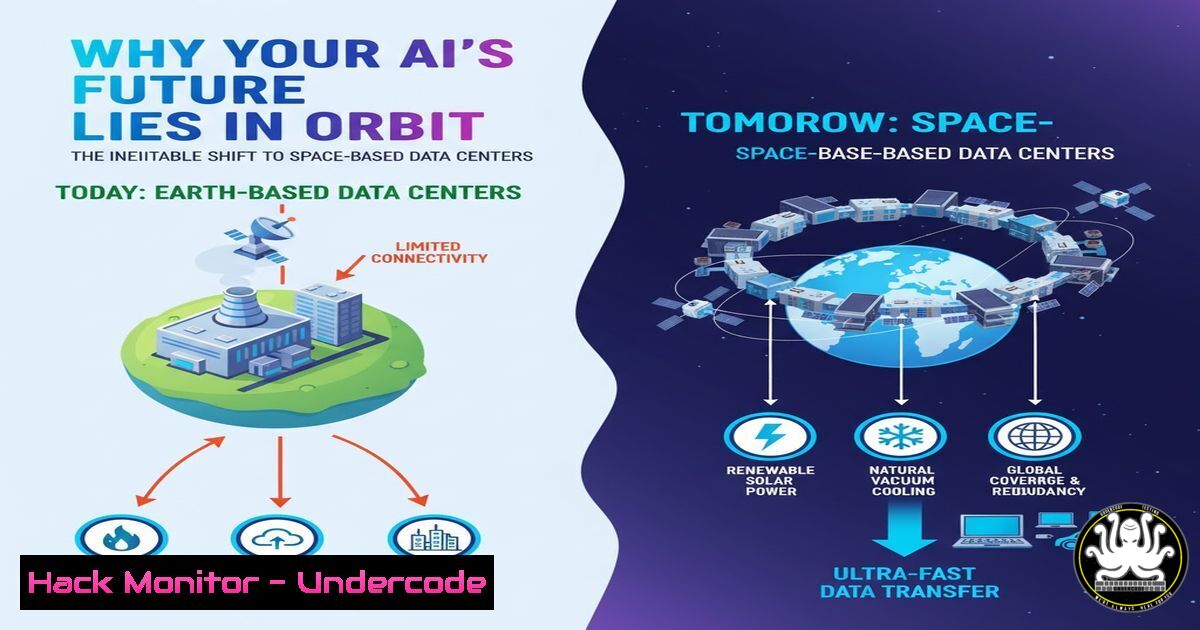
Introduction:
The explosive growth of Artificial Intelligence is colliding with the physical limits of Earth’s energy grid, forcing tech giants to pioneer a once-unthinkable solution: orbital data centers. As AI’s power demands trigger national energy emergencies, industry leaders are executing a strategic pivot toward space-based computing, leveraging constant solar exposure and natural vacuum cooling to overcome terrestrial constraints.
Learning Objectives:
- Understand the energy crisis driving AI infrastructure beyond Earth’s atmosphere
- Analyze the technical and economic feasibility of orbital data processing
- Evaluate the cybersecurity implications of space-based computing infrastructure
- Explore the emerging space-tech partnerships shaping this new frontier
- Assess the implementation timeline and potential bottlenecks
You Should Know:
- The Terrestrial Energy Crisis Fueling the Space Race
The AI energy emergency has reached critical levels, with U.S. electricity demand projections shattered by AI compute requirements. OpenAI’s call for 100 gigawatts annually represents approximately 10% of current total U.S. generating capacity—an unprecedented infrastructure challenge.
Step-by-step guide to assessing AI energy impact:
 Calculate data center power usage effectiveness (PUE)
 PUE = Total Facility Energy / IT Equipment Energy
 Ideal PUE approaches 1.0, typical terrestrial centers average 1.5-2.0

Sample energy monitoring command (Linux)
powertop --csv=power_consumption.csv
 Analyze energy patterns per process
turbostat --interval 5

Windows power configuration for high-performance computing
powercfg /qh scheme_min
powercfg /setactive scheme_min
2. Orbital Advantage: Beyond 24/7 Solar Power
Space offers fundamental physics advantages that terrestrial locations cannot match. Beyond uninterrupted solar collection, the vacuum environment enables passive radiative cooling that eliminates traditional cooling infrastructure—currently consuming 40% of data center energy.
Step-by-step orbital advantage calculation:
 Calculate orbital solar collection efficiency
import math

earth_solar_constant = 1361  W/m²
terrestrial_efficiency = 0.20  20% capacity factor on Earth
orbital_efficiency = 0.95  95% capacity factor in orbit
panel_area = 1000  m²

terrestrial_daily = earth_solar_constant  panel_area  terrestrial_efficiency  24
orbital_daily = earth_solar_constant  panel_area  orbital_efficiency  24

print(f"Terrestrial generation: {terrestrial_daily/1000:.0f} kWh")
print(f"Orbital generation: {orbital_daily/1000:.0f} kWh")
print(f"Orbital advantage: {orbital_daily/terrestrial_daily:.1f}x")
- Big Tech’s Orbital Roadmap: From Prototypes to Production
Google’s Project Suncatcher represents the vanguard with planned 2027 satellite launches, while Nvidia’s partnership with Starcloud focuses on space-hardened compute platforms. Musk’s Starlink evolution strategy demonstrates how existing orbital infrastructure can be repurposed for distributed AI processing.
Step-by-step orbital deployment timeline:
- 2024-2026: Component testing and radiation hardening
- 2027-2029: Small-scale prototype deployments (Google, Nvidia)
- 2030-2035: Commercial-scale orbital data parks
- 2035+: Lunar surface operations with mass driver launches
4. Space-Grade Cybersecurity: Hardening Orbital Infrastructure
Orbital data centers introduce unprecedented attack surfaces, requiring quantum-resistant encryption and autonomous threat response systems capable of operating during communication blackouts.
Step-by-step orbital security implementation:
[bash]
Configure quantum-resistant SSH for space-ground links
ssh-keygen -t ed25519 -f space_station_key
Add to sshd_config on orbital node:
KexAlgorithms [email protected]
HostKeyAlgorithms ssh-ed25519
Ciphers [email protected]
Implement delay-tolerant authentication
Using Blockchain-based temporary credentials
git clone https://github.com/nasa/DTN-security-framework
cd DTN-security-framework
make deploy
🎯Let’s Practice For Free:
IT/Security Reporter URL:
Reported By: Keith King – Hackers Feeds
Extra Hub: Undercode MoN
Basic Verification: Pass ✅


