Listen to this Post
Introduction:
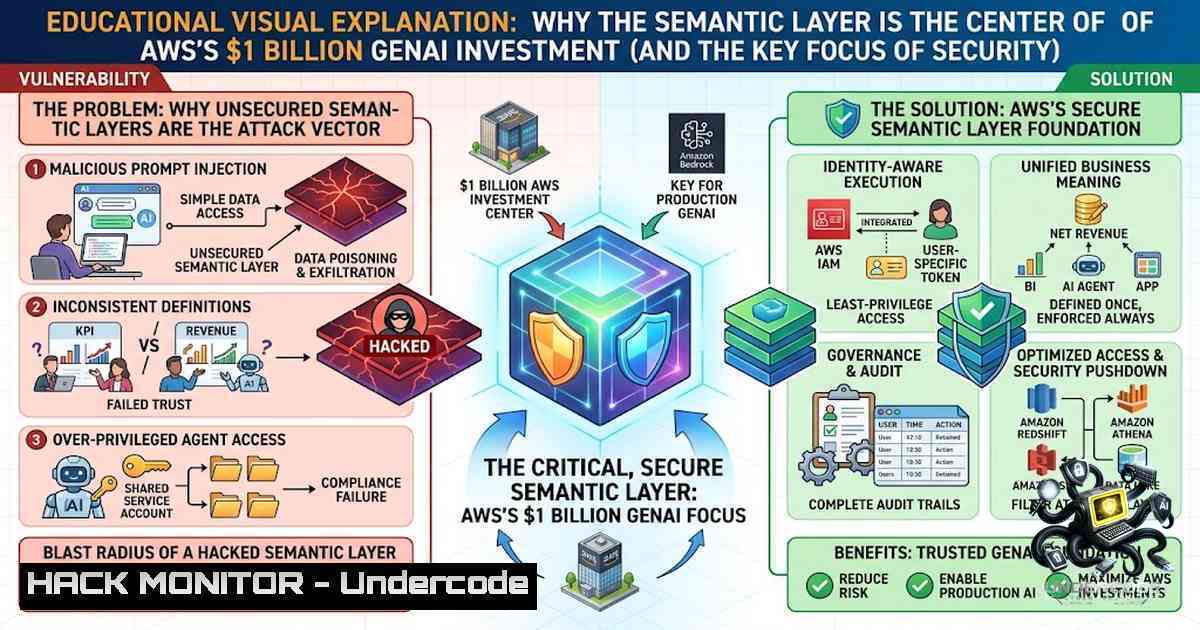
A semantic layer is a governed translation layer between raw data and business users, translating technical database schemas into consistent, business-friendly terms like “Revenue” or “Churn” that every tool and AI agent can understand. When this layer is absent or poorly implemented, AI systems are forced to guess critical business definitions—often with costly, recurring failures. Amazon Web Services (AWS) is now betting $1 billion that embedding Forward Deployed Engineers (FDEs) to build these semantic layers inside customer accounts is the key to unlocking reliable, enterprise-grade AI.
Learning Objectives & Secrets:
- Objective 1: Master the Architecture of a Governed Semantic Layer – Learn how a semantic layer centralizes metric definitions, enforces business rules at query time, and publishes a governed, versioned knowledge graph that AI agents can reason over.
- Objective 2 Secret Tips: Audit Your AI’s “Guesses” – Uncover where your LLM is guessing revenue definitions, region mappings, or fiscal calendars. The secret is to intercept these guesses with a semantic layer that explicitly defines these business terms before any SQL is generated.
- Objective 3 Secret Tips: Implement Dynamic Model Routing – No single LLM stays the best for long. The secret is to architect your AI gateway to route each task to the optimal model, balancing cost and performance dynamically as the landscape evolves.
You Should Know:
- What a Semantic Layer Does and Why It’s Critical for AI
A semantic layer is not just a data catalog; it is an active enforcement point. It defines metrics once—for example, “Revenue excludes cancelled orders”—and applies that logic consistently to every BI dashboard, API, and AI agent that queries your data. Without this layer, an LLM reading a column named `CUST_REV` cannot know that System A calculates it gross, System B calculates it net, and System C operates on a fiscal calendar starting in April. The semantic layer eliminates this ambiguity by resolving the meaning of every business term identically at query time. For enterprises, this is the only mechanism that prevents the same metric from returning different numbers in different tools.
Step‑by‑Step Guide: Auditing Your Current Semantic Gaps
- Identify Ambiguous Business Terms: List the top 10 metrics your organization uses (e.g., Revenue, Active Users, Churn Rate).
- Trace Their Definitions: For each metric, document how it is calculated in your data warehouse (SQL logic), in your BI dashboards, and in any AI/LLM applications.
- Check for Consistency: Compare the definitions. If they differ, you have a semantic gap.
- Pinpoint LLM Guesses: Run a natural language query like “What was our revenue last quarter?” through your LLM and inspect the generated SQL. Check if the LLM correctly identified the fiscal calendar, the correct source table, and the exact definition of “revenue”.
- Document the Guesses: Note every assumption the LLM made (e.g., fiscal year start, region mapping, exclusion filters). These are the “guesses” a semantic layer must codify.
-
Building a Governed Knowledge Graph for AI Agents
The technical core of AWS’s FDE investment is deploying a semantic layer that connects to enterprise data sources, enriches metadata, and creates a “governed, versioned knowledge graph”. This knowledge graph is what AI agents use to reason over your data, rather than guessing. It sits inside the customer’s own AWS account, ensuring data never leaves your control. The semantic layer acts as a centralized enforcement point for role-based access controls, implementing permissions that follow users regardless of which tool they use.
Step‑by‑Step Guide: Deploying a Semantic Layer (Conceptual)
- Choose Your Semantic Layer Tool: Evaluate tools like AtScale, dbt, or cloud-1ative options.
- Connect to Data Sources: Configure the semantic layer to connect to your primary data warehouse (e.g., Snowflake, Redshift, BigQuery).
- Define Business Metrics: Using the tool’s interface, define your key business metrics (e.g., “Revenue = SUM(amount) WHERE status != ‘cancelled'”).
- Map Dimensions: Define your business dimensions (e.g., “Region” maps to `customer_region` column, “Fiscal Quarter” maps to a specific date logic).
- Publish the Knowledge Graph: Expose the semantic layer as an API or a query endpoint that all your BI tools and AI agents can use.
-
Enforce Access Controls: Configure row-level and column-level security within the semantic layer.
-
The Paradox of Governance: Why AI Failures Rise with a Semantic Layer
A VentureBeat survey of 101 enterprises found a striking paradox: companies with a governed semantic layer in production reported recurring AI agent failures at 50%, compared to just 21% for those without one. This is not a sign that semantic layers cause failures, but rather that they enable organizations to catch failures they were previously blind to. Enterprises with a semantic layer are effectively “catching twice as many bad answers” because they have the governance framework to identify when an AI agent is confidently wrong. The 50% failure rate is a measure of detection, not causation. Without a semantic layer, the failures are still happening; you just don’t know about them.
Step‑by‑Step Guide: Detecting and Mitigating AI Agent Failures
- Implement a Feedback Loop: Create a process where every AI-generated answer (especially SQL queries) is logged and reviewed.
- Track Recurring Failures: Categorize failures by type (e.g., wrong definition, wrong table, wrong filter).
- Codify the Fix: For each recurring failure, update the semantic layer to explicitly define the correct logic.
- Monitor the 50% Rate: Use the failure rate as a metric for how well your governance is working. A high detection rate is a sign of a healthy, transparent system.
-
Iterate: Continuously refine your semantic layer based on new failure patterns.
-
Dynamic Model Routing: No Single Model Stays Best for Long
Snowflake CEO Sridhar Ramaswamy has emphasized that “achieving intelligence efficiency requires the flexibility to use the best model for each task as the landscape evolves”. Relying on a single LLM is risky because model capabilities change rapidly. Dynamic model routing, as implemented in Snowflake’s Cortex AI Gateway, automatically selects the optimal AI model for each task, balancing quality and cost. This means a simple data retrieval task might use a cheaper, faster model, while a complex analytical query routes to a more capable (and expensive) frontier model. This routing logic must be integrated with your semantic layer to ensure that regardless of which model is chosen, it is operating on the same governed business definitions.
Step‑by‑Step Guide: Implementing Dynamic Model Routing
- Assess Your Workloads: Categorize your AI tasks by complexity (e.g., simple lookups vs. complex analytical queries).
- Define Routing Rules: Create rules that route tasks to specific models based on cost, latency, and accuracy requirements.
- Integrate with Semantic Layer: Ensure that all routed models query the same semantic layer API, so they all use the same governed definitions.
- Monitor Performance: Track the cost and accuracy of each model for each task type.
-
Iterate on Rules: Continuously adjust your routing rules as new models emerge and existing models improve.
-
The Gartner Reality Check: Only 10% Will Be AI-First by 2030
Gartner predicts that by 2030, fewer than one in ten enterprises will be AI-first. This is not due to a lack of GPU budgets or AI talent, but because most organizations lack the foundational data governance—specifically, semantic layers and governed context layers—required to make AI reliable. The enterprises that succeed will be those that have invested in semantic technologies and converged data and analytics platforms. The semantic layer is the prerequisite for AI-first, not an afterthought.
Step‑by‑Step Guide: Preparing Your Organization for AI-First
- Audit Your Data Governance: Assess the current state of your data definitions, access controls, and metadata management.
- Prioritize Semantic Consistency: Make building a semantic layer a top priority before scaling AI initiatives.
- Invest in Training: Train your data engineers and analysts on semantic layer tools and best practices.
- Start Small: Pilot the semantic layer with one critical business domain (e.g., Finance or Sales) before expanding.
- Measure Impact: Track metrics like “time-to-insight” and “AI failure rate” to demonstrate the value of the semantic layer.
What Undercode Say:
- Key Takeaway 1: The semantic layer is the missing link between raw data and reliable AI. It is not a nice-to-have; it is the foundational infrastructure that prevents LLMs from guessing your business definitions.
- Key Takeaway 2: The 50% AI failure rate in governed enterprises is a red herring. It represents a dramatic increase in visibility, not a worsening of AI performance. The real danger is the 21% failure rate in ungoverned enterprises, where failures go undetected.
Analysis:
The industry is waking up to a hard truth: LLMs are brilliant at generating SQL but terrible at understanding business context. AWS’s $1 billion bet on Forward Deployed Engineers is a tacit admission that the semantic layer must be built inside the customer’s environment, not sold as a standalone product. The paradox of governance (50% failure rate with a semantic layer vs. 21% without) is a classic example of Goodhart’s Law: when a metric becomes a target, it ceases to be a good metric. In this case, the “failure rate” is a measure of detection, and a high detection rate is a sign of a healthy system. The real challenge is not building the semantic layer, but maintaining it as business definitions evolve. Snowflake’s push for dynamic model routing and Gartner’s sobering prediction that only 10% of enterprises will be AI-first by 2030 both point to the same conclusion: the bottleneck for enterprise AI is not compute, but context. The organizations that crack the semantic layer problem will be the ones that truly become AI-first. The rest will remain stuck in a cycle of AI pilots that never scale.
Prediction:
- +1 By 2028, “semantic layer” will become a standard component of every major cloud data platform, much like data warehouses are today. AWS’s $1 billion investment will accelerate this trend, forcing competitors like Azure and GCP to respond with similar offerings.
- +1 The role of the “Forward Deployed Engineer” will become a highly sought-after career path, blending data engineering, AI, and consulting skills. This will create a new generation of technologists who are as fluent in business logic as they are in code.
- -1 Organizations that fail to invest in semantic layers will see their AI initiatives stall or, worse, produce consistently wrong answers that erode trust in AI. The 21% failure rate in ungoverned enterprises is likely an undercount, and these failures will eventually surface as costly business errors.
- -1 The semantic layer will become a new attack surface. If an attacker can compromise the semantic layer, they can manipulate the definitions that every AI agent and dashboard relies on, leading to widespread data poisoning and incorrect decision-making.
- -1 The complexity of maintaining a semantic layer will lead to a new class of “semantic debt,” where outdated definitions accumulate and cause subtle, hard-to-detect errors. This will require new tools and processes for continuous semantic layer validation.
▶️ Related Video (82% Match):
🎯Let’s Practice For Free:
🎓 Live Courses & Certifications:
Join Undercode Academy for Verified Certifications
🚀 Request a Custom Project:
Secure, high-velocity infrastructure and disruptive technological engineering. Contact our engineering team for high-tier development and proprietary systems:
[email protected]
💎 Smart Architecture | 🛡️ Secure by Design | ⭐ Trusted by Thousands
IT/Security Reporter URL:
Reported By: https://lnkd.in/p/eicpyzbW – Hackers Feeds
Extra Hub: Undercode MoN
Basic Verification: Pass ✅


