Listen to this Post
Introduction:
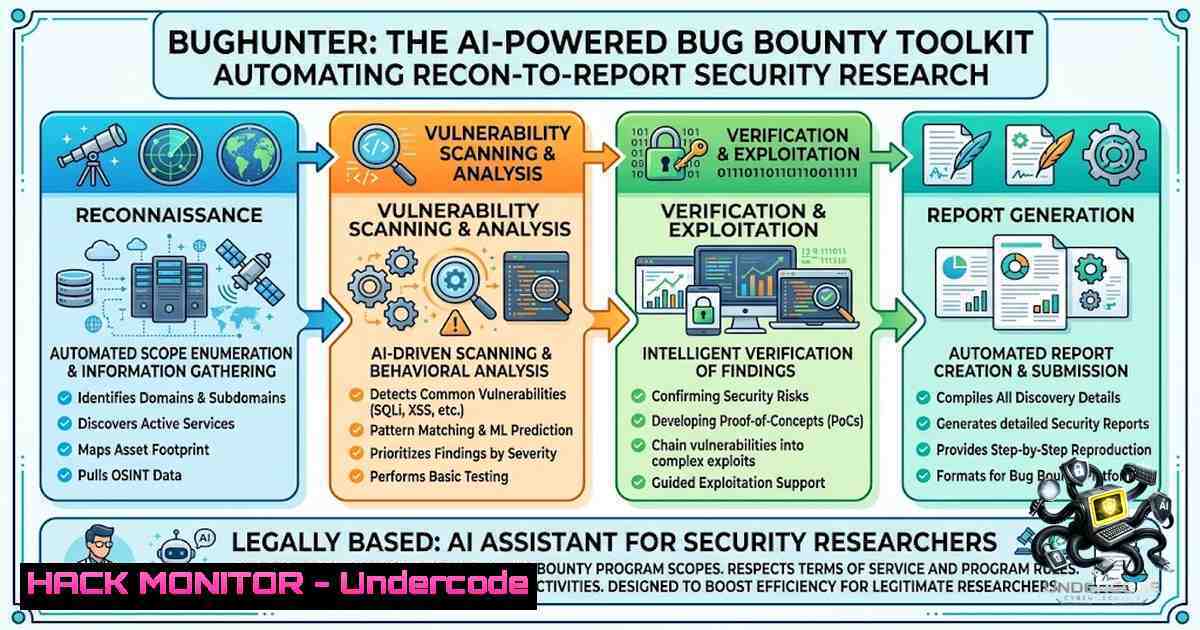
The traditional bug bounty workflow remains a grind: hours of passive reconnaissance, manual vulnerability testing across dozens of classes, tedious validation of false positives, and even more time crafting reports that may still get rejected.BugHunter, an open-source AI-powered toolkit developed by security researcher Shuvon Md Shariar Shanaz, disrupts this paradigm by automating the entire pipeline—from reconnaissance to submission-ready reports—without requiring any paid AI subscription.Now surpassing 4,300 GitHub stars with 25+ contributors, BugHunter orchestrates approximately 35 security tools including subfinder, httpx, nuclei, katana, ffuf, and dalfox, covering every phase of a bug bounty operation.Available as both a Claude Code plugin and a fully standalone CLI, the toolkit brings professional-grade vulnerability discovery capabilities to security researchers at any level.
Learning Objectives & Secrets:
- Objective 1: Master Zero-Cost AI-Powered Bug Bounty Automation — Deploy BugHunter in standalone mode using local LLMs like Ollama for fully offline, zero-cost bug bounty operations, eliminating the need for paid AI subscriptions.
-
Objective 2 Secret Tip: Leverage the 7-Question Validation Gate — Before wasting time on weak findings, BugHunter’s validate command runs findings through a strict 7-Question Gate that filters false positives and duplicate submissions, drastically improving your submission success rate.
-
Objective 3 Secret Tip: Cross-Session Memory Persistence — BugHunter logs findings and discovered patterns to a JSONL-based memory store, allowing vulnerability patterns identified on one target to inform testing on the next target. Sessions pick up where they left off, prioritizing untested endpoints via the pickup command.
You Should Know:
- Zero-Cost Arsenal: Deploying Your Autonomous AI Hunting Stack
BugHunter’s core innovation is its ability to operate without ongoing subscriptions, prioritizing local and free AI providers in a strict order: Ollama → Groq → DeepSeek → Claude → OpenAI.This section provides a verified, step-by-step guide to deploying a fully functional, offline-capable installation on Linux, macOS, or Windows (via WSL).
Step-by-Step Guide:
Step 1: Install Ollama and Pull a Local Model
 Install Ollama (local LLM runner)
curl -fsSL https://ollama.ai/install.sh | sh

Pull a capable model (~9 GB download, runs fully offline afterward)
ollama pull qwen2.5:14b
Step 2: Install BugHunter and Its Toolchain
 Clone the repository
git clone https://github.com/shuvonsec/claude-bug-bounty.git
cd claude-bug-bounty

Install standalone mode (no subscription required)
./install.sh --agent standalone

Install the scanning tools (subfinder, nuclei, ffuf, etc.)
chmod +x install_tools.sh && ./install_tools.sh
Step 3: Configure Your AI Provider
 Choose your AI provider (Ollama is free + offline)
bughunter setup

List all available AI providers
bughunter providers

Check which provider is active
bughunter status
Windows (PowerShell) Installation:
 Create directory and clone
New-Item -ItemType Directory -Force -Path "$HOME\security-research"
cd "$HOME\security-research"
git clone https://github.com/elementalsouls/Claude-BugHunter.git
cd Claude-BugHunter

Run the installer
pwsh ./scripts/install.ps1
- The Bug Hunting Pipeline: Recon, Hunt, Validate, Report
BugHunter exposes a structured CLI that mirrors a professional bug bounty workflow.Each command builds upon the previous, creating a seamless automation pipeline.
Step-by-Step Guide:
Step 1: Reconnaissance — Attack Surface Mapping
 Map the attack surface
bughunter recon target.com

Short alias
bughunter r target.com
This command performs passive subdomain enumeration via subfinder and crt.sh, live host discovery with httpx, and generates a comprehensive attack surface map.
Step 2: Vulnerability Hunting
 Hunt for vulnerabilities across 20+ Web2 and 10 Web3 bug classes
bughunter hunt target.com

Short alias
bughunter h target.com
The toolkit tests for SQL injection, XSS, SSRF, XXE, reentrancy, flash loan attacks, proxy/upgrade flaws, and more.
Step 3: Validation — The 7-Question Gate
 Validate a finding through the strict quality gate
bughunter validate "finding"

Short alias
bughunter v "finding"
The 7-Question Gate eliminates weak or duplicate findings before a researcher wastes time on a submission.
Step 4: Report Generation
 Generate submission-ready report for HackerOne, Bugcrowd, Intigriti, or Immunefi
bughunter report
Reports are platform-compliant with VRT-aware severity scoring, ready for copy-paste submission.
3. Advanced Features: AI Agents and Specialized Modules
BugHunter deploys nine specialized AI agents that handle individual tasks within the pipeline: a recon agent, report writer, validator, Web3 auditor, chain builder, autopilot, recon ranker, token auditor, and credential hunter.
Step-by-Step Guide for Web3 Security:
Smart Contract Audit Mode
 Audit smart contracts for Web3 vulnerabilities
bughunter audit --web3 contract_address

Token auditor for rug pull indicators
bughunter token-audit token_address
The token auditor module scans for rug pull indicators, mint authority, LP lock status, honeypot detection, and bonding curve anomalies—relevant to Immunefi-style Web3 programs.
Interactive AI Hunting Shell
 Launch interactive AI hunting shell
bughunter chat
This allows conversational interaction with the AI agent for custom hunting scenarios.
4. Claude Code Plugin Integration
For researchers using Claude Code, BugHunter installs as a skill bundle with 71 security skills and 15 slash commands, built from 681 disclosed-report patterns curated across 24 core vulnerability classes.
Step-by-Step Guide:
Step 1: Install Claude Code
Download and install Claude Code from https://claude.ai/download.
Step 2: Install BugHunter as Claude Code Plugin
 Clone the repository
git clone https://github.com/elementalsouls/Claude-BugHunter.git
cd Claude-BugHunter

Run the installer (detects Claude Code automatically)
bash scripts/install.sh
Step 3: Use Slash Commands in Claude Code
/recon target.com  Run reconnaissance
/hunt target.com  Hunt for vulnerabilities
/validate "finding"  Validate finding
/report  Generate report
/chain  Chain vulnerabilities
/autopilot  Full automated pipeline
/scope  Define scope
5. Burp Suite Integration and API Security Testing
BugHunter integrates with Burp Suite Professional or Community for advanced traffic analysis and manipulation.
Step-by-Step Guide:
Enable Burp Proxy Mode
 Route all traffic through Burp's proxy
bughunter recon target.com --burp
bughunter hunt target.com --burp
API Security Testing
 Test API endpoints for misconfigurations
bughunter hunt --api target.com

Test GraphQL endpoints
bughunter hunt --graphql target.com
The toolkit covers OData WAF blacklist bypass, NSwag/Swagger spec exposure, and includes a ~100-path discovery wordlist for API endpoints.
6. CI/CD Automation and Scripted Hunting
BugHunter can be integrated into CI/CD pipelines for automated, deterministic security testing.
Step-by-Step Guide for Automation:
Bulk Passive Recon
 Bulk passive reconnaissance across hundreds of subdomains
cbh recon --bulk targets.txt
Scheduled Hunting with Autopilot
 Run autopilot mode for full automated pipeline
bughunter autopilot target.com --schedule daily
CI/CD Pipeline Integration Example (GitHub Actions):
name: Security Scan
on: [bash]
jobs:
scan:
runs-on: ubuntu-latest
steps:
- uses: actions/checkout@v3
- name: Install BugHunter
run: |
git clone https://github.com/shuvonsec/claude-bug-bounty.git
cd claude-bug-bounty
./install.sh --agent standalone
- name: Run Recon
run: bughunter recon ${{ secrets.TARGET_DOMAIN }}
- name: Run Hunt
run: bughunter hunt ${{ secrets.TARGET_DOMAIN }}
7. Security Hardening and Responsible Use
BugHunter includes built-in legal guardrails that hard-stop before any credential spraying activity.The toolkit also enforces scope validation before any active testing to prevent out-of-scope activities.
Security Best Practices:
 Define scope before testing
bughunter scope add target.com
bughunter scope add .target.com

Validate scope before hunting
bughunter scope validate target.com

Use proxy for safe testing
bughunter hunt target.com --proxy http://127.0.0.1:8080
What Undercode Say:
- Key Takeaway 1: BugHunter democratizes professional-grade bug bounty hunting by eliminating the need for paid AI subscriptions. With free providers like Ollama (fully offline) and Groq (free cloud tier), independent researchers can now access capabilities previously reserved for well-funded teams.The toolkit orchestrates ~35 security tools automatically, saving researchers 8-10 hours per target that would otherwise be spent on manual tool execution and result aggregation.
-
Key Takeaway 2: The 7-Question Validation Gate represents the highest-value feature for practical bounty hunting.By filtering false positives and duplicate submissions before researchers invest time, BugHunter dramatically improves submission success rates and reduces rejection rates—a critical advantage in competitive bug bounty programs where time-to-submission often determines bounty awards.
-
Key Takeaway 3: Cross-session memory persistence and pattern recognition create a compounding advantage over time. Vulnerability patterns discovered on one target inform testing on subsequent targets, and interrupted sessions can be resumed exactly where they left off.This means researchers build institutional knowledge automatically, with each hunt making subsequent hunts more effective.
-
Key Takeaway 4: The toolkit’s coverage is comprehensive—20+ Web2 vulnerability classes (SQLi, XSS, SSRF, XXE, etc.) and 10+ Web3 classes (reentrancy, flash loan attacks, proxy/upgrade flaws).Real-world usage has already demonstrated discovery of authorization bypass vulnerabilities and access control issues that manual testing misses, as AI pattern recognition catches inconsistencies humans overlook in large codebases.
-
Key Takeaway 5: With 71 security skills, 15 slash commands, and 681 disclosed-report patterns, BugHunter represents a living knowledge base of vulnerability research.The project’s active maintenance with 25+ contributors ensures continuous updates, including recent additions covering Duende BFF role-partitioned CSRF, OData WAF bypass, and AWS Cognito IdentityPool misconfigurations.
Prediction:
-
+1 BugHunter’s zero-cost standalone mode will accelerate the democratization of professional security research, enabling thousands of new researchers to participate in bug bounty programs and increasing the overall security posture of web applications and smart contracts globally.
-
+1 The toolkit’s AI-powered automation will shift the bug bounty industry from manual, labor-intensive hunting toward AI-assisted vulnerability discovery, with researchers spending less time on repetitive tasks and more time on complex exploitation chains and logic flaw discovery.
-
+1 Cross-session memory persistence and pattern learning will create network effects where the BugHunter community collectively improves the tool’s detection capabilities, similar to how open-source threat intelligence platforms have evolved.
-
-1 The increased accessibility of automated hunting tools may lead to higher submission volumes on bug bounty platforms, potentially overwhelming program triage teams and creating signal-to-1oise ratio challenges if researchers rely too heavily on automation without proper validation.
-
-1 Organizations may need to adapt their bug bounty program scopes and rules to account for AI-powered automated testing, potentially introducing new compliance and legal considerations around automated scanning of production systems.
▶️ Related Video (88% Match):
https://www.youtube.com/watch?v=3TQXptkz5i8
🎯Let’s Practice For Free:
🎓 Live Courses & Certifications:
Join Undercode Academy for Verified Certifications
🚀 Request a Custom Project:
Secure, high-velocity infrastructure and disruptive technological engineering. Contact our engineering team for high-tier development and proprietary systems:
[email protected]
💎 Smart Architecture | 🛡️ Secure by Design | ⭐ Trusted by Thousands
IT/Security Reporter URL:
Reported By: https://lnkd.in/p/eG6faZxN – Hackers Feeds
Extra Hub: Undercode MoN
Basic Verification: Pass ✅


