Listen to this Post
Introduction:
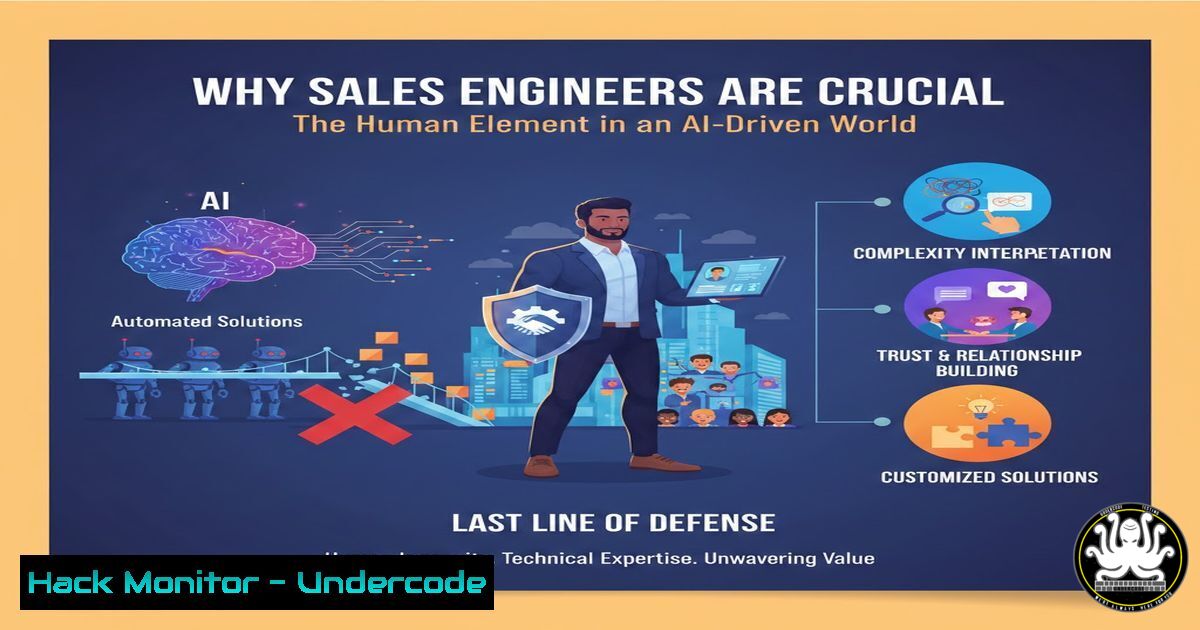
As leading AI firms like Anthropic and OpenAI aggressively scale their workforce, a surprising trend has emerged from the analysis of their job postings: the relative safety of sales roles. In an era where code can be written by machines, the inherently human elements of trust, persuasion, and relationship building remain the critical, un-automated barrier between technology and revenue. This shift redefines the cybersecurity landscape, not by replacing firewalls, but by elevating the role of the human interface—specifically, the Sales Engineer and the security professional who can translate technical complexity into business trust.
Learning Objectives:
- Understand the convergence of AI automation and the increasing value of human-centric security roles.
- Learn how to identify and mitigate the risks associated with AI-generated code and automated workflows.
- Acquire practical command-line and configuration techniques to secure AI-integrated applications and infrastructure.
You Should Know:
- The Anatomy of Trust: Why “Human-in-the-Loop” Security Matters
The LinkedIn post highlights a critical truth: “We buy because we believe the person.” In cybersecurity, this translates directly to the “human-in-the-loop” (HITL) model. While AI can detect anomalies and patch vulnerabilities faster than any human, it cannot negotiate a ransomware延期 or explain a compliance failure to a board member with the necessary empathy and gravitas.
To prepare for this hybrid environment, professionals must secure the channels where human interaction meets AI logic. For instance, when deploying an AI chatbot for customer support (a sales touchpoint), you must ensure the underlying infrastructure is locked down.
Step‑by‑step guide: Securing an AI Chatbot Interface on Linux
This assumes you have a chatbot container (e.g., using Docker) that needs to interact with a backend API.
1. Isolate the Environment:
 Create an isolated network namespace for the AI service
sudo ip netns add ai_chatbot_ns
 Run the container within this namespace to limit lateral movement
docker run --net=container:ai_chatbot_ns --name chatbot -d your-chatbot-image
2. Restrict Outbound Traffic (Defense in Depth):
Only allow the chatbot to talk to its specific API gateway, preventing data exfiltration if the model is compromised.
 Allow traffic only to your internal API gateway (e.g., 10.0.0.45)
sudo iptables -A OUTPUT -p tcp --dport 443 -d 10.0.0.45 -j ACCEPT
 Drop all other outbound traffic
sudo iptables -A OUTPUT -j DROP
- The API Economy: Securing the Handshake Between Sales and Systems
The post mentions that until “AI agents buy from other AI agents,” humans handle sales. This means humans are interacting with APIs—the digital pipelines for features and data. Securing these APIs is paramount because a compromised API is a compromised sales pitch and potentially a data breach. We must move beyond basic authentication to granular authorization.
Step‑by‑step guide: Hardening API Keys in a Windows Environment
Often, sales engineers or technical account managers might have scripts that pull customer usage data. Hardcoding keys is a common but dangerous practice.
1. Use Windows Credential Manager:
Instead of storing API keys in a `.env` file or script, store them securely.
 Store the API key securely
Add-Type -AssemblyName System.Runtime.WindowsRuntime
$cred = Get-Credential -Message "Enter your API Key (Username as Key Name, Password as Key)"
 To store (run as admin):
cmdkey /generic:MyAIServiceAPI /user:"MyAPIKeyName" /pass:"ActualAPIKeyValue"
2. Retrieve and Use in a Script:
Modify your scripts to pull the key only when needed.
 Retrieve the stored key
$apiCred = cmdkey /list | Select-String "MyAIServiceAPI" -Context 0,1
 Parse and use the key in your API call
$key = $apiCred.Context.PostContext[bash].Trim()
Invoke-RestMethod -Uri "https://api.ai-service.com/data" -Headers @{"Authorization" = "Bearer $key"}
3. Vulnerability Exploitation: When AI Writes the Code
The rapid development cycles enabled by AI (like the code Anthropic’s employees might be writing) introduce new vectors. AI can generate vulnerable code quickly. A sales demo environment built with AI assistance might contain basic web vulnerabilities. It is crucial to test these environments before they are exposed to potential clients.
Step‑by‑step guide: Scanning for OWASP Top 10 in an AI-Generated Web App (Linux)
Use open-source tools to simulate a basic attack surface review.
1. Install and Run a Vulnerability Scanner (Nikto):
sudo apt update && sudo apt install nikto -y
 Scan the demo environment (replace with target IP)
nikto -h http://demo.yourapp.local -ssl -Format html -o nikto_scan.html
2. Check for Sensitive Data Exposure (using grep):
AI models trained on public data might inadvertently suggest exposing debug endpoints.
 Recursively search the webroot for common debug patterns
grep -r --include=".php" --include=".js" "DEBUG|PRIVATE_KEY|DB_PASSWORD" /var/www/demo-site/
4. Cloud Hardening: Protecting the AI Sales Pipeline
The data flowing from sales conversations to AI analytics tools (like CRMs or custom LLM fine-tuning) must be encrypted and access-controlled. A misconfigured S3 bucket leaking sales call transcripts is a disaster.
Step‑by‑step guide: Enforcing Encryption on AWS S3 for AI Training Data
Using AWS CLI, ensure that any bucket storing human interaction data (sales calls, emails) used to train AI models is secure.
1. Enable Default Encryption:
 Apply AES-256 encryption by default to a bucket
aws s3api put-bucket-encryption --bucket ai-sales-data-bucket \
--server-side-encryption-configuration '{
"Rules": [
{
"ApplyServerSideEncryptionByDefault": {
"SSEAlgorithm": "AES256"
}
}
]
}'
2. Block Public Access (Defense in Depth):
 Ensure no accidental public exposure
aws s3api put-public-access-block --bucket ai-sales-data-bucket \
--public-access-block-configuration BlockPublicAcls=true,IgnorePublicAcls=true,BlockPublicPolicy=true,RestrictPublicBuckets=true
5. The “Shadow AI” Risk in Sales Departments
Just as there was “Shadow IT,” sales teams will adopt “Shadow AI”—using unsanctioned AI tools to write emails or analyze leads. This introduces data leakage risks.
Step‑by‑step guide: Detecting and Blocking Unauthorized AI Tools on the Corporate Network
On a Linux-based gateway or firewall (e.g., using iptables or nftables), you can monitor and restrict traffic to known, unauthorized AI endpoints.
1. Monitor for Connections (Detection):
 Use tcpdump to watch for traffic to common AI APIs (example: OpenAI, )
sudo tcpdump -i eth0 -n -A 'host api.openai.com or host api.anthropic.com'
2. Implement a Blocklist (Prevention):
Add entries to `/etc/hosts` to redirect unauthorized domains to localhost, or use iptables.
 Block access to a specific service
sudo iptables -A OUTPUT -d api.unsanctioned-ai.com -j DROP
6. Securing the AI-to-Human Interaction
As the post suggests, we aren’t at “AI-to-AI” sales yet, but we are at “AI-to-Human.” This means interfaces like voicebots and chatbots must be hardened against prompt injection attacks, where a user (or potential attacker) tries to manipulate the AI into breaking its rules or revealing sensitive data.
Mitigation Example: Input Sanitization in Python
Before passing user input to the LLM, sanitize it.
import re

def sanitize_input(user_input):
 Remove common escape characters and injection attempts
sanitized = re.sub(r'[\n\r\t]', ' ', user_input)
 Limit input length to prevent resource exhaustion
sanitized = sanitized[:500]
 Reject or escape characters used in system prompt injection (e.g., ":", "")
if "system:" in sanitized.lower() or "human:" in sanitized.lower():
return "Invalid input pattern detected."
return sanitized

Usage before calling the AI model
clean_query = sanitize_input(request.form['user_message'])
response = ai_model.generate(clean_query)
What Undercode Say:
- Human Element as a Security Control: The reliance on human trust in sales acts as an inherent security control against fully automated social engineering and fraud, but it also creates a new attack surface—the human representative. Social engineering will pivot from targeting generic users to targeting specific, high-trust sales engineers.
- API Sprawl is the New Perimeter: As AI agents begin to handle more pre-sales qualification and data gathering, the number of APIs will explode. Traditional network security is obsolete; securing the API contract and its data flow is the new battleground for protecting the “human-to-human” business value.
- Upskilling is the Only Constant: The analysis of job postings is a clear signal. Technical professionals must evolve into “Trust Architects”—professionals who can build systems that are not only secure but also convey trust and reliability to human buyers. This requires blending deep technical knowledge (cloud, AI, code) with business communication skills.
Prediction:
Within the next 18-24 months, we will witness the emergence of a new category of cybersecurity threats: “Trust Poisoning.” Attackers will not target the AI models directly but will manipulate the data and interactions that sales professionals rely on to build trust with clients. This could involve subtly altering the data an AI assistant provides to a salesperson before a client call, leading to misrepresentation, or injecting false positive reviews into the datasets used by AI sales tools. The “human layer” will become the most targeted, yet most defended, asset in the enterprise. The companies that succeed will be those that embed security deeply into their sales engineering and customer-facing technical roles, not just their IT departments.
▶️ Related Video (82% Match):
🎯Let’s Practice For Free:
IT/Security Reporter URL:
Reported By: Huzeyfe Sales – Hackers Feeds
Extra Hub: Undercode MoN
Basic Verification: Pass ✅


