Listen to this Post
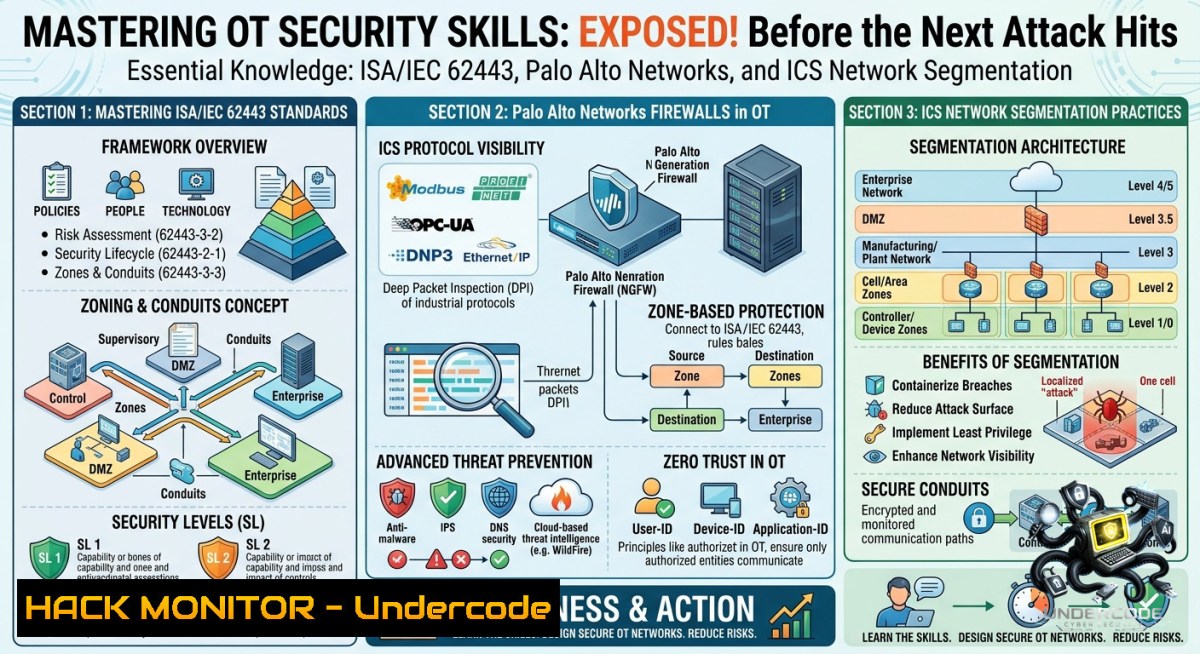
Introduction:
Operational Technology (OT) security is no longer a niche concern—it’s the frontline defense for manufacturing plants, power grids, and critical infrastructure. As industrial control systems (ICS) converge with enterprise IT, threat actors increasingly target Layer 2/3 weaknesses, unsegmented networks, and misconfigured OT-aware firewalls. This article extracts real-world job requirements from a leading manufacturing recruitment post and builds a hands-on technical playbook covering network segmentation, compliance checks, and mitigation strategies aligned with ISA/IEC 62443.
Learning Objectives:
– Design and audit OT network architectures with proper Layer 2/3 segmentation and OT-aware firewall policies (Palo Alto, Zscaler).
– Apply ISA/IEC 62443 fundamentals to conduct compliance checks and harden industrial control systems against lateral movement.
– Execute Linux/Windows commands and security tests to identify misconfigurations in ICS/OT environments.
You Should Know:
1. Mapping the ICS/OT Network Architecture – From Flat to Segmented
Most legacy OT networks are flat, allowing a compromised workstation to pivot to programmable logic controllers (PLCs). The job post demands “understanding of ICS/OT network architectures” and “segmenting Layer 2/3.” Below is a step‑by‑step guide to discover, document, and segment an OT network.
Step‑by‑step guide:
1. Discover OT devices using passive and active scanning (use caution – active scans can crash legacy PLCs).
Linux (nmap with safe options):
`sudo nmap -sS -p 102,502,44818,2222 –open –max-retries 1 –host-timeout 30s 192.168.1.0/24`
Windows (PowerShell with Test-1etConnection):
`1..254 | ForEach-Object { Test-1etConnection -Port 502 -ComputerName “192.168.1.$_” -InformationLevel Quiet }`
2. Map Layer 2 adjacency (CDP/LLDP) to understand switch topology.
Linux: `sudo lldpcli show neighbors`
Windows: `Get-1etNeighbor -AddressFamily IPv4`
3. Design segmentation zones (per ISA/IEC 62443‑3‑3) – e.g., separate cell/area zones from control and safety zones.
4. Implement VLANs and ACLs on OT switches. Example Cisco ACL to block unauthorized Modbus access:
`access-list 100 deny tcp any any eq 502`
`access-list 100 permit ip any any`
2. Configuring OT‑Aware Firewalls (Palo Alto & Zscaler)
The job requires “hands‑on experience with OT‑aware firewalls (e.g., Palo Alto, Zscaler).” Unlike traditional firewalls, OT‑aware models understand industrial protocols (Modbus, DNP3, S7comm) and can enforce deep packet inspection without breaking real‑time operations.
Step‑by‑step guide for Palo Alto (PAN‑OS):
1. Create a custom application override for a non‑standard Modbus port:
`set application Modbus_502_Override protocol tcp port 502`
Then bind to `application modbus` in the security policy.
2. Enable protocol decoders – Go to Objects → Applications → search for “modbus” and ensure “Content Inspection” is enabled.
3. Set up zone protection profiles for OT‑to‑IT traffic:
`set zone-protection-profile OT-Protect flags flood-protection`
`set zone “OT-Zone” network layer 3 zone-protection-profile OT-Protect`
4. Zscaler configuration for remote OT access:
– Create an “OT Access” policy in Zscaler Internet Access (ZIA) to inspect Modbus/TCP via Cloud IPS.
– Use “Traffic Forwarding” with a PAC file that routes OT subnets through specific SSL inspection profiles.
5. Audit firewall rules using CLI:
`show rule all | match “Modbus”` (Palo Alto)
`zpa audit logs | grep “OT”` (Zscaler)
3. ISA/IEC 62443 Certification Fundamentals – Compliance Checks for Manufacturing Systems
The job post highlights “knowledge of ISA/IEC 62443 certification fundamentals.” This standard defines security levels (SL1‑SL4) and requirements for IACS (Industrial Automation and Control Systems). Below are compliance validation commands and scripts.
Step‑by‑step guide to perform a basic 62443 compliance check:
1. Check for unused open ports on OT controllers (violates FR 5 – Security Monitoring).
Linux: `sudo nmap -sU -p 161,137,520 –script=modbus-discover 10.10.10.0/24 -oA ot_compliance_scan`
Windows: `Get-1etTCPConnection -State Listen | Where-Object {$_.LocalPort -in @(161,502,102,44818)}`
2. Verify account management (FR 1 – Access Control). List local users on Windows ICS workstations:
`net user` (cmd) or `Get-LocalUser | Format-Table Name,Enabled,LastLogon`
3. Check patch levels on HMIs (Human‑Machine Interfaces). Use Windows Update history:
`Get-HotFix | Sort-Object InstalledOn -Descending | Select-Object -First 10`
4. Test for insecure fieldbus protocols using `modbus-cli` (install via `pip install modbus-cli`):
`modbus read 192.168.1.100 40001 1` – If it returns values without authentication, that’s a critical finding.
5. Generate a compliance report highlighting violations against ISA/IEC 62443‑4‑2 (Embedded Device Requirements).
4. Network Segmentation Hardening: Preventing Lateral Movement in OT
“Segmentation” is explicitly requested. Many attacks (e.g., TRITON, Industroyer) succeeded because IT‑OT segmentation was either missing or misconfigured. This section provides commands to enforce strict segmentation.
Step‑by‑step guide (Linux iptables as an OT gateway):
1. Block all direct traffic from IT to OT except an explicit jump host:
`sudo iptables -A FORWARD -i eth0 (IT) -o eth1 (OT) -j DROP`
`sudo iptables -A FORWARD -i eth0 -o eth1 -p tcp –dport 22 -d 10.10.10.10 -j ACCEPT` (allow SSH only to a secure jump box)
2. Implement rate limiting for Modbus to prevent flooding:
`sudo iptables -A FORWARD -p tcp –dport 502 -m limit –limit 10/second -j ACCEPT`
3. Log all segment violations to a syslog server:
`sudo iptables -A FORWARD -i eth0 -o eth1 -j LOG –log-prefix “OT-SEGMENT-VIOLATION: ”`
4. Windows Server with Routing and Remote Access (RRAS) :
– Install RRAS, then create network policies to deny all traffic between IT and OT subnets except specific service accounts.
– Use PowerShell to set firewall rules:
`New-1etFirewallRule -DisplayName “Block IT-to-OT” -Direction Inbound -LocalSubnet “192.168.10.0/24” -RemoteSubnet “10.0.0.0/8” -Action Block`
5. Vulnerability Exploitation & Mitigation in ICS/OT Environments
To protect critical manufacturing systems, you must understand how attackers exploit misconfigurations. The job requires “managing stakeholders globally” and “compliance checks” – this includes red‑teaming or tabletop exercises.
Step‑by‑step guide to simulate a basic OT attack and apply mitigations:
1. Exploit default credentials on a simulated PLC (e.g., using `pymodbus` or `modbus-tk`).
Python script to write a coil (turn off a pump):
from pymodbus.client import ModbusTcpClient
client = ModbusTcpClient('192.168.1.100', port=502)
client.write_coil(1, False)  Write False to coil 1
2. Mitigation: Enforce 802.1X port authentication on OT switches. Use FreeRADIUS:
`sudo apt install freeradius` then configure `clients.conf` to allow only whitelisted MAC addresses of known PLCs.
3. Detect Modbus function code anomalies using Snort with OT ruleset:
`alert tcp $HOME_NET any -> $EXTERNAL_NET 502 (msg:”Modbus Write Coil detected”; content:”|05|”; depth:1; sid:1000001;)`
4. Hardening countermeasure – Enable SANS 5 critical controls for OT: disable unused ports/services on HMIs.
Windows (Stop unnecessary services): `Stop-Service -1ame “LLDP” -Force` and `Set-Service -1ame “LLDP” -StartupType Disabled`
6. Global Stakeholder Management for OT Security Compliance
While not technical, the job mentions “Global Experience for managing stakeholders.” From a technical perspective, this means automating compliance reports for different factories and regulatory regimes (e.g., NERC CIP, NIST SP 800‑82).
Step‑by‑step guide to build a multi‑site compliance dashboard:
1. Deploy OpenVAS or GVM to remotely scan OT subnets across manufacturing sites.
`gvm-cli –gmp-username admin –gmp-password pass socket –socketpath /var/run/gvmd.sock –xml “
2. Parse scan results into CSV using Python and email summaries to global stakeholders.
Python snippet:
import pandas as pd
results = pd.read_json(‘openvas_vulns.json’)
results.groupby(‘severity’).size().to_csv(‘site_compliance.csv’)
3. Integrate with SIEM (e.g., Splunk or Wazuh) to correlate OT firewall logs and generate monthly governance packs.
What Undercode Say:
– Key Takeaway 1: Real‑world OT security hiring (like this SKF post) prioritizes hands‑on segmentation and ISA/IEC 62443 knowledge over generic cybersecurity – professionals must demonstrate Layer 2/3 design and vendor‑specific firewall configs (Palo Alto, Zscaler).
– Key Takeaway 2: Automated compliance checks and active scanning commands (nmap, modbus‑cli, iptables) are non‑negotiable skills for OT platform owners because manufacturing systems cannot afford prolonged downtime for manual audits.
Analysis: The shift from IT to OT security is accelerating as nation‑state attacks (e.g., Volt Typhoon targeting critical infrastructure) expose the fragility of flat industrial networks. The job advertisement indirectly reveals an industry gap: 10–15 years experience suggests companies want engineers who understand legacy protocols (Modbus, DNP3) and modern firewalls simultaneously. Moreover, the emphasis on “global stakeholder management” indicates that OT security is no longer isolated – it requires feeding compliance metrics up to board level. If you lack practical knowledge of Palo Alto’s OT‑aware signatures or how to write an iptables segmenting rule, you will be outcompeted. Interestingly, no AI or machine learning tools are mentioned – the focus remains on fundamental network hygiene and standards adherence, proving that OT security still needs human‑driven configuration and verification before automation layers can be trusted.
Expected Output:
Introduction:
Operational Technology (OT) security is no longer a niche concern—it’s the frontline defense for manufacturing plants, power grids, and critical infrastructure. As industrial control systems (ICS) converge with enterprise IT, threat actors increasingly target Layer 2/3 weaknesses, unsegmented networks, and misconfigured OT-aware firewalls. This article extracts real-world job requirements from a leading manufacturing recruitment post and builds a hands-on technical playbook covering network segmentation, compliance checks, and mitigation strategies aligned with ISA/IEC 62443.
What Undercode Say:
– Key Takeaway 1: Real‑world OT security hiring prioritizes hands‑on segmentation and ISA/IEC 62443 knowledge over generic cybersecurity – professionals must demonstrate Layer 2/3 design and vendor‑specific firewall configs (Palo Alto, Zscaler).
– Key Takeaway 2: Automated compliance checks and active scanning commands (nmap, modbus‑cli, iptables) are non‑negotiable skills for OT platform owners because manufacturing systems cannot afford prolonged downtime for manual audits.
Prediction:
– -1 By 2027, over 60% of manufacturing firms that fail to implement ISA/IEC 62443‑mandated segmentation will experience a successful ransomware lateral movement from IT to OT, causing production halts of 72+ hours.
– +1 Conversely, adoption of OT‑aware firewalls (Palo Alto, Zscaler) combined with Layer 2/3 micro‑segmentation will become a competitive differentiator, reducing incident response costs by an estimated $2.3M per factory per year.
– -1 The global shortage of OT security talent with 10+ years of experience will drive salary premiums above 40% for qualified platform owners, leading to dangerous skills gaps in emerging economies.
– +1 AI‑driven anomaly detection on Modbus/DNP3 traffic will mature by 2028, but only for organizations that have already completed basic segmentation – AI cannot fix flat networks.
– -1 Regulatory bodies (NERC, CISA) will increasingly mandate quarterly on‑site compliance checks with actual exploit testing (not just paper audits), exposing non‑prepared manufacturers to heavy fines.
▶️ Related Video (70% Match):
🎯Let’s Practice For Free:
🎓 Live Courses & Certifications:
[Join Undercode Academy for Verified Certifications](https://undercode.co.uk/certifications/)
🚀 Request a Custom Project:
Secure, high-velocity infrastructure and disruptive technological engineering. Contact our engineering team for high-tier development and proprietary systems:
[[email protected]](mailto:[email protected])
💎 Smart Architecture | 🛡️ Secure by Design | ⭐ Trusted by Thousands
IT/Security Reporter URL:
Reported By: [Pushpa K](https://www.linkedin.com/posts/pushpa-k-746201115_hiring-cybersecurity-otsecurity-share-7464209211812483072-5l6x/) – Hackers Feeds
Extra Hub: Undercode MoN
Basic Verification: Pass ✅
🔐JOIN OUR CYBER WORLD [ CVE News • HackMonitor • UndercodeNews ]
[💬 Whatsapp](https://undercode.help/whatsapp) | [💬 Telegram](https://t.me/UndercodeCommunity)
📢 Follow UndercodeTesting & Stay Tuned:
[𝕏 formerly Twitter 🐦](https://x.com/undercodeupdate) | [@ Threads](https://www.threads.net/@undercodetesting) | [🔗 Linkedin](https://www.linkedin.com/company/undercodetesting/) | [🦋BlueSky](https://bsky.app/profile/undercode.bsky.social)


