
Listen to this Post
Introduction:
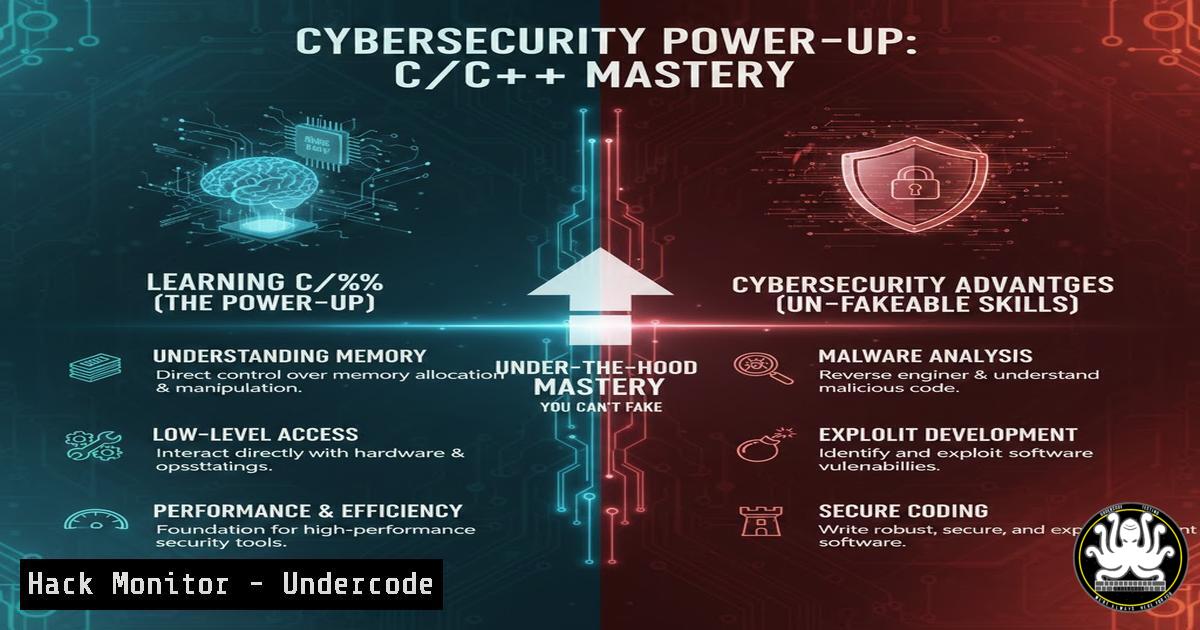
In an era dominated by high‑level languages and AI‑assisted coding, a foundational grasp of low‑level programming remains the definitive differentiator for elite security engineers and developers. The debate ignited by a recent industry discussion underscores a critical truth: early experience with C and C++ forges a deep, intuitive understanding of system internals—memory, processors, and hardware—that directly translates to superior debugging, secure architecture, and effective vulnerability analysis. This isn’t about writing production C++ today; it’s about building the mental model to dissect and defend complex systems.
Learning Objectives:
- Understand how explicit memory management in C/C++ builds the foundational knowledge to exploit and mitigate critical vulnerabilities like buffer overflows.
- Translate low‑level debugging and “cost model” thinking into practical skills for reverse engineering, malware analysis, and performance‑sensitive security tooling.
- Apply the discipline of API and architecture design from unmanaged languages to harden cloud configurations, secure API gateways, and design resilient systems.
You Should Know:
- Memory Management: The Hacker’s Playground and First Line of Defense
Understanding stack vs. heap, pointers, and manual memory allocation is not academic—it’s the blueprint for every memory‑corruption exploit. This knowledge allows you to read vulnerability reports (CVEs) and instantly grasp the root cause.
Step‑by‑step guide:
- Concept: A buffer overflow occurs when data exceeds a buffer’s allocated memory, overwriting adjacent data. This is trivial to create in C and impossible in managed languages like Python or Java.
2. Vulnerable Code Snippet (C):
include <string.h>
void vulnerable_function(char input) {
char buffer[bash]; // Fixed-size stack buffer
strcpy(buffer, input); // No bounds checking!
}
3. Exploitation Preview: If `input` is longer than 15 characters + null terminator, it overwrites the stack’s return pointer. A crafted payload can redirect execution to malicious code.
4. Mitigation Practice: Learn and apply mitigations:
Compiler Flags (Linux): `gcc -fstack-protector-all -z execstack -o vulnerable vulnerable.c`
Modern Compiler Protections: Understand what `-fstack-protector` (Canary), `-z noexecstack` (NX), and ASLR (Address Space Layout Randomization) do to break exploits.
- Debugging and Reverse Engineering: Building Resilience Beyond Modern Tooling
Modern IDEs are fantastic, but they abstract away the execution reality. C/C++ debugging with `gdb` or WinDbg forces you to confront the CPU register state, assembly instructions, and memory maps—skills directly transferable to analyzing malicious binaries.
Step‑by‑step guide:
- Tool Setup: Install `gdb` on Linux (
sudo apt install gdb) or WinDbg on Windows.
2. Analyze a Crash:
Compile with debug symbols: `gcc -g -o test test.c`
Run in `gdb`: `gdb ./test`
Trigger a crash (e.g., null pointer dereference).
3. Key Commands:
(gdb) run  Execute program
(gdb) backtrace (bt)  Show call stack at crash
(gdb) info registers  Inspect CPU registers
(gdb) x/20x $sp  Examine 20 words of stack memory
(gdb) disassemble  View assembly of current function
This hands‑on inspection is identical to the initial triage of a crash dump from a compromised system or malware sample.
- Thinking in “Cost Models”: Writing Efficient Security Tooling
Security tools often operate at scale: parsing terabytes of logs, scanning networks, or encrypting/decrypting data. A developer with a “cost model” mindset from C/C++ understands the CPU cycle, memory, and I/O impact of their code, leading to more efficient scanners, forensics utilities, and intrusion detection systems.
Step‑by‑step tutorial: Write a Simple Log Parser
- Inefficient Python‑Style Approach (Conceptual): Repeated string concatenation, unnecessary copies, and high‑level abstractions can bottleneck performance.
2. Optimized C‑Inspired Approach (in Python):
 Use bytearrays, memoryviews, and single-pass processing
def parse_large_log(log_file_path):
with open(log_file_path, 'rb') as f:
for chunk in iter(lambda: f.read(65536), b''):  Read in 64KB chunks
process_chunk(chunk)  Operate on bytes, not decoded strings
3. Lesson: Apply the principle of minimal data movement and cache awareness—a habit ingrained by C/C++—even when using high‑level languages for security scripts.
4. API & Architecture Discipline: Designing Secure Systems
C/C++ have no hand‑holding; every resource must be explicitly managed and every interface meticulously defined. This breeds the discipline needed for secure API and system design.
Step‑by‑step guide: Hardening a REST API
- Define a Tight Interface: Just as a C header file defines strict function contracts, use OpenAPI specifications to define your API endpoints, input types, and responses.
- Validate All Inputs Externally: Mimic the paranoia of parsing untrusted data in C. Implement validation middleware before business logic.
- Manage Resources: Like managing memory lifetimes, explicitly manage database connections, file handles, and authentication tokens. Implement rate‑limiting and timeouts.
- Audit Dependencies: Treat third‑party libraries like you would
include <stdlib.h>—audit them for known vulnerabilities (usingOWASP Dependency‑Check,snyk, etc.).
5. Cloud and System Hardening: The “Undercode” Perspective
The insight into “what’s under the hood” enables you to question cloud abstractions. You understand that a Kubernetes pod is a group of processes with shared namespaces, not just a YAML definition, leading to better security configurations.
Step‑by‑step commands for Linux Hardening:
 1. Limit Process Capabilities (Principle of Least Privilege)
sudo setcap cap_net_raw+ep /usr/bin/ping  Give ping only RAW socket capability
sudo setcap -r /usr/bin/ping  Remove all capabilities

<ol>
<li>Investigate System Calls (for anomaly detection)
strace -f -e trace=network,process -p <PID>  Trace network/process calls of a running service</p></li>
<li><p>Harden Kernel Parameters via sysctl
sudo sysctl -w kernel.randomize_va_space=2  Enable full ASLR
sudo sysctl -w net.ipv4.icmp_echo_ignore_all=1  Disable ICMP (ping)
What Undercode Say:
- Foundation Over Fashion: The core argument is validated. Engineers with low‑level experience possess a durable mental model of the machine, making them adept at diagnosing systemic issues, optimizing critical paths, and understanding attack surfaces at a fundamental level. This is less about the language and more about the foundational computer science concepts it forces you to master.
- The Hiring Signal: In cybersecurity roles—particularly in vulnerability research, reverse engineering, OS/kernel security, and building foundational infrastructure—this low‑level proficiency is a high‑value filter. It indicates resilience, the ability to work with ambiguity, and a propensity for deep problem‑solving beyond framework‑specific knowledge.
Prediction:
As AI‑generated code and further abstractions permeate development, the value of engineers who understand the underlying machinery will not diminish—it will concentrate and increase. The ability to audit, secure, and optimize the foundational layers upon which AI models and automated systems run will become a premium, niche expertise. The future of cybersecurity will be split between practitioners who operate at the high‑level tool layer and a smaller, critical cohort of “under‑the‑hood” experts who can respond when those tools fail or are subverted, ensuring system integrity at the metal. The brain built by “squats” like C/C++ will be the one that secures the future.
🎯Let’s Practice For Free:
IT/Security Reporter URL:
Reported By: Jonathondown Want – Hackers Feeds
Extra Hub: Undercode MoN
Basic Verification: Pass ✅


