Listen to this Post
Introduction:
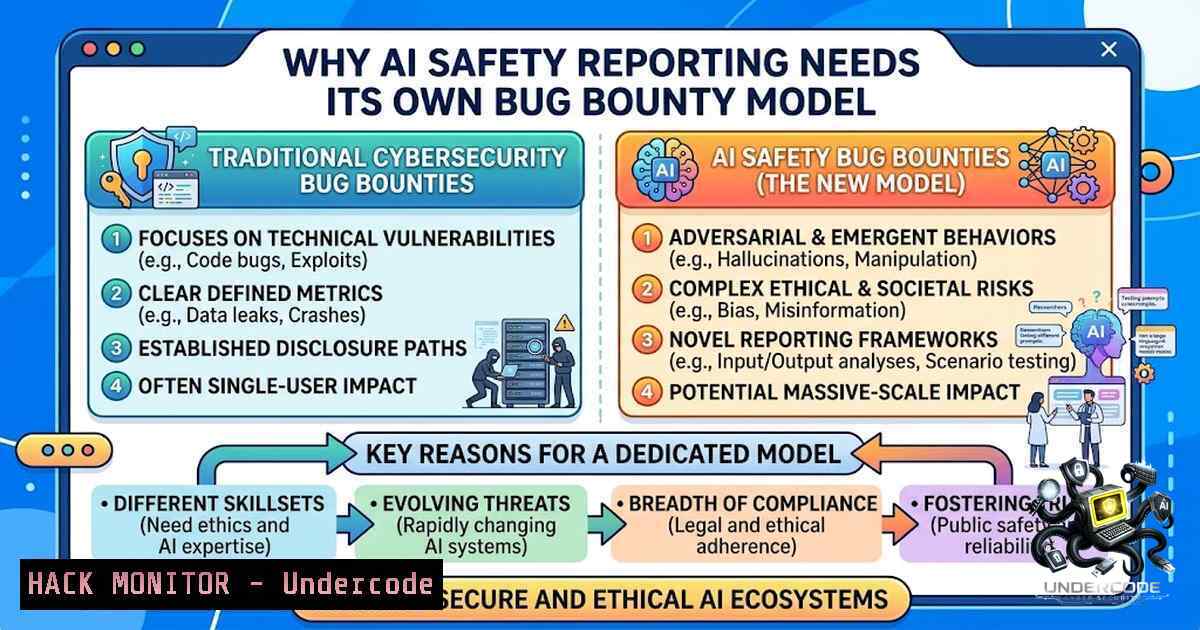
The rapid proliferation of large language models (LLMs) and autonomous AI agents has introduced a new class of vulnerabilities that traditional security bug bounty platforms are ill-equipped to handle. Unlike conventional web application flaws—such as SQL injection or cross-site scripting—AI-specific risks like prompt injection, model extraction, jailbreak attacks, and behavioural harm operate at the intersection of machine learning, linguistics, and cognitive security. As Genbounty, an AI safety bug bounty platform, argues in its recent whitepaper, applying conventional security frameworks to AI safety reporting is fundamentally misguided. The industry requires a dedicated bug bounty model that accounts for probabilistic outputs, adversarial inputs, and the unique failure modes of neural networks.
Learning Objectives & Secrets:
- Objective 1: Distinguish AI safety vulnerabilities from traditional security bugs. Traditional bug bounty programs reward researchers for finding deterministic flaws in code. AI safety reporting, by contrast, must assess behavioural harms—such as a model generating harmful content, leaking training data, or being manipulated via crafted prompts. Understanding this distinction is the first step toward building an effective AI bug bounty program.
-
Objective 1 Secret Tip: When triaging AI safety reports, prioritise reproducibility and harm potential over traditional CVSS scores. A prompt injection that works 30% of the time but causes reputational damage may be more critical than a low-severity XSS. Use probabilistic severity matrices that account for model behaviour under diverse conditions.
-
Objective 2: Implement continuous independent adversarial testing. Genbounty’s model emphasises private, invite-only bug bounty programs where vetted researchers conduct adversarial testing on LLMs and AI agents before public deployment. This proactive approach finds risks before attackers, customers, or regulators do.
-
Objective 2 Secret Tip: Run differential scanning across multiple model versions. Use tools like `basilisk diff` to compare behaviour between model checkpoints and identify regressions in safety guardrails.
-
Objective 3: Align researcher incentives with AI safety outcomes. Traditional bounties pay for proof-of-concept exploits. AI safety programs should reward researchers for discovering novel attack surfaces—including multi-turn jailbreaks, tool misuse, and agent goal hijacking—even if the immediate business impact is unclear.
-
Objective 3 Secret Tip: Structure payouts around behavioural harm categories rather than technical severity. For example, set higher bounties for findings that bypass content filters in ways that could enable disinformation campaigns or financial fraud, as defined in OWASP’s LLM Top 10.
You Should Know:
- Mapping the AI Attack Surface: OWASP LLM Top 10 and Beyond
Traditional bug bounty scopes typically cover OWASP Top 10 web vulnerabilities. AI safety reporting requires a different taxonomy. The OWASP Top 10 for LLM Applications (2026) ranks prompt injection and sensitive information disclosure as the top two risks, with excessive agency jumping from sixth to third place. Agentic AI introduces additional risks: agent goal hijack, tool misuse and exploitation, identity and privilege abuse, memory and context injection, insecure inter-agent communication, cascading failures, human-agent trust exploitation, and rogue agents.
Step-by-step guide to mapping your AI attack surface:
- Inventory your AI components: List all LLMs, agents, MCP servers, and vector databases in your environment.
- Map data flows: Document how inputs reach models, what tools agents can invoke, and where outputs are rendered.
- Apply OWASP LLM Top 10: For each component, assess susceptibility to each of the ten risk categories.
- Identify behavioural harm scenarios: Define what “harm” means for your use case—reputational damage, regulatory non-compliance, financial loss, or safety risks.
- Prioritise based on harm potential: Use a risk matrix that combines likelihood (based on model behaviour) with impact.
2. Essential Tools for AI Red Teaming
Several open-source tools have emerged for adversarial testing of AI systems. NVIDIA’s garak (LLM vulnerability scanner) offers 100+ attack modules for probing model weaknesses. redteam-cli runs local-first adversarial, extraction, and prompt-injection attacks. MetaLLM, a Metasploit-inspired framework, provides 40+ exploit modules covering OWASP LLM Top 10 vulnerabilities. basilisk enables differential scanning across models and guardrail posture assessment. For API-level testing, offsec-ai includes AI OWASP scanning and MCP attack modules.
Step-by-step guide to setting up an AI red teaming environment:
1. Install garak (Linux/macOS):
pip install garak
garak --model_type huggingface --model_name meta-llama/Llama-2-7b-chat-hf --probe_list prompt_injection
This runs a basic prompt-injection probe against a local model.
2. Run redteam-cli for extraction attacks:
pip install "redteam-cli[bash]"
redteam scan --model your-model --attack extraction --dry-run
The `–dry-run` flag runs locally and outputs JSON without uploading results.
3. Deploy basilisk for differential analysis:
basilisk scan --target your-api-endpoint
basilisk diff --baseline model_v1 --candidate model_v2
basilisk posture --guardrail your_guardrail_config
This compares behaviour across model versions and assesses guardrail effectiveness.
- Test MCP (Model Context Protocol) endpoints with offsec-ai:
pip install offsec-ai
offsec-ai mcp-scan https://your-mcp-server/mcp
offsec-ai mcp-attack https://your-mcp-server/mcp --i-have-authorization
Ensure you have explicit authorisation before running attack modules.
5. For web-based AI APIs, use mantis-redteam:
npm install -g mantis-redteam
mantis scan --target https://your-ai-app.com/api/chat
This performs a basic scan with table-formatted output.
3. AI Vulnerability Disclosure: A New Paradigm
Traditional vulnerability disclosure assumes that patches can be deployed quickly. AI vulnerabilities are different—fixing a model often requires retraining, fine-tuning, or updating guardrails, which can take weeks or months. The European Telecommunications Standards Institute (ETSI) published ETSI EN 304 223 in late 2025, explicitly requiring organisations that develop or operate AI systems to publish clear vulnerability disclosure policies. Major AI vendors like OpenAI and Anthropic have established responsible disclosure programs that accept AI-specific vulnerability reports.
Step-by-step guide to building an AI vulnerability disclosure program:
- Define scope explicitly: Specify which models, APIs, agents, and MCP servers are in-scope. Clarify what constitutes a valid vulnerability (e.g., prompt injection, model extraction, alignment failures).
- Establish a coordinated disclosure timeline: Allow reasonable time for mitigation before public disclosure—typically 30–90 days for AI models.
- Set reporting requirements: Require detailed summaries, reproducible steps, proof-of-concept code, and impact assessments.
- Create a triage process: Assign AI-specialist triage teams who understand model behaviour, not just code-level bugs.
- Communicate mitigation strategies: Be transparent about whether fixes involve retraining, fine-tuning, prompt engineering, or guardrail updates.
4. API Security for AI Endpoints
AI APIs introduce unique security challenges beyond standard API security. Attackers can use prompt injection to manipulate model outputs, extract training data via carefully crafted queries, or cause denial-of-service through unbounded consumption. Securing AI APIs requires combining traditional API security (authentication, rate limiting, input validation) with AI-specific defences.
Step-by-step guide to hardening AI API endpoints:
- Implement robust authentication: Use API keys or OAuth2 for all AI endpoints. Never expose models without authentication.
- Apply rate limiting per user: Prevent unbounded consumption attacks by limiting requests per minute per API key.
- Validate and sanitise inputs: While prompt injection is difficult to fully prevent, implement input filtering for known malicious patterns.
- Log all interactions: Maintain audit logs of all prompts and responses for forensic analysis.
- Deploy a Web Application Firewall (WAF) with AI-specific rules: Configure WAF rules to detect prompt injection patterns and anomalous request volumes.
- Use prompt guards: Implement system-level prompts that instruct the model to refuse harmful requests, and monitor for guardrail bypass attempts.
-
Linux and Windows Commands for AI Security Monitoring
Linux Commands:
-
Monitor model API traffic:
sudo tcpdump -i any port 443 -A | grep -i "prompt"
Captures HTTPS traffic to AI APIs and filters for prompt-related keywords.
-
Analyse model output logs for anomalies:
grep -i "jailbreak|bypass|ignore" /var/log/ai-model/outputs.log | wc -l
Counts occurrences of potential jailbreak attempts in model outputs.
-
Scan for exposed model endpoints:
nmap -p 8000-9000 --open your-1etwork-range
Identifies open ports that might be hosting model APIs.
-
Monitor GPU utilisation during adversarial testing:
nvidia-smi --query-gpu=utilization.gpu --format=csv,noheader
Tracks GPU usage to detect unusual activity during model inference.
Windows Commands (PowerShell):
-
Monitor AI API traffic:
netstat -an | findstr :443 | findstr ESTABLISHED
Lists established HTTPS connections to identify active AI API calls.
-
Parse model logs for security events:
Select-String -Path "C:\Logs\ai-model\outputs.log" -Pattern "jailbreak|bypass" | Measure-Object
Counts security-relevant events in model output logs.
- Check for unauthorised model access:
Get-EventLog -LogName Security -InstanceId 4625 | Select-Object -First 10
Reviews failed login attempts that might indicate credential brute-forcing against AI endpoints.
What Undercode Say:
-
Key Takeaway 1: Traditional bug bounty platforms are structurally incapable of evaluating AI safety reports because they are designed for deterministic vulnerabilities, not probabilistic behavioural harms. The industry needs dedicated AI safety bug bounty models with specialised triage, severity scoring, and researcher incentives.
-
Key Takeaway 2: Continuous independent adversarial testing—conducted by vetted researchers in private, invite-only programs—is the most effective way to identify AI risks before they reach production. This proactive approach outperforms reactive patching, especially given the time required to retrain or fine-tune models.
Analysis: The debate over whether AI safety belongs in traditional bug bounty programs reflects a deeper tension in cybersecurity: the shift from known vulnerabilities to unknown failure modes. AI systems are not deterministic; their behaviour emerges from training data and model architecture in ways that are often unpredictable. This means that traditional vulnerability lifecycles—discover, patch, deploy—break down. Patching an AI model may require weeks of retraining and validation, during which time the vulnerability remains exploitable. Furthermore, AI vulnerabilities are often contextual—a prompt that works in one application may fail in another, making standardisation difficult.
The emergence of dedicated AI bug bounty platforms like Genbounty, alongside frameworks like OWASP LLM Top 10 and ETSI standards for AI vulnerability disclosure, signals a maturing ecosystem. However, significant challenges remain: defining “harm” in AI contexts, establishing fair compensation for researchers, and building triage teams with both security and ML expertise. Organisations that fail to adapt—relying on traditional bug bounties to catch AI flaws—will find themselves exposed to risks that their security frameworks were never designed to address. The future of AI safety reporting lies not in adapting old models, but in building new ones from the ground up.
Prediction:
- +1 Dedicated AI bug bounty platforms will grow 300% year-over-year through 2028, driven by regulatory requirements (EU AI Act, ETSI standards) and increasing enterprise adoption of LLMs.
-
+1 OWASP LLM Top 10 will become the de facto standard for AI vulnerability classification, enabling consistent severity scoring and researcher compensation across programs.
-
-1 Traditional bug bounty platforms that fail to develop AI-specific capabilities will lose market share to specialised competitors, potentially creating a fragmented security landscape where organisations must manage multiple bounty programs.
-
-1 The “patch gap”—the time between vulnerability discovery and model mitigation—will widen as AI systems grow more complex, leaving organisations exposed for extended periods unless they adopt continuous adversarial testing.
-
+1 Automated AI red teaming tools will become essential components of CI/CD pipelines, enabling organisations to catch vulnerabilities before deployment and reducing reliance on manual bug bounty programs.
▶️ Related Video (88% Match):
https://www.youtube.com/watch?v=29iIeNpUknQ
🎯Let’s Practice For Free:
🎓 Live Courses & Certifications:
Join Undercode Academy for Verified Certifications
🚀 Request a Custom Project:
Secure, high-velocity infrastructure and disruptive technological engineering. Contact our engineering team for high-tier development and proprietary systems:
[email protected]
💎 Smart Architecture | 🛡️ Secure by Design | ⭐ Trusted by Thousands
IT/Security Reporter URL:
Reported By: https://lnkd.in/p/eAD-WvZJ – Hackers Feeds
Extra Hub: Undercode MoN
Basic Verification: Pass ✅


