Listen to this Post
Introduction:
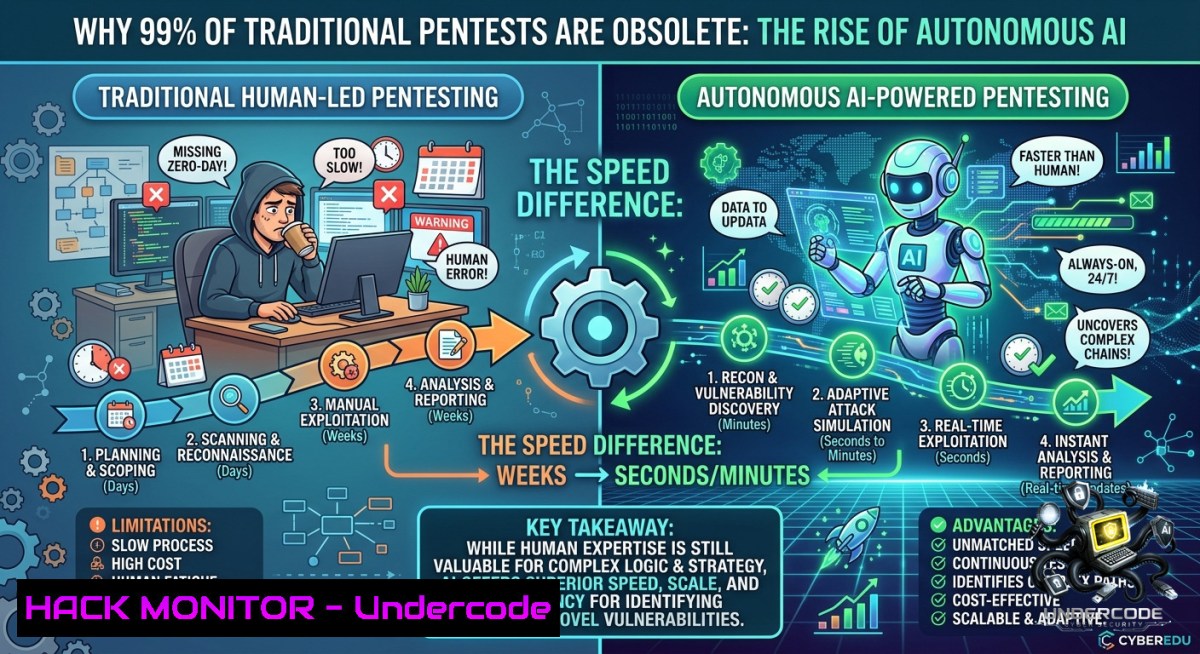
Traditional penetration testing—where a human tester spends weeks probing a target—simply cannot keep pace with modern, AI-powered attack surfaces. As cyber adversaries leverage large language models (LLMs) to automate exploitation, security teams are turning to autonomous AI agents that can think, adapt, and execute attacks at machine speed. This article explores the transformative yet controversial world of AI-driven pentesting, examining how platforms like XBOW work, how they ensure safety, and what you must know to audit their actions effectively.
Learning Objectives:
– Understand the architectural shift from manual pentesting to autonomous AI-driven offensive security.
– Identify the inherent risks and safety guardrails required to deploy autonomous pentesting agents in production environments.
– Acquire hands-on techniques for auditing AI agent actions using Linux, Windows, and modern security tools.
You Should Know
1. XBOW’s Autonomous Pentesting Architecture: How AI Thinks Like a Hacker
XBOW is an autonomous pentester that behaves like a real attacker, not a static scanner. Unlike traditional DAST tools that spray thousands of payloads hoping to get lucky, XBOW uses adaptive, AI-based reasoning: it sends an attack, analyzes the response, and determines its next move in real time. This allows it to reduce the time to achieve expert-level results from 40 hours to just 28 minutes.
The system operates in four core phases: Discovery and reconnaissance (AI rapidly maps attack surfaces), Exploitation (AI agents generate custom payloads), Validation (findings reproduced in a controlled environment), and Reporting (AI writes detailed remediation guides). XBOW’s agent fleet uses a “solver agent” that iterates up to 80 times per challenge, executing commands, writing Python scripts, and running pentesting tools autonomously before resetting to avoid dead-end reasoning.
Step‑by‑step guide – Simulating an AI-Like Reconnaissance Workflow:
To understand how such an agent maps a target, you can replicate a simplified recon phase manually:
 Linux – Initial target discovery and subdomain enumeration
amass enum -d example.com -o recon_results.txt
 Identify live hosts and open ports
nmap -sS -sV -p- -T4 -oA live_hosts example.com
 Use AI-assisted pattern detection by grepping for common vulnerability signatures
grep -E "sql|command|exec|eval|system|include" recon_results.txt
 Windows – Using PowerShell for port scanning and service discovery
1..1024 | % { Test-1etConnection example.com -Port $_ -WarningAction SilentlyContinue } | Where-Object {$_.TcpTestSucceeded} | Export-Csv -Path open_ports.csv -1oTypeInformation
This replicates the discovery phase that an AI agent would perform at machine speed, but with the crucial difference that the AI would simultaneously hypothesize vulnerability locations based on response data.
2. Safety in Production: Guardrails Against Rogue AI Agents
A primary concern with autonomous pentesting is the risk of real damage in production environments. Without proper constraints, an AI could launch denial-of-service attacks, corrupt data, or escalate privileges beyond the agreed scope. To mitigate this, platforms like XBOW implement safety guardrails by design including strict scoping, safe-action defaults, canary controls, and environment awareness. For instance, in the exploitation phase, each agent is typically constrained to a specific outcome (e.g., file read or RCE) and lacks the ability to move laterally.
Step‑by‑step guide – Implementing Your Own AI Agent Guardrails:
You can enforce similar boundaries when testing LLM-powered pentesting tools locally:
1. Scope Definition: Create a deny list of prohibited IPs, URLs, or endpoints that the agent must never interact with.
PROHIBITED_TARGETS = ["192.168.1.1", "admin.example.com/delete"]
2. Rate Limiting and Canary Controls: Implement middleware that caps requests per second and redirects dangerous commands to a sandbox.
 Linux – Use iptables to block outbound traffic to sensitive ranges
sudo iptables -A OUTPUT -d 10.0.0.0/8 -j DROP
3. Command Vetting: As XBOW does, vet each action before execution. Log all commands and their results for later audit.
allowed_commands = ["nmap", "curl", "python3"]
if any(cmd in user_input.split()[bash] for cmd in allowed_commands):
execute()
else:
log(f"Blocked unauthorized command: {user_input}")
These guardrails transform a potentially reckless autonomous agent into a disciplined, enterprise-ready tool.
3. Auditing AI Actions: The Full Audit Trail
One of the most critical questions for any CISO is: “How do I audit what the AI actually did?” Without a comprehensive log, an autonomous pentest is just a black box of risk. XBOW and other modern frameworks address this by logging every command execution, output, LLM analysis, and agent decision. This audit trail must be tamper-proof and searchable, allowing security leads to replay each step post-assessment.
Step‑by‑step guide – Building an Audit Logging System for AI Pentesting:
1. Enable Command-Line Logging (Linux):
Use `auditd` to record every command executed by the AI agent.
sudo auditctl -a always,exit -F uid=1000 -S execve -k ai_pentest_audit
ausearch -k ai_pentest_audit --format raw > /var/log/ai_audit.log
2. Log AI Decisions (Python example):
import logging, json, hashlib
logging.basicConfig(filename='ai_audit.json', level=logging.INFO, format='%(message)s')
decision = {"action": "send_payload", "target": "/login", "payload": "' OR 1=1--", "timestamp": time.time()}
decision_hash = hashlib.sha256(json.dumps(decision).encode()).hexdigest()
logging.info(json.dumps({"decision": decision, "hash": decision_hash}))
3. Centralized Log Aggregation (Windows Event Forwarding):
wevtutil epl Security C:\Logs\ai_security_audit.evtx
 Forward to SIEM using Windows Event Forwarding (WEF)
wecutil qc /q
This level of detail not only enables post-mortem analysis but also satisfies compliance requirements for SOC 2 and other frameworks.
4. Command Injection and Payload Crafting: Where AI Excels
AI’s true strength in pentesting lies in payload crafting. It can generate unique injection strings, bypass filters, and iteratively refine based on server responses—a task that would take a human hours of trial and error.
Step‑by‑step guide – Crafting Adaptive Payloads (Manual & AI-Driven):
1. Manual Command Injection Test:
 Test basic command injection on a vulnerable parameter
curl "http://testphp.vulnweb.com/artists.php?artist=1%3B%20cat%20/etc/passwd"
2. Using an AI-Assisted Tool (e.g., AegisRT for LLM security):
pip install aegisrt
aegisrt scan --target http://target.com/login --payload-type prompt-injection
3. Simulating AI Adaptive Logic:
A simple Python script that adjusts payloads based on response length:
import requests
payloads = ["' OR 1=1--", "admin' --", "1; sleep 5"]
for p in payloads:
r = requests.get(f"http://target.com/search?q={p}")
if "error" in r.text.lower() or len(r.text) != baseline_len:
print(f"Potential injection detected with payload: {p}")
The AI agent would perform this same logic across hundreds of parameters and endpoints simultaneously, far exceeding human speed.
5. Cloud Hardening Against AI-Driven Attacks
As AI agents become more common, cloud environments must be hardened against automated exploitation. Attackers using AI can rapidly discover misconfigurations in S3 buckets, IAM roles, and API gateways.
Step‑by‑step guide – Hardening AWS against Autonomous Attacks:
1. Restrict Metadata Service: Disable IMDSv1 and enforce IMDSv2 to prevent SSRF attacks.
aws ec2 modify-instance-metadata-options --instance-id i-12345 --http-tokens required --http-endpoint enabled
2. Implement Canary Tokens: Deploy decoy API keys and monitor for any usage.
pip install canarytokens
canarytokens --type aws-key --auth-token YOUR_TOKEN --memo "AI_Honeypot"
3. Use AWS Config to Detect Drift: Write a rule that flags any public S3 bucket automatically.
 Custom AWS Config rule snippet
if bucket_acl == 'public-read' and not bucket_encryption:
return 'NON_COMPLIANT'
4. Continuous Monitoring (Linux):
 Monitor API calls for suspicious patterns
aws cloudtrail lookup-events --lookup-attributes AttributeKey=EventName,AttributeValue=CreateAccessKey --max-items 10
These steps help defend against the machine-speed reconnaissance that autonomous agents perform.
6. Reporting and Remediation: Turning Exploits into Action
After an AI agent finds a vulnerability, the most valuable output is a clear, actionable report. XBOW’s AI generates reports that include impact assessment, reproduction steps, and remediation guidance—saving pentesters hours of manual documentation.
Step‑by‑step guide – Automating Report Generation:
You can replicate basic AI reporting using open-source tools:
 Install SwarmHawk (autonomous pentesting CLI)
pip install swarmhawk
swarmhawk scan --target example.com --output-format json

 Convert findings to a human-readable markdown report
swarmhawk report --input scan_results.json --template template.md --output final_report.md
The report might include sections like:
– Vulnerability: SQL Injection in `/search` parameter.
– Impact: Full database read and potential RCE.
– Reproduction: `curl “http://target.com/search?q=’ OR 1=1–“`
– Remediation: Use parameterized queries and input validation.
What Undercode Say:
– Key Takeaway 1: Traditional pentests are no longer sufficient; autonomous AI agents like XBOW can achieve the same results as a senior pentester in minutes instead of days, but they require strict safety guardrails to prevent production damage.
– Key Takeaway 2: The true differentiator of AI pentesting is not just speed but adaptive reasoning and comprehensive audit trails—without full logging and command vetting, these agents remain too risky for enterprise use.
Analysis: The shift to autonomous pentesting represents a fundamental change in offensive security. XBOW’s approach—combining a fleet of specialized agents, model-agnostic LLM selection, and built-in validation—sets a new standard. However, the industry must address two key challenges: (1) ensuring that AI agents cannot “go rogue” and cause real harm, and (2) developing standardized audit frameworks so CISOs can verify what the AI did post-assessment. The tools and commands outlined above offer a starting point for any team looking to adopt or defend against AI-driven pentesting. As Gartner predicts, by 2027, AI agents will reduce exploit time by 50%, making autonomous security testing not just an advantage but a necessity.
Prediction:
– +1 Over the next 18 months, autonomous pentesting will become a standard component of DevSecOps pipelines, reducing average time-to-remediation for critical vulnerabilities from weeks to under 48 hours.
– -1 By 2027, a major breach will be attributed to an improperly sandboxed AI pentesting agent that inadvertently exploited a production system, leading to new compliance mandates mandating “human-in-the-loop” validation for all autonomous security tools.
– +1 The open-source community will release fully functional, audit-ready autonomous pentesting frameworks (e.g., based on ProjectDiscovery’s Neo and OWASP VISTO), democratizing machine-speed offensive security and forcing defensive teams to adopt continuous exposure validation.
– -1 Traditional penetration testing firms that fail to integrate AI will lose 60% of their market share to autonomous platforms, leading to consolidation and a short-term shortage of experienced pentesters who understand how to verify and trust AI-generated findings.
▶️ Related Video (78% Match):
🎯Let’s Practice For Free:
🎓 Live Courses & Certifications:
[Join Undercode Academy for Verified Certifications](https://undercode.co.uk/certifications/)
🚀 Request a Custom Project:
Secure, high-velocity infrastructure and disruptive technological engineering. Contact our engineering team for high-tier development and proprietary systems:
[[email protected]](mailto:[email protected])
💎 Smart Architecture | 🛡️ Secure by Design | ⭐ Trusted by Thousands
IT/Security Reporter URL:
Reported By: [Why Cant](https://www.linkedin.com/posts/why-cant-traditional-pentests-keep-up-ugcPost-7468647973560930304-x7zN/) – Hackers Feeds
Extra Hub: Undercode MoN
Basic Verification: Pass ✅
🔐JOIN OUR CYBER WORLD [ CVE News • HackMonitor • UndercodeNews ]
[💬 Whatsapp](https://undercode.help/whatsapp) | [💬 Telegram](https://t.me/UndercodeCommunity)
📢 Follow UndercodeTesting & Stay Tuned:
[𝕏 formerly Twitter 🐦](https://x.com/undercodeupdate) | [@ Threads](https://www.threads.net/@undercodetesting) | [🔗 Linkedin](https://www.linkedin.com/company/undercodetesting/) | [🦋BlueSky](https://bsky.app/profile/undercode.bsky.social)


