Listen to this Post
Introduction:
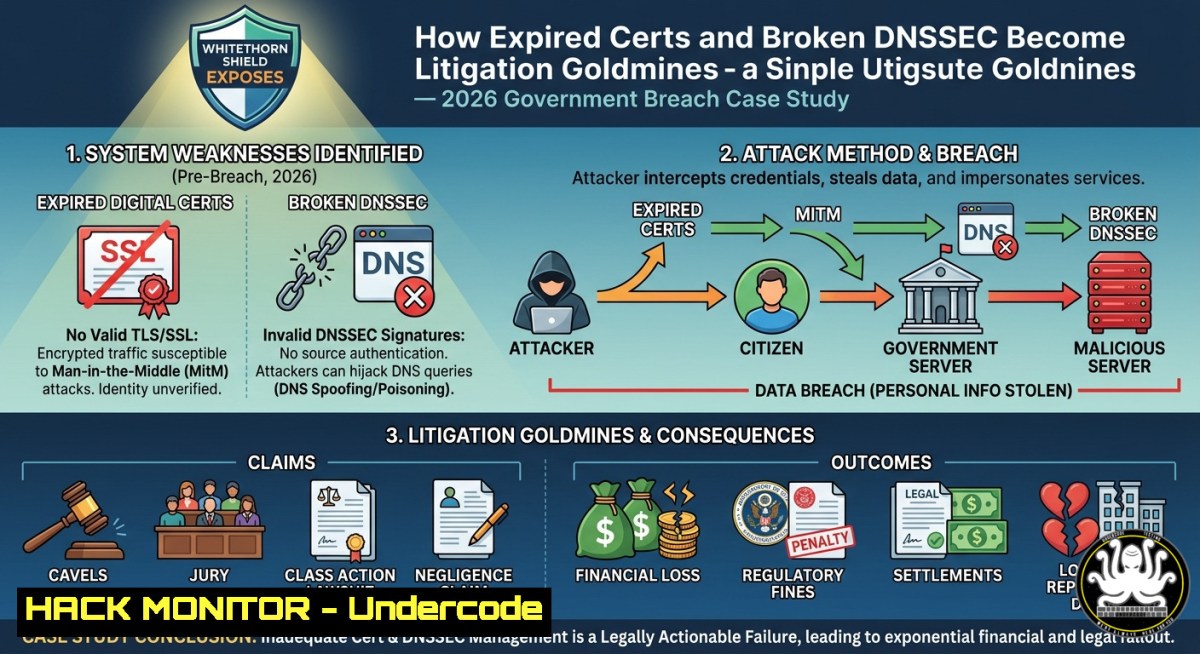
In modern cybersecurity, the difference between compliance and negligence is often binary: either your DNSSEC is secure, or it is not; either your HTTPS redirection works, or it fails. Attack Surface Management (ASM) gaps are not just technical oversights—they are provable violations of regulations like GDPR, DORA, HIPAA, and CMMC. Whitethorn Shield’s new litigation-grade evidence service captures timestamped, independently verifiable data that turns expired certificates and missing HSTS headers into court-ready proof of governance failure.
Learning Objectives:
- Identify and document insecure DNS/DNSSEC configurations using open-source command-line tools
- Perform forensic analysis of TLS certificates, HSTS enforcement, and HTTP redirect chains
- Map common ASM weaknesses to specific regulatory compliance violations (GDPR, HIPAA, DORA, etc.)
- Preserve timestamped, verifiable evidence suitable for litigation and expert witness reports
You Should Know:
- Attack Surface Mapping – Finding Expired Certs & Missing HSTS
The first step in litigation-grade evidence is discovering what an organization exposed to the internet. Whitethorn Shield’s case example (Government Insurance Agency, May 2026) found an expired certificate on the public homepage (27 days expired), zero secure subdomains, and a D-grade (30/100) on Mozilla Observatory due to missing HTTPS redirect and HSTS.
Step‑by‑step guide to enumerate attack surface and detect expired certificates:
Linux / macOS (using openssl and curl):
 Enumerate subdomains (passive) – use crt.sh or securitytrails
curl -s "https://crt.sh/?q=%.example.com&output=json" | jq -r '.[].name_value' | sort -u

Check certificate expiration for a domain
echo | openssl s_client -servername example.com -connect example.com:443 2>/dev/null | openssl x509 -noout -dates

Batch check multiple subdomains from a file
while read d; do
expiry=$(echo | openssl s_client -servername "$d" -connect "$d":443 2>/dev/null | openssl x509 -noout -enddate 2>/dev/null | cut -d= -f2)
echo "$d : $expiry"
done < subdomains.txt

Test HSTS and HTTPS redirect
curl -sIL http://example.com | grep -i "location|strict-transport-security"
Windows (PowerShell):
 Check certificate expiry
$cert = New-Object System.Net.Sockets.TcpClient("example.com", 443)
$stream = $cert.GetStream()
$ssl = New-Object System.Net.Security.SslStream($stream)
$ssl.AuthenticateAsClient("example.com")
$ssl.RemoteCertificate.NotAfter

Test HSTS header
Invoke-WebRequest -Uri "https://example.com" -UseBasicParsing | Select-Object -ExpandProperty Headers
Interpretation: If the expiry date is in the past or within 30 days, it indicates weak lifecycle management. Missing `Strict-Transport-Security` header means HSTS is not enforced, violating NIST SP 800-53 and ISO 27001 controls.
2. DNSSEC Validation – Detecting Insecure Delegations
Whitethorn Shield’s assessment found “7 insecure RRsets, 2 errors, 3 warnings” on an employee SSO portal. DNSSEC insecurity means attackers can spoof DNS responses, redirect users to phishing sites, and bypass authentication.
Step‑by‑step guide to validate DNSSEC with dig (Linux):
 Check if DNSSEC is enabled for a domain
dig +dnssec example.com SOA

Look for "ad" (authenticated data) flag in response
dig +dnssec +multi example.com A | grep "flags:"

Verify DNSKEY and RRSIG records
dig +dnssec example.com DNSKEY
dig +dnssec example.com A +sigchase

Detect broken chain of trust (no RRSIG or invalid)
dig +dnssec example.com SOA +cd
Windows (using nslookup with DNSSEC extension – requires PowerShell module):
Resolve-DnsName -Name example.com -Type SOA -DnssecOK
Step‑by‑step forensic documentation:
- Run `dig +dnssec example.com A` and capture full output with timestamp (
date -u +"%Y-%m-%dT%H:%M:%SZ"). - Look for `flags: qr rd ra ad` – if `ad` missing, response is insecure.
- Use `rndc` (BIND) or `unbound` to validate from recursive resolver perspective.
- Hash output files using SHA256 (
sha256sum output.txt) for integrity preservation.
Legal relevance: DNSSEC insecurity directly violates PSPF Direction 002-2024 (Australia), NIST SP 800-81r3, and PCI DSS v4.0 requirement 2.2.
3. TLS Certificate Forensics – Expired, Mismatched, Untrusted
Expired certificates on public homepages (as in the May 2026 case) are prima facie evidence of neglected governance. Whitethorn Shield also reported “internal API endpoint labelled ‘internal2’ exposed with expired certificate.”
Step‑by‑step certificate chain validation and mismatch detection:
Linux:
 Full certificate chain and validation
openssl s_client -showcerts -servername example.com -connect example.com:443

Extract subject and issuer – detect mismatched CN/SAN
echo | openssl s_client -servername example.com -connect example.com:443 2>/dev/null | openssl x509 -noout -subject -issuer -ext subjectAltName

Check revocation status using CRL (requires wget/curl)
openssl s_client -connect example.com:443 2>&1 < /dev/null | openssl x509 -noout -text | grep -A4 "X509v3 CRL Distribution Points"
Windows (PowerShell):
 Get certificate chain and check expiration
$cert = Get-Acl "Cert:\CurrentUser\My"  Not direct; use .NET as above
 Better: Use Test-NetConnection and custom function
Test-NetConnection example.com -Port 443
Automated forensic script (Linux) to log evidence:
!/bin/bash
domain=$1
timestamp=$(date -u +"%Y-%m-%d_%H-%M-%S")
logfile="cert_${domain}_${timestamp}.log"
{
echo "=== DOMAIN: $domain ==="
echo "Timestamp: $timestamp UTC"
echo | openssl s_client -servername "$domain" -connect "$domain":443 2>/dev/null | openssl x509 -noout -issuer -subject -dates -ext subjectAltName
echo "HTTP Observatory grade (simulated):"
curl -s "https://http-observatory.security.mozilla.org/api/v1/analyze?host=$domain" | jq .grade
} | tee "$logfile"
sha256sum "$logfile" >> "$logfile.sha256"
You should know: Missing revocation checking and expired certs violate HIPAA Security Rule §164.312(a)(2)(iv) and NYDFS 23 NYCRR 500.
- Internal API Exposure – Finding Public-Facing Internal Endpoints
The case example identified “internal2” API endpoint exposed to the internet with an expired certificate. This is a classic “shadow IT” and governance failure.
Step‑by‑step discovery using content discovery tools:
Linux (using ffuf, gospider, or simple grep):
 Fetch common API paths from robots.txt, JS files, and HTML
wget -q https://example.com/robots.txt && cat robots.txt | grep -i "api|internal|dev"

Use ffuf to brute-force internal paths
ffuf -u https://example.com/FUZZ -w /usr/share/seclists/Discovery/Web-Content/api-words.txt -c -t 50 -fc 404

Extract internal-looking URLs from JavaScript
curl -s https://example.com/app.js | grep -Eo "https?://[^\"']+internal[^\"']"
Windows (PowerShell + Invoke-WebRequest):
$js = Invoke-WebRequest -Uri "https://example.com/app.js" -UseBasicParsing
$js.Content | Select-String -Pattern "https?://[^\"']internal[^\"']"
Mitigation command (for defenders – nginx block rule):
location ~ /internal(2)?/ {
deny all;
return 403;
}
Legal angle: Exposed internal APIs without encryption or access controls breach GDPR 32 (security of processing) and CMMC AC.1.001.
5. Preserving Litigation-Grade Evidence – Timestamping & Hashing
Whitethorn Shield emphasizes “observable, timestamped, independently verifiable evidence.” You must create an immutable chain of custody.
Step‑by‑step evidence capture workflow:
- Set time source: Use NTP sync (
sudo ntpdate -u pool.ntp.orgon Linux; `w32tm /resync` on Windows).
2. Capture raw command outputs with full timestamps:
script -q evidence_$(date -Iseconds).log
dig +dnssec example.com A +multi
openssl s_client -connect example.com:443 -showcerts 2>&1
curl -sIL http://example.com
exit
3. Create SHA256 hashes of log files:
sha256sum evidence_.log > hashes.txt
4. Sign the hash file with GPG (optional for court admissibility):
gpg --clearsign hashes.txt
5. Store on read-only media or blockchain timestamp service (e.g., OpenTimestamps).
Windows equivalent:
Get-FileHash evidence.log -Algorithm SHA256 | Out-File hashes.txt
You should know: Without cryptographic integrity proof, logs are hearsay. Whitethorn Shield’s model relies on verifiability – any third party can repeat the commands and confirm results.
- Regulatory Mapping – From Technical Flaw to Compliance Violation
Whitethorn Shield’s service maps findings directly to legal frameworks. Here’s how to build your own mapping table.
Step‑by‑step compliance checklist for ASM gaps:
| Technical Finding | Regulation | Violation Clause |
|-|||
| Expired TLS certificate | HIPAA | §164.312(a)(2)(iv) – integrity controls |
| Missing HSTS | PCI DSS v4.0 | Req. 2.2.4 – secure configuration |
| DNSSEC insecure | PSPF (Australia) | Direction 002-2024 – critical DNS protection |
| Exposed internal API | GDPR | Art. 32 – appropriate technical measures |
| No HTTPS redirect | CMMC | AC.L2-3.1.19 – encrypt CUI in transit |
Automated mapping script (Linux using bash and curl to API):
 Example: fetch Mozilla Observatory results and map to NIST CSF
score=$(curl -s "https://http-observatory.security.mozilla.org/api/v1/analyze?host=example.com" | jq .score)
if [ "$score" -lt 50 ]; then
echo "FAIL: Grade F/D → Likely violates NIST SP 800-53 CM-6 (configuration settings)"
fi
Defender remediation commands (for immediate hardening):
 Enforce HSTS on Apache (add to .htaccess or vhost)
Header always set Strict-Transport-Security "max-age=31536000; includeSubDomains; preload"

Redirect HTTP to HTTPS on Nginx
server {
listen 80;
server_name example.com;
return 301 https://$server_name$request_uri;
}
What Undercode Say:
- Key Takeaway 1: Expired certificates and missing DNSSEC are not “minor misconfigurations” – they are litigable failures that have persisted for years (2024–2026 in the government case). Attack Surface Management is now a legal compliance requirement, not just a security best practice.
- Key Takeaway 2: Whitethorn Shield’s model of timestamped, public-source evidence removes any excuse for “we didn’t know.” Any third party can independently verify the same insecure state, making it nearly impossible to dispute in court. This shifts cyber accountability from reactive breach response to proactive governance auditing.
Analysis (10 lines):
The government insurance agency example – zero secure subdomains, expired cert on homepage, DNSSEC errors, exposed internal API, and Mozilla D grade – illustrates a systemic failure that regulators will increasingly treat as gross negligence. Unlike a zero‑day exploit, these are known, measurable weaknesses with clear remediation steps. Whitethorn Shield’s emphasis on binary answers (secure/insecure) removes ambiguity; a judge or jury doesn’t need deep technical expertise to understand “certificate expired 27 days ago.” The legal world is catching up – frameworks like DORA (EU) and PSPF (Australia) now explicitly require continuous ASM and certificate lifecycle management. Expect a surge in class‑action lawsuits and regulatory fines using exactly this type of evidence. Organizations that cannot produce their own signed, timestamped ASM reports will be forced to rely on third‑party experts – and the evidence will likely show negligence. The only safe path is automated, continuous, verifiable attack surface scanning integrated with compliance reporting.
Prediction:
-
- Courts and regulators will standardize “digital evidence of ASM failure” as a distinct category, similar to digital forensics, creating a new legal tech sub-industry.
-
- Insurance carriers will mandate third‑party ASM audits (like Whitethorn Shield) before underwriting cyber policies, driving premium reductions for verifiably secure organizations.
-
- SMBs that ignore ASM will face disproportionately high fines and lawsuit payouts because their insecure configurations are easily discoverable and irrefutable – no advanced hacking required.
▶️ Related Video (72% Match):
🎯Let’s Practice For Free:
IT/Security Reporter URL:
Reported By: Andy Jenkinson – Hackers Feeds
Extra Hub: Undercode MoN
Basic Verification: Pass ✅
🎓 Live Courses & Certifications:
Join Undercode Academy for Verified Certifications
🚀 Request a Custom Project:
Secure, high-velocity infrastructure and disruptive technological engineering. Contact our engineering team for high-tier development and proprietary systems:
[email protected]


