Listen to this Post
Introduction:
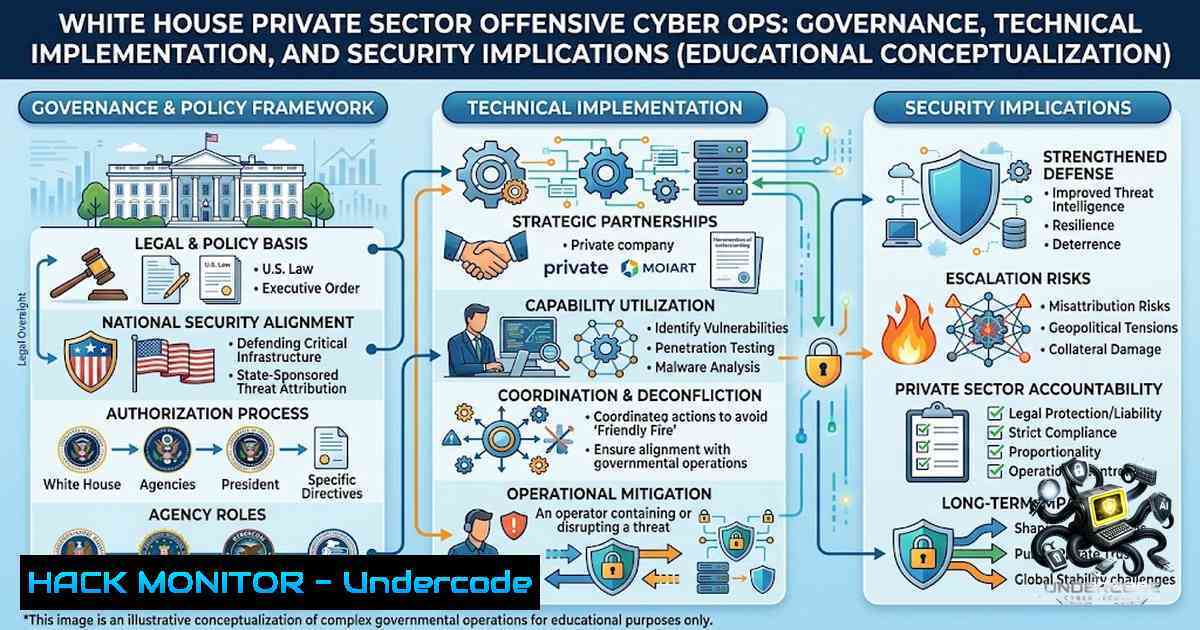
The White House national security memorandum issued August 12, 2026, marks a fundamental shift in U.S. cyber strategy—authorizing select private sector companies to participate in offensive hacking operations against transnational cyber threat groups. While companies like Microsoft and Google have long collaborated with the government on takedown operations, this memorandum expands the program and formalizes private sector involvement in what was traditionally the exclusive domain of military and intelligence agencies. The central challenge is no longer whether private expertise should be involved, but how to establish technical and governance guardrails that prevent authorized partners from becoming independent cyber privateers.
Learning Objectives:
- Understand the technical architecture and command hierarchy required for government-directed private sector offensive operations
- Master attribution, target validation, and legal authorization frameworks in collaborative cyber operations
- Implement defensive monitoring and incident response protocols to detect unauthorized offensive activities originating from partner networks
You Should Know:
- Command and Control Architecture for Government-Private Sector Cyber Operations
The memorandum establishes that military, intelligence, and law enforcement agencies retain control over attribution, target selection, legal authorization, coordination with allies, and escalation decisions. Authorized partners can contribute intelligence, infrastructure access, technical capabilities, and operational personnel within a clearly defined mission. This requires a technical architecture that enforces government command authority at every level.
Step-by-Step Guide: Implementing a Government-Directed Operational Framework
- Establish Secure Communication Channels: Deploy encrypted point-to-point links between partner operations centers and government command nodes using NSA-approved cryptographic suites. Configure IPsec tunnels with mutual authentication:
Linux (StrongSwan):
 Install StrongSwan
sudo apt-get install strongswan strongswan-pki
 Generate CA certificate
pki --gen --type rsa --size 4096 --outform pem > ca-key.pem
pki --self --ca --lifetime 3650 --in ca-key.pem --type rsa --dn "CN=GovCyberCA" --outform pem > ca-cert.pem
 Configure ipsec.conf for government peer
sudo nano /etc/ipsec.conf
conn gov-cyber-ops
left=%defaultroute
[email protected]
leftcert=partner-cert.pem
right=gov-cyber-command.mil
[email protected]
rightsubnet=10.0.0.0/8
authby=pubkey
auto=start
ikelifetime=8h
keylife=1h
ike=aes256-sha256-modp2048
esp=aes256-sha256
Windows (PowerShell – Built-in VPN):
 Create VPN connection with machine certificate authentication
Add-VpnConnection -1ame "GovCyberOps" -ServerAddress "gov-cyber-command.mil" `
-TunnelType Ikev2 -AuthenticationMethod MachineCertificate `
-EncryptionLevel Required -PassThru
 Set IPsec encryption
Set-VpnConnectionIPsecConfiguration -ConnectionName "GovCyberOps" `
-AuthenticationTransformConstants SHA256 -CipherTransformConstants AES256 `
-EncryptionMethod AES256 -IntegrityCheckMethod SHA256 `
-PfsGroup ECP256 -PassThru
- Deploy Mission-Specific Access Controls: Implement role-based access control (RBAC) that restricts partner personnel to predefined operational parameters. Use attribute-based access control (ABAC) with tags for target categories, authorized actions, and time windows.
-
Implement Continuous Monitoring and Audit Logging: All partner actions must be logged with cryptographic chain-of-custody for forensic review. Deploy centralized logging with tamper-evident storage.
2. Attribution and Target Validation in Collaborative Operations
Attribution is rarely certain—adversaries route attacks through infrastructure belonging to legitimate organizations and plant false flags. In a collaborative model where private sector partners contribute intelligence and visibility, the risk of acting on incorrect attribution increases.
Step-by-Step Guide: Building a Multi-Source Attribution Pipeline
- Aggregate Threat Intelligence Feeds: Combine government intelligence, private sector telemetry, and open-source intelligence (OSINT). Normalize indicators of compromise (IoCs) using STIX/TAXII:
 Python script to aggregate and normalize IoCs from multiple sources
import stix2
import requests

Fetch government threat intelligence feed
gov_feed = requests.get('https://gov-cyber-feed.mil/api/v1/indicators',
headers={'Authorization': 'Bearer ${GOV_API_KEY}'})

Fetch private sector telemetry
private_feed = requests.get('https://telemetry.partner-company.com/api/indicators',
headers={'Authorization': 'Bearer ${PARTNER_API_KEY}'})

Normalize into STIX 2.1 format
indicators = []
for ioc in gov_feed.json()['indicators']:
indicator = stix2.Indicator(
pattern=f"[{ioc['type']}:value = '{ioc['value']}']",
pattern_type="stix",
confidence=ioc.get('confidence', 50),
labels=['government-source']
)
indicators.append(indicator)
- Implement Cross-Validation Workflow: Require corroboration from at least two independent sources before any offensive action is authorized. Use a weighted confidence scoring system:
-- PostgreSQL table for attribution scoring
CREATE TABLE attribution_scores (
target_id UUID PRIMARY KEY,
target_identifier TEXT NOT NULL,
gov_confidence INTEGER CHECK (gov_confidence BETWEEN 0 AND 100),
partner_confidence INTEGER CHECK (partner_confidence BETWEEN 0 AND 100),
osint_confidence INTEGER CHECK (osint_confidence BETWEEN 0 AND 100),
weighted_score INTEGER GENERATED ALWAYS AS
(gov_confidence  0.5 + partner_confidence  0.3 + osint_confidence  0.2) STORED,
requires_human_review BOOLEAN GENERATED ALWAYS AS (weighted_score < 85) STORED,
created_at TIMESTAMP DEFAULT CURRENT_TIMESTAMP
);
- Establish Escalation Procedures: Define clear thresholds for when human intervention is required—particularly when autonomous systems are involved.
3. Legal Authorization and Compliance Frameworks
Selected companies are subject to $1 million fines for violations of the program. This creates significant compliance requirements that must be embedded into technical workflows.
Step-by-Step Guide: Embedding Legal Authorization into Operational Tooling
- Implement Digital Authorization Workflows: Every operation requires a digitally signed authorization order from the appropriate government agency. Deploy a workflow engine that validates signatures before any action:
 Linux: Verify GPG-signed authorization orders
gpg --verify operation-order-2026-08-15.sig operation-order-2026-08-15.txt
 Extract authorization parameters
cat operation-order-2026-08-15.txt | jq '.target, .authorized_actions, .time_window, .legal_basis'
- Enforce Time-Bounded Operations: Authorization orders must include explicit time windows. Implement automated revocation when time expires:
 Python: Time-bound authorization enforcement
from datetime import datetime, timedelta
import json

def validate_authorization(order_file):
with open(order_file) as f:
order = json.load(f)

Check if within authorized time window
now = datetime.utcnow()
start = datetime.fromisoformat(order['authorized_start'])
end = datetime.fromisoformat(order['authorized_end'])

if not (start <= now <= end):
raise PermissionError("Authorization window has expired")

Check if target matches authorized target list
 Implement target validation logic
return True
- Maintain Immutable Audit Trails: All actions must be logged with reference to the specific authorization order that authorized them. Use blockchain or similar tamper-evident storage for audit trails.
4. Defensive Monitoring for Unauthorized Offensive Activities
Chris Jacob, Field CISO at Securonix, noted that private-sector teams moving closer to offensive operations adjust the risk they carry personally and professionally. Organizations must implement defensive monitoring to detect unauthorized offensive activities originating from their networks.
Step-by-Step Guide: Detecting Unauthorized Offensive Activities
- Deploy Network Detection and Response (NDR): Monitor for outbound exploitation traffic, C2 beaconing, and data exfiltration patterns:
 Linux: Monitor for suspicious outbound connections using Zeek (formerly Bro)
 Install Zeek
sudo apt-get install zeek

Zeek script to detect potential exploitation traffic
cat > /usr/local/zeek/share/zeek/site/detect-offensive.zeek << 'EOF'
module OffensiveDetection;

export {
redef enum Log::ID += { LOG };
type Info: record {
ts: time &log;
uid: string &log;
id: conn_id &log;
proto: string &log;
service: string &log &optional;
offense_score: count &log;
indicators: string &log &optional;
};
}

event connection_established(c: connection) {
 Detect known exploitation patterns
if (c$id$resp_p == 445 && /\x00\x00\x00\x85/ in c$orig) {
Log::write(OffensiveDetection::LOG, [
$ts=network_time(),
$uid=c$uid,
$id=c$id,
$proto=get_port_transport_proto(c$id$resp_p),
$offense_score=80,
$indicators="SMB exploitation pattern detected"
]);
}
}
EOF
- Implement UEBA for Insider Threat Detection: Monitor for anomalies in user behavior—particularly personnel with access to offensive tooling:
 Windows PowerShell: Monitor for unusual privilege usage
Get-WinEvent -FilterHashtable @{LogName='Security'; ID=4672} |
Where-Object { $<em>.TimeCreated -gt (Get-Date).AddHours(-24) } |
Group-Object -Property @{Expression={$</em>.Properties[bash].Value}} |
Where-Object { $_.Count -gt 10 } |
Export-Csv -Path "C:\Security\unusual_privilege_usage.csv" -1oTypeInformation
- Establish a SOC Playbook for Partner Activities: Define specific procedures for investigating suspicious activities originating from partner networks.
5. Autonomous Cyber Agents and Machine-Speed Operations
Anurag Gurtu, co-founder and CEO at Airrived, warned that we are rapidly moving toward autonomous cyber agents fighting at machine speed. The future of cyber is governed offense—get the governance right, and the cost of cybercrime increases dramatically; get it wrong, and the cost of mistakes multiplies.
Step-by-Step Guide: Implementing Governance for Autonomous Offensive Operations
- Define Operational Boundaries for Autonomous Agents: Implement guardrails that prevent autonomous agents from acting outside authorized parameters:
 Python: Autonomous agent governance framework
class AutonomousCyberAgent:
def <strong>init</strong>(self, agent_id, authorized_targets, max_concurrent_ops):
self.agent_id = agent_id
self.authorized_targets = authorized_targets
self.max_concurrent_ops = max_concurrent_ops
self.active_ops = []
self.action_log = []

def validate_action(self, target, action_type):
 Check if target is authorized
if target not in self.authorized_targets:
self.log_unauthorized_attempt(target, action_type)
return False

Check rate limiting
if len(self.active_ops) >= self.max_concurrent_ops:
return False

Check if action type is authorized for this target
if action_type not in self.authorized_targets[bash]['allowed_actions']:
return False

return True

def execute(self, target, action_type, payload):
if not self.validate_action(target, action_type):
raise PermissionError(f"Action {action_type} on {target} not authorized")

Execute with full logging
result = self._execute_action(target, action_type, payload)
self.action_log.append({
'timestamp': datetime.utcnow().isoformat(),
'target': target,
'action': action_type,
'result': result,
'authorization_ref': self.authorized_targets[bash]['auth_order_id']
})
return result
- Implement Human-in-the-Loop (HITL) for High-Impact Actions: Define categories of actions that require human approval regardless of automation:
 YAML configuration for HITL thresholds
hitl_requirements:
- action: "target_compromise"
threshold: "any"
requires_human: true
- action: "data_exfiltration"
threshold: "volume > 1GB"
requires_human: true
- action: "persistence_installation"
threshold: "any"
requires_human: true
- action: "lateral_movement"
threshold: "network_hop > 2"
requires_human: true
- action: "exploitation"
threshold: "critical_vulnerability"
requires_human: true
- Implement Automated Kill Switch: Deploy a centralized kill switch capability that can terminate all autonomous operations immediately:
 Linux: Kill switch script
!/bin/bash
 Terminate all autonomous agent processes
pkill -f "autonomous_cyber_agent"

Revoke all active authorizations
curl -X POST https://gov-cyber-command.mil/api/v1/revoke-all \
-H "Authorization: Bearer ${EMERGENCY_TOKEN}" \
-H "Content-Type: application/json" \
-d '{"reason":"emergency_kill_switch_activated","timestamp":"'$(date -u +"%Y-%m-%dT%H:%M:%SZ")'"}'

Lock down network access
sudo iptables -A OUTPUT -d 10.0.0.0/8 -j DROP
What Undercode Say:
- Key Takeaway 1: The technical challenge of private sector offensive operations is not capability—it is control. Attribution, target selection, and escalation decisions must remain with government agencies, with technical controls enforcing these boundaries at every layer. Organizations must implement multi-source attribution pipelines, digital authorization workflows, and tamper-evident audit trails to prevent mission creep.
-
Key Takeaway 2: The rise of autonomous cyber agents operating at machine speed fundamentally changes the risk equation. A precise strike against the wrong target is still the wrong strike, only faster and potentially repeated in parallel. Organizations participating in these programs must implement governance frameworks that include human-in-the-loop thresholds, automated kill switches, and continuous monitoring to detect unauthorized activities before they escalate.
Prediction:
- -1: The privatization of offensive cyber capabilities introduces significant escalation risks. As Tim Mackey noted, endorsing private companies to conduct offensive cyber activity is far more likely to increase criminal and nation-state activity than deter it. Without careful governance, individuals with access to sophisticated surveillance technologies could easily abuse that access for personal gain.
- -1: The memorandum sends a signal to adversaries that the U.S. government needs private companies and their capabilities to defend against cyberattacks. This perceived weakness may embolden threat actors and increase the frequency and sophistication of attacks against both public and private sector targets.
- +1: If governance frameworks are implemented correctly, the collaboration could dramatically increase the cost of cybercrime by enabling faster, more coordinated takedown operations. Private sector visibility into malicious activity, combined with government authority, creates a powerful deterrent.
- -1: The liability question remains unresolved—if a private company attacks the wrong target under government authorization, who owns the mistake? This ambiguity creates significant legal and reputational risks for participating organizations.
- +1: The memorandum may accelerate innovation in defensive technologies as organizations rush to implement the monitoring, attribution, and governance capabilities required for participation. This could benefit the broader cybersecurity ecosystem.
▶️ Related Video (82% Match):
https://www.youtube.com/watch?v=-qwQA-lSYmA
🎯Let’s Practice For Free:
🎓 Live Courses & Certifications:
Join Undercode Academy for Verified Certifications
🚀 Request a Custom Project:
Secure, high-velocity infrastructure and disruptive technological engineering. Contact our engineering team for high-tier development and proprietary systems:
[email protected]
💎 Smart Architecture | 🛡️ Secure by Design | ⭐ Trusted by Thousands
IT/Security Reporter URL:
Reported By: https://lnkd.in/p/eiN3jKmM – Hackers Feeds
Extra Hub: Undercode MoN
Basic Verification: Pass ✅


