Listen to this Post
Introduction:
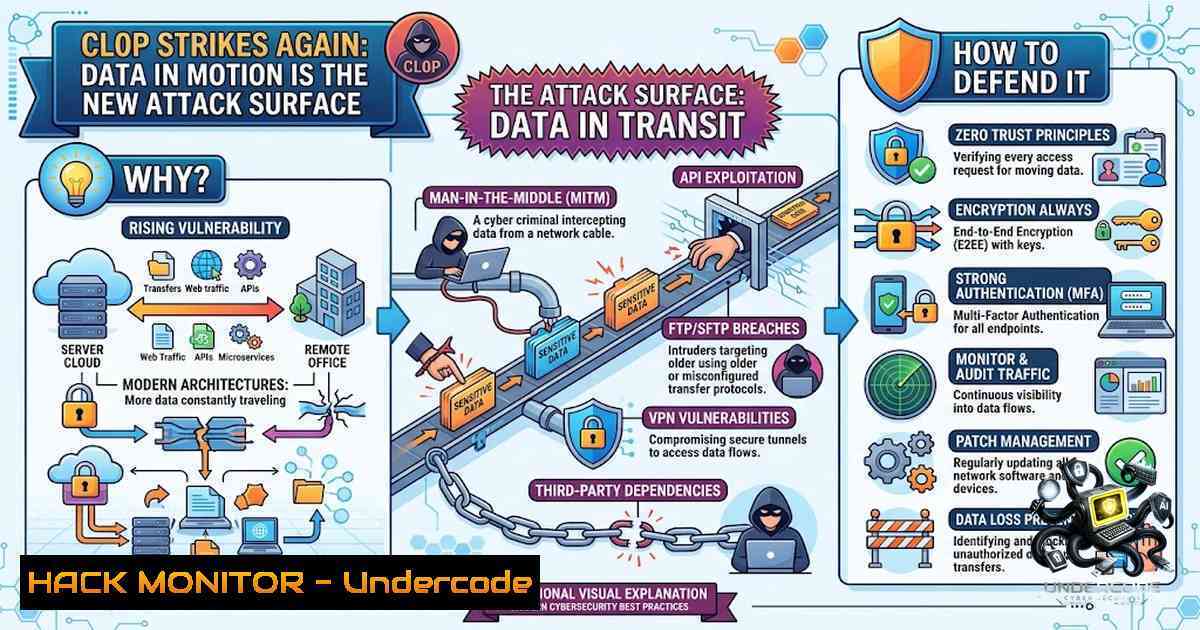
The Russia-linked Cl0p hacking group has claimed responsibility for a massive data theft campaign targeting nearly 50 global enterprises, including Philips, Shell, GE, and Fiserv. While breach investigations typically focus on initial access vectors—the how—security leaders must also ask a more critical question: where could the data go next? In today’s deeply interconnected enterprise environments, sensitive data moves across vendors, cloud services, APIs, AI platforms, and software dependencies, creating thousands of potential exfiltration paths that attackers only need to find one of.
Learning Objectives:
- Understand the operational mechanics of the Cl0p group and its mass-data-exfiltration tactics
- Learn how to map, monitor, and govern data flows across third-party and AI ecosystems
- Implement technical controls to detect and block unauthorized data movement in real time
You Should Know:
- Understanding the Cl0p Threat: Mass Exfiltration via Software Vulnerabilities
Cl0p, a prolific ransomware and extortion group with suspected Russian ties, has demonstrated a consistent playbook: exploit zero-day vulnerabilities in managed file transfer (MFT) and enterprise software to infiltrate networks, then exfiltrate massive volumes of sensitive data before deploying ransomware. In this latest campaign, the group claims to have stolen approximately 89 gigabytes of data from Shell—including engineering drawings—and 13.5 gigabytes from Philips, comprising PDF drawings, diagrams, and blueprints.
The scale is staggering: nearly 50 companies across energy, healthcare, financial services, and technology sectors were simultaneously targeted. This is not a series of isolated incidents—it is a coordinated, industrialized data theft operation.
Step‑by‑step guide: What this means for defenders
- Assume compromise is inevitable. Focus on detection and response speed rather than purely prevention.
- Inventory all internet-facing file transfer and collaboration tools (e.g., MFT servers, SharePoint, Teams, Slack integrations).
- Monitor for unusual outbound data volumes. Establish baseline traffic patterns for each critical system.
- Implement file integrity monitoring on directories containing engineering drawings, blueprints, and intellectual property.
- Deploy data loss prevention (DLP) policies that flag and block uploads of sensitive file types to unauthorized external destinations.
Linux command to detect large outbound transfers:
 Monitor active outbound connections with data volume
sudo nethogs -d 2

Track large file modifications in sensitive directories
sudo inotifywait -m -r -e modify,create /path/to/sensitive/data --format '%w%f %e' | while read file event; do
size=$(stat -c%s "$file" 2>/dev/null || echo 0)
if [ $size -gt 10485760 ]; then  10MB threshold
echo "[bash] Large file modified: $file ($size bytes)"
fi
done
Windows PowerShell command to detect large outbound transfers:
 Monitor outbound network connections with byte counts
Get-1etTCPConnection | Where-Object {$<em>.State -eq "Established"} | ForEach-Object {
$proc = Get-Process -Id $</em>.OwningProcess -ErrorAction SilentlyContinue
[bash]@{
Process = $proc.ProcessName
LocalPort = $<em>.LocalPort
RemoteAddress = $</em>.RemoteAddress
RemotePort = $_.RemotePort
}
}

Audit recent large file creations in sensitive folders
Get-ChildItem -Path "C:\SensitiveData\" -Recurse | Where-Object {$_.Length -gt 10MB} |
Select-Object Name, Length, LastWriteTime, FullName
- Data in Motion: The Blind Spot Traditional Security Misses
Traditional security tools excel at protecting data at rest—encrypted databases, access-controlled file shares, and endpoint DLP. But data in motion—the flow of information between applications, APIs, cloud services, and AI platforms—remains dangerously under-monitored.
When a vendor, AI assistant, or cloud service requests data, security teams often have no visibility into:
– What data is being shared
– Who (or what) is receiving it
– Whether that destination is authorized
– How that data might be further propagated
This blind spot is exactly what Cl0p and similar groups exploit. Once inside, they move laterally, identify high-value data repositories, and exfiltrate through seemingly legitimate outbound channels—often blending with normal business traffic.
Step‑by‑step guide: Building data-in-motion visibility
- Map all data flows between internal systems and external entities (vendors, cloud providers, AI APIs).
- Classify data by sensitivity at the point of egress—not just at rest.
- Deploy a data flow observability layer that inspects API payloads, cloud storage syncs, and third-party integrations in real time.
- Create a dynamic inventory of all third-party and AI services interacting with your data.
- Enforce granular policies based on data classification, destination risk score, and user context.
API inspection with mitmproxy (for testing and validation):
 Install mitmproxy
pip install mitmproxy

Run transparent proxy to inspect API traffic
mitmproxy --mode transparent --showhost

Log all JSON payloads containing sensitive patterns
mitmdump -q | grep -E '"email"|"ssn"|"credit_card"|"password"' >> api_sensitive.log
Cloud hardening: Restrict data egress with AWS S3 bucket policies
{
"Version": "2012-10-17",
"Statement": [
{
"Effect": "Deny",
"Action": "s3:PutObject",
"Resource": "arn:aws:s3:::sensitive-bucket/",
"Condition": {
"StringNotEquals": {
"aws:SourceVpc": "vpc-12345678"
}
}
}
]
}
3. The Third‑Party and AI Exposure Crisis
Modern enterprises rely on hundreds, often thousands, of third-party vendors and AI services. Each integration represents a potential data exfiltration channel. In the Cl0p campaign, the group exploited vulnerabilities in widely used third-party software to gain initial access, then pivoted to steal data from multiple victim organizations simultaneously.
The AI dimension adds new complexity. AI platforms process vast amounts of data—often including proprietary business information, customer records, and intellectual property. When an AI service is compromised, or when API keys are accidentally exposed, the data sent to that service becomes accessible to attackers.
Step‑by‑step guide: Securing third‑party and AI data flows
- Conduct a full inventory of third-party AI and data integration capabilities interacting with your systems via APIs.
- Review all API keys embedded in client-side code, frontend JavaScript, and mobile apps—these can be scraped and abused.
- Implement service-account-backed authentication for AI APIs rather than standard, unrestricted keys.
- Establish data-sharing agreements with all vendors that specify data usage, retention, and breach notification.
- Continuously monitor AI service interactions—what data is sent, where it is processed, and who has access.
Auditing exposed API keys in public repositories:
 Scan a GitHub repository for exposed secrets
git clone https://github.com/yourorg/yourrepo.git
cd yourrepo
grep -r -E "api_key|apikey|secret|token|password" --include=".js" --include=".py" --include=".json" .

Use truffleHog for deep secret scanning
docker run -it -v "$PWD:/pwd" trufflesecurity/trufflehog:latest github --repo https://github.com/yourorg/yourrepo
Azure AI service access restriction:
 Restrict Azure OpenAI access to specific virtual networks
$resource = Get-AzResource -ResourceGroupName "rg-security" -ResourceName "openai-instance" -ResourceType "Microsoft.CognitiveServices/accounts"
$resource.Properties.networkAcls = @{
defaultAction = "Deny"
virtualNetworkRules = @(
@{id = "/subscriptions/xxx/resourceGroups/rg-1etwork/providers/Microsoft.Network/virtualNetworks/vnet-prod/subnets/default"}
)
}
Set-AzResource -ResourceId $resource.ResourceId -Properties $resource.Properties -Force
- GRC Integration: Connecting Data Flows to Contracts and Compliance
Data security is not just a technical problem—it is a governance, risk, and compliance (GRC) challenge. When data flows to a third party, that flow should be backed by a contract that defines permitted usage, security requirements, and breach notification obligations.
Yet in most organizations, there is a disconnect between:
– What data is being shared
– Which contracts govern that sharing
– Whether those contracts are being honored
Step‑by‑step guide: Operationalizing GRC for data flows
- Create a data flow register that maps each data flow to a specific vendor, contract, and data classification.
- Automate contract clause extraction—identify data protection, breach notification, and subprocessor provisions.
- Implement policy-as-code that enforces contractual obligations at the technical layer (e.g., block transfers to vendors without active contracts).
- Generate compliance reports that demonstrate data flow mappings for regulators and auditors.
- Establish breach response playbooks that include immediate data flow termination capabilities.
Enforcing data flow policies with Open Policy Agent (OPA):
package data_flow

default allow = false

allow {
input.destination in data.authorized_destinations
input.data_classification == "public"
}

allow {
input.destination in data.authorized_destinations
input.data_classification == "internal"
input.contract_status == "active"
}

Block all sensitive data to unauthorized destinations
deny[bash] {
input.data_classification == "sensitive"
not input.destination in data.authorized_destinations
msg = sprintf("Sensitive data flow to unauthorized destination: %v", [input.destination])
}
5. Proactive Defense: Building a Data‑in‑Motion Security Program
The Cl0p campaign is a wake-up call. Organizations can no longer afford to treat data security as a perimeter problem. Attackers are inside—or they will be—and the question is whether you can see and stop data as it moves.
A comprehensive data-in-motion security program should include:
- Real-time data flow observability across all environments (on-prem, cloud, hybrid)
- Automated discovery of third-party and AI service integrations
- Dynamic data classification at egress points
- Policy enforcement that blocks unauthorized flows before they complete
- Continuous monitoring for anomalous data movement patterns
Linux command for real‑time data flow monitoring (using Zeek):
 Install Zeek (formerly Bro)
sudo apt-get install zeek

Run Zeek in live capture mode
sudo zeek -i eth0

Analyze DNS and HTTP logs for data exfiltration patterns
zeek-cut -d id.orig_h id.resp_h method uri host < http.log | grep -E "POST|PUT" |
awk '{print $1 " -> " $2 " : " $3 " " $4}' >> data_egress.log
Windows: Enable advanced audit logging for file access and network shares
 Enable advanced audit policies
auditpol /set /subcategory:"File System" /success:enable /failure:enable
auditpol /set /subcategory:"Detailed File Share" /success:enable /failure:enable

Configure SACL on sensitive folders
$acl = Get-Acl "C:\SensitiveData"
$auditRule = New-Object System.Security.AccessControl.FileSystemAuditRule(
"Everyone", "ReadData,WriteData", "Success,Failure"
)
$acl.AddAuditRule($auditRule)
Set-Acl "C:\SensitiveData" $acl

Monitor security event logs for file access events (4663)
Get-WinEvent -FilterHashtable @{LogName='Security'; ID=4663} -MaxEvents 50 |
Where-Object {$_.Message -match "C:\SensitiveData"} |
Select-Object TimeCreated, Message
What Undercode Say:
- Visibility is not optional. The Cl0p attacks demonstrate that attackers will find and exploit data exfiltration paths. Organizations that lack visibility into data in motion are flying blind.
- GRC must become operational. Contracts and compliance requirements are meaningless if they are not enforced at the technical layer. Data flows must be mapped to contracts, and policies must be automated.
- AI introduces new risk vectors. As AI adoption accelerates, so does the exposure of sensitive data to third-party AI platforms. Organizations must govern AI data flows with the same rigor as any other data channel.
- Data in motion is the new perimeter. Traditional perimeter defenses are insufficient when data moves constantly across hybrid environments. Security must shift to protecting data itself, wherever it goes.
- The Cl0p campaign is a preview. Mass, coordinated data theft will only increase. Organizations that invest in data-in-motion security now will be better positioned to survive the next wave of attacks.
Prediction:
- +1 The Cl0p campaign will accelerate enterprise adoption of data flow observability platforms, creating a new cybersecurity sub-category focused specifically on data in motion.
- -1 The sheer scale of this breach—nearly 50 companies simultaneously—will likely trigger a wave of class-action lawsuits and regulatory fines, potentially exceeding $1 billion in aggregate penalties.
- +1 AI-powered data governance tools will emerge as a critical defense layer, enabling real-time classification and enforcement at machine speed.
- -1 The reliance on third-party software vulnerabilities for initial access will persist until the software industry adopts more rigorous secure-by-design practices—a shift that remains years away.
- +1 Organizations that successfully implement data-in-motion security will gain a competitive advantage, demonstrating to customers and partners that they take data protection seriously in an era of escalating threats.
▶️ Related Video (74% Match):
🎯Let’s Practice For Free:
🎓 Live Courses & Certifications:
Join Undercode Academy for Verified Certifications
🚀 Request a Custom Project:
Secure, high-velocity infrastructure and disruptive technological engineering. Contact our engineering team for high-tier development and proprietary systems:
[email protected]
💎 Smart Architecture | 🛡️ Secure by Design | ⭐ Trusted by Thousands
IT/Security Reporter URL:
Reported By: https://lnkd.in/p/eeMzsSXY – Hackers Feeds
Extra Hub: Undercode MoN
Basic Verification: Pass ✅


