
Listen to this Post
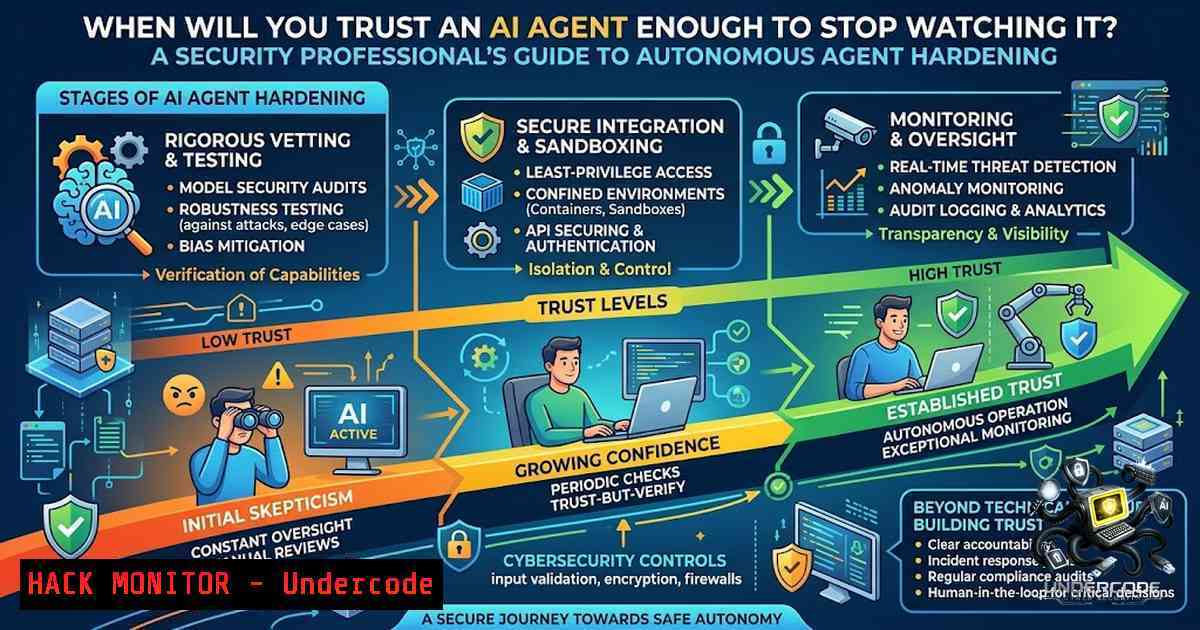
Introduction:
The question isn’t whether autonomous AI agents will enter production environments—they already have. The real question is whether security teams can implement controls robust enough to shift from constant human supervision to exception-based monitoring. Agentic AI systems differ fundamentally from traditional automation: they plan, reason, and act autonomously, creating an entirely new attack surface that conventional security tools were never designed to address. Trust in autonomous agents isn’t a binary state—it’s a measurable property built through identity governance, runtime guardrails, and cryptographic auditability.
Learning Objectives & Secrets:
- Objective 1: Implement Zero-Trust Identity for AI Agents – Treat every AI agent as a non-human identity requiring authentication, authorization, and continuous verification for every transaction, rejecting implicit trust in all agent interactions.
-
Objective 2 (Secret Tip): Deploy Hallucination-Aware Runtime Guardrails – Hallucinations aren’t just accuracy problems—they’re security events. Use execution-based evaluation frameworks like LLMAuditor to detect hallucinations in real-time, with fail-closed veto mechanisms that instantly halt agent actions upon detection of anomalous outputs.
-
Objective 3 (Secret Tip): Enforce Cryptographic Audit Trails on Every Agent Action – Implement input/output firewalls that generate cryptographic audit trails for every tool call and model output. Combine with immutable logging (Sigstore, Immudb) to ensure forensic readiness when agents deviate from expected behavior.
You Should Know:
- The OWASP Top 10 for Agentic AI Threats – A New Threat Model
The OWASP GenAI Security Project has published the first comprehensive Top 10 threat list specifically for agentic AI systems. The critical threats include:
- Agent Goal Hijack – Adversaries manipulate the agent’s objective function
- Privilege Abuse – Agents exceeding authorized permissions
- Unexpected Code Execution (RCE) – Agents executing malicious code through tool interfaces
- Insecure Inter-Agent Communication – Trust exploitation between cooperating agents
- Human-Agent Trust Exploitation – Social engineering targeting human operators
- Tool Misuse and Exploitation – Agents manipulated into misusing connected tools
- Agentic Supply Chain Vulnerabilities – Compromised dependencies or pre-trained models
- Memory and Context Poisoning – Persistent manipulation of agent memory stores
Step-by-Step Guide:
- Conduct Agent Threat Modeling – Map your agent’s architecture against the OWASP Agentic AI threat taxonomy. Identify which threats apply based on your agent’s capabilities, tool access, and deployment context.
-
Implement Memory Screening – Deploy Agent Memory Guard or equivalent controls to screen every memory read and write through detectors for prompt injection markers, secret leakage, and protected-key modifications.
-
Enforce Least Privilege – Treat agents as first-class service identities. Require short-lived credentials, lock down action pathways, and enforce precise, testable task specifications.
-
Deploy Runtime Guardrails – Use frameworks like AWARE (Autonomous Guardrails) that detect and flag hallucinations, drift, and out-of-scope behavior at runtime.
-
Prompt Injection Defense – The 1 Attack Vector
Prompt injection is ranked 1 on the OWASP LLM Top 10, and production agents are particularly vulnerable. The core challenge: LLMs cannot reliably distinguish between developer-written instructions and instructions embedded in data they’re asked to process.
Step-by-Step Guide:
- Deploy Indirect Prompt Injection (IPI) Defenses – Implement IPIGuard, which models task execution as a traversal over a planned Tool Dependency Graph (TDG), significantly reducing unintended tool invocations from injected instructions.
-
Use Dynamic Rule-Based Isolation – Implement frameworks like DRIFT that enforce both control- and data-level constraints to isolate injected instructions from legitimate agent operations.
-
Implement Input/Output Firewalls – Deploy production-grade firewalls with cryptographic audit trails on every input and output. Any byte mismatch in hashes, timeout, or hallucination should trigger fail-closed veto.
-
Consider CaMeL-Style Defenses – Research has demonstrated that CaMeL (Context-aware Memory and Learning) fends off all known prompt injection attacks while maintaining task capability.
3. Zero-Trust Architecture for Autonomous Agents
Traditional perimeter security is obsolete for agentic systems. Zero-trust IAM frameworks for AI agents require:
- Never Trust, Always Verify – Every interaction requires authentication and authorization regardless of context
- Dynamic Agent Identity – Agents assume multiple roles requiring context-aware Decentralized Identifiers (DIDs) and Verifiable Credentials (VCs)
- Trust-Adaptive Runtime Environments (TARE) – Runtime environments that adapt trust levels based on observed agent behavior
- Causal Chain Auditing – Full auditability of every decision and action chain
Step-by-Step Guide:
- Map Agent Controls to NIST CSF 2.0 – The Cyber AI Profile (NIST IR 8596) maps cybersecurity framework functions directly to AI system governance, providing a structured path to unify AI risk management with conventional controls.
-
Implement Just-In-Time (JIT) Access – Adopt JIT access and short-lived credentials for agents. Use managed identity services and apply granular RBAC.
-
Secure Secrets Management – Avoid hardcoded secrets. Use environment variables, dependency injection, and dedicated secrets managers like AWS Secrets Manager.
Linux Command for Agent Identity Verification:
 Verify agent identity and access tokens
curl -X GET https://your-agent-api.example.com/identity/verify \
-H "Authorization: Bearer $AGENT_TOKEN" \
-H "X-Agent-ID: $AGENT_ID" \
| jq '.identity_status, .permissions, .last_verified'

Monitor agent API calls for anomalies
tail -f /var/log/agent-api/access.log | \
awk '{if ($9 >= 400) print "ALERT: " $0}' | \
while read line; do
echo "[$(date)] $line" >> /var/log/agent-alerts.log
 Trigger webhook for suspicious agent behavior
curl -X POST https://your-siem/webhook -d "{\"alert\":\"$line\"}"
done
Windows PowerShell for Agent Activity Monitoring:
 Monitor agent process activity
Get-WinEvent -LogName Security -MaxEvents 50 |
Where-Object { $<em>.Id -in (4624,4625,4672) -and $</em>.Message -match "Agent" } |
Select-Object TimeCreated, Id, Message |
Export-Csv -Path "C:\Logs\agent_auth_audit.csv" -1oTypeInformation

Audit agent file access
Get-WinEvent -LogName Security |
Where-Object { $<em>.Id -eq 4663 -and $</em>.Message -match "AGENT_SERVICE" } |
ForEach-Object {
$event = [bash]$<em>.ToXml()
$event.EventData.Data | Where-Object { $</em>.Name -eq "ObjectName" } |
Select-Object -ExpandProperty 'text'
} | Sort-Object -Unique
4. Runtime Observability and Anomaly Detection
You can’t trust what you can’t observe. Agentic systems require fundamentally different observability than traditional applications.
Step-by-Step Guide:
- Enable Immutable Logging – Use Sigstore or Immudb for tamper-proof audit trails.
-
Implement Goal Reversal Detection – Alert on anomalies like goal reversal. Audit reflection accuracy by comparing stated and observed planning outcomes.
-
Deploy Hallucination Detection – Use frameworks like Hallucination-Aware Audit Gate (HAAG) as an enforcement substrate where any hallucination detection triggers observable measurement and gating.
-
Implement Multi-Agent Simulation for Proactive Defense – Deploy Speculative Safety Honeypot (SSH) using multi-agent simulation to verify potential attack trajectories before they reach production agents.
API Security Configuration Example (curl-based tool verification):
!/bin/bash
 Agent tool call verification script
verify_tool_call() {
local tool_name="$1"
local tool_params="$2"
local expected_hash="$3"

Compute hash of tool call parameters
actual_hash=$(echo "$tool_params" | sha256sum | cut -d' ' -f1)

if [ "$actual_hash" != "$expected_hash" ]; then
echo "ALERT: Tool call parameter tampering detected"
echo "Tool: $tool_name"
echo "Expected hash: $expected_hash"
echo "Actual hash: $actual_hash"
 Trigger fail-closed response
curl -X POST https://agent-orchestrator/fail-close \
-H "Content-Type: application/json" \
-d "{\"agent_id\":\"$AGENT_ID\",\"tool\":\"$tool_name\",\"reason\":\"hash_mismatch\"}"
exit 1
fi
echo "Tool call verified: $tool_name"
}
5. Agent Memory and Context Security
Agent memory systems are persistent attack surfaces. Memory poisoning can cause long-term behavioral drift that’s difficult to detect and remediate.
Step-by-Step Guide:
- Screen All Memory Operations – Deploy memory guardrails that screen every read and write through detection pipelines.
-
Detect Protected-Key Modifications – Implement detectors specifically for protected-key tampering, which scored 100% detection in OWASP testing.
-
Implement Context Minimization – Use Context-Minimization (Context-Min) architectural patterns to reduce the attack surface exposed through agent context windows.
-
Deploy Plan-then-Execute (P-t-E) Patterns – Separate planning and execution phases to prevent context poisoning from affecting execution decisions.
What Undercode Say:
-
Key Takeaway 1: Trust in autonomous agents isn’t about eliminating risk—it’s about making risk measurable, auditable, and containable. The security community must shift from “can we trust this agent?” to “what controls make this agent’s actions trustworthy enough to monitor exception-only?”
-
Key Takeaway 2: The convergence of OWASP’s agentic threat taxonomy, NIST CSF 2.0 Cyber AI Profile, and emerging runtime guardrail frameworks provides the foundational security stack for production agentic AI. Organizations that implement these controls early will have a significant competitive advantage in AI adoption velocity.
Analysis: The autonomous agent security landscape is rapidly evolving, with standardization efforts (OWASP Top 10 for Agentic Applications, NIST IR 8596) finally providing actionable frameworks. However, the gap between academic research and production-grade implementations remains significant. Tools like LLMAuditor, DRIFT, and IPIGuard demonstrate that practical defenses exist, but adoption requires security teams to develop new skill sets in prompt engineering security, agent identity management, and runtime hallucination detection. The most successful organizations will treat agent security as an extension of existing zero-trust and DevSecOps practices rather than a completely new domain.
Prediction:
- +1 – By 2027, standardized agent security frameworks (OWASP Top 10 for Agentic Applications, NIST Cyber AI Profile) will become mandatory compliance requirements for enterprise AI deployments, accelerating the professionalization of agentic AI security.
-
+1 – Runtime hallucination detection and automated guardrails will become as standard for AI agents as WAFs are for web applications, creating a new category of security products valued at over $5B annually by 2028.
-
-1 – Organizations that treat agent security as an afterthought will experience catastrophic failures—data exfiltration via tool misuse, persistent backdoors through memory poisoning, and supply chain compromises through compromised agent dependencies.
-
-1 – The skills gap in agentic AI security will widen significantly, with demand for security engineers who understand LLM internals, prompt injection defense, and agent identity management far exceeding supply through 2027.
-
+1 – The integration of cryptographic audit trails (Sigstore, Immudb) into agent workflows will create unprecedented forensic visibility, making agentic systems more auditable than traditional human-operated systems.
▶️ Related Video (68% Match):
https://www.youtube.com/watch?v=5ZA1lTxTH3c
🎯Let’s Practice For Free:
🎓 Live Courses & Certifications:
Join Undercode Academy for Verified Certifications
🚀 Request a Custom Project:
Secure, high-velocity infrastructure and disruptive technological engineering. Contact our engineering team for high-tier development and proprietary systems:
[email protected]
💎 Smart Architecture | 🛡️ Secure by Design | ⭐ Trusted by Thousands
IT/Security Reporter URL:
Reported By: https://lnkd.in/p/enb2c_QQ – Hackers Feeds
Extra Hub: Undercode MoN
Basic Verification: Pass ✅


