
Listen to this Post
Introduction:
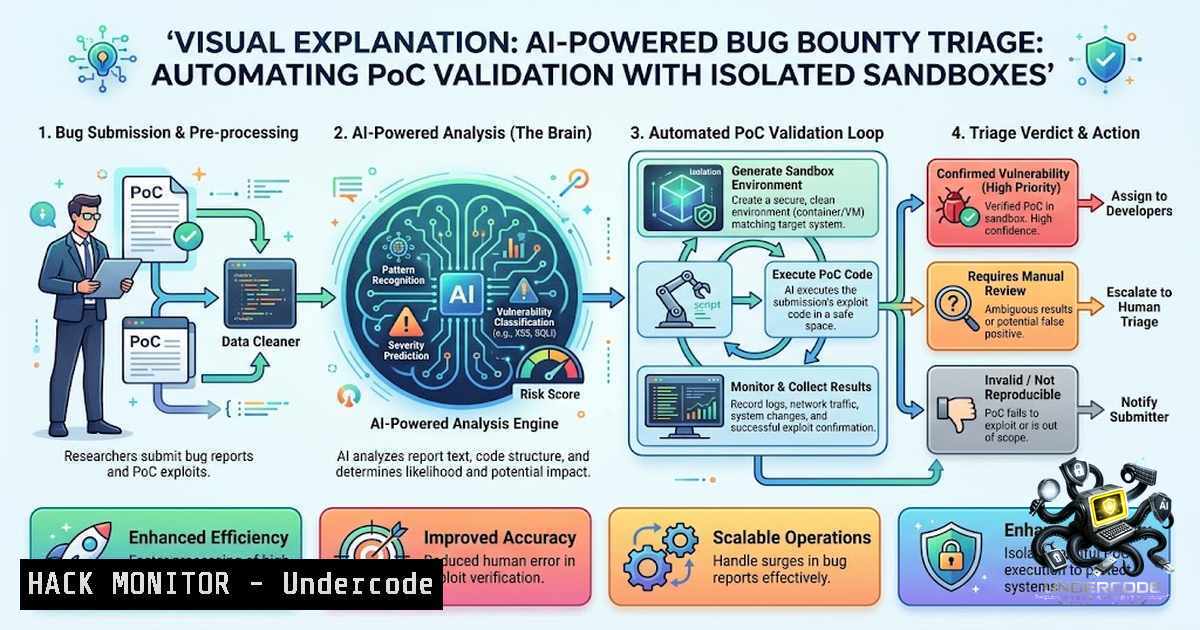
The cybersecurity industry is facing a critical bottleneck: the exponential growth of bug bounty submissions, fueled by AI-generated reports, is overwhelming human analysts. Traditional triage processes require security engineers to manually read, interpret, and execute potentially malicious proof-of-concept (PoC) code. This not only wastes valuable time but also exposes internal environments to significant risk. Diana Shidakova’s PoC Validator, developed at the Daytona HackSprint London, addresses this by combining natural language processing with ephemeral, disposable sandboxes to automate and secure the entire validation process.
Learning Objectives & Secrets:
- Objective 1: Understand the Core Architecture. Learn how to parse unstructured bug bounty reports using an LLM (Codex) to extract repeatable test steps and store them in a structured database for efficient deduplication.
- Objective 2: Master Disposable Environments. Discover how to leverage Daytona or similar infrastructure-as-code tools to spin up isolated, ephemeral sandboxes on-demand, ensuring that untrusted PoC code never touches your host system or corporate network.
- Objective 3: Optimize Triage Workflows. Gain secret insights into automating the “reproduced / not reproduced” verdict, dramatically cutting down the mean-time-to-triage (MTTT) and allowing security teams to focus on high-impact, verified vulnerabilities.
You Should Know:
1. Extracting Structured Data from Unstructured Reports
The first critical step in automating triage is translating a free-text bug bounty report into a machine-readable action plan. Diana’s project uses an AI model (Codex) to parse the text. The goal is to identify key components like the target URL, specific HTTP requests, required authentication headers, and the payload causing the issue.
Step‑by‑Step Guide:
- Setup: Use the OpenAI API to send a prompt to the model. The prompt should define a JSON schema for the expected output (e.g.,
{"target": "", "method": "", "headers": {}, "body": "", "steps": []}). - Prompt Engineering: Instruct the model to ignore subjective opinions and focus on objective technical details. For example: “Extract the exact curl command or HTTP request used to trigger the vulnerability. If steps are missing, infer them from common attack patterns.”
- Parsing: The LLM returns a structured JSON object. Save this object to a database (e.g., PostgreSQL or MongoDB) for future duplicate searches. If two reports generate similar hashes of their request structures, they are likely duplicates.
Example Linux Command (Parsing with `jq`):
If you have a file `report.txt` containing raw text and use a command-line LLM tool, you might pipe the output to `jq` to validate the structure before ingestion.
cat report.txt | llm -m gpt-4 "Extract steps to reproduce as JSON" | jq '.steps[]'
2. Building the Disposable Sandbox Environment
To execute untrusted code safely, the tool must create an isolated environment that mimics the target application. Daytona provides an API to programmatically create workspaces. The tool spins up a container or VM, clones the target repository (if applicable), runs the extracted commands, and monitors the output for the expected indicator of vulnerability (e.g., a 500 error, a specific response string, or a time delay).
Step‑by‑Step Guide:
- Initialization: Use the Daytona CLI or SDK to create a new workspace. Define the environment variables and network policies (e.g., block outgoing internet traffic to prevent data exfiltration).
- Execution: The tool runs the extracted steps via a secure shell session inside the sandbox. For web applications, this often involves using `curl` commands.
- Monitoring: Capture stdout, stderr, and the exit code. The sandbox has a strict timeout (e.g., 60 seconds) to prevent resource exhaustion.
Code Snippet (Conceptual Python with Daytona SDK):
import daytona
from daytona.models import CreateWorkspaceRequest

workspace = daytona.create_workspace(CreateWorkspaceRequest(
language="bash",
image="ubuntu:latest"
))
result = workspace.run_command("curl -X POST http://target-app.com/vuln -d 'payload=test'")
workspace.delete()  Tear down immediately
print(result.output)
3. API Security and Configuration Management
The validator itself has several APIs that must be secured to prevent abuse. It needs to accept raw report text via a webhook or CLI input, authenticate the user (e.g., using an API key), and interface with the Daytona API. Hardening these components is essential.
Step‑by‑Step Guide:
- Secure Input Validation: Sanitize all incoming text to prevent command injection attacks on your own validator service. Use a validation library to ensure the input is within character limits.
- API Key Rotation: Implement a robust API key management system for your tool. Store keys using environment variables or a secrets manager like HashiCorp Vault.
- Network Isolation: When the sandbox is created, ensure it runs on a separate network segment (e.g., a VLAN) to prevent it from accessing internal enterprise resources, even by accident.
Environment Variables (Linux):
export OPENAI_API_KEY="sk-..."
export DAYTONA_API_KEY="dp-..."
Windows Command (PowerShell):
$env:OPENAI_API_KEY="sk-..."
$env:DAYTONA_API_KEY="dp-..."
4. Database Integration and Deduplication
One of the key features is storing the parsed reports in a database to identify duplicates quickly. This is crucial because AI-generated reports often repeat the same known vulnerabilities. The structure needs to include fields for the target host, the vulnerability type, and a hash of the request.
Step‑by‑Step Guide:
- Schema Design: Create a table `reports` with columns like
id,target_url,vulnerability_type,request_hash,parsed_json,created_at. - Hashing: Calculate a SHA-256 hash of the normalized request (e.g., sort parameters alphabetically) to group similar reports.
- Querying: Before starting a new validation, query the database for a recent report with the same hash. If found, skip execution and return the stored verdict.
- PostgreSQL Example:
-- Insert a new validated report
INSERT INTO reports (target_url, request_hash, verdict, raw_text) VALUES ('https://example.com', 'a1b2c3...', 'Valid', 'Report text...');</li>
</ul>

-- Check for duplicates
SELECT verdict FROM reports WHERE request_hash = 'a1b2c3...' ORDER BY created_at DESC LIMIT 1;
5. Automating the Triage Workflow (CI/CD Integration)
To be truly effective, this tool should be integrated into the bug bounty intake pipeline. This could be a GitHub Action, a Jenkins job, or a simple webhook that triggers the validation process when a new report is submitted.
Step‑by‑Step Guide:
- Create a Webhook: Set up a simple Flask/FastAPI endpoint that listens for POST requests containing the report.
- Asynchronous Processing: Offload the heavy processing (sandbox creation) to a background task queue using Celery or RQ to avoid timeouts.
- Reporting Results: Send the verdict back to the user via an email or a Slack/Teams notification.
Docker Command (Running the Tool):
 Build the container
docker build -t poc-validator .
 Run the container, mount the report directory
docker run -e OPENAI_API_KEY=$OPENAI_API_KEY -v ./reports:/data poc-validator python validate.py /data/report.txt
6. Limitations and Mitigation of AI “Hallucinations”
While AI is powerful, it can misinterpret report context or generate steps that are technically impossible. The validator must have a “nothing to run” or “parsing error” fallback to alert a human when the AI confidence is low.
Step‑by‑Step Guide:
- Confidence Scoring: The AI model should return a confidence score for each extracted step. If the score is below a threshold (e.g., 0.7), flag the report for manual review.
- Validation of Steps: Before executing `curl` commands, perform a sanity check to ensure the target is a valid IP or domain format.
- Fallback Mechanism: If the sandbox returns a generic error (e.g., “command not found”), the tool should halt and notify the operator.
What Undercode Say:
- Key Takeaway 1: The era of manual triage is ending. AI and ephemeral environments are the only scalable solution to the AI-driven flood of bug bounty reports. This tool is a blueprint for modern SecOps.
- Key Takeaway 2: Security is shifting from “checking boxes” to “automating validation.” The ability to execute untrusted code safely is now a core engineering requirement, not just a nice-to-have.
Analysis: Diana’s project highlights a fundamental shift in application security. The “AI vs. AI” arms race is on: attackers use AI to generate more bugs, and defenders must use AI to triage them. The PoC Validator addresses the most painful part of this cycle—the wasted human hours. By creating a structured workflow that ensures safety (sandbox) and speed (AI parsing), it allows AppSec engineers to reclaim their cognitive load. It also underscores the importance of tools like Daytona, which abstract away the complexity of infrastructure, allowing developers to focus on logic. The move towards full isolation is critical; it prevents the “supply chain” attack vector where a PoC inadvertently compromises the security team’s own environment.
Prediction:
- +1 By 2027, the majority of enterprise bug bounty programs will require AI-assisted triage tools like PoC Validator as a standard entry point for submissions, reducing average triage time from days to minutes.
- +1 This trend will create a new market for “Security Automation Engineers” who blend AI prompt engineering with cloud infrastructure skills, increasing salaries and demand in this niche.
- -1 Attackers will begin crafting AI-resistant reports that include obfuscated or multi-step environmental dependencies to bypass automated parsers, forcing a cat-and-mouse game of prompt engineering to detect evasion.
- -1 Over-reliance on automated triage might lead to “validation fatigue,” where security teams ignore the system logs, potentially missing a critical vulnerability if the AI misclassifies it as a false negative.
- +1 The open-sourcing and sharing of “PoC validation recipes” will become a new community standard, similar to YARA rules or Snort signatures, accelerating defense capabilities across the industry.
▶️ Related Video (88% Match):
🎯Let’s Practice For Free:
🎓 Live Courses & Certifications:
Join Undercode Academy for Verified Certifications
🚀 Request a Custom Project:
Secure, high-velocity infrastructure and disruptive technological engineering. Contact our engineering team for high-tier development and proprietary systems:
[email protected]
💎 Smart Architecture | 🛡️ Secure by Design | ⭐ Trusted by ThousandsIT/Security Reporter URL:
Reported By: https://lnkd.in/p/eCabquVB – Hackers Feeds
Extra Hub: Undercode MoN
Basic Verification: Pass ✅🔐JOIN OUR CYBER WORLD [ CVE News • HackMonitor • UndercodeNews ]
📢 Follow UndercodeTesting & Stay Tuned:


