Listen to this Post
Introduction:
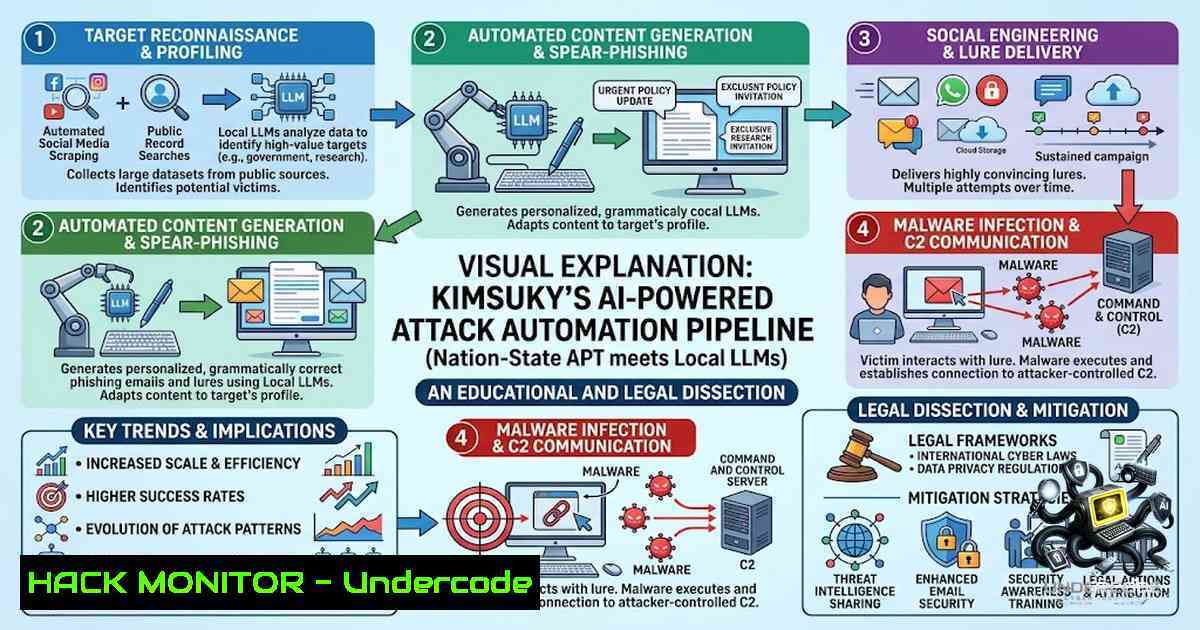
The integration of generative AI into the cyber kill chain has transitioned from theoretical discussion to operational reality. According to a recent report by South Korean cybersecurity firm Genians, the North Korean-linked advanced persistent threat (APT) group Kimsuky has been observed building and operating local large language model (LLM) environments—leveraging tools such as Ollama, GPT4All, and Msty—combined with retrieval-augmented generation (RAG), AI agent frameworks, and the Cursor coding assistant to automate and enhance its attack operations. This development marks a significant escalation: the group is moving beyond using generative AI merely for phishing lure creation toward full-spectrum integration across malware development, stolen-data analysis, and attack automation.
Learning Objectives:
- Understand the technical architecture and tooling used by Kimsuky to operationalize local AI models within an attack framework.
- Identify the specific security risks associated with local LLM deployments, RAG pipelines, and AI-assisted coding tools in enterprise environments.
- Acquire actionable detection, hardening, and incident response techniques to defend against AI-augmented threats.
You Should Know:
1. Understanding the Kimsuky AI Attack Toolchain
The Genians report (referenced as “Operation GitPower”) reveals that Kimsuky has established a local AI environment to process sensitive documents without exfiltrating data to third-party cloud services, thereby reducing exposure and complicating defender attribution. The toolchain includes:
- Ollama, GPT4All, and Msty: Local LLM execution and management frameworks that enable offline model inference.
- Retrieval-Augmented Generation (RAG): Document search and retrieval technology that allows the group to query and synthesize information from stolen datasets.
- Cursor: An AI-assisted coding tool used to streamline malware development and script generation.
- Speech-to-Text (STT) tools: For transcribing intercepted audio communications.
- Git-based C2 infrastructure: Abusing public repositories (GitHub, GitLab) as command-and-control channels and distribution vectors for encrypted AsyncRAT payloads.
Step-by-Step Guide: What This Means and How to Hunt for It
The attack flow typically begins with a spear-phishing email containing a ZIP archive. Inside the archive resides a malicious LNK file. When executed, the LNK file triggers obfuscated PowerShell commands that fetch and execute payloads from Git repositories.
Detection Commands (Windows PowerShell):
 Hunt for LNK files with abnormally long command-line arguments
Get-ChildItem -Path C:\ -Recurse -Filter .lnk -ErrorAction SilentlyContinue | ForEach-Object {
$shell = New-Object -ComObject Shell.Application
$folder = Split-Path $<em>.FullName
$file = Split-Path $</em>.FullName -Leaf
$shellfolder = $shell.Namespace($folder)
$shellfile = $shellfolder.ParseName($file)
$link = $shellfolder.GetDetailsOf($shellfile, 0)
if ($link -match "powershell|base64|github|raw.githubusercontent") {
Write-Output "Suspicious LNK: $($_.FullName) - $link"
}
}

Detect hidden PowerShell execution via LNK
Get-WinEvent -LogName "Microsoft-Windows-PowerShell/Operational" | Where-Object { $_.Message -match "LNK|Base64|GitHub" }
Linux Detection (Auditd and Process Monitoring):
 Monitor for suspicious curl/wget to GitHub raw content
auditctl -a always,exit -S execve -k github_c2 -F path=/usr/bin/curl
auditctl -a always,exit -S execve -k github_c2 -F path=/usr/bin/wget

Search for Base64-encoded PowerShell commands in process lists
ps aux | grep -E "powershell|base64|-e|enc"
2. Local LLM Infrastructure: The New Attack Surface
Kimsuky’s use of local LLMs introduces a paradigm shift. By running models on compromised infrastructure, the group can analyze stolen documents, automate information extraction, and generate highly convincing decoy materials—all without sending data to external AI providers. The decoy documents observed include finance and cryptocurrency-themed investment reports that closely mimic legitimate business materials, leveraging AI-generated natural language and polished structures to increase victim trust.
Step-by-Step Guide: Hardening Against Local LLM Abuse
Organizations must treat unauthorized local LLM deployments as a critical security concern. “Shadow AI” deployments pose significant risks including data exfiltration through local model inference and intellectual property leakage.
Windows Detection for Local LLM Frameworks:
 Detect running processes associated with common LLM frameworks
Get-Process | Where-Object { $_.ProcessName -match "ollama|gpt4all|msty|lm-studio|jan|llamacpp" }

Check for DNS queries to known LLM domains (Splunk-based detection example)
 Monitor for queries to: gpt4all.io, ollama.ai, etc.
Linux Detection and Blocking:
 Detect Ollama service running locally
ps aux | grep ollama
netstat -tulpn | grep 11434  Default Ollama port

Block outgoing connections to known LLM update/telemetry domains
iptables -A OUTPUT -d ollama.ai -j DROP
iptables -A OUTPUT -d gpt4all.io -j DROP
Critical Vulnerability Awareness: Ollama versions before 0.17.1 contain CVE-2026-7482, a heap out-of-bounds read vulnerability in the GGUF model loader that allows unauthenticated attackers to leak the entire process memory—potentially exposing API keys, system prompts, and conversation data. This flaw affects over 300,000 publicly accessible instances globally.
3. RAG Pipeline Security: The Poisoned Knowledge Base
Retrieval-augmented generation systems introduce multiple attack surfaces. Kimsuky’s integration of RAG technology allows for automated querying and synthesis of stolen documents, but for defenders, RAG pipelines present vulnerabilities including knowledge base poisoning, indirect prompt injection, search result manipulation, and embedding inversion. The attack surface spans six to seven distinct components, yet most teams monitor only one.
Step-by-Step Guide: Securing RAG Deployments
- Validate All Data Sources: Implement strict validation for any documents ingested into the RAG knowledge base. Treat the knowledge base as a potential attack vector.
- Enforce Authentication for API Endpoints: CVE-2026-57476 demonstrated how unauthenticated RAG API endpoints can allow attackers to read from or inject content into the retrieval corpus.
- Monitor for Anomalous Queries: Implement behavioral analytics to detect unusual query patterns that may indicate data exfiltration attempts.
API Security Commands (Linux – Nginx/Apache rate limiting):
 Nginx rate limiting for RAG API endpoints
limit_req_zone $binary_remote_addr zone=ragapi:10m rate=10r/s;
location /api/rag/ {
limit_req zone=ragapi burst=20;
proxy_pass http://rag-backend;
}
4. AI-Generated Phishing: Beyond Traditional Detection
The sophistication of Kimsuky’s AI-generated lures renders traditional signature-based detection obsolete. The Genians report confirms that the group is using AI to create documents that “use natural language, a highly polished structure, and formats similar to actual business materials”. During a tabletop exercise with a Singapore banking operations team, a simulated decoy report—crafted to mirror an investment note—slipped past several controls because the language, structure, and embedded figures matched the bank’s stylebook. This is not theoretical; it is a realistic scenario with real risk to reputation, customers, and capital flows.
Step-by-Step Guide: AI-Aware Phishing Detection
- Deploy Behavioral Anomaly Detection: Move beyond content-based filtering to analyze sender behavior, email metadata, and infrastructure patterns.
- Implement Multi-Signal Detection: Combine rule-based heuristic classification with machine learning models for network anomaly detection.
- Use LLM-Powered Detection Systems: Systems like SocialPhishGuard leverage multiple debating agents and prompt-based analysis to spot intent and simulate behavior.
Linux SIEM Integration (Example with Elastic Stack):
 Elasticsearch detection rule for AI-generated phishing indicators
- name: "Suspicious Email with AI-Generated Characteristics"
index: "email-"
filter:
- term:
"email.headers.from": ""
- range:
"email.body.length": { "gt": 500 }
- exists:
field: "email.attachments.lnk"
severity: "high"
5. EDR-Based Threat Hunting for AI-Augmented Attacks
Genians Security Center Director Moon Jong-hyun emphasized that as AI advances, “social engineering attacks will become more refined, making EDR-based threat hunting systems—focused on detecting execution behaviors rather than document content—critical”. The group’s use of obfuscation techniques—including Base64 encoding, string splitting, and custom decoding routines—requires behavior-based detection.
Step-by-Step Guide: EDR Tuning for Kimsuky-Style Attacks
- Monitor LNK File Execution: Focus on abnormally long command-line arguments in LNK files.
- Detect Custom Base64 Decoding: Hunt for PowerShell scripts that implement non-standard Base64 decoding routines.
- Track GitHub Raw Content API Access: Monitor for outbound connections to `raw.githubusercontent.com` or
raw.gitlab.com. - Correlate Scheduled Tasks: Identify newly created scheduled tasks that execute PowerShell or download payloads.
Windows EDR Hunting Script:
 Hunt for scheduled tasks with suspicious PowerShell commands
Get-ScheduledTask | Where-Object { $_.Actions -match "powershell|curl|wget|github" }

Query Windows Event Log for PowerShell download cradle patterns
Get-WinEvent -LogName "Microsoft-Windows-PowerShell/Operational" | Where-Object {
$_.Message -match "DownloadString|Invoke-Expression|IEX|github"
}
What Undercode Say:
- Key Takeaway 1: The Kimsuky report is not an isolated incident—it represents a strategic pivot by nation-state actors to weaponize accessible AI tooling across the entire cyber kill chain. The shift from opportunistic AI use to deliberate integration into attack frameworks demands an immediate reassessment of defensive postures.
-
Key Takeaway 2: Local LLM deployments create a “shadow AI” problem that mirrors the early days of cloud shadow IT. Organizations must proactively discover and govern unauthorized AI tools within their environments, as these tools can process sensitive data without any visibility or control.
Analysis: The Genians findings, while not independently verifiable, align with the broader trend of state-sponsored groups adopting AI capabilities. The U.S. Treasury’s 2023 sanctioning of Kimsuky underscores the group’s significance as a North Korean government-controlled cyber-espionage entity. For Singapore—a regional data hub and financial nerve center—the threat is particularly acute. Threat actors weaponizing accessible AI tooling can target not just institutions but trust itself, by producing decoys that mimic local partners, regulators, and vendors. The attack surface expands exponentially when open-source models and low-barrier agent frameworks are combined with domain knowledge harvested from breached documents. Organizations must prioritize AI-aware detection, hunt for automation indicators, and tighten supply chain controls around vendor AI usage policies.
Prediction:
- +1 The cybersecurity industry will accelerate the development of AI-powered defensive tools, including LLM-based phishing detection and automated threat hunting platforms, creating a new market segment valued at over $10 billion by 2028.
- +1 Regulatory frameworks will evolve to mandate AI governance and local LLM inventory requirements for financial institutions and critical infrastructure operators, driving compliance-driven security spending.
- -1 The barrier to entry for sophisticated social engineering attacks will drop dramatically, enabling a wider range of threat actors—including cybercriminal groups—to deploy AI-generated lures at scale, overwhelming traditional security controls.
- -1 The use of local LLMs by attackers will make attribution significantly more difficult, as malicious activity will not generate cloud-based telemetry that can be traced back to specific actors or infrastructures.
- -1 RAG pipeline vulnerabilities will be increasingly exploited, leading to high-profile data breaches where attackers poison knowledge bases to manipulate AI outputs and exfiltrate sensitive information from enterprise AI systems.
▶️ Related Video (84% Match):
🎯Let’s Practice For Free:
🎓 Live Courses & Certifications:
Join Undercode Academy for Verified Certifications
🚀 Request a Custom Project:
Secure, high-velocity infrastructure and disruptive technological engineering. Contact our engineering team for high-tier development and proprietary systems:
[email protected]
💎 Smart Architecture | 🛡️ Secure by Design | ⭐ Trusted by Thousands
IT/Security Reporter URL:
Reported By: North Korean – Hackers Feeds
Extra Hub: Undercode MoN
Basic Verification: Pass ✅


