
Listen to this Post
Introduction:
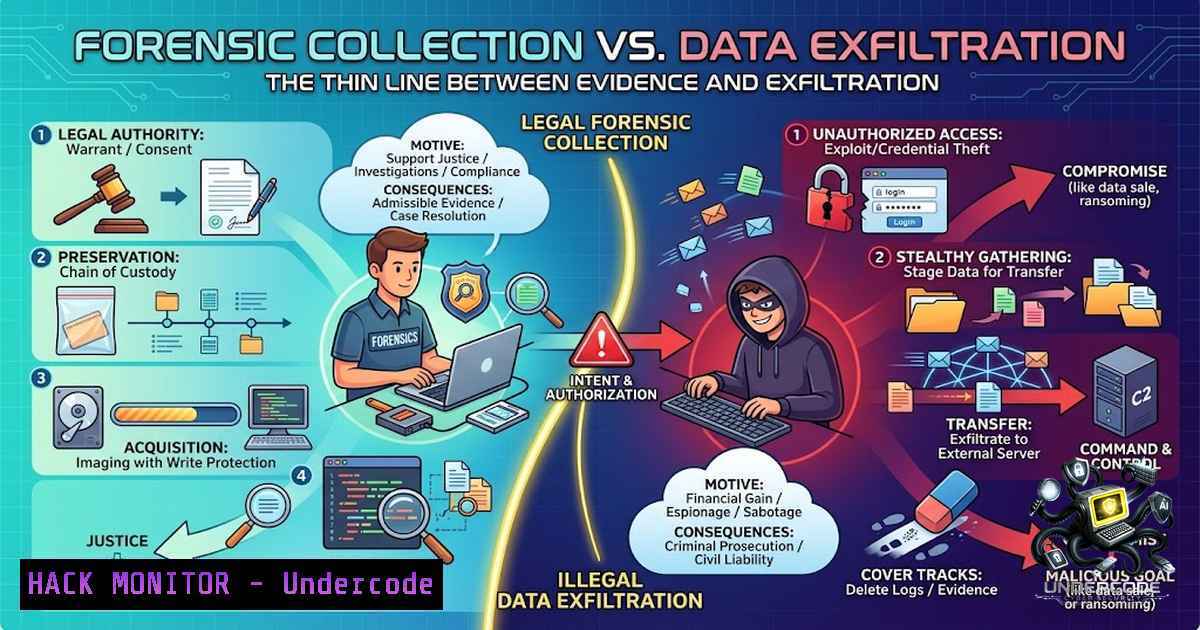
The cybersecurity industry has long maintained a conceptual firewall between digital forensics and offensive security, but the technical foundation of both disciplines shares an unsettling commonality. At Air University’s Penetration Testing Lab, Muhammad Fahad and Ayesha Wajid developed DataEx, a data exfiltration simulation framework that began as a legitimate digital forensics agent. By fixing its broken internals and extending its capabilities, they demonstrated that the architecture responsible for collecting digital evidence for incident response is virtually identical to the infrastructure used for data theft—the only differentiator being authorization.
Learning Objectives & Secrets:
- Objective 1: Understand the architectural parallels between remote evidence collection tools and command-and-control (C2) frameworks, including policy engines, cloud relays, and integrity verification mechanisms.
- Objective 2 (Secret Tip): When building security tools, focus on behavior-based detection rather than signature-based identification—malicious actors will always repurpose legitimate binaries with valid certificates and clean signatures.
- Objective 3 (Secret Tip): Leverage AI-assisted development but remain aware that large language models evaluate surface vocabulary rather than downstream intent, creating a significant gap that defenders must actively address through rigorous code review and behavioral analysis.
You Should Know:
- The Architecture of Remote Collection vs. Data Theft
The DataEx project revealed a fundamental truth: the architectural components of digital forensics agents and data exfiltration tools are interchangeable. A controller in forensics becomes a C2 server in offensive operations. A policy engine that determines which files to collect mirrors targeting rules that specify which documents to steal. The cloud relay functionality designed to bypass egress firewalls serves identical purposes in both contexts, and integrity verification mechanisms that ensure evidence authenticity also guarantee that stolen data arrives intact.
Step‑by‑step guide to analyzing this architecture:
- Map the components: Identify your tool’s controller interface, policy configuration, data transport layer, and authentication mechanisms.
- Audit the authorization layer: Examine where and how authorization checks occur—this is the only meaningful difference between legitimate and malicious use.
- Test for misconfiguration: On Linux, use `netstat -tulpn` to identify listening ports and `ps aux | grep [bash]` to view running processes. On Windows, employ `netstat -ano` and `Get-Process` in PowerShell.
- Monitor outbound traffic: Use `tcpdump -i eth0 -w capture.pcap` or Wireshark to analyze what data is being transmitted and to which destinations.
- Review logging capabilities: Ensure your tool generates comprehensive audit trails that record every action taken, including file access timestamps and user identities.
2. Integrity Verification and Chunked HTTPS Uploads
DataEx implemented chunked HTTPS uploads with integrity verification, a feature borrowed from forensic best practices. In both forensics and exfiltration, data must arrive intact and verifiable—the difference lies in who holds the verification keys.
Step‑by‑step guide for implementing integrity‑verified chunked uploads:
- Calculate file hash: Use `sha256sum [bash]` on Linux or `Get-FileHash [bash] -Algorithm SHA256` in PowerShell to generate a baseline checksum.
- Split into chunks: Use `split -b 1M [bash] chunk_` on Linux or `[System.IO.File]::ReadAllBytes()` with chunked array handling in PowerShell.
- Add per‑chunk integrity: Append or prepend each chunk with its own checksum or use a Merkle tree structure for efficient verification.
- Implement HTTPS POST with Bearer token auth: Configure your client with `Authorization: Bearer [bash]` headers and ensure TLS 1.2+ is enforced.
- Validate on receipt: At the server side, reconstruct the original file and compare hash values to detect corruption or tampering.
- Audit each transfer: Log every chunk upload, including timestamps, source IPs, and file identifiers.
3. Cloud Relay as a Firewall Bypass Mechanism
Both forensics agents and exfiltration frameworks use cloud relays to circumvent restrictive egress filtering. A compromised workstation with no direct internet access can still exfiltrate data through a cloud service that acts as an intermediate relay, with the domain being trusted by default security appliances.
Step‑by‑step guide for configuring a cloud relay:
- Set up an Azure Function or AWS Lambda: Deploy a simple API endpoint that accepts POST requests with encrypted payloads.
- Configure CORS and authentication: Restrict access to known headers and validate Bearer tokens or API keys.
- Implement forwarding logic: On the cloud function, receive the chunked data, verify its integrity, and forward it to a storage account or downstream server.
- Test egress filtering: On a Windows machine with firewall enabled, use `Test-1etConnection [bash] -Port 443` to verify the relay is accessible.
- Log all relay activities: Enable Azure Monitor or CloudWatch logs and configure alerts for unusual patterns.
- Simulate exfiltration: Send test data through the relay and verify it arrives intact at the final destination.
4. Authorization Controls and Audit Trails
The critical lesson from DataEx is that authorization—not tool capability—determines legitimacy. Comprehensive audit trails that record who used the tool, what data was collected, when the collection occurred, and with what permissions are essential for differentiating legitimate forensic operations from malicious data theft.
Step‑by‑step guide for implementing robust authorization:
- Implement role‑based access control (RBAC): Define roles such as ForensicAnalyst, IncidentResponder, and Auditor with distinct permission sets.
- Enforce token‑based authentication: Use JWT or OAuth2 tokens with short expiration times to limit session duration.
- Log all actions: Capture user IDs, timestamps, source IPs, and targets in a write‑only, append‑only log store.
- Monitor for anomalies: Use `auditd` on Linux or Windows Event Forwarding to detect unauthorized attempts.
- Integrate with SIEM: Forward logs to a security information and event management system for correlation and alerting.
- Regularly review permissions: Use `az role assignment list` or AWS IAM list‑policies to audit access rights periodically.
5. AI Tooling and the Vocabulary Gap
Fahad’s team built much of DataEx using AI tools by framing everything in forensics and blue‑team language. This highlights a critical gap: language models assess surface vocabulary rather than downstream use cases. An AI‑generated agent built with forensic terminology could be repurposed for offensive operations without triggering ethical or security flags.
Step‑by‑step guide to mitigating AI‑assisted security risks:
- Conduct code reviews: Never deploy AI‑generated code without human review, regardless of how benign it appears.
- Perform static analysis: Use `bandit` on Python, `npm audit` on JavaScript, or `dotnet security` on .NET to identify vulnerabilities.
- Test in isolated environments: Deploy the tool in a sandboxed VM or container with `docker run –read-only` to limit file modifications.
- Examine dependencies: Use `pip-audit` or `npm audit` to check for known vulnerabilities in third‑party libraries.
- Validate functionality: Ensure the tool only accesses authorized directories and performs actions matching its documented purpose.
- Implement behavior‑based monitoring: Use Sysmon on Windows or `eBPF` on Linux to observe the tool’s system calls and file operations.
6. Tool Configuration and Hardening
To securely deploy tools like DataEx in a production environment, organizations must implement hardened configurations that prevent misuse even if the tool is compromised.
Step‑by‑step guide for hardening a forensic/exfiltration tool:
- Restrict network bindings: Configure the tool to only listen on `127.0.0.1` or specific management interfaces using `–bind-address` flags.
- Enforce encrypted storage: Require AES‑256 encryption for any local storage or cache with keys stored in a hardware security module (HSM) or Azure Key Vault.
- Limit file system access: Use `chroot` on Linux or Windows AppContainer to restrict the tool’s file permissions to specific directories.
- Control egress: On a Windows domain, use Group Policy to restrict outbound connections to known IP ranges. On Linux, use `iptables` or `nftables` to block all outbound traffic except to allowed destinations.
- Monitor with FIM: Deploy file integrity monitoring (FIM) using
Tripwire,AIDE, or `Azure Defender` to detect unauthorized modifications to the tool’s binaries. - Schedule regular audits: Run `bash` scripts to review logs, check hashes, and confirm that configuration files remain unchanged.
What Undercode Say:
- Key Takeaway 1: The distinction between a forensics tool and a hacking tool is semantic—both serve identical technical functions, but authorization and intent define legality and ethics. Defenders must shift from asking “is this tool malicious?” to “is this behavior authorized?”
- Key Takeaway 2: AI‑assisted development introduces a new class of risk. Language models cannot distinguish between blue‑team and red‑team applications; they operate on vocabulary, not intent. Organizations must implement robust code review and behavioral monitoring to close this gap.
Analysis: The DataEx project serves as a microcosm of a broader industry challenge. As cybersecurity tools become more powerful and AI‑generated code proliferates, the ability to repurpose legitimate capabilities for malicious ends increases exponentially. The solution is not to restrict tool functionality, but to harden authorization, enhance audit trails, and implement continuous behavioral monitoring. The architecture itself is neutral; it is the context of its use that matters. Organizations should adopt Zero Trust principles and assume that any tool, regardless of its advertised purpose, could be misused. Integrating behavior‑based detection into endpoint detection and response (EDR) systems and emphasizing continuous validation of user permissions are essential defenses. This paradigm shift from “what is this tool?” to “what is this tool doing?” represents the next evolution in defensive strategies.
Prediction:
- -1: As AI tools become more advanced, adversaries will increasingly leverage them to generate polished, legitimate‑looking code that bypasses surface‑level security reviews, accelerating the speed and sophistication of data exfiltration attacks.
- -1: Organizations that rely solely on signature‑based detection will face mounting difficulties as malicious binaries increasingly originate from legitimate AI‑generated sources with clean certificates and no known signatures.
- +1: The spotlight on this vulnerability will drive innovation in behavioral‑based monitoring and context‑aware security tools that analyze action patterns rather than binary signatures.
- -1: The gap between forensic and offensive tools will widen as adversaries apply AI to not only generate code but also automate the obfuscation of malicious behavior behind forensic terminology.
- +1: Forward‑thinking security teams will invest in robust internal authorization frameworks, privileged access management (PAM), and Zero Trust architectures that restrict tool usage to explicitly authorized personas and contexts.
- -1: Cloud relay services, already utilized by legitimate forensics teams, will become prime targets for abuse, requiring cloud providers to implement stricter metadata‑level monitoring and anomaly detection.
- -1: The cybersecurity industry faces a skills gap in understanding the architecture of both sides of this equation, leaving organizations vulnerable to professionals who can exploit forensic tools for malicious purposes.
- +1: Educational programs like the one at Air University will increasingly integrate blue‑team and red‑team perspectives into their curricula, producing graduates capable of identifying and mitigating these overlap vulnerabilities.
- -1: Compliance frameworks and audit standards may lag behind the technical reality, allowing malicious actors to operate within the boundaries of authorized forensic tool behavior.
- +1: Community collaboration on open‑source detection rules and threat intelligence sharing will strengthen collective defenses against repurposed forensic agents, turning this challenge into an opportunity for industry‑wide improvement.
▶️ Related Video (80% Match):
🎯Let’s Practice For Free:
🎓 Live Courses & Certifications:
Join Undercode Academy for Verified Certifications
🚀 Request a Custom Project:
Secure, high-velocity infrastructure and disruptive technological engineering. Contact our engineering team for high-tier development and proprietary systems:
[email protected]
💎 Smart Architecture | 🛡️ Secure by Design | ⭐ Trusted by Thousands
IT/Security Reporter URL:
Reported By: https://lnkd.in/p/e2vS6t_q – Hackers Feeds
Extra Hub: Undercode MoN
Basic Verification: Pass ✅


