
Listen to this Post
Introduction:
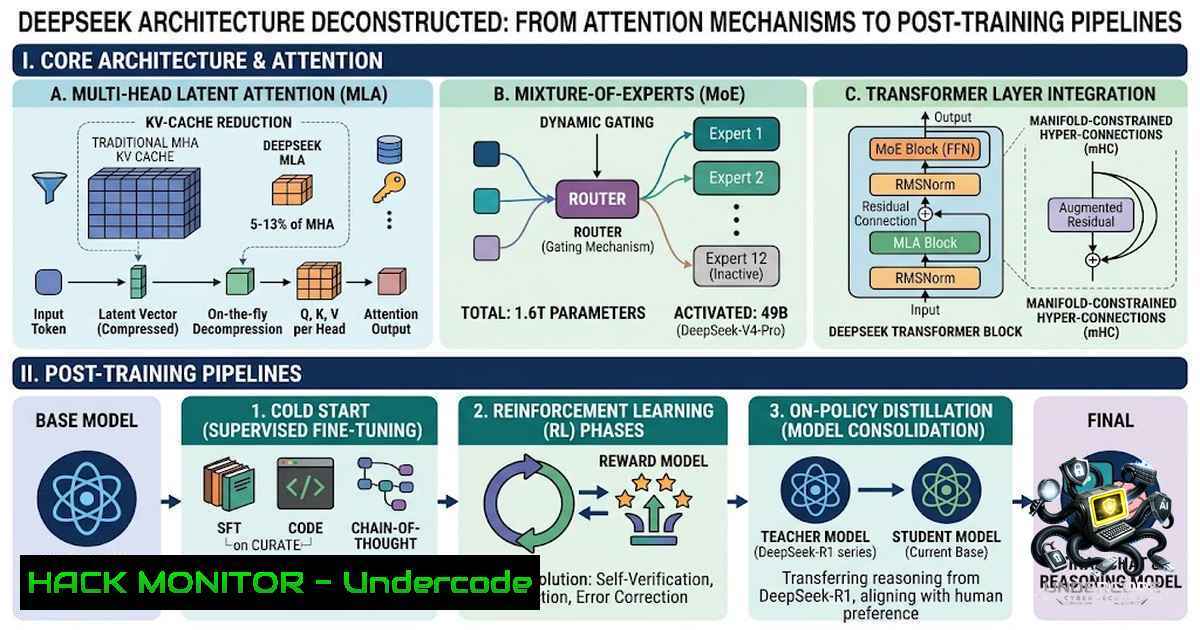
The rapid evolution of large language models (LLMs) has introduced complex architectural innovations that often remain opaque to practitioners who only consume final research papers. Understanding why specific components exist—rather than merely what they do—represents the critical gap between theoretical knowledge and practical implementation. This article examines the technical foundations of the DeepSeek family of models, breaking down key innovations including latent attention mechanisms, sparse expert routing, and reinforcement learning pipelines, while providing hands-on implementation guidance for these advanced techniques.
Learning Objectives & Secrets:
- Objective 1: Master Multi-Head Latent Attention (MLA) architecture and understand its memory efficiency advantages over traditional attention mechanisms, including the integration of decoupled rotary position embeddings (RoPE) and KV cache compression techniques.
- Objective 2 Secret Tip: Leverage auxiliary-loss-free bias updates for load balancing in MoE architectures by implementing a dynamic bias term that adjusts during training, eliminating the need for separate loss functions while maintaining expert utilization balance.
- Objective 3 Secret Tip: Implement Group Relative Policy Optimization (GRPO) for post-training by sampling multiple outputs per prompt and using relative rewards, which reduces computational overhead compared to traditional PPO while maintaining effective policy learning.
You Should Know:
- Understanding KV Cache Evolution: From Standard Attention to Latent Compression
The fundamental challenge in transformer-based LLMs lies in the memory consumption of key-value (KV) caches during autoregressive generation. Standard Multi-Head Attention (MHA) stores separate key and value projections for each attention head, creating a memory bottleneck that scales linearly with sequence length and head count. The evolution from MHA to Multi-Query Attention (MQA) and Grouped-Query Attention (GQA) represented initial attempts to address this issue, with MQA sharing a single key-value head across all query heads and GQA grouping queries into clusters sharing key-value pairs.
Multi-Head Latent Attention (MLA) advances this concept further by compressing the KV cache into a latent vector representation. The implementation involves projecting keys and values into a lower-dimensional latent space through learnable weight matrices, effectively reducing the cache size by a factor of 4-8× while maintaining performance parity. The decoupled RoPE component applies rotational position encoding separately to the latent representation, preserving positional information without interfering with the attention computation.
To implement MLA in practice:
import torch
import torch.nn as nn

class MultiHeadLatentAttention(nn.Module):
def <strong>init</strong>(self, d_model, n_heads, d_latent, d_rope):
super().<strong>init</strong>()
self.d_model = d_model
self.n_heads = n_heads
self.d_latent = d_latent

Linear projections for latent compression
self.W_q = nn.Linear(d_model, d_model)
self.W_kv = nn.Linear(d_model, d_latent  2)  Compressed K and V
self.W_o = nn.Linear(d_model, d_model)

RoPE implementation
self.rope = RotaryPositionalEmbedding(d_rope)

def forward(self, x, mask=None):
batch, seq_len, _ = x.shape

Query projection remains full dimension
q = self.W_q(x).view(batch, seq_len, self.n_heads, -1)

Compressed KV projection
kv_compressed = self.W_kv(x).view(batch, seq_len, 2, self.n_heads, -1)
k_compressed, v_compressed = kv_compressed.unbind(dim=2)

Apply RoPE to queries and keys
q_rotated = self.rope(q)
k_rotated = self.rope(k_compressed)

Scaled dot-product attention with compressed keys/values
scores = torch.matmul(q_rotated, k_rotated.transpose(-2, -1)) / math.sqrt(d_model)
if mask is not None:
scores = scores.masked_fill(mask == 0, -1e9)

attn_weights = F.softmax(scores, dim=-1)
output = torch.matmul(attn_weights, v_compressed)

return self.W_o(output)
The key insight is that MLA achieves comparable validation loss to full MHA while maintaining only a quarter of the KV cache size, making it suitable for deployment in memory-constrained environments.
2. DeepSeek-MoE: Sparse Expert Routing Without Auxiliary Loss
Mixture of Experts (MoE) architectures enable scaling model capacity without proportional increases in computation by selectively activating subsets of parameters. DeepSeek-MoE introduces three key innovations: fine-grained expert segmentation, shared expert isolation, and auxiliary-loss-free bias updates for load balancing.
The fine-grained segmentation approach divides the expert network into smaller, more specialized components, allowing for more granular routing decisions. Each token is routed to a small subset of experts based on learned routing weights, with a shared expert component always receiving tokens to capture common patterns.
The auxiliary-loss-free bias update mechanism represents a significant departure from traditional load-balancing methods that rely on auxiliary loss terms. Instead, DeepSeek-MoE maintains a learnable bias term for each expert that gets updated during training without explicit load-balancing objectives. The bias update follows:
class DeepSeekMoE(nn.Module):
def <strong>init</strong>(self, num_experts, experts_per_token, hidden_size):
super().<strong>init</strong>()
self.num_experts = num_experts
self.experts_per_token = experts_per_token
self.hidden_size = hidden_size

Expert networks
self.experts = nn.ModuleList([
ExpertNetwork(hidden_size) for _ in range(num_experts)
])

Shared expert
self.shared_expert = ExpertNetwork(hidden_size)

Router parameters
self.router = nn.Linear(hidden_size, num_experts)
self.bias = nn.Parameter(torch.zeros(num_experts))  Auxiliary-loss-free bias

def forward(self, x):
 Compute routing scores
scores = self.router(x)  Shape: [batch, seq_len, num_experts]
scores += self.bias  Add learnable bias

Select top-k experts
top_k_scores, top_k_indices = torch.topk(scores, self.experts_per_token, dim=-1)

Normalize selected scores
routing_weights = F.softmax(top_k_scores, dim=-1)

output = torch.zeros_like(x)
for i, expert in enumerate(self.experts):
 Find tokens routed to this expert
mask = (top_k_indices == i).any(dim=-1)
if mask.any():
selected_x = x[bash]
expert_output = expert(selected_x)
 Apply routing weights
weights = routing_weights[bash][top_k_indices[bash] == i]
output[bash] += expert_output  weights.unsqueeze(-1)

Add shared expert contribution
output += self.shared_expert(x)  0.1  Scale factor for shared expert

return output
The bias update mechanism effectively balances expert utilization by adjusting the bias term during backpropagation, eliminating the need for complex load-balancing loss functions.
- Multi-Token Prediction and FP8 Training: Scaling Without Compromising Quality
Multi-token prediction (MTP) extends the traditional next-token prediction objective by training the model to predict multiple future tokens simultaneously. This approach improves sample efficiency and enables better utilization of training data, particularly beneficial for code generation and structured outputs.
The five pillars of FP8 training represent a comprehensive approach to reducing memory footprint and computational cost during training:
- FP8 Quantization: Using 8-bit floating-point format for weights and activations
- Per-Tensor Scaling: Dynamic scaling factors for each tensor to maintain dynamic range
- Mixed Precision: Alternating between FP8 and higher precision for critical operations
- Gradient Accumulation: Accumulating gradients in higher precision before quantization
- Loss Scaling: Adjusting loss scale to prevent underflow during backpropagation
Implementation of FP8 training requires careful handling of numerical stability:
def fp8_forward(x, scale=1.0):
 Convert to FP8 (simulated with FP16 in this example)
x_scaled = x  scale
x_fp8 = x_scaled.to(torch.float8_e4m3fn)
 Dequantize
x_dequant = x_fp8.float() / scale
return x_dequant

Example training loop with FP8
def fp8_training_step(model, inputs, optimizer):
with torch.autocast(device_type='cuda', dtype=torch.float8_e4m3fn):
outputs = model(inputs)
loss = criterion(outputs, targets)

Accumulate gradients with loss scaling
loss_scaled = loss  loss_scale_factor
loss_scaled.backward()

Update scale factor
optimizer.step()
loss_scale_factor = adjust_scale(loss_scale_factor, grad_norm)
This approach enables training of large-scale models on consumer hardware by reducing memory requirements while maintaining numerical stability.
4. Post-Training Pipeline: GRPO and Knowledge Distillation
The post-training phase for DeepSeek models incorporates advanced reinforcement learning techniques and knowledge distillation. Group Relative Policy Optimization (GRPO) represents a significant advancement over traditional PPO by sampling multiple outputs per prompt and computing relative rewards, reducing the need for a separate value network.
GRPO implementation follows:
class GroupRelativePolicyOptimization:
def <strong>init</strong>(self, policy_model, ref_model, beta=0.1):
self.policy = policy_model
self.reference = ref_model
self.beta = beta  KL penalty coefficient

def grpo_update(self, prompts, responses, rewards):
"""
Perform GRPO update given prompts, responses, and rewards
"""
 Compute log probabilities under current policy
policy_logps = self.policy.log_prob(prompts, responses)
ref_logps = self.reference.log_prob(prompts, responses)

Compute KL divergence
kl_div = policy_logps - ref_logps

Normalize rewards within group
rewards_mean = rewards.mean(dim=-1, keepdim=True)
rewards_std = rewards.std(dim=-1, keepdim=True)
normalized_rewards = (rewards - rewards_mean) / (rewards_std + 1e-8)

Compute GRPO objective
objective = (policy_logps - self.beta  kl_div)  normalized_rewards
return -objective.mean()  Maximize objective

def update(self, prompts, responses, rewards):
loss = self.grpo_update(prompts, responses, rewards)
loss.backward()
self.policy.optimizer.step()
The knowledge distillation component involves training smaller models using outputs from larger reasoning models. The book demonstrates that supervised fine-tuning on reasoning traces from DeepSeek-R1 consistently outperforms RL from scratch, with a 25-point improvement on AIME 2024 when using a Qwen2.5-32B base.
5. Implementation Considerations and Practical Deployment
When implementing these techniques, several practical considerations emerge:
- Memory Management: For MLA, careful tensor reshaping is required to maintain cache efficiency without introducing unnecessary memory copies
- Expert Routing: The bias update mechanism requires monitoring expert utilization to detect potential collapse
- FP8 Training: Error accumulation from quantization requires gradient checkpointing and periodic full-precision updates
Deployment commands for FP8 training with PyTorch:
 Set environment variables for FP8
export PYTORCH_ENABLE_FP8=1
export CUDA_DEVICE_MAX_CONNECTIONS=1

Launch training with mixed precision
python train.py \
--fp8-training \
--batch-size 256 \
--gradient-accumulation-steps 8 \
--learning-rate 1e-4 \
--weight-decay 0.01
What Undercode Say:
- The book’s approach of tracing design decisions through failed attempts provides invaluable context for understanding why modern architectures incorporate specific features, making the material accessible for implementation-minded practitioners.
- The empirical validation of MLA achieving MHA-level performance with reduced memory overhead suggests significant opportunities for efficient LLM deployment, though the TinyStories benchmark limitations warrant cautious extrapolation.
- The integration of auxiliary-loss-free bias updates in MoE routing demonstrates a shift toward simpler, more stable optimization objectives that reduce training complexity while maintaining performance.
- While the architecture coverage stops at V3 and R1, the foundational concepts of latent compression and sparse routing remain relevant to current research directions.
Prediction:
+N The democratization of advanced LLM architectures through consumer-grade implementation guides will accelerate innovation in edge AI applications and reduce dependency on large-scale cloud infrastructure.
+N The techniques demonstrated in this book, particularly MLA and GRPO, will become standard components in next-generation LLM pipelines, driving efficiency gains across the industry.
-1 The reliance on distillation from larger models for performance gains may concentrate AI capabilities among organizations capable of training massive foundational models, potentially widening the accessibility gap.
-1 The dynamic nature of attention architecture development, with recent shifts toward sparse stacks, suggests that implementation knowledge may have a shorter shelf life, requiring continuous learning to maintain relevance.
▶️ Related Video (90% Match):
🎯Let’s Practice For Free:
🎓 Live Courses & Certifications:
Join Undercode Academy for Verified Certifications
🚀 Request a Custom Project:
Secure, high-velocity infrastructure and disruptive technological engineering. Contact our engineering team for high-tier development and proprietary systems:
[email protected]
💎 Smart Architecture | 🛡️ Secure by Design | ⭐ Trusted by Thousands
IT/Security Reporter URL:
Reported By: https://lnkd.in/p/eaJ4NqmR – Hackers Feeds
Extra Hub: Undercode MoN
Basic Verification: Pass ✅


