Listen to this Post
Introduction:
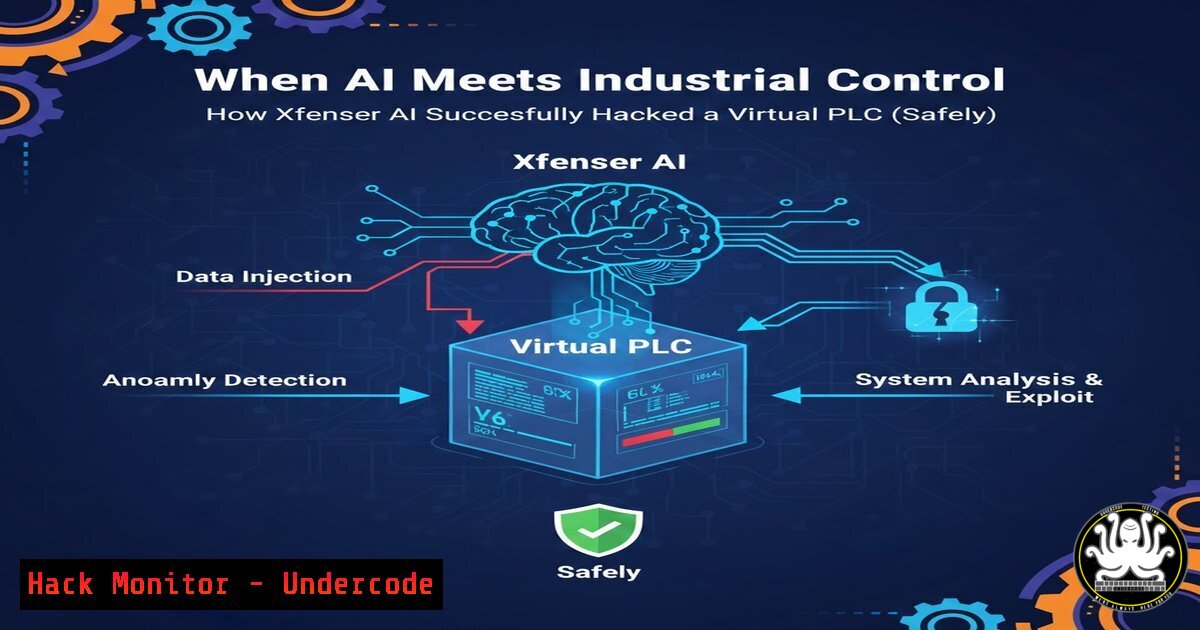
The convergence of Artificial Intelligence (AI) and Operational Technology (OT) is reshaping the cybersecurity battleground. A recent controlled demonstration by Labshock Security, leveraging the Xfenser AI platform, showcased a pivotal moment: an AI agent autonomously interpreting an industrial scenario, interacting with a Programmable Logic Controller (PLC), and achieving a measurable impact within a safe, virtual lab environment. This exercise moves beyond theoretical IT workflows and into the high-stakes realm of industrial control systems (ICS), where the consequences of a breach can be physical and catastrophic.
Learning Objectives:
- Understand the unique security vulnerabilities present in OT/ICS environments and why they are prime targets for advanced attacks.
- Learn how adaptive AI platforms like Xfenser are being developed for both offensive security testing and defensive cyber operations.
- Gain practical knowledge on foundational security hardening steps for industrial and IT systems using open-source toolkits like BackBox Linux.
You Should Know:
- The OT/ICS Threat Landscape: Why Factories and Grids Are Different
The operational technology that runs power plants, manufacturing lines, and water treatment facilities was designed for reliability and safety, not security. These systems often run on legacy software, use proprietary protocols like Modbus or PROFINET, and cannot be easily patched. A successful attack can lead to physical damage, environmental harm, or disruption of critical infrastructure. The Labshock demo highlights this by targeting a PLC, the “brain” of an industrial process.
Step-by-step guide to understanding the attack surface:
- Asset Discovery: Use passive and active scanning to map the OT network. A tool like `nmap` can be used cautiously (as aggressive scanning can disrupt legacy devices).
Command: `sudo nmap -sS –script broadcast-dhcp-discover -p 1-1024 192.168.1.0/24` (Scans for common OT ports on a subnet). - Protocol Analysis: Identify and analyze industrial communication protocols. Use a network analyzer like Wireshark with dedicated dissectors for Modbus TCP.
Tutorial: Capture traffic to a suspected PLC IP. In Wireshark, apply the filter `modbus` to isolate and inspect commands reading coils or holding registers, which control physical outputs. - Vulnerability Mapping: Cross-reference discovered devices and services with ICS-specific vulnerability databases from CISA or repositories like ExploitDB.
-
Building Your Own Security Lab: From BackBox Linux to Virtual PLCs
Before testing any security tool, especially in the OT space, a controlled, isolated lab is non-negotiable. The Xfenser demo was conducted in the Labshock virtual lab, a safe sandbox. You can build a similar foundational lab using free, open-source tools.Step-by-step guide to building a basic cyber range:
- Set Up a Hypervisor: Install VMware Workstation Player or VirtualBox on a host machine with sufficient RAM (16GB+ recommended).
- Deploy BackBox Linux: Download the latest BackBox Linux ISO, an open-source penetration testing distribution pre-loaded with hundreds of security tools. Create a new virtual machine and mount the ISO.
Command (Post-Install): Update the toolkit repository:sudo apt update && sudo apt full-upgrade -y. - Introduce Target Systems: Create virtual machines for Windows (as a representative IT/SCADA host) and an OT simulation. Use projects like `simatic-wincc` (for SCADA) or the open-source `pymodbus` library to simulate a simple PLC listener on a Linux VM.
Python Simulated PLC Code Snippet:
from pymodbus.server import StartTcpServer
from pymodbus.datastore import ModbusSlaveContext, ModbusServerContext

store = ModbusSlaveContext(zero_mode=True)
context = ModbusServerContext(slaves=store, single=True)
StartTcpServer(context=context, address=("0.0.0.0", 502))
- AI as the Hacker: Autonomous Reconnaissance and Initial Access
Platforms like Xfenser AI operate in “Agent Mode,” where they can be given a mission (e.g., “interact with the PLC at 192.168.1.100”) and generate a structured plan. This mimics the reconnaissance and weaponization phases of the Cyber Kill Chain.
Step-by-step guide to AI-driven reconnaissance:
- AI Profile Selection: In Xfenser, you would select the “Red Team” or “Penetration Tester” profile, defining the AI’s behavioral parameters for offensive security.
- Mission Definition: The user provides the objective: “Identify open ports and services on the target PLC at 192.168.1.100.” The AI engine selects the appropriate model and generates a plan.
- Plan Execution & Approval: The AI might propose using `nmap` with specific, non-disruptive flags and then a focused banner grab on port 502 (Modbus). The user must approve each step before execution.
Example AI-Generated Command: `nmap -sV -sC -p 502 –script modbus-discover 192.168.1.100 -oN plc_scan.txt`
4. The Payload: AI Interaction with Industrial Protocols
The core of the demo was the AI’s ability to understand the context (an industrial system) and craft a valid protocol-specific payload. This moves from scanning to actual interaction and potential manipulation.
Step-by-step guide to protocol interaction:
- Protocol Comprehension: The AI uses its training to understand that Modbus TCP function code `05` is “Write Single Coil,” used to turn a digital output ON/OFF.
- Crafting the Payload: The AI constructs a raw Modbus TCP packet or uses a tool like `mbclient` from the `libmodbus` utilities.
Manual Command Equivalent: `mbclient -t 0 -a 1 -r 1 192.168.1.100` (This starts an interactive modbus client session where you could then issue a write command). - Safety-Limited Execution: In a controlled demo, the AI’s action is limited to writing to a specific, non-critical coil address defined as a “test region,” proving capability without causing harm. The platform’s “Built-in Safety & Governance Controls” require explicit user confirmation for this step.
-
Defense in Depth: Hardening IT/OT Systems Against AI-Driven Attacks
The same AI capabilities used for ethical testing can be weaponized. Defense requires a multi-layered approach, starting with foundational IT hygiene that many OT environments lack.
Step-by-step guide to foundational hardening:
- Network Segmentation: Implement strict firewall rules to segment the OT network from the corporate IT network.
Windows Command (Firewall): `New-NetFirewallRule -DisplayName “Block-OT-Inbound” -Direction Inbound -LocalPort 502 -Protocol TCP -Action Block`
Linux Command (iptables): `sudo iptables -A INPUT -p tcp –dport 502 -s ! [bash] -j DROP`
2. Least Privilege Access: Harden SSH access used by tools (and potentially AI platforms) for remote management.
Command: Edit/etc/ssh/sshd_config: SetPermitRootLogin no,PasswordAuthentication no, and use key-based authentication. -
Logging and Monitoring: Ensure all access attempts, especially to critical PLCs, are logged and forwarded to a SIEM.
Tutorial: Use `rsyslog` on Linux to forward logs. Configure `/etc/rsyslog.conf` to send `auth` and `authpriv` facility logs to a central SIEM server IP. -
Securing the New Frontline: APIs and Cloud Management Interfaces
Modern OT systems often have cloud-based management dashboards and APIs. These become lucrative targets. AI agents excel at fuzzing APIs and discovering misconfigurations.
Step-by-step guide to basic API security testing:
- Endpoint Discovery: Use tools like `katana` or `gau` to gather API endpoints from historical data or JS files.
Command: `echo “https://target.com” | katana -jc -aff -d 5 -o endpoints.txt`
2. Authentication Testing: The AI might test for broken authentication by manipulating JWT tokens or API keys. - Input Fuzzing: Test endpoints for injection flaws (SQLi, command injection) using a tool like
ffuf.
Command: `ffuf -w /usr/share/wordlists/SecLists/Discovery/Web-Content/common.txt -u https://target.com/api/v1/FUZZ -fc 403 -o fuzz.json` - The Human Firewall: Continuous Training and AI-Assisted Blue Teaming
The final, most critical layer is the human operator. Platforms like Xfenser also feature “Blue Team” and “Threat Analyst” profiles designed to assist defenders.
Step-by-step guide to AI-assisted defense:
- Log Triage: The AI can be tasked: “Analyze this SSH auth log and identify potential brute-force attempts.”
- Threat Correlation: It can cross-reference internal alerts with external threat intelligence feeds (like MITRE ATT&CK techniques) to provide context.
- Mitigation Recommendation: Based on analysis, the AI can propose specific, actionable firewall rules or isolation steps for a compromised host, which the analyst must review and approve.
What Undercode Say:
- The Paradigm Shift is Operational, Not Just Theoretical: This demo isn’t about a fancy chatbot. It’s about an AI that can execute a sequence of technically valid actions—from network scanning to protocol-specific payload generation—within a real (albeit virtual) system. This transitions AI from an advisory role to an operational one in cybersecurity.
- The Double-Edged Sword is Sharpening: The capability demonstrated is inherently dual-use. The same platform that allows a security team to safely stress-test their PLCs in a lab could, in malicious hands, be tailored to disrupt physical processes. The democratization of advanced offensive tradecraft is accelerating.
The core analysis is that we are moving from an era of “script kiddies” to an era of “AI agents.” The barrier to executing complex, multi-stage cyber-physical attacks is being lowered not by simpler tools, but by more intelligent ones that can guide a less-skilled user or autonomously navigate unforeseen obstacles in a target network. The critical differentiator will be the governance, safety controls, and ethical frameworks built into these platforms, as highlighted by Xfenser’s required confirmation steps.
Prediction:
Within the next 2-3 years, AI agents capable of autonomous, goal-directed cyber operations will become a standard tool in both red and blue teams for critical infrastructure operators. On the offensive front, we will see AI that can dynamically adapt its attack path based on the specific defenses and system fingerprints it encounters in OT environments, making traditional signature-based detection even more obsolete. Defensively, the focus will shift to “AI vs. AI” engagements, where defensive AI systems will be tasked with monitoring network behavior at a granular level, identifying the subtle, anomalous patterns of a probing AI agent before it can reach its final payload stage. This will necessitate the development of new security paradigms built around continuous authentication, zero-trust principles applied at the operational protocol level, and heavily instrumented “honeypot” processes designed to detect and engage autonomous attackers.
▶️ Related Video (80% Match):
🎯Let’s Practice For Free:
IT/Security Reporter URL:
Reported By: Raffaeleforte Xfenser – Hackers Feeds
Extra Hub: Undercode MoN
Basic Verification: Pass ✅


