Listen to this Post
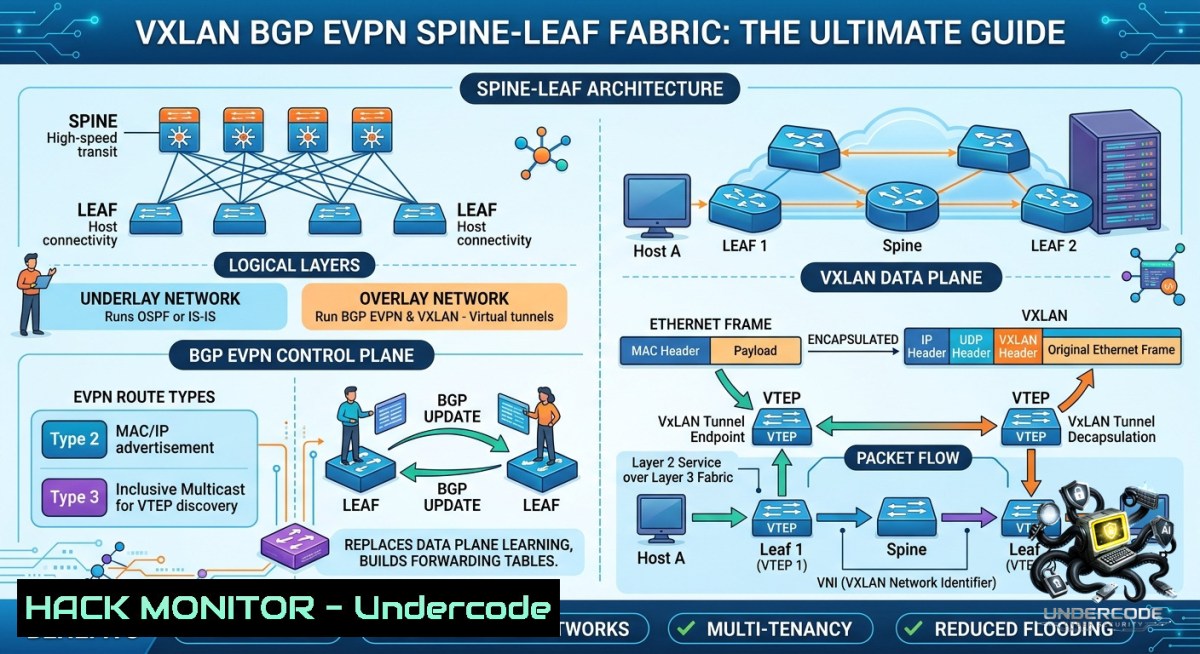
Introduction:
Modern data centers demand scalable, multi-tenant network architectures that overcome traditional VLAN limitations. VXLAN (Virtual Extensible LAN) combined with BGP EVPN (Ethernet VPN) provides a robust overlay solution, enabling Layer 2 and Layer 3 segmentation across a Clos spine-leaf fabric. This article dissects a production-grade VXLAN BGP EVPN topology, covering underlay routing, overlay tunnels, tenant isolation, redundancy via vPC, and external connectivity using OSPF — while highlighting design pitfalls, security hardening, and migration paths to full BGP control.
Learning Objectives:
– Design and configure a VXLAN BGP EVPN spine-leaf fabric with VTEPs, VNIs, and symmetric IRB routing.
– Implement vPC for server redundancy and border leaf integration with firewalls and core routers using OSPF.
– Apply Linux/Windows diagnostic commands and security mitigations to troubleshoot and harden EVPN fabrics.
You Should Know:
1. Building the Underlay: Point-to-Point Routing and VTEP Loopback Configuration
The underlay provides IP reachability between VTEPs. Each spine and leaf uses routed point-to-point links (e.g., /31 subnets) and a loopback interface for the VTEP source IP. The spines act as BGP route reflectors (RR) for EVPN address family.
Step‑by‑step guide (Cisco NX‑OS style):
1. Configure interfaces on leaf-1:
interface Ethernet1/1
description to-SPINE-1
no switchport
ip address 10.0.0.0/31
no shutdown
interface loopback0
ip address 192.168.1.1/32
2. Enable BGP with EVPN address family:
router bgp 65001
router-id 192.168.1.1
neighbor 10.0.0.1 remote-as 65001
neighbor 10.0.0.1 update-source loopback0
address-family l2vpn evpn
neighbor 10.0.0.1 activate
neighbor 10.0.0.1 route-reflector-client
3. Verify underlay reachability (Linux/Windows):
– Linux: `ping 192.168.1.2` (remote VTEP loopback)
– Windows: `ping -1 4 192.168.1.2`
– Trace route: `traceroute -1 192.168.1.2` (Linux) / `tracert -d 192.168.1.2` (Windows)
Security Tip: Use BGP MD5 authentication to prevent route injection:
neighbor 10.0.0.1 password 7 MySecretKey
2. Overlay Provisioning: Mapping VLANs to VNIs and Deploying L3VNI
Tenant segmentation is achieved by mapping customer VLANs to VXLAN Network Identifiers (VNIs). A dedicated L3VNI (e.g., 22000) enables inter‑subnet routing via symmetric IRB.
Step‑by‑step guide:
1. Create VLAN and VNI mapping on leaf:
vlan 20
name Tenant1-Web
vn-segment 20020
interface vlan20
vrf member Tenant1
ip address 172.16.20.1/24
2. Define the L3VNI and VRF:
vrf context Tenant1
vni 22000
rd auto
address-family ipv4 unicast
route-target import auto
route-target export auto
3. Verify EVPN route types (Linux tcpdump):
`tcpdump -i eth0 -1 -e vxlan`
Look for VXLAN encapsulated packets with VNI 20020. Check BGP EVPN Type‑2 routes on spine:
`show bgp l2vpn evpn route-type mac-ip`
Windows alternative: Use `Get-1etAdapterVmqQueue` or Wireshark with VXLAN dissector.
3. vPC Redundancy and Border Leaf Integration with Fortigate Firewall
Leaf pairs (LEAF‑1/2 and LEAF‑3/4) use vPC for active‑active server connections. Border leaves connect to Fortigate 1200D via Port‑Channel (Po10, Po11) and to core campus switches via OSPF.
Step‑by‑step guide for vPC:
1. Configure vPC domain on leaf-1:
vpc domain 1
role priority 1000
peer-keepalive destination 10.1.1.2 source 10.1.1.1
peer-gateway
interface port-channel10
vpc peer-link
2. OSPF external peering (border leaf):
router ospf 100
vrf Tenant1
router-id 192.168.1.1
network 172.16.0.0/16 area 0
redistribute bgp 65001 route-map BGP->OSPF
3. Firewall failover testing (Linux command to monitor OSPF adjacency):
`watch -1 1 “vtysh -c ‘show ip ospf neighbor'”` (if using FRR)
Windows: Use `powershell “Get-1etRoute -Protocol OSPF”` (requires RAS)
Critical mitigation: Apply route‑maps to prevent asymmetric routing:
route-map OSPF->BGP permit 10
match ip address prefix-list Tenant1_Subnets
set vrf Tenant1
4. Route Leaking Between L3VNI and Global Table: Enabling North‑South Traffic
For tenants to exit the fabric, routes from the L3VNI (VRF) must be leaked to the global routing table, and vice versa. Without proper leaking, external pings fail.
Step‑by‑step guide (NX‑OS):
1. Configure route‑target import/export for VRF leaking:
vrf context Tenant1
route-target import 65001:22000
route-target export 65001:22000
2. On border leaf, redistribute connected and static:
router bgp 65001
address-family ipv4 unicast
redistribute direct route-map DIRECT_TO_BGP
redistribute static
3. Verify route propagation (Linux):
`ip route show vrf Tenant1` (if using VRF‑lite)
On a Linux host in VLAN 20, ping an external IP: `ping -I eth0.20 8.8.8.8`
Capture VXLAN decapsulation: `tcpdump -i vxlan_sys_20020 -1`
Security note: Restrict route leaking with prefix‑lists to avoid exposing internal subnets.
5. OSPF Scalability and Migration to External BGP: Step‑by‑Step Plan
While OSPF works for small fabrics, it lacks the fine policies and scalability of BGP. The post warns of limited control, failover issues, and suboptimal routing.
Migration steps:
1. On border leaves, establish eBGP peers with core routers:
router bgp 65001
neighbor 10.2.1.2 remote-as 65000
address-family ipv4 unicast
neighbor 10.2.1.2 activate
neighbor 10.2.1.2 route-map CORE_IN in
neighbor 10.2.1.2 route-map CORE_OUT out
2. Remove OSPF configuration while preserving route‑maps:
`no router ospf 100`
3. Redistribute BGP into EVPN for tenant prefixes:
address-family l2vpn evpn
redistribute bgp 65001 route-map BGP_TO_EVPN
4. Test failover (Linux):
`mtr –report 8.8.8.8` (monitor path changes)
Windows: `pathping 8.8.8.8`
6. Security Hardening for VXLAN EVPN Fabrics
Attack vectors include MAC flooding, ARP spoofing, and BGP session hijacking. Mitigations are essential.
Step‑by‑step hardening:
1. Limit MAC moves (control plane policing):
mac address-table move limit 10 action drop
2. Enable ARP suppression (prevents broadcast storms):
interface nve1
host-reachability protocol bgp
suppress-arp
3. BGP security (Linux commands to verify session state):
`netstat -tn | grep 179` (check BGP port)
`openssl s_client -connect 10.0.0.1:179` (for BGP over TLS if configured)
Windows: `netstat -an | findstr “:179″`
4. VXLAN tunnel endpoint (VTEP) ACL:
ip access-list VTEP_PROTECT
permit udp any eq 4789 any eq 4789
deny ip any any
7. Troubleshooting Asymmetric Routing with Symmetric IRB
EVPN expects symmetric Integrated Routing and Bridging (IRB). If traffic ingresses via one border leaf but egresses via another, path asymmetry breaks sessions.
Step‑by‑step diagnosis:
1. Check VTEP mapping on spine:
`show bgp l2vpn evpn mac-ip` (verify MAC/IP is learned from correct VTEP)
2. Use Linux `bridge fdb` to inspect local VXLAN table:
bridge fdb show | grep vxlan
3. Force symmetric policy with route‑maps:
route-map ASYMMETRY_FIX permit 10
set ip next-hop 192.168.1.1 (border leaf loopback)
4. Windows PowerShell network capture:
`New-1etEventSession -1ame “VXLAN” | Add-1etEventPacketCaptureProvider -TruncationLength 128`
Then start: `Start-1etEventSession -1ame “VXLAN”`
What Undercode Say:
– Key Takeaway 1: OSPF external connectivity is simple but risky — route leaking, asymmetric paths, and failover breaks require explicit policy design. Border leaf vPC must be tested with firewall stateful failover.
– Key Takeaway 2: Migration to eBGP at the external edge dramatically improves scalability and granular route control. Use route‑maps to filter and manipulate prefix attributes, and always enable BGP graceful restart for nondisruptive upgrades.
Analysis: The architecture described is production‑ready for medium data centers, but the reliance on OSPF for north‑south traffic introduces potential blackholes during link flaps. A stronger design would use eBGP between border leaves and the Fortigate cluster (via dynamic routing support on Fortigate) combined with BFD for sub‑second failover. Additionally, the L3VNI (22000) should be isolated with a dedicated VRF and strict prefix‑list inbound from the core to prevent route leaks from compromised external routers. Security teams should also implement VXLAN‑aware IPS on the spines using ERSPAN to decapsulate and inspect tenant traffic.
Prediction:
– -1 Increased attack surface: As VXLAN EVPN fabrics grow, misconfigured route‑target imports/exports will become a leading cause of tenant isolation breaches, allowing lateral movement across VNIs. Automated BGP RPKI validation will become mandatory.
– +1 Shift to programmable fabrics: Over the next 18 months, AI‑driven network assurance platforms will autonomously correct asymmetric routing and optimize VTEP path selection, reducing human error in EVPN route‑type distribution.
– -1 OSPF stagnation: Environments that retain OSPF for external peering will experience cascading failures during partial link outages, pushing enterprises toward eBGP or SD‑WAN overlays as a prerequisite for cloud interconnect.
▶️ Related Video (76% Match):
🎯Let’s Practice For Free:
🎓 Live Courses & Certifications:
[Join Undercode Academy for Verified Certifications](https://undercode.co.uk/certifications/)
🚀 Request a Custom Project:
Secure, high-velocity infrastructure and disruptive technological engineering. Contact our engineering team for high-tier development and proprietary systems:
[[email protected]](mailto:[email protected])
💎 Smart Architecture | 🛡️ Secure by Design | ⭐ Trusted by Thousands
IT/Security Reporter URL:
Reported By: [%F0%9D%93%AA%F0%9D%93%B1 %F0%9D%93%B6%F0%9D%93%AE%F0%9D%93%BB](https://www.linkedin.com/posts/%F0%9D%93%AA%F0%9D%93%B1-%F0%9D%93%B6%F0%9D%93%AE%F0%9D%93%BB-1ab59817a_vxlan-bgp-evpn-based-spine-leaf-fabric-share-7468657073300357120-UHkd/) – Hackers Feeds
Extra Hub: Undercode MoN
Basic Verification: Pass ✅
🔐JOIN OUR CYBER WORLD [ CVE News • HackMonitor • UndercodeNews ]
[💬 Whatsapp](https://undercode.help/whatsapp) | [💬 Telegram](https://t.me/UndercodeCommunity)
📢 Follow UndercodeTesting & Stay Tuned:
[𝕏 formerly Twitter 🐦](https://x.com/undercodeupdate) | [@ Threads](https://www.threads.net/@undercodetesting) | [🔗 Linkedin](https://www.linkedin.com/company/undercodetesting/) | [🦋BlueSky](https://bsky.app/profile/undercode.bsky.social)


