Listen to this Post
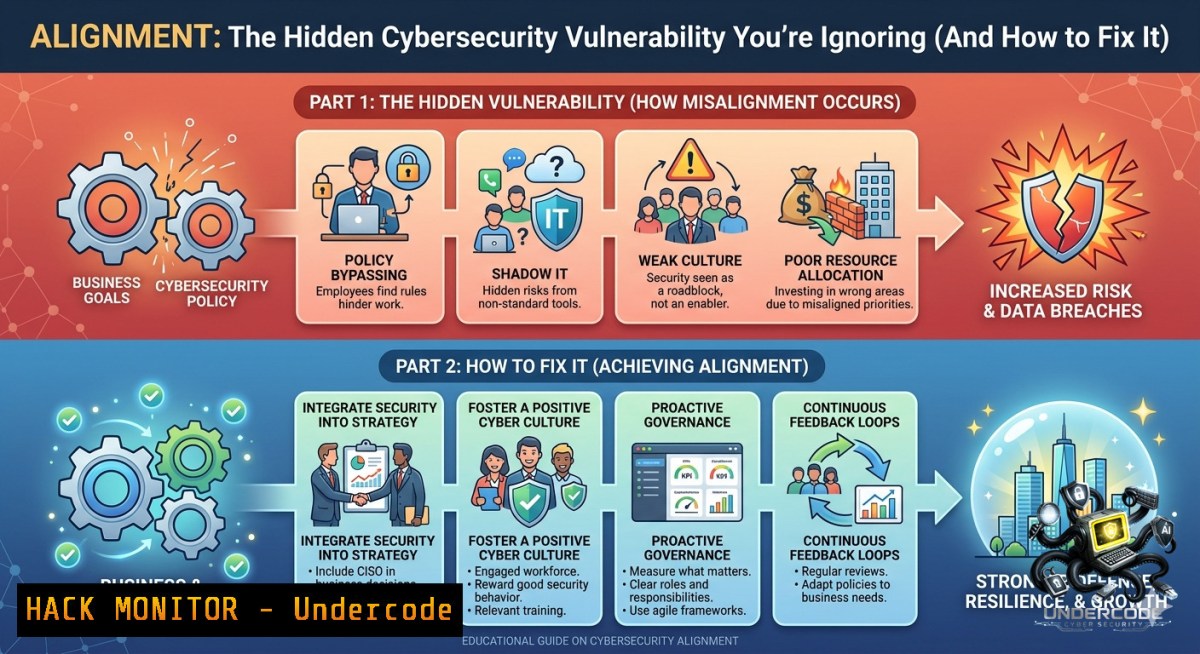
Introduction:
In security, “alignment” isn’t just a soft skill—it’s the difference between a resilient posture and a breach waiting to happen. Misalignment between security policies, system configurations, and user behavior creates exploitable gaps that attackers love. This article transforms the abstract concept of alignment into actionable technical controls, from Linux hardening to cloud API security, so you can lock down every layer of your infrastructure.
Learning Objectives:
– Map security controls to business and compliance goals (e.g., NIST, CIS, ISO 27001)
– Implement alignment checks using native OS commands and automated tools
– Remediate configuration drift across cloud, containers, and endpoints
You Should Know:
1. Aligning System Hardening with Security Baselines
Misaligned configurations (e.g., unnecessary services, weak password policies) are the 1 cause of privilege escalation. Use these commands to audit and enforce alignment with CIS benchmarks.
Step‑by‑step guide:
– Linux (audit & fix):
 Check for weak password algorithms in /etc/login.defs
grep -E "^PASS_MAX_DAYS|^PASS_MIN_DAYS|^PASS_WARN_AGE" /etc/login.defs

 Enforce strong password hashing (SHA-512)
authconfig --passalgo=sha512 --update

 Remove world‑writable files
find / -type f -perm -0002 -exec chmod o-w {} \;

 List all listening ports and associated services (detect drift)
ss -tulnp
– Windows (Group Policy alignment):
 Export local security policy for baseline comparison
secedit /export /cfg C:\secpol_backup.inf

 Enforce password complexity and lockout policy
net accounts /minpwlen:12 /maxpwage:90 /lockoutthreshold:5

 Audit privileged groups (ensure no unexpected members)
net localgroup "Administrators"
– Automated alignment tool: `OpenSCAP` for Linux or `LGPO.exe` for Windows – generate reports against DISA STIG or CIS.
2. Aligning API Security with Zero Trust Principles
Misaligned API endpoints (e.g., excessive data exposure, missing rate limiting) are prime targets. Align your API gateway and code to OWASP API Security Top 10.
Step‑by‑step guide:
– Validate authentication & authorization:
 Using curl to test JWT token expiration and scopes
curl -X GET "https://api.example.com/admin/users" -H "Authorization: Bearer $TOKEN" -v
– Enforce rate limiting with Nginx (align with business SLA):
limit_req_zone $binary_remote_addr zone=login:10m rate=5r/m;
server {
location /api/login {
limit_req zone=login burst=10 nodelay;
proxy_pass http://auth_backend;
}
}
– Align API schemas using OpenAPI validator:
 Install spectral and validate against your spec
npm install -g @stoplight/spectral
spectral lint api-spec.yaml --ruleset oas3-recommended
– Windows / PowerShell (for IIS API hardening):
 Disable insecure HTTP methods
Import-Module WebAdministration
Get-WebConfigurationProperty -Filter "system.webServer/security/requestFiltering/verbs" -1ame "verbs" | ForEach-Object { $_.Add("TRACE") }
3. Aligning Cloud Infrastructure with Least Privilege (IAM & SCPs)
Misaligned IAM roles lead to cloud breaches. Use infrastructure‑as‑code to enforce alignment continuously.
Step‑by‑step guide (AWS):
– Audit over‑privileged roles with `prowler`:
prowler aws -M csv -g check_iam_administrator_access
– Enforce SCPs to align with organization boundaries:
{
"Effect": "Deny",
"Action": ["ec2:RunInstances"],
"Resource": "",
"Condition": {"StringNotEquals": {"ec2:InstanceType": ["t3.micro", "t3.small"]}}
}
– Azure CLI – align resource locks with compliance tags:
az lock create --1ame ProdLock --resource-group myRG --lock-type CanNotDelete --1otes "Production alignment"
– GCP – enforce VPC Service Controls to align data exfiltration boundaries:
gcloud access-context-manager perimeters create test-perimeter --resources=projects/123 --restricted-services=storage.googleapis.com
4. Aligning Vulnerability Management with Patching Cycles
Without alignment between asset inventory, CVE scoring, and patching windows, critical vulnerabilities linger.
Step‑by‑step guide:
– Linux – align installed packages with known CVEs:
 Use `vulners` or `cve-check`
dpkg-query -W -f='${Package}\n' | xargs -I {} curl -s "https://vulners.com/api/v3/search/lucene/?query={}"
– Automated alignment with `ansible` – patch only critical CVEs:
- name: Align patching with Red Hat OVAL definitions
yum:
name: ''
state: latest
security: yes
bugfix: no
– Windows – use `Get-WUList` with severity filter:
$Sessions = New-Object -ComObject Microsoft.Update.Session
$Criteria = "IsInstalled=0 and Type='Software' and IsHidden=0 and MsrcSeverity='Critical'"
$Updates = $Session.CreateUpdateSearcher().Search($Criteria).Updates
$Updates | ForEach-Object { $_.Download(); $_.Install() }
5. Aligning Container Security (Docker/K8s) with Runtime Policies
Misaligned container images and pod security contexts allow container escape. Use `kube-bench` and `trivy` to align.
Step‑by‑step guide:
– Scan images before deployment:
trivy image --severity HIGH,CRITICAL --exit-code 1 python:3.9-slim
– Enforce Pod Security Standards (Kubernetes):
apiVersion: policy/v1
kind: PodSecurityPolicy
metadata:
name: restricted
spec:
privileged: false
allowPrivilegeEscalation: false
requiredDropCapabilities: ["ALL"]
runAsUser: { rule: MustRunAsNonRoot }
– Detect runtime misalignment with Falco:
 Install falco and check for unexpected shell in container
falco -r /etc/falco/falco_rules.yaml -e "shell in container"
What Undercode Say:
– Key Takeaway 1: Alignment isn’t a one‑time audit—it’s a continuous feedback loop. Use `auditd` (Linux) and `Event Viewer` (Windows) with forwarding to SIEM to detect drift in real time.
– Key Takeaway 2: The human layer is often the most misaligned. Combine technical controls (e.g., Just‑in‑Time access in Azure PIM or AWS IAM Identity Center) with forced‑choice phishing simulations to align user behavior with security culture.
Analysis: The original post from Mindful Matters highlights personal alignment for productivity and well‑being. In cybersecurity, the same principle applies: when security policies, system configurations, and operational procedures are misaligned, friction increases and risks multiply. For example, a developer bypassing WAF because “it blocks CI/CD” indicates misalignment between security and DevOps goals. Using the commands and steps above, you can create automated pipelines that enforce alignment without sacrificing speed. The hardest part is not the technology—it’s getting leadership to treat configuration drift with the same urgency as a vulnerability. Start by publishing a weekly “alignment scorecard” (e.g., % of compliant instances, average time to remediate policy deviations).
Prediction:
– +1 Proactive alignment will become a standard KPI in SOC and cloud dashboards, driven by CISA’s Secure by Design principles and EU’s DORA. Tools like `Open Policy Agent` and `Kyverno` will automate alignment across clusters.
– -1 Without automated remediation, manual alignment efforts will fail as infrastructure complexity grows—expect a spike in breaches caused by misconfigured cloud storage (e.g., S3 public ACLs) and legacy service accounts.
– +1 AI‑driven configuration alignment (e.g., using LLMs to translate compliance documents into Rego policies) will cut audit prep time by 70% by 2026.
– -1 Alignment fatigue will become a real issue: too many overlapping benchmarks (CIS, NIST, ISO, SOC2) will cause teams to ignore warnings, leading to alert saturation and missed critical changes.
▶️ Related Video (84% Match):
🎯Let’s Practice For Free:
🎓 Live Courses & Certifications:
[Join Undercode Academy for Verified Certifications](https://undercode.co.uk/certifications/)
🚀 Request a Custom Project:
Secure, high-velocity infrastructure and disruptive technological engineering. Contact our engineering team for high-tier development and proprietary systems:
[[email protected]](mailto:[email protected])
💎 Smart Architecture | 🛡️ Secure by Design | ⭐ Trusted by Thousands
IT/Security Reporter URL:
Reported By: [%F0%9D%90%80%F0%9D%90%A5%F0%9D%90%A2%F0%9D%90%A0%F0%9D%90%A7%F0%9D%90%A6%F0%9D%90%9E%F0%9D%90%A7%F0%9D%90%AD %F0%9D%90%93%F0%9D%90%A1%F0%9D%90%9E](https://www.linkedin.com/posts/%F0%9D%90%80%F0%9D%90%A5%F0%9D%90%A2%F0%9D%90%A0%F0%9D%90%A7%F0%9D%90%A6%F0%9D%90%9E%F0%9D%90%A7%F0%9D%90%AD-%F0%9D%90%93%F0%9D%90%A1%F0%9D%90%9E-%F0%9D%90%8A%F0%9D%90%9E%F0%9D%90%B2-%F0%9D%90%AD%F0%9D%90%A8-%F0%9D%90%94-ugcPost-7468641813122273280-FoJz/) – Hackers Feeds
Extra Hub: Undercode MoN
Basic Verification: Pass ✅
🔐JOIN OUR CYBER WORLD [ CVE News • HackMonitor • UndercodeNews ]
[💬 Whatsapp](https://undercode.help/whatsapp) | [💬 Telegram](https://t.me/UndercodeCommunity)
📢 Follow UndercodeTesting & Stay Tuned:
[𝕏 formerly Twitter 🐦](https://x.com/undercodeupdate) | [@ Threads](https://www.threads.net/@undercodetesting) | [🔗 Linkedin](https://www.linkedin.com/company/undercodetesting/) | [🦋BlueSky](https://bsky.app/profile/undercode.bsky.social)


