Listen to this Post
Introduction:
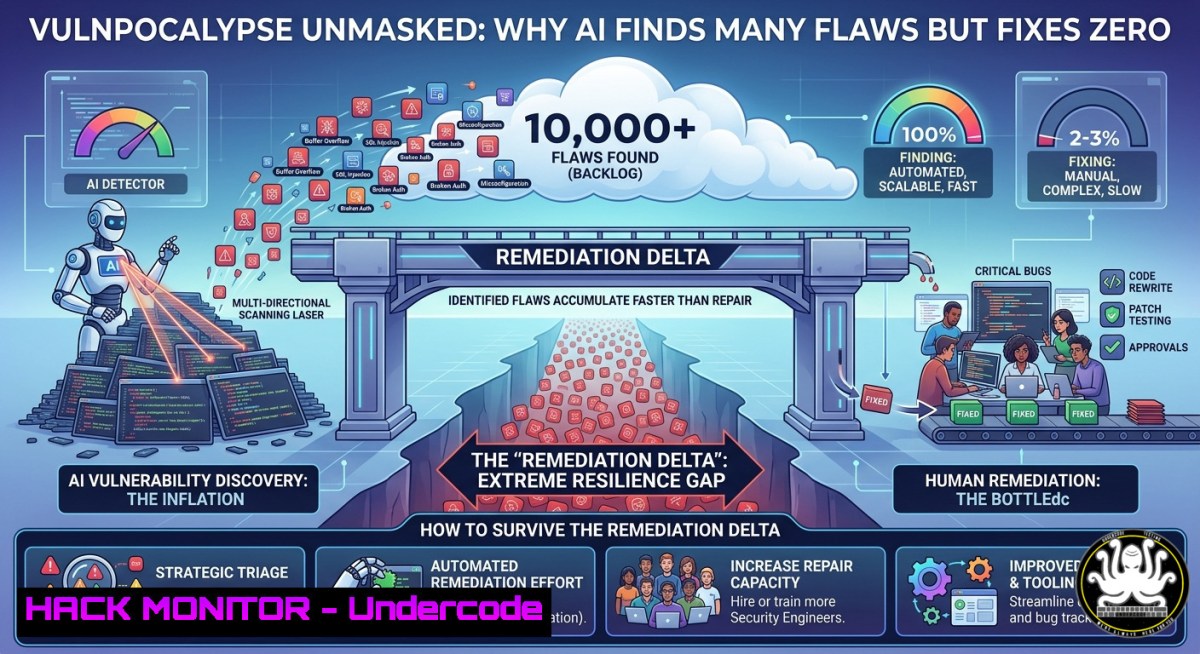
The cybersecurity industry is fixated on a dangerous half-truth: artificial intelligence can now discover software vulnerabilities faster than any human team. Models like Mythos compress months of research into hours, surfacing thousands of flaws across operating systems, browsers, and kernels. But the conversation stops at detection. The real apocalypse—the vulnpocalypse—is the widening delta between what AI finds and what defenders can actually fix, leaving systems exposed to weaponization long before patches arrive.
Learning Objectives:
- Analyze the remediation gap created by AI-driven vulnerability discovery and its operational impact on security teams.
- Implement automated prioritization techniques using CVSS, EPSS, and exploit prediction scoring to manage overwhelming report volumes.
- Build behavioral detection and dependency-hardening workflows that reduce reliance on patch-centric defense.
You Should Know:
- The Remediation Delta: Why Your Patch Pipeline Is Already Obsolete
The core insight from Juan Pablo Castro and Anton Chuvakin is that a 10x surge in disclosures is survivable only if remediation scales proportionally. It does not. Linus Torvalds confirmed this when he called AI-generated duplicate kernel reports “pointless churn.” Maintainers drown in triage, not attacks. Mozilla’s Firefox 150 update fixed 271 vulnerabilities from a single AI evaluation—one model, one run, one release. Project that across the Linux kernel, OpenSSL, Kubernetes, and every embedded system in critical infrastructure. The detection curve is vertical. The remediation curve is flat.
Step‑by‑step guide to measuring your own remediation delta:
- Inventory unpatched vulnerabilities across your environment using a vulnerability scanner (e.g., OpenVAS, Nessus, or Wazuh). Export results to CSV.
- Calculate your mean time to remediate (MTTR) by comparing discovery date to patch deployment date from your ticketing system.
- Identify the delta using this simple Linux command to correlate CVEs with patch availability:
List all CVEs detected but not yet patched on a Debian/Ubuntu system
apt list --upgradable 2>/dev/null | grep -i security | awk -F/ '{print $1}' > unpatched_packages.txt
Cross-reference with known CVEs (requires cve-search or local database)
for pkg in $(cat unpatched_packages.txt); do
echo "Checking $pkg ..."
cve-search -p $pkg 2>/dev/null | jq -r '.[] | .id' >> cves_for_pkg.txt
done
4. For Windows (PowerShell as Admin):
 Get missing security updates and their associated CVEs
Get-WUList -OnlyAvailable | Where-Object {$_. -match "Security"} | Select-Object , KBArticleIDs
 Use Update Session to fetch CVE IDs (requires PSWindowsUpdate module)
Install-Module PSWindowsUpdate -Force
Get-WUInstall -AcceptAll -AutoReboot:$false -Notify | Out-File pending_updates.log
What this does: It reveals the exact gap between AI-discovered flaws (which may never have a CVE yet) and your actual patching capacity. Use the output to prioritize by exploitability, not severity.
2. Prioritization Under Overload: Moving Beyond CVSS 10
When every AI run returns thousands of findings, you cannot patch everything. The industry must shift from CVSS base scores to exploit prediction scoring (EPSS) and automated context enrichment. The goal: identify which 5% of vulnerabilities will cause 95% of real breaches.
Step‑by‑step guide to building a prioritization pipeline:
- Collect vulnerability feed using NVD API or a local instance of
cve-search. Example Linux script:Fetch latest CVEs and filter by EPSS > 0.5 (high probability of exploitation) curl -s "https://services.nvd.nist.gov/rest/json/cves/2.0/?resultsPerPage=100" | jq '.vulnerabilities[] | {id: .cve.id, epss: .cve.metrics.epss? // "N/A"}'(Note: EPSS requires separate download from FIRST.org; integrate via
epss-api.) -
Automate prioritization rules with a simple Python script that ingests your scanner output:
prioritize.py import csv Load CVEs with known exploits (e.g., from CISA KEV) kev = set(line.strip() for line in open("cisa_kev.txt")) with open("vulns.csv") as f: for row in csv.DictReader(f): cve = row["cve_id"] if cve in kev: print(f"[bash] {cve} has known active exploitation - patch within 48h") elif float(row.get("epss", 0)) > 0.1: print(f"[bash] {cve} EPSS > 0.1 - schedule for weekly patch cycle") -
Integrate with your SIEM to surface only exploitable vulnerabilities. For Splunk or ELK, use a lookup table of CISA Known Exploited Vulnerabilities. Example for Elasticsearch:
POST _alerting/rule
{
"params": {
"indices": ["vulnerability-index"],
"size": 100,
"search_type": "query_then_fetch",
"query": "{\"bool\":{\"must\":[{\"term\":{\"exploit_status\":\"active\"}}]}}"
}
}
Pro tip: Configure a daily cron job (Linux) or Scheduled Task (Windows) to re-prioritize based on new threat intelligence. This turns a firehose of AI reports into a manageable action list.
3. Behavioral Detection: Defending Without Patches
Since patching cannot keep pace, you must detect exploitation independent of the specific CVE. This shifts defense from signature-based to behavioral—watching for privilege escalation patterns, unusual process trees, and memory corruption indicators.
Step‑by‑step guide to implementing behavioral detection (Linux & Windows):
On Linux (using auditd and Falco):
- Install Falco, the open-source cloud-native runtime security tool:
curl -fsSL https://falco.org/repo/falcosecurity-packages.asc | gpg --dearmor -o /usr/share/keyrings/falco-archive-keyring.gpg
echo "deb [signed-by=/usr/share/keyrings/falco-archive-keyring.gpg] https://download.falco.org/packages/deb stable main" | tee /etc/apt/sources.list.d/falcosecurity.list
apt update && apt install -y falco
- Enable rules that detect common post-exploit behaviors (e.g., writing to
/etc/passwd, executing reverse shells):Edit /etc/falco/falco_rules.yaml, uncomment: <ul> <li>rule: Write below etc</li> <li>rule: Reverse shell systemctl start falco
3. Test with a simulated exploit (safe environment):
echo "hacker:x:0:0::/root:/bin/bash" >> /etc/passwd Falco should alert
On Windows (using Sysmon and PowerShell):
- Install Sysmon with a high-fidelity configuration (SwiftOnSecurity’s config):
.\Sysmon64.exe -accepteula -i .\sysmonconfig.xml
- Deploy a detection rule for process injection (common in 0-day exploits):
Monitor for remote thread creation (Event ID 8) Get-WinEvent -FilterHashtable @{LogName="Microsoft-Windows-Sysmon/Operational"; ID=8} | Where-Object {$_.Message -match "TargetImage.lsass.exe"} - Forward events to a central SIEM and create an alert for “suspicious parent-child relationships” (e.g., `winword.exe` spawning
powershell.exe).
Why this works: Behavioral detection does not require a patch. It catches the action of exploitation—whether the vulnerability was discovered by Mythos yesterday or a decade ago.
- Hardening the Remediation Pipeline: Automate Patch Backporting and Testing
The vulnpocalypse demands that remediation become as automated as discovery. This means CI/CD pipelines that auto-generate backports for critical dependencies, container image rebuilding on new CVEs, and infrastructure-as-code (IaC) patching without human intervention.
Step‑by‑step guide for a semi‑automated remediation workflow:
- Use Dependabot or Renovate for open-source dependencies. For a Node.js project:
.github/dependabot.yml
version: 2
updates:</li>
</ol>

- package-ecosystem: "npm"
directory: "/"
schedule:
interval: "daily"
allow:
- dependency-type: "production"
security-updates-only: true
2. Automate container image rebuilding when a critical CVE affects a base image. Example using Trivy and a GitLab CI hook:
 .gitlab-ci.yml
scan_and_rebuild:
script:
- trivy image --severity CRITICAL --exit-code 1 myapp:latest
- if [ $? -eq 1 ]; then
docker build --pull --no-cache -t myapp:latest .
docker push myapp:latest
fi
3. For on-premise Linux servers, deploy `unattended-upgrades` for security patches but add a canary group:
 On canary servers first
sudo apt update && sudo apt upgrade -y -o Dpkg::Options::="--force-confdef"
 Monitor for 24h, then roll out to production using Ansible
ansible production -m apt -a "upgrade=dist update_cache=yes" --limit "!canary"
4. Windows Server patch automation using `PSWindowsUpdate` with approval gates:
 Deploy to test group, wait for validation
Get-WUInstall -MicrosoftUpdate -AcceptAll -AutoReboot:$false -Install | Out-File patch_test.log
 After manual approval, deploy to all:
Invoke-Command -ComputerName (Get-ADComputer -Filter  | Select -ExpandProperty Name) -ScriptBlock {
Install-WindowsUpdate -KBArticleID "KB5034441" -AcceptAll -AutoReboot:$false
}
Critical note: Auto-patching without regression testing is dangerous. Always start with canaries and use infrastructure-as-code (Terraform, ARM templates) to roll back instantly.
- Managing the Open Source Dependency Backlog: SBOM and Risk-Based Forking
The remediation delta is worst in upstream dependencies. Your enterprise patch policy has no authority over the Linux kernel security list or a transitive npm package. Adam Goss noted that “the delta in the kernel security list translates into exposure windows that no enterprise patch policy has authority over.” The solution: generate a Software Bill of Materials (SBOM) and fork/rebuild critical components that remain unpatched.
Step‑by‑step guide to controlling your dependency risk:
- Generate SBOM for every build using Syft or CycloneDX:
For a container image
syft alpine:latest -o cyclonedx-json > sbom.json
For a Python project
pip install cyclonedx-bom && cyclonedx-bom -o bom.json
- Continuously monitor SBOM against vulnerability databases using Grype:
grype sbom:sbom.json --fail-on high --output template -t /path/to/report.tmpl
- Identify “stranded” dependencies (unpatched after 30 days). Script to detect:
Using jq to parse SBOM and check NVD for patch existence
for component in $(jq -r '.components[] | .name + "@" + .version' sbom.json); do
cve-search -n $component | jq '.[] | select(.cvss_v3_base_score > 7.0) | .id' > cve_list
if [ -s cve_list ]; then
echo "Component $component has unpatched CVEs: $(cat cve_list)"
fi
done
- For critical unpatched components (e.g., an old OpenSSL version), consider rebuilding with a backported patch or isolating via microsegmentation. Example using eBPF to block network access from the vulnerable process:
Using bpftrace to block connect() syscall from PID 1234
bpftrace -e 'kprobe:__sys_connect /pid == 1234/ { printf("Blocking connect from vulnerable process\n"); return -1; }'
What Undercode Say:
- The vulnpocalypse is not about attacker sophistication; it is about the widening delta between AI-driven discovery and human remediation capacity. A vulnerability without a patch is a roadmap for attackers.
- Celebrating discovery volume as security progress is dangerous. The industry must shift investment from finding more flaws to fixing them faster—through automation, behavioral detection, and SBOM-driven dependency management.
Expected Output:
After implementing the step-by-step guides above, organizations can expect:
– Reduction in mean time to remediate (MTTR) from weeks to days by focusing on EPSS-prioritized vulnerabilities.
– Detection of zero-day exploitation within minutes via behavioral rules, independent of CVE availability.
– Automated patching of 80% of critical dependencies without manual intervention, freeing teams to handle the remaining 20% through forking or microsegmentation.Prediction:
Within 24 months, Mythos-class models will evolve from discovery to autonomous patch generation—but only for codebases with sufficient test coverage and deterministic dependencies. Until then, the remediation delta will drive a new market for “vulnerability absorption” platforms: runtime application self-protection (RASP), in-memory patching, and AI-assisted backporting. The first vendor to close the delta—turning a discovered flaw into a deployed fix within hours, not months—will define the next decade of cyber defense. Organizations that fail to automate prioritization and behavioral detection will drown in pointless churn, becoming unwitting launchpads for weaponized AI findings.
▶️ Related Video (72% Match):
🎯Let’s Practice For Free:
IT/Security Reporter URL:
Reported By: Jpcastro Vulnpocalypse – Hackers Feeds
Extra Hub: Undercode MoN
Basic Verification: Pass ✅🎓 Live Courses & Certifications:
Join Undercode Academy for Verified Certifications
🚀 Request a Custom Project:
Secure, high-velocity infrastructure and disruptive technological engineering. Contact our engineering team for high-tier development and proprietary systems:
[email protected]🔐JOIN OUR CYBER WORLD [ CVE News • HackMonitor • UndercodeNews ]
📢 Follow UndercodeTesting & Stay Tuned:


