
Listen to this Post
Introduction
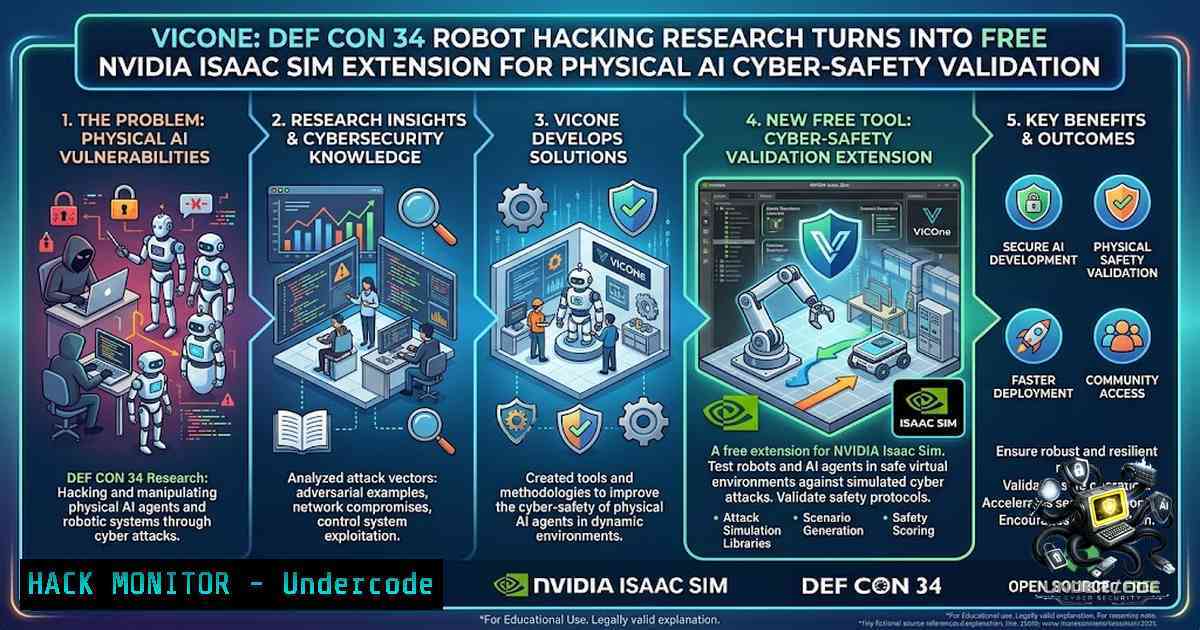
As AI-driven robots transition from controlled demonstrations to real-world deployment in factories, warehouses, public spaces, and mission-critical environments, the safety equation is fundamentally changing. A robot no longer needs a broken motor to become unsafe—it can become dangerous if it receives the wrong signal, follows a compromised instruction, trusts a poisoned AI model, or exposes an unprotected API. At DEF CON 34, VicOne’s Robotic Hacking Community (RHC) brought together security researchers, hackers, and engineers to explore the attack surface of intelligent machines through the Physical AI Safety Stress Test CTF, hands-on workshops, and a fireside chat with Boston Dynamics. The result: 16 teams recorded 25 successful solves across nearly every core AI and robotics cyber-safety challenge, and VicOne transformed those findings into the free Radeis Extension for NVIDIA Isaac Sim—enabling robotics teams to test how cyberattacks could change robot behavior before deployment.
Learning Objectives & Secrets
- Objective 1: Understand the Physical AI Attack Surface – Learn how vulnerabilities across AI models, perception systems, cloud APIs, robotics communications (ROS 2/DDS), and embedded firmware can cascade from digital compromise to altered physical robot behavior.
-
Objective 2 Secret Tip: Simulate Before You Deploy – Instead of testing only in generic demonstration environments, use the Radeis Extension to test your own robot models, intended tasks, and operating assumptions within NVIDIA Isaac Sim. This allows teams to identify cyber-to-safety risks before hardware or field access is available.
-
Objective 3 Secret Tip: Treat Every Attack Attempt as Intelligence – Successful attacks reveal complete attack paths from digital compromise to changed robot behavior. Even unsuccessful attempts expose attacker assumptions, unexplored control paths, and safeguards that need further validation. Structure these findings into repeatable test scenarios that evolve with your robot software.
You Should Know
- The Physical AI Safety Stress Test CTF: Understanding the Attack Surface
The RoboHack AI CTF at DEF CON 34 was built like a virtual escape room for AI robots, translating real-world Physical AI security scenarios into repeatable missions. The challenge spanned six safety-relevant areas that every robotics developer must understand:
- Prompt Injection targeting robot AI reasoning—when LLMs and VLMs move into the robot brain, prompt injection becomes a physical-action problem
- Poisoned AI Policy Models that alter task behavior
- Adversarial Visual Inputs targeting embodied perception
- Cloud and API Security Weaknesses
- Robotics Communication Protocol Weaknesses (ROS 2 and DDS)
- Embedded Firmware Trust-Chain Weaknesses
Step‑by‑step guide to testing your robot’s attack surface:
- Map your robot stack: Identify all components—sensors, AI models, APIs, firmware, middleware, communications protocols, and cloud-connected services
- Prioritize entry points: Start with external interfaces (APIs, network services, cloud endpoints) that attackers can reach remotely
- Simulate attack scenarios: Use the Radeis Extension within NVIDIA Isaac Sim to introduce attack scenarios against your own robot model
- Observe behavioral deviations: Monitor whether the robot deviates from intended task, operating boundaries, or expected response
- Document and remediate: Treat each finding as a safety case input—not just a security bug
Linux command for API endpoint discovery (robotics cloud services):
 Discover open API endpoints on your robot's cloud infrastructure
nmap -sV -p 5000-6000 <robot-cloud-ip>
 Test for common API misconfigurations
curl -X GET https://<robot-api-endpoint>/api/v1/system/info
 Check for exposed ROS 2 services
ros2 node list
ros2 service list
Windows command for network service enumeration:
 Scan for open ports on robot control interfaces
Test-1etConnection -ComputerName <robot-ip> -Port 9090
 Test API authentication weaknesses
Invoke-RestMethod -Uri "https://<robot-api>/api/v1/status" -Method Get
- Radeis Extension for NVIDIA Isaac Sim: Cyber-Safety Validation in Simulation
The VicOne Radeis Extension for NVIDIA Isaac Sim is a free tool that enables robotics teams to test cyber-safety attack scenarios within their existing simulation workflows. Instead of exposing physical robots or real operating environments to unnecessary risk, teams can observe whether their robot deviates from intended behavior when subjected to manipulated visual inputs, hijacked commands, poisoned AI policies, and exploited connected interfaces.
Step‑by‑step guide to using the Radeis Extension:
- Download the extension: Available for free for developers using supported versions of NVIDIA Isaac Sim
- Import your robot model: Bring your own robot model, intended tasks, and operating assumptions into NVIDIA Isaac Sim
- Select attack scenarios: Choose from test scenarios designed based on VicOne Physical AI security research and DEF CON findings
- Run simulations: Test how Vision Language Models (VLMs) respond to adversarial visual inputs, malicious inputs, and sensor manipulation
- Re-test continuously: As AI models, software, sensors, communications, or control paths change, re-run tests to continuously validate safety
Example configuration for simulating adversarial visual input in Isaac Sim:
 Pseudocode for injecting adversarial perturbations into camera feed
from isaacsim import SimulationApp
import numpy as np

Load your robot model
robot = load_robot_model("your_robot.usd")

Apply adversarial perturbation to visual input
def apply_adversarial_noise(image, epsilon=0.01):
noise = np.random.normal(0, epsilon, image.shape)
return np.clip(image + noise, 0, 255)

Simulate and observe behavior deviation
simulation.run(steps=1000)
behavior_log = robot.get_behavior_trajectory()
3. Securing the Robot Software Supply Chain
VicOne LAB R7 has tracked more than 20 public Physical AI security incidents and vulnerability disclosures over the past 18 months. In 2025, a wireless setup flaw documented as UniPwn (CVE-2025-35027, CVE-2025-60250, CVE-2025-60251) allowed an attacker to take root access on a robot and then spread it to the next one nearby. This demonstrates that safety functions preventing physical harm increasingly depend on sensors, software, and AI models that can be compromised the same way.
Step‑by‑step guide to securing the robot software supply chain:
- Audit firmware trust chains: Verify that bootloaders, firmware updates, and secure enclaves have proper cryptographic verification
- Scan dependencies: Use software composition analysis (SCA) tools to identify vulnerable third-party components
- Validate AI model integrity: Implement AI BOM (Bill of Materials) tracking and model signing
- Harden communications: Use TLS for all network communications, authenticate ROS 2 nodes, and implement DDS security extensions
- Monitor for anomalies: Deploy runtime guardrails and anomaly detection for field-deployed robots
Linux commands for firmware security verification:
 Check for unsigned firmware updates
fwupdmgr get-updates
 Verify GPG signatures on firmware packages
gpg --verify firmware_update.sig firmware_update.bin
 Audit running processes for unexpected services
ps aux | grep -E "(ros|robot|ai)"
Windows PowerShell for dependency scanning:
 Scan for known vulnerable dependencies (using OWASP Dependency-Check)
dependency-check --scan ./robot_software --format HTML
 Check certificate trust for API endpoints
CertUtil -verify -urlfetch https://<robot-api-endpoint>
4. Cloud and API Security for Physical AI
As robots increasingly depend on cloud-connected services for AI model inference, policy updates, and fleet management, API security becomes critical. The DEF CON CTF demonstrated that cloud and API security weaknesses can lead to physical behavior changes in robots.
Step‑by‑step guide to securing robot APIs:
- Implement authentication: Use OAuth 2.0 or API keys with proper rotation policies
- Enforce authorization: Implement role-based access control (RBAC) for all API endpoints
- Validate inputs: Sanitize all inputs to prevent injection attacks targeting robot reasoning
- Rate limit: Protect against denial-of-service attacks that could impair robot decision-making
- Audit logging: Maintain tamper-proof logs of all API calls for incident investigation
Example API security configuration (NGINX reverse proxy for robot cloud services):
location /api/ {
 Enforce authentication
auth_request /auth;
 Rate limiting
limit_req zone=api_limit burst=10;
 Input validation proxy
proxy_pass http://robot_backend;
 Log all requests
access_log /var/log/nginx/robot_api.log;
}
5. Continuous Monitoring with R-SOC
After deployment, VicOne’s Rthena provides telemetry-driven visibility for robotic systems in the field, including anomaly detection, system integrity assurance, runtime protection, AI guardrails, and continuous monitoring through VicOne’s Robotics Security Operations Center (R-SOC).
Step‑by‑step guide to implementing robot monitoring:
- Deploy telemetry agents: Install monitoring agents on robot control systems
- Define baselines: Establish normal behavior patterns for perception, decision-making, and actions
- Set alert thresholds: Configure alerts for deviations from expected parameters
- Integrate with SIEM: Forward robot security events to Security Information and Event Management systems
- Establish incident response: Develop playbooks for robot-specific security incidents
Linux commands for robot system monitoring:
 Monitor system calls for anomalous behavior
strace -p <robot_pid> -e trace=open,read,write,execve
 Monitor network connections
ss -tunap | grep <robot_process>
 Check for unexpected file system changes
auditctl -w /etc/robot/ -p wa -k robot_config_change
Windows PowerShell for monitoring:
 Monitor process creation
Get-WinEvent -FilterHashtable @{LogName='Security'; ID=4688} |
Where-Object {$<em>.Message -match "robot"}
 Check for unauthorized service changes
Get-Service | Where-Object {$</em>.Status -eq 'Running' -and $_.StartType -eq 'Automatic'}
What Undercode Say
- Key Takeaway 1: Cyber-Safety Must Become Standard in Robotics Development – The DEF CON 34 results—25 successful solves across 16 teams—prove that behavior-changing risks can emerge across multiple layers of the robot stack. Robot makers invest heavily in functional testing and safety engineering, but cyber-induced conditions still fall outside conventional test plans. Cyber-safety validation must become a standard part of robotics development, not an afterthought.
-
Key Takeaway 2: Simulation is the Bridge from Research to Practice – The Radeis Extension for NVIDIA Isaac Sim represents a critical shift: turning DEF CON research into repeatable, actionable testing scenarios that developers can use immediately. By enabling teams to test their own robot models under attack conditions before deployment, VicOne is helping the industry build more resilient Physical AI at scale.
-
Key Takeaway 3: The Attack Surface is Expanding Rapidly – With more than 20 public Physical AI security incidents documented in just 18 months, the robot attack surface is growing as robots become more autonomous, connected, and AI-driven. From prompt injection becoming a physical-action problem to compromised robots acting as moving attack stations, the industry must treat cybersecurity as inseparable from physical safety.
-
Key Takeaway 4: Community-Driven Security Works – The Robotic Hacking Community at DEF CON 34 brought together researchers, hackers, and engineers in a field where research is still sparse and deployment is moving fast. The openness of the community and the willingness to share and help each other represent the kind of collaborative approach needed to secure Physical AI.
-
Key Takeaway 5: Full Lifecycle Security is Non-1egotiable – From pre-deployment validation with Radeis to field monitoring with Rthena and R-SOC, cybersecurity must span the entire robot lifecycle. As Max Cheng, CEO of VicOne, stated: “The industry needs a new deployment model where intelligent machines are assessed before they enter the field, validated against safety-related scenarios, and monitored continuously once they operate in the real world”.
Prediction
-
+1 The Radeis Extension for NVIDIA Isaac Sim will become an industry standard for pre-deployment robot security validation, similar to how static application security testing (SAST) became standard in software development. Free availability lowers the barrier to entry for robotics startups and accelerates adoption.
-
+1 Regulatory frameworks like the EU Machinery Regulation will increasingly mandate cyber-safety validation for AI-driven robots, creating a compliance market that benefits early adopters of simulation-based testing.
-
-1 Without widespread adoption of pre-deployment cyber-safety testing, the industry will see an increase in Physical AI security incidents—from warehouse robots making unsafe decisions to autonomous systems being remotely compromised—eroding public trust in robotics.
-
-1 The skills gap in Physical AI cybersecurity will widen as robotics deployment outpaces security research, creating a shortage of professionals who understand both robotics and offensive security.
-
+1 Community-driven initiatives like the Robotic Hacking Community will expand globally, fostering a new generation of security researchers focused on Physical AI and creating shared vulnerability databases specific to robotics platforms.
-
+1 Integration of cyber-safety testing into CI/CD pipelines for robotics will become standard practice, enabling continuous validation as robot software, AI models, and control architectures evolve.
-
-1 Attackers will increasingly target Physical AI systems as they become more prevalent in critical infrastructure, defense, and public safety—shifting from theoretical research to real-world exploitation.
-
+1 The collaboration between VicOne and California Robotics to define the cybersecurity foundation for mission-ready Physical AI will serve as a template for other industries deploying AI-driven robots in high-risk environments.
-
+1 The shift from isolated vulnerability assessment to system-level cyber-safety evaluation will become the new paradigm, recognizing that individual component vulnerabilities can cascade into dangerous robot behavior.
▶️ Related Video (70% Match):
https://www.youtube.com/watch?v=-MWescGjIY8
🎯Let’s Practice For Free:
🎓 Live Courses & Certifications:
Join Undercode Academy for Verified Certifications
🚀 Request a Custom Project:
Secure, high-velocity infrastructure and disruptive technological engineering. Contact our engineering team for high-tier development and proprietary systems:
[email protected]
💎 Smart Architecture | 🛡️ Secure by Design | ⭐ Trusted by Thousands
IT/Security Reporter URL:
Reported By: https://lnkd.in/p/efBheW8K – Hackers Feeds
Extra Hub: Undercode MoN
Basic Verification: Pass ✅


