
Listen to this Post
Introduction:
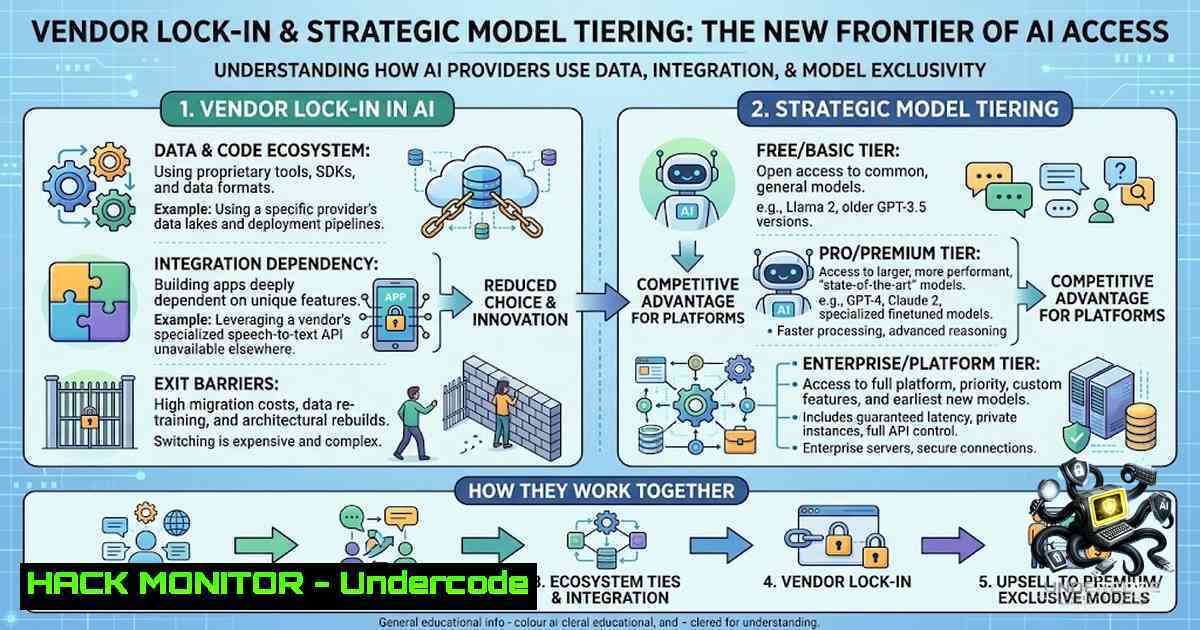
The artificial intelligence landscape is undergoing a significant transformation as major players like OpenAI, Anthropic, Google, and xAI begin to aggressively segment the market, limiting access to their premier models. A recent development involving OpenAI’s plan to restrict Cursor’s access to its models signals a shift from open collaboration to ecosystem capture, where the best AI capabilities are increasingly reserved for internal use or sold at a premium. This trend forces enterprises and developers to rethink their reliance on single vendors and explore robust strategies for leveraging cheaper, alternative models while maintaining data sovereignty and operational resilience.
Learning Objectives & Secrets:
- Objective 1: Understand the Ecosystem Shift — Gain insight into the market dynamics driving major AI labs to restrict model access and how this impacts business continuity.
- Objective 2: Mitigate Vendor Lock-in — Learn secret tips for designing AI-dependent systems that are portable, using abstraction layers and middleware to swap models without overhauling your architecture.
- Objective 3: Optimize Cheaper Models — Discover secret tips for fine-tuning and prompting smaller or non-US models to achieve performance comparable to premium offerings, using techniques like synthetic data generation and task-specific distillation.
You Should Know:
1. Implementing a Model Abstraction Layer
To shield your applications from vendor-specific API changes, start by building a universal model client. This step-by-step guide explains how to create an abstraction that allows seamless switching between OpenAI, Anthropic, and open-source models.
- Step 1: Define a standard interface for chat completions, embeddings, and fine-tuning in your preferred language (Python example below).
- Step 2: Create adapter classes for each provider that translate your standard requests into the provider’s specific API format.
- Step 3: Implement a configuration-driven factory that instantiates the correct adapter based on environment variables.
- Step 4: Log all requests and responses to monitor performance differences and fallback triggers.
- Step 5: Set up circuit breakers to automatically switch to backup models if primary API latency exceeds thresholds or returns errors.
Example Python Snippet:
class ModelAdapter:
def generate(self, prompt, kwargs):
raise NotImplementedError

class OpenAIChatAdapter(ModelAdapter):
def generate(self, prompt, kwargs):
 Convert to OpenAI format
return openai.ChatCompletion.create(model=kwargs.get('model'), messages=[{"role": "user", "content": prompt}])
Linux Command for Environment Switching:
export PRIMARY_MODEL=openai
export BACKUP_MODEL=huggingface
python app.py
2. Deploying Local Open-Source Models for Critical Tasks
Reducing dependency on US-based labs involves deploying local models like Llama 3, Mistral, or DeepSeek. This guide covers setting up a secure, on-premise inference server using Ollama or vLLM.
- Step 1: Install Ollama on a Linux server:
curl -fsSL https://ollama.com/install.sh | sh. - Step 2: Pull a model:
ollama pull llama3:70b. - Step 3: Run the model as a service: `ollama serve` and configure systemd for persistence.
- Step 4: Implement API rate limiting and authentication using Nginx as a reverse proxy.
- Step 5: Benchmark latency and accuracy against cloud models using a curated test set.
- Windows Equivalent: Use WSL2 to run the same Linux commands, or deploy using Docker Desktop with GPU passthrough.
- Establishing a Hybrid Cloud and On-Premise AI Architecture
Balance cost, performance, and data privacy by splitting workloads. This section details routing sensitive data to local models while using cloud models for non-sensitive, high-complexity tasks.
- Step 1: Classify data sensitivity levels and assign routing rules in your application’s configuration.
- Step 2: Use Kubernetes to orchestrate both local and cloud model deployments, enabling auto-scaling.
- Step 3: Implement a VPN or Direct Connect for secure, low-latency communication between your VPC and on-premise GPU clusters.
- Step 4: Monitor data egress and ingress using tools like Prometheus and Grafana to track costs.
- Step 5: Use service meshes (Istio) to enforce mTLS between services and ensure compliance.
- API Security and Access Control for AI Services
With multiple models in play, securing API keys and managing user permissions becomes critical. Implement robust API key management and rotation policies.
- Step 1: Store all API keys in a secrets manager (HashiCorp Vault or AWS Secrets Manager).
- Step 2: Rotate keys automatically every 90 days using Lambda functions or cron jobs.
- Step 3: Use OAuth2/OIDC for user authentication and map roles to specific model tiers.
- Step 4: Enforce IP whitelisting for all model API calls to prevent abuse.
- Linux Command for Vault Initialization:
vault kv put secret/models/openai key=xxx. - Windows PowerShell: Use `Set-Secret` in the SecretManagement module.
5. Fine-Tuning Cheaper Models with Synthetic Data
Improve the performance of smaller models by fine-tuning them on task-specific data generated by premium models. This reduces reliance on expensive API calls over time.
- Step 1: Use a premium model (like GPT-4) to generate a high-quality dataset of 10,000 examples.
- Step 2: Clean and format the data into a chat template compatible with Hugging Face.
- Step 3: Use the Transformers library to fine-tune a model like Llama 3 8B on your local GPU.
- Step 4: Evaluate the fine-tuned model against the original using ROUGE or BLEU scores.
- Step 5: Deploy the fine-tuned model in a shadow mode to compare live outputs with the cloud model.
6. Cost Optimization and Monitoring for Multi-Model Environments
Using multiple models can lead to unpredictable costs. Implement a cost-savvy strategy by tracking token usage and setting budget alerts.
- Step 1: Implement a token counting library (tiktoken for OpenAI) to estimate costs before sending requests.
- Step 2: Cache responses for identical queries using Redis to avoid duplicate API charges.
- Step 3: Set up budget alerts in AWS/GCP/Azure that trigger if daily spend exceeds a threshold.
- Step 4: Use model routing based on query complexity—simple queries go to cheaper local models, complex ones to premium.
- Linux Monitoring Command: `watch -1 1 ‘curl -s http://localhost:8000/metrics | grep cost’` to monitor live inference cost.
7. Implementing a Fallback Mechanism for API Failures
Ensure high availability by designing a failover system that gracefully downgrades when primary models are unavailable.
- Step 1: Wrap all model API calls in a try-except block that catches timeout and rate-limit errors.
- Step 2: Configure a retry with exponential backoff (e.g., 1s, 2s, 4s).
- Step 3: After three retries, switch to a secondary model (e.g., from OpenAI to Anthropic).
- Step 4: Log all failures and fallback triggers to an ELK stack for analysis.
- Step 5: Send alerts to your on-call engineer via PagerDuty if fallback occurs more than 5% of the time.
What Undercode Say:
- Key Takeaway 1: The era of unrestricted access to frontier AI is ending; organizations must treat model availability as a risk factor, not a given.
- Key Takeaway 2: Diversifying model portfolios and investing in internal optimization of smaller models is the only sustainable path to AI independence.
Analysis:
The move to restrict access to top-tier AI models is a double-edged sword. On one hand, it forces innovation in model efficiency and open-source development, as seen with the rapid advancement of Llama and Mistral. On the other hand, it creates a dangerous moat where only a few corporations hold the keys to the most capable AI, potentially stifling competition and innovation in downstream applications. Dima Istomin’s approach at 8Hats Lab—benchmarking against US models while building with non-US alternatives—demonstrates a pragmatic foresight. This strategy not only mitigates vendor lock-in but also aligns with global data sovereignty regulations, making it a resilient framework for the evolving AI landscape.
Prediction:
- -1 Within 18 months, at least two major AI labs will introduce “Enterprise-Exclusive” model tiers, effectively creating a two-class system of AI haves and have-1ots.
- -1 Smaller startups relying heavily on a single provider’s API will face sudden disruptions, leading to a wave of pivots or failures.
- +1 The open-source community will fill the gap, with collaborative fine-tuning projects achieving 90% of premium performance on specific verticals like legal and medical reasoning.
- +1 Non-US models (DeepSeek, Yi, Falcon) will gain significant market share in regions with strict data localization laws, fostering a more balanced global AI ecosystem.
- -1 The costs associated with maintaining a multi-model infrastructure will increase operational expenses for SMBs, accelerating consolidation in the AI application market.
- +1 There will be a rise in “Model Orchestration” as a service, where third-party platforms manage fallback, cost, and performance across multiple providers, democratizing access.
- -1 Major labs will begin to heavily watermark outputs from their best models, making it difficult to use them for training competitive alternatives.
- +1 The focus will shift from model size to data curation and fine-tuning efficiency, as enterprises realize that smaller, targeted models are more secure and cost-effective.
- -1 Vendor API pricing will become increasingly volatile, akin to cloud egress fees, making long-term budgeting a nightmare.
- +1 Strategic partnerships with smaller, national AI labs will emerge as a competitive advantage, offering stability and customization that global giants cannot match.
▶️ Related Video (84% Match):
🎯Let’s Practice For Free:
🎓 Live Courses & Certifications:
Join Undercode Academy for Verified Certifications
🚀 Request a Custom Project:
Secure, high-velocity infrastructure and disruptive technological engineering. Contact our engineering team for high-tier development and proprietary systems:
[email protected]
💎 Smart Architecture | 🛡️ Secure by Design | ⭐ Trusted by Thousands
IT/Security Reporter URL:
Reported By: https://lnkd.in/p/eiuuMkrU – Hackers Feeds
Extra Hub: Undercode MoN
Basic Verification: Pass ✅


