Listen to this Post
Introduction:
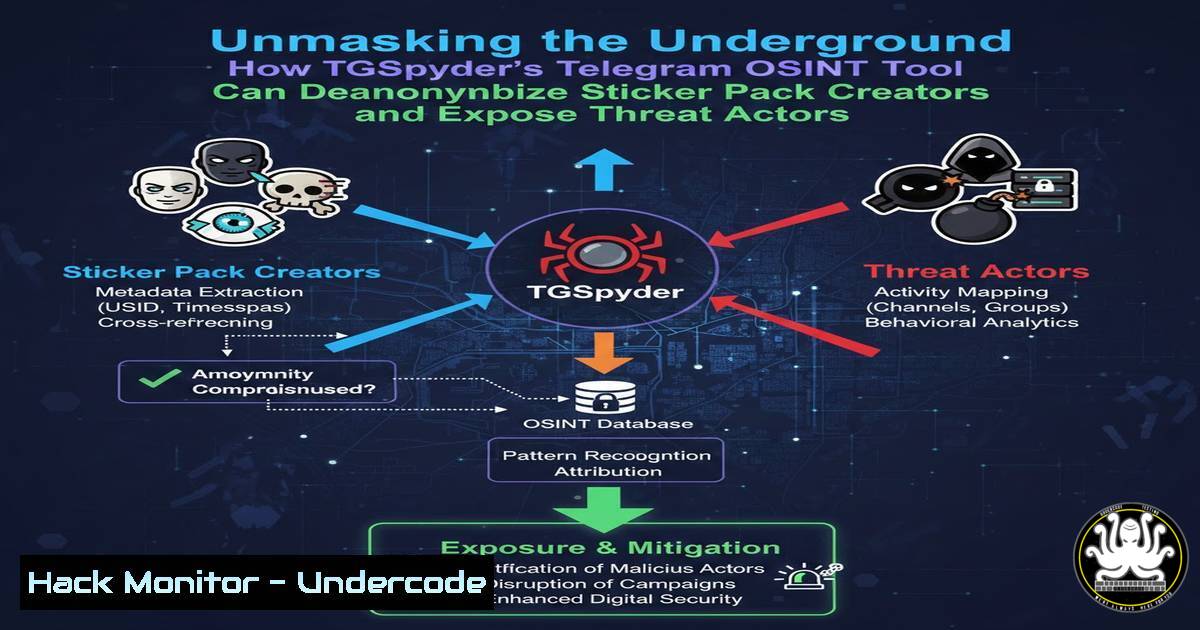
The encrypted messaging platform Telegram has become a dual-use arena, serving as a hub for both private communication and, concerningly, for coordination among threat actors and extremist groups. Open-Source Intelligence (OSINT) tools designed for Telegram are crucial for security researchers and investigators to monitor these spaces. TGSpyder emerges as a powerful, Python-based command-line interface (CLI) tool that automates the extraction and analysis of data from both public and private Telegram groups and channels, with a unique capability to deanonymize the creators of sticker packs—a feature often exploited by malicious communities.
Learning Objectives:
- Understand the core data extraction capabilities of the TGSpyder tool for Telegram OSINT investigations.
- Learn how to utilize its unique feature for inferring and identifying Telegram Sticker Pack creators.
- Apply operational security (OPSEC) best practices to conduct ethical and safe OSINT research using such tools.
You Should Know:
1. Core Capabilities and Installation
TGSpyder is built with Python using the Telethon library and is designed to automate the collection of structured data from Telegram. Its primary functions include scraping member lists and chat messages, crawling chat histories to discover invite links, performing user lookups, and exporting all collected data to organized CSV files. It also supports SOCKS proxies, such as Tor, for anonymized queries.
Step-by-step Installation and Setup:
- Prerequisites: Ensure you have Python 3.7+ and `pip` installed on your system.
- Clone the Repository: Navigate to your desired directory and clone the official repository.
git clone https://github.com/Darksight-Analytics/tgspyder.git
cd tgspyder
- Install Dependencies: Install the required Python libraries, primarily Telethon.
pip install -r requirements.txt
- API Configuration: To interact with Telegram’s API, you must obtain API credentials. Visit
my.telegram.org, log in with your phone number, and create an application to get an `api_id` andapi_hash. - Configure Telethon: Run a simple authentication script or configure Telethon within your environment using the obtained credentials. TGSpyder will leverage this session.
2. Executing Basic Data Extraction Operations
The tool’s power is accessed through specific command-line arguments, allowing for targeted data collection.
Step-by-step Command Usage:
- Scrape Members and Messages: To collect the user list and chat history from a target group or channel.
python tgspyder.py "https://t.me/target_group" --members --chats
This command will create CSV files in a dedicated output directory containing usernames, user IDs, message text, and timestamps.
- Crawl for Invite Links: To search through a chat’s history and extract any invitation links shared, which can reveal connected communities.
python tgspyder.py "https://t.me/target_group" --crawl-invites
- Perform User Lookups: To retrieve available information about a specific user via their ID or username.
python tgspyder.py --user 123456789
python tgspyder.py --user @username
-
Deanonymizing Sticker Pack Creators: A Technical Deep Dive
This is TGSpyder’s standout feature. Threat actors frequently use custom sticker packs for branding and communication. While anonymous, the pack’s ID can be mathematically linked to its creator.
Step-by-step Reverse Engineering Process:
- Retrieve Pack Metadata: TGSpyder first extracts the sticker pack’s unique identifier.
- Apply Bitwise Operation: The tool applies a known 32-bit right shift operation to the pack ID. This operation reverses a known obfuscation technique used by Telegram, converting the pack ID into a potential Telegram User ID.
- Resolve the User ID: The inferred user ID is then queried against the Telegram API using methods like
client.get_entity(user_id). - Identity Correlation: If the API returns a username or other details, the creator is identified. If not (due to privacy settings), the naked user ID remains valuable. As noted by the developer, this user ID can be cross-referenced with external services like DARKSIDE by District 4 Labs, which aggregates data from previous breaches, potentially linking the ID to a known identity.
4. Integrating with the Broader OSINT Toolkit
TGSpyder does not operate in a vacuum. It fits into a larger investigative workflow alongside other specialized OSINT tools. For instance, after extracting usernames or phone numbers with TGSpyder, an investigator might use a tool like Maltego to visually map relationships to other social media accounts or domains. Alternatively, extracted email addresses could be checked in a platform like Intelligence X to search for historical data breaches and linked passwords. This layered approach, using TGSpyder for Telegram-specific data and other tools for cross-platform correlation, is standard practice for comprehensive threat intelligence.
5. Operational Security (OPSEC) and Ethical Guidelines
Conducting OSINT, especially against hostile groups, carries risk. Protecting your identity and infrastructure is paramount. General OSINT security guidelines strongly recommend using virtual machines or disposable environments to isolate your research activities. Always route your traffic through a VPN or the Tor network (which TGSpyder supports via SOCKS5 proxy). Use dedicated, non-personal accounts for research and rigorously review the Terms of Service for any platform you interact with. Furthermore, developers building tools that interact with Telegram’s API must adhere to strict security guidelines, such as validating encryption parameters and message integrity, to ensure their tools are not vulnerable to exploitation.
What Undercode Say:
- Shifting the Attribution Battle: TGSpyder’s ability to link sticker packs to user IDs represents a significant leap in attribution techniques within encrypted platforms. It weaponizes a seemingly benign feature (stickers) into a potential forensic trail, forcing threat actors to reconsider their operational security.
- The Automation Advantage: By transforming manual, time-consuming Telegram scraping into an automated, structured data collection process, TGSpyder lowers the barrier for persistent monitoring of threat communities. This allows security teams to scale their surveillance and gain insights from larger datasets, such as network growth patterns and communication trends over time.
The development of TGSpyder highlights the ongoing cat-and-mouse game in cybersecurity. As platforms like Telegram add features, the OSINT community reverse-engineers them for intelligence value. This tool specifically undermines a layer of anonymity that malicious actors may have taken for granted. However, its effectiveness also raises ethical questions about the scope of investigation and privacy. Its use underscores a critical principle: in the digital age, anonymity is often fragile, and persistent, technically skilled investigation can piece together identities from seemingly unconnected data points.
Prediction:
The methodology pioneered by TGSpyder will likely inspire a new wave of specialized OSINT tools focused on “feature exploitation”—extracting intelligence from ancillary platform features like gifts, reactions, or custom emojis. In response, we anticipate that Telegram and similar platforms may further obscure or encrypt metadata associated with these features. Furthermore, sophisticated threat groups will adapt by rotating sticker packs, using them more sparingly, or misusing other, less-monitored platform functionalities. This will continuously push the OSINT field towards more advanced cryptographic reverse-engineering and behavioral analysis to maintain the intelligence edge.
▶️ Related Video (74% Match):
🎯Let’s Practice For Free:
IT/Security Reporter URL:
Reported By: Jmetayer Github – Hackers Feeds
Extra Hub: Undercode MoN
Basic Verification: Pass ✅


