Listen to this Post
Introduction:
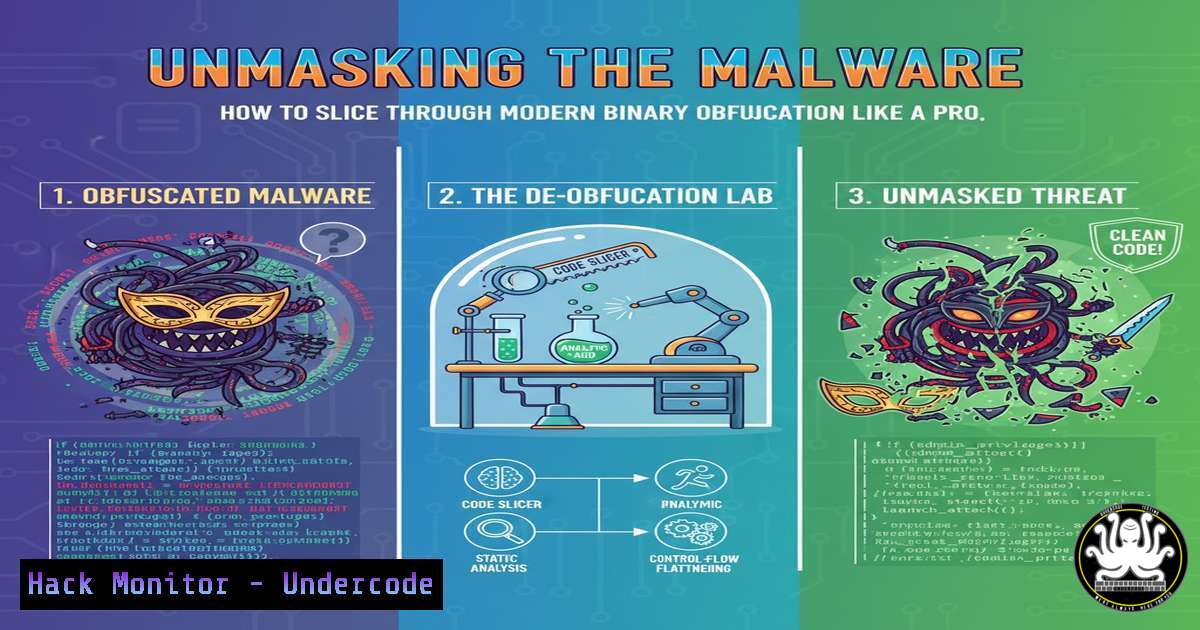
Modern malware and software protection schemes increasingly rely on sophisticated binary obfuscation to evade detection and hinder analysis. These techniques transform readable code into a tangled mess, but with the right methodology and tools, reverse engineers can systematically deconstruct these defenses. This article delves into the practical application of heuristics, program analysis, and solver technology to detect, analyze, and ultimately neutralize complex obfuscation.
Learning Objectives:
- Identify common obfuscation patterns using heuristic-based detection plugins.
- Recover clean disassembly by removing fake functions and inlining helper routines.
- Simplify complex Mixed Boolean-Arithmetic (MBA) expressions and resolve opaque predicates using symbolic execution and SMT solvers.
You Should Know:
1. Heuristic-Based Obfuscation Detection
The first line of defense against obfuscated code is to quickly identify its presence within a large binary. This is achieved using heuristics that flag statistically anomalous patterns.
Step-by-step guide explaining what this does and how to use it.
1. Install the Obfuscation Detection Plugin: Clone the repository from the provided URL (`https://lnkd.in/g_6wKdB`) into your Binary Ninja plugins directory.
2. Run the Analysis: Open your target binary in Binary Ninja. The plugin typically adds a new menu or panel. Execute a scan across the entire binary or a specific function.
3. Interpret the Heuristics:
Control-Flow Flattening: The plugin looks for a central dispatcher loop (a `while(true)` loop) that controls execution flow via a state variable, flattening the natural control-flow graph (CFG).
Cyclomatic Complexity & Loop Nesting: Functions with an unusually high number of independent paths or deeply nested loops are flagged. You can calculate cyclomatic complexity manually in a script with `len(bv.get_basic_blocks()) – len(bv.get_edges()) + 2` for a given function.
Large Basic Blocks: Look for blocks containing hundreds of instructions, often indicative of unrolled cryptographic loops or heavy arithmetic obfuscation.
Instruction n-grams: The plugin analyzes the frequency of instruction sequences. Functions that deviate significantly from standard compiler output patterns are highlighted.
Malware Heuristics: Specific patterns like XOR decryption loops (look for `xor` instructions inside a tight loop) or RC4 key-scheduling (KSA) and pseudo-random generation (PRGA) algorithms are pinpointed.
2. Disassembly Recovery and Decompiler Inlining
Obfuscators often insert junk bytes or create “fake” functions to break disassemblers. Cleaning this up is crucial for a correct decompiler output.
Step-by-step guide explaining what this does and how to use it.
1. Clean Fake Functions: Using the Obfuscation Analysis plugin (https://lnkd.in/e94wJhgb`), scan for functions that do not contribute to the actual program logic. These are often short sequences ending in an invalid instruction or a jump into the middle of another instruction.Undefine Function`) or let the plugin handle it, allowing the disassembler to reinterpret the bytes correctly.
2. Remove/Undefine Functions: Once identified, you can manually undefine the function (Right-click ->
3. Recursive Function Inlining: Obfuscators split logic across many small helper functions. The analysis plugin can recursively inline these helpers into the calling function in the High-Level IL (HLIL) view.
4. Verify Decompilation: After inlining, the decompiler can now see the entire dataflow and perform cross-boundary optimizations, often revealing a much simpler and more logical code structure.
3. Simplifying Mixed Boolean-Arithmetic (MBA) Expressions
MBAs mix arithmetic (+, -, ) and bitwise operations (&, |, ^) to create expressions that are complex but equivalent to a simple form (e.g., `(x ^ y) + 2(x & y)` is equivalent to x + y).
Step-by-step guide explaining what this does and how to use it.
1. Identify MBA Patterns: Look for complex expressions in the HLIL view involving a mix of integer and bitwise operations.
2. Use the MBA Simplifier: The Obfuscation Analysis plugin includes a simplifier. Highlight the complex HLIL expression.
3. Apply Simplification: The plugin slices the expression, passes it to a custom solver (like Z3 or its own simplifier), and replaces it with the simplified form, often annotating the result directly as a comment in the decompiler. For example, the expression `(a ^ b) + 2(a & b)` would be simplified and commented as ; = a + b.
4. Symbolic Execution for Opaque Predicate Resolution
Opaque predicates are conditional branches that always evaluate to either true or false, but are constructed to be non-obvious to a static analyzer. Symbolic execution can prove their fixed outcome.
Step-by-step guide explaining what this does and how to use it.
1. Set a Symbolic State: Begin symbolic execution at the function entry or a point before the conditional jump. Define the initial register and memory state symbolically.
2. Execute the Block: Follow the execution path to the conditional branch (e.g., `JZ` or JNZ). The condition will now be a symbolic formula based on the initial state.
3. Query the SMT Solver: Ask the solver (integrated into the analysis plugin) if both paths of the branch are possible. For a predicate P, the solver checks if `P` and `not P` can both be true. If not, it’s an opaque predicate.
4. Example Command Concept: While often GUI-driven, the core logic is: solver.check(And(initial_constraints, Not(branch_condition))). If this returns unsat, the branch is always taken.
5. Patching and Control-Flow Straightening
Once opaque predicates are identified, you can permanently patch the binary to remove the obfuscation and reveal the true control flow.
Step-by-step guide explaining what this does and how to use it.
1. Identify the Opaque Predicate: Using the method above, confirm a conditional jump is always taken (e.g., JZ).
2. Patch the Instruction: Overwrite the conditional jump (JZ) with an unconditional jump (JMP) to the correct target, or a `NOP` sled to fall through to the correct block. In Binary Ninja, you can do this by right-clicking the instruction and selecting Patch -> Assemble.
Linux Command-Line with objdump/xxd/printf: While cumbersome, you can find the file offset, convert the new instruction to opcodes, and use `printf` to overwrite the bytes in a copy of the binary.
3. Propagate Constants: After patching, use Binary Ninja’s dataflow analysis to propagate the now-constant branch outcomes, which will further clean up and simplify the decompiled code.
What Undercode Say:
- Heuristic detection is the essential first step, turning an intractable problem of “reverse this entire binary” into a manageable one of “analyze these specific, suspicious regions.”
- The combination of semantic-preserving simplification (MBA solving) and control-flow manipulation (patching opaque predicates) is the most powerful approach for transforming obfuscated code back into a compiler-like output.
The methodology presented represents a shift from manual, intuition-based reversing to a systematic, tool-assisted scientific process. By leveraging program analysis and formal methods, analysts can deconstruct obfuscation that would be otherwise impenetrable. The plugins demonstrated are not just tools but embodiments of a sophisticated strategy: first, profile the binary to find anomalies; second, clean the disassembly to establish a correct foundation; and third, apply algebraic and logical solvers to simplify the core obscured logic. This layered approach is becoming the new standard in advanced malware analysis and software security research.
Prediction:
The arms race between obfuscation and deobfuscation will increasingly migrate towards AI-driven techniques. We can expect obfuscators to use generative models to create vast, unique MBA expressions and control-flow structures, while deobfuscation tools will counter with AI-powered simplification and pattern recognition. Furthermore, the tight integration of SMT solvers and symbolic execution into mainstream reverse engineering platforms will become the baseline, moving these advanced techniques from academic research to essential skills for every professional malware analyst. The focus will shift from purely static obfuscation to hybrid, dynamically-evolving code that alters its obfuscation scheme at runtime, demanding more advanced dynamic analysis and emulation integrations.
🎯Let’s Practice For Free:
IT/Security Reporter URL:
Reported By: Tim Blazytko – Hackers Feeds
Extra Hub: Undercode MoN
Basic Verification: Pass ✅


