
Listen to this Post
Introduction:
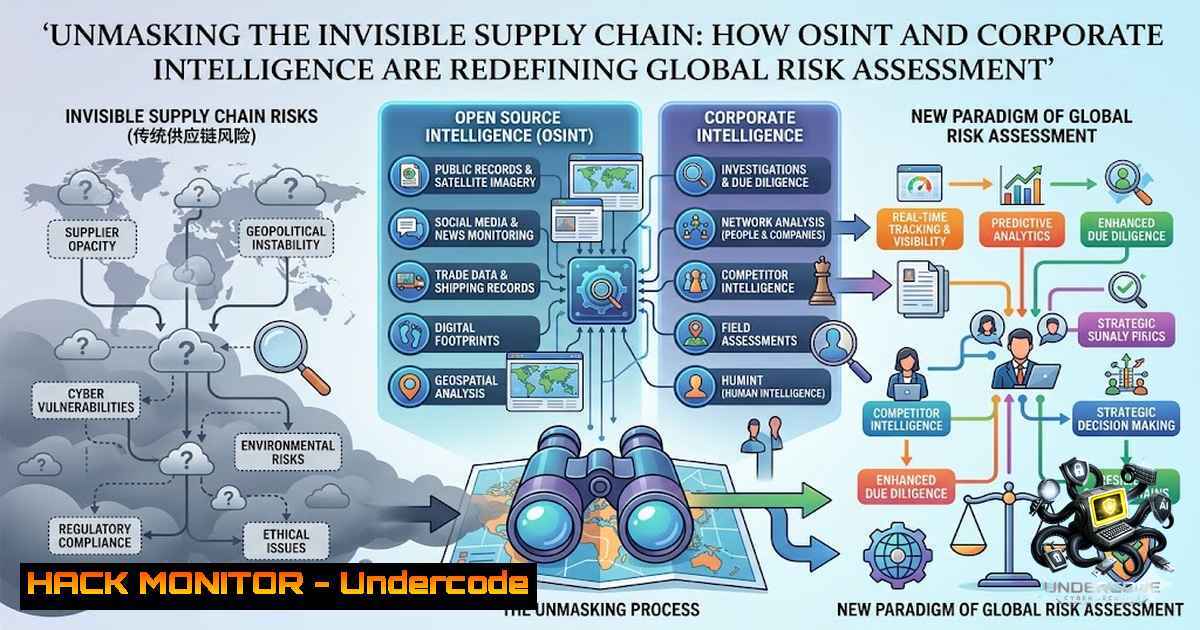
In an era where global supply chains span dozens of countries and thousands of suppliers, the greatest threat to your organization isn’t a direct cyberattack—it’s the hidden risk buried four layers deep in your vendor network. Open-Source Intelligence (OSINT) has evolved far beyond social media scraping; it now powers a new breed of corporate intelligence platforms that map ownership chains, flag sanctions evasion, and expose financial networks that were designed to remain invisible. Platforms like Sayari and OSINT tool aggregators such as OSINTRack are equipping cybersecurity analysts, threat intelligence professionals, and compliance officers with the ability to trace cross-border ownership, identify beneficial owners, and detect anomalous trade patterns before they become regulatory nightmares.
Learning Objectives:
- Master the application of OSINT techniques for multi-tier supply chain risk mapping and third-party due diligence.
- Learn to leverage corporate registry data, trade flow records, and AI-powered knowledge graphs to uncover hidden ownership and sanctions exposure.
- Develop hands-on skills using API-driven intelligence platforms, Python automation, and Linux/Windows command-line tools for continuous risk monitoring.
You Should Know:
1. Corporate Intelligence Platforms: The New OSINT Frontier
Traditional risk intelligence involved cobbling together credit data from one vendor, sanctions screening from another, and manually researching ownership structures. Modern platforms like Sayari have revolutionized this by consolidating primary source documents, structured commercial records from over 250 jurisdictions, and a resolved knowledge graph of over 1.5 billion entities into a single queryable interface. This isn’t just OSINT; it’s “resolved intelligence”—AI trained on real investigative tradecraft that proves every step of its work.
The platform’s Graph AI integrates OSINT, adverse media screening, and drag-and-drop document ingestion to resolve each entity, flag trade risk indicators, identify sanctions and export control exposure, and generate compliance documentation. For threat finance analysts, Sayari integrates corporate registry data with trade flow records and financial intelligence, enabling them to trace ownership networks, identify node dependencies, and map the full corporate infrastructure behind a threat actor.
Step‑by‑step guide:
To begin leveraging corporate intelligence platforms for OSINT investigations:
- Identify Your Risk Surface: Map your organization’s tier-1, tier-2, and tier-3 suppliers. Document all known legal entities, DUNS numbers, and jurisdictions of operation.
- Access the Intelligence Layer: If using Sayari, navigate to the platform’s search interface. Input a supplier’s legal name or registration number. The platform will return a resolved entity profile incorporating data from 250+ jurisdictions.
- Perform Beneficial Ownership Traversal: Use the platform’s ownership mapping feature to trace multi-tier corporate structures. Click through each layer to identify Ultimate Beneficial Owners (UBOs) and flag any connections to Politically Exposed Persons (PEPs) or sanctioned entities.
- Analyze Trade Flow Anomalies: Access the trade data visualization module. Look for unusual commodity-country combinations, atypical routing, or volume spikes that may indicate transshipment or sanctions evasion.
- Generate Compliance Documentation: Export the resolved entity profile, ownership chain, and flagged risk indicators to build a defensible Suspicious Activity Report (SAR) narrative.
2. OSINTRack: The Aggregator’s Advantage
While platforms like Sayari provide deep corporate intelligence, comprehensive OSINT investigations often require a diverse toolkit. OSINTRack (available at https://osintrack.com) serves as a curated hub for OSINT tools, offering investigators a centralized starting point for gathering intelligence across multiple domains. The philosophy behind OSINTRack aligns with modern OSINT methodology: combining multiple dashboards and monitoring tools rather than relying on a single source.
OSINTRack provides access to tools for reverse image search, data breach detection, social media hashtag analysis, and more. This aggregation is critical because effective OSINT requires triangulation—verifying findings across multiple independent sources to ensure reliability.
Step‑by‑step guide for setting up an OSINT workstation:
- Browser Configuration: Use a privacy-focused browser (Firefox with uBlock Origin and NoScript) or a dedicated investigation browser. Configure it to clear cookies and cache between sessions.
- Tool Aggregation: Bookmark OSINTRack as your starting point. From there, identify and access specialized tools for:
– Corporate Intelligence: Sayari, OpenCorporates, and country-specific business registries.
– Data Breach Detection: Breach search engines to check if vendor emails or domains have been compromised.
– Social Media Intelligence: Hashatit.com for hashtag tracking across Facebook, Twitter, YouTube, and Instagram.
– Technical OSINT: Tools like SpiderFoot for automating data collection on IP addresses, email addresses, usernames, and domains.
3. Data Organization: Use spreadsheets or OSINT collection tools to consistently organize metadata and maintain a clear audit trail for each finding.
4. Automation with Python: For advanced users, build smart pipelines that gather and filter data 24/7 using APIs, Python, and no-code automation tools.
- API-Driven Intelligence: Integrating OSINT into Your Security Stack
Modern OSINT isn’t just about manual web searches; it’s about API-driven automation that provides continuous, real-time risk monitoring. Sayari’s World Model MCP exposes all three layers of intelligence—source documents, resolved structures, and risk intelligence—as 41 callable tools that any AI agent can use. This API-first approach allows organizations to integrate corporate and trade intelligence directly into their existing security information and event management (SIEM) systems, third-party risk management (TPRM) workflows, and custom dashboards.
API Integration Workflow (Linux/macOS):
 Example: Querying the Sayari API for a supplier's risk profile
 Note: Replace API_KEY and ENTITY_ID with actual values

Set your API key and endpoint
API_KEY="your_sayari_api_key"
BASE_URL="https://api.sayari.com/v1"
ENTITY_ID="supplier_entity_id"

Perform a GET request to retrieve entity risk summary
curl -X GET "$BASE_URL/entities/$ENTITY_ID/risk" \
-H "Authorization: Bearer $API_KEY" \
-H "Content-Type: application/json" \
| jq '.'  Pretty-print JSON response

Retrieve ownership chain (multi-tier)
curl -X GET "$BASE_URL/entities/$ENTITY_ID/ownership" \
-H "Authorization: Bearer $API_KEY" \
-H "Content-Type: application/json" \
| jq '.data.relationships'

Check for sanctions exposure
curl -X GET "$BASE_URL/entities/$ENTITY_ID/sanctions" \
-H "Authorization: Bearer $API_KEY" \
-H "Content-Type: application/json"
Windows PowerShell Equivalent:
 PowerShell script for API-based OSINT checks
$apiKey = "your_sayari_api_key"
$baseUrl = "https://api.sayari.com/v1"
$entityId = "supplier_entity_id"

Retrieve entity risk summary
$headers = @{
"Authorization" = "Bearer $apiKey"
"Content-Type" = "application/json"
}
$response = Invoke-RestMethod -Uri "$baseUrl/entities/$entityId/risk" -Headers $headers -Method Get
$response | ConvertTo-Json -Depth 10

Retrieve ownership chain
$ownership = Invoke-RestMethod -Uri "$baseUrl/entities/$entityId/ownership" -Headers $headers -Method Get
$ownership.data.relationships
For organizations without direct API access, tools like SpiderFoot can be deployed to automate OSINT collection. SpiderFoot is an open-source intelligence automation tool that can be run locally or via a web interface.
Deploying SpiderFoot on Linux:
 Install SpiderFoot on Ubuntu/Debian
sudo apt update && sudo apt install python3-pip git -y
git clone https://github.com/smicallef/spiderfoot.git
cd spiderfoot
pip3 install -r requirements.txt

Run SpiderFoot in headless mode with a specific scan
python3 sf.py -l 127.0.0.1:5001 -s "example.com" -m "sfp_dnsresolve,sfp_whois,sfp_robots"
4. OSINT-Driven Third-Party Risk Assessment (TPRM)
Traditional TPRM approaches often rely on manual surveys, delayed security audits, or vendor-provided self-assessments that fail to adapt to suppliers’ speed, scale, and complexity. OSINT-driven models like GEN-TPRM use LLM-based question answering and scoring aligned with ISO/IEC 27001:2022 and Gartner risk thresholds to provide continuous, automated assessments. Research shows that 295 out of 780 high-priority vulnerabilities are OSINT-discoverable, meaning attackers can identify affected systems using publicly available tools.
Step‑by‑step guide for OSINT-driven TPRM:
- Inventory Your Vendor Ecosystem: Create a comprehensive list of all third-party vendors, including sub-contractors and fourth-party suppliers.
- OSINT Discovery: Use OSINT tools to identify externally visible vulnerabilities in your vendors’ infrastructure. Check for exposed services, outdated software versions, and misconfigured cloud assets.
- Cross-Reference with Threat Intelligence: Correlate discovered vulnerabilities with known exploits (KEV) and exploitability scores (EPSS) to prioritize remediation.
- Continuous Monitoring: Set up automated scans and API-based alerts to monitor your vendor ecosystem in real-time. Sayari’s supply chain monitor can check a single supplier for risks or map multi-tier supply chain relationships.
- Action and Remediation: For critical findings, engage vendors directly with evidence from your OSINT investigations. Use the intelligence to renegotiate contracts or require specific security controls.
-
Advanced OSINT Techniques: Graph Analysis and Network Mapping
The most powerful OSINT investigations go beyond individual entities to map entire networks. By integrating trade data, shipping records, and corporate linkages, platforms like Sayari enable investigators to identify potential exposure several layers down the supply chain, where visibility is weakest. Graph analysis techniques allow analysts to:
– Map a supply chain back to source across dozens of countries
– Trace connections through intermediary jurisdictions to identify foreign control that creates counter-intelligence and FOCI risks in energy, defense, and critical infrastructure
– Identify shell companies and money laundering typologies even when the direct counterparty appears clean
Practical Graph Analysis with Python:
import requests
import networkx as nx
import matplotlib.pyplot as plt

Fetch ownership data from Sayari API (pseudo-code)
def fetch_ownership_chain(entity_id, api_key):
headers = {"Authorization": f"Bearer {api_key}"}
response = requests.get(f"https://api.sayari.com/v1/entities/{entity_id}/ownership", headers=headers)
return response.json()

Build a directed graph of ownership relationships
def build_ownership_graph(ownership_data):
G = nx.DiGraph()
for relationship in ownership_data.get('data', {}).get('relationships', []):
parent = relationship.get('parent_name')
child = relationship.get('child_name')
ownership_pct = relationship.get('ownership_percentage')
if parent and child:
G.add_edge(parent, child, weight=ownership_pct)
return G

Visualize the network
def visualize_graph(G):
pos = nx.spring_layout(G)
nx.draw(G, pos, with_labels=True, node_color='lightblue',
edge_color='gray', arrows=True, font_size=8)
plt.title("Ownership Network Graph")
plt.show()

Example usage
 G = build_ownership_graph(fetch_ownership_chain("supplier_entity_id", "your_api_key"))
 visualize_graph(G)
What Undercode Say:
- Key Takeaway 1: The convergence of OSINT, AI, and corporate registry data has created an unprecedented capability to map global economic networks. Platforms like Sayari are not just tools; they represent a fundamental shift from reactive compliance to proactive intelligence.
- Key Takeaway 2: The most significant supply chain risks are not found in tier-1 vendors but in the hidden relationships four or five layers deep. OSINT-driven investigations that combine trade data, ownership mapping, and sanctions screening are essential for uncovering these blind spots.
Analysis:
The landscape of corporate intelligence is undergoing a seismic shift. Traditional compliance approaches—built on periodic screening against static watchlists—cannot keep pace with the complexity of modern supply chains. The integration of AI, particularly Graph AI and LLM-based analysis, is enabling analysts to process vast amounts of structured and unstructured data at scale. However, this power comes with a caveat: generic AI will give you a confident answer, but it might not be correct. The future belongs to platforms that ground AI in real commercial intelligence and train it on real investigative tradecraft.
For cybersecurity professionals, this means developing new skills. The ability to query APIs, interpret graph data, and integrate OSINT findings into security operations is becoming as important as traditional penetration testing or incident response. The OSINT community is also emphasizing privacy-first, locally-run tools that don’t store user data, reflecting a growing awareness of the ethical dimensions of intelligence gathering.
Prediction:
- +1 The democratization of corporate intelligence through platforms like Sayari and aggregators like OSINTRack will empower small and medium-sized enterprises to conduct due diligence that was previously only available to Fortune 500 companies, leveling the playing field in global trade.
- +1 AI-driven OSINT will become a standard component of all TPRM frameworks within the next 18-24 months, with regulatory bodies increasingly expecting organizations to demonstrate proactive, continuous monitoring rather than annual compliance checklists.
- -1 The same tools that enable legitimate due diligence will be weaponized by advanced persistent threat (APT) groups and state-sponsored actors to map critical infrastructure supply chains and identify vulnerable points of attack, escalating the cyber-physical risk landscape.
- -1 As corporate registry data becomes more accessible and interconnected, the volume of false positives and “noise” will increase dramatically, requiring sophisticated AI filtering and human analytical oversight to avoid alert fatigue and missed critical signals.
- +1 The integration of OSINT platforms with existing SIEM and SOAR solutions will enable automated threat hunting and incident response, reducing the mean time to detect (MTTD) and respond (MTTR) to supply chain compromises.
- -1 Privacy and data protection regulations will struggle to keep pace with the capabilities of modern OSINT platforms, creating legal grey areas and potential compliance pitfalls for organizations that push the boundaries of data collection and analysis.
▶️ Related Video (78% Match):
🎯Let’s Practice For Free:
🎓 Live Courses & Certifications:
Join Undercode Academy for Verified Certifications
🚀 Request a Custom Project:
Secure, high-velocity infrastructure and disruptive technological engineering. Contact our engineering team for high-tier development and proprietary systems:
[email protected]
💎 Smart Architecture | 🛡️ Secure by Design | ⭐ Trusted by Thousands
IT/Security Reporter URL:
Reported By: Mariosantella Osint – Hackers Feeds
Extra Hub: Undercode MoN
Basic Verification: Pass ✅


