
Listen to this Post
Introduction:
In an era where remote work has transitioned from a temporary solution to a permanent fixture of the corporate landscape, the digital boardroom has become the new frontline of cybersecurity. The seemingly innocuous act of joining a virtual meeting—as highlighted by security professional Rik van Duijn’s lighthearted post about attending meetings without being physically present—masks a complex web of vulnerabilities that threat actors are actively exploiting in 2026. From AI-powered deepfake impersonations to fake meeting links that deliver remote-access malware, the attack surface has expanded dramatically, demanding a fundamental shift in how organizations approach remote collaboration security.
Learning Objectives:
- Understand the evolving threat landscape targeting virtual meeting platforms and remote work infrastructure.
- Master the configuration and deployment of essential security controls, including VPNs, endpoint detection and response (EDR), and zero-trust architectures.
- Learn to identify, mitigate, and respond to social engineering attacks, AI-driven threats, and API vulnerabilities in remote work environments.
You Should Know:
- Securing the Virtual Meeting: Beyond the “Join” Button
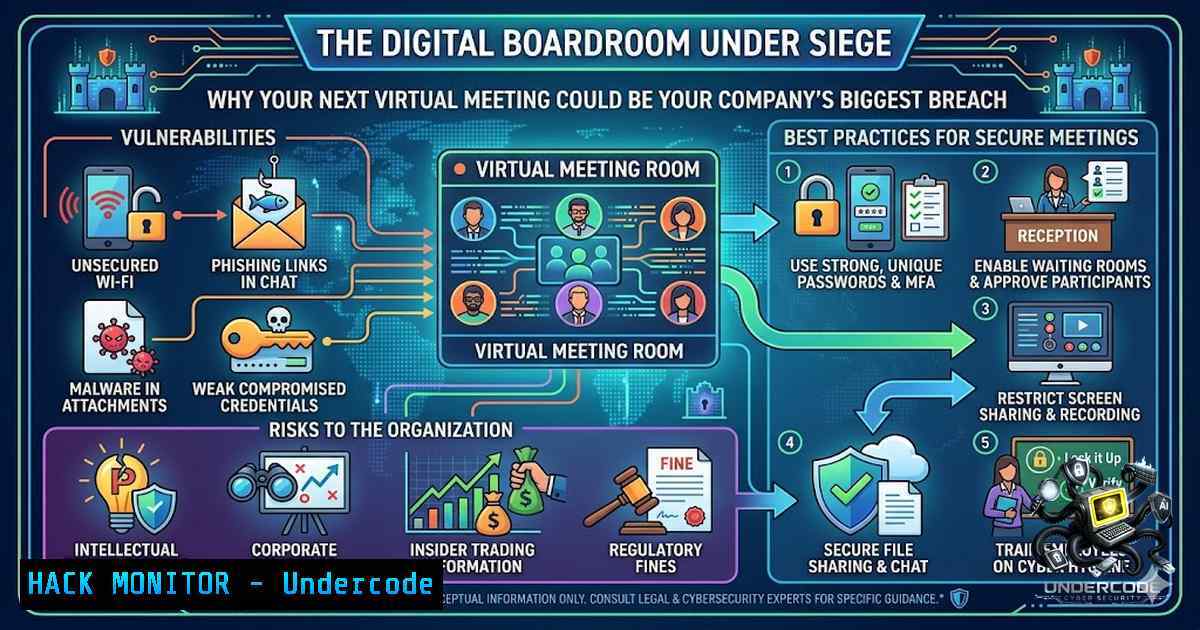
The convenience of virtual meetings has introduced a plethora of attack vectors that many organizations overlook. The foundational principle of securing these interactions is to treat every meeting as a potential breach point. Threat actors in 2026 are employing sophisticated tactics, including fake Google Meet and Zoom pages that lure users into fraudulent calls, ultimately delivering remote-access software. In more advanced campaigns, attackers use AI-generated deepfakes and voice cloning to impersonate executives during live meetings, enabling corporate espionage and financial fraud.
Step-by-Step Guide to Hardening Virtual Meetings:
- Eliminate Personal Meeting IDs (PMIs): Never use PMIs for public or recurring sessions. Instead, generate a unique meeting link for each session to prevent unauthorized access.
- Implement Multi-Layered Access Controls: Enable meeting passwords, utilize waiting rooms to vet participants, and lock the meeting once all legitimate attendees have joined.
- Restrict Screen and File Sharing: Configure settings to limit sharing to the host only, preventing attackers from distributing malware or stealing sensitive information during the session.
- Secure Endpoints and Connections: Keep operating systems and meeting applications patched with the latest security updates. Use a trusted, private Wi-Fi network or a corporate VPN to encrypt traffic.
- Develop and Enforce a Usage Policy: Create a formal policy that dictates how virtual meetings should be conducted, including guidelines for sharing links, handling recordings, and reporting suspicious activity.
- Fortifying the Remote Connection: VPN and Endpoint Security
A secure connection is the backbone of remote work. Virtual Private Networks (VPNs) remain a critical component, but their configuration and usage must evolve to meet modern threats. In 2026, the consensus is clear: choose VPNs with strict no-logs policies, independent audits, and strong encryption protocols like WireGuard or OpenVPN. The “always-on” VPN feature and kill switch are non-1egotiable; they ensure that traffic is never accidentally exposed if the VPN connection drops.
Step-by-Step Guide to VPN and Endpoint Hardening:
- Configure Always-On VPN: On Windows, this can be enforced via Group Policy or the VPN client settings. On Linux, use NetworkManager or systemd-1etworkd to establish a persistent connection.
- Enable the Kill Switch: This feature blocks all internet traffic if the VPN disconnects. On Linux, this can be achieved with `iptables` rules that only allow traffic through the VPN interface.
- Audit for Leaks: After configuration changes, test for IP and DNS leaks using tools like `ipleak.net` or
dnsleaktest.com. - Deploy Endpoint Detection and Response (EDR): Move beyond traditional antivirus. EDR solutions provide behavioral detection and automated threat response, which are essential for catching modern malware that evades signature-based defenses.
- Enforce Multi-Factor Authentication (MFA): Combine VPN use with strong passwords and MFA for all systems. This creates a layered defense that significantly reduces the risk of credential theft.
Linux Command Example (Kill Switch with iptables):
 Allow traffic only through the VPN interface (tun0)
iptables -P INPUT DROP
iptables -P OUTPUT DROP
iptables -P FORWARD DROP
iptables -A OUTPUT -o tun0 -j ACCEPT
iptables -A INPUT -i tun0 -j ACCEPT
iptables -A OUTPUT -o lo -j ACCEPT
iptables -A INPUT -i lo -j ACCEPT
3. Governing the Shadow AI and API Explosion
The rapid adoption of AI tools in the enterprise has created a new class of security challenges. “Shadow AI”—the use of unapproved AI applications by employees—poses significant data leakage risks. Furthermore, the APIs that power these AI integrations are often vulnerable to the OWASP API Security Top 10 risks, with Broken Object Level Authorization (BOLA) remaining the most prevalent vulnerability in 2026.
Step-by-Step Guide to AI and API Security:
- Discover and Govern AI Usage: Implement platforms that monitor and govern how employees interact with AI tools. Solutions like Sophos Workspace Protection and Cloudbrink are designed to secure hybrid work and govern AI use.
- Harden API Endpoints: Apply the OWASP API Security Top 10 framework to all internal and external APIs. Prioritize fixing BOLA vulnerabilities by implementing robust authorization checks on every object access.
- Integrate Security into AI Workflows: Use tools like the Detectify MCP Server to deliver real-time vulnerability data directly into AI-powered workflows, providing “hacker-proof guardrails”.
4. Cloud Security Hardening for Remote Access
As organizations migrate to the cloud, securing remote access to cloud resources becomes paramount. The principle of least privilege and just-in-time (JIT) access are critical strategies. Microsoft Defender for Cloud’s JIT VM access feature, for example, locks down inbound traffic to virtual machines, reducing exposure to attacks on management ports like RDP and SSH.
Step-by-Step Guide to Cloud Security Hardening:
- Implement Just-in-Time (JIT) Access: Configure cloud security tools to block all inbound traffic to management ports by default and only open them when a user requests access, for a limited time.
- Adopt Zero Trust Network Access (ZTNA): Replace traditional VPNs with ZTNA solutions like SASE, which provide secure, scalable access to cloud applications without the latency and performance bottlenecks of legacy models.
- Enforce Privilege Controls: Use privileged access management (PAM) solutions to enforce just-in-time and just-enough privileges, ensuring users have only the permissions they need for the task at hand.
- Defending Against Social Engineering in the Remote Era
Social engineering has been supercharged by AI. In 2026, attackers are using large language models (LLMs) to craft highly personalized meeting invites and in-meeting messages, making phishing attempts nearly indistinguishable from legitimate communications. The human element remains the weakest link, and training must evolve to address these AI-driven threats.
Step-by-Step Guide to Social Engineering Defense:
- Conduct Realistic Simulations: Use AI-1ative platforms that simulate real-world attacks within live video meetings, including deepfake impersonations.
- Implement Strict Verification Protocols: Establish a policy that any request for sensitive information or financial transactions, even if it appears to come from a senior executive, must be verified through a secondary channel.
- Educate Employees on Deepfake Risks: Train staff to recognize the signs of AI-generated audio and video, such as unnatural blinking, inconsistent lip-sync, or audio delays.
What Undercode Say:
- Key Takeaway 1: The digital boardroom is a prime target for attackers in 2026, with threats ranging from fake meeting links to AI-powered deepfake impersonations. Securing virtual meetings requires a multi-layered approach that includes unique meeting IDs, waiting rooms, and strict access controls.
- Key Takeaway 2: Remote work security is not a single tool but a layered strategy. Combining VPNs with always-on features, EDR, MFA, and zero-trust principles creates a robust defense-in-depth posture that can withstand modern cyber threats.
Analysis:
Rik van Duijn’s post, while humorous, underscores a critical reality: the physical absence from the office does not equate to an absence of risk. The casual, offhand remark about “not attending meetings” highlights the pervasive nature of remote work, which, while offering flexibility, has exponentially expanded the attack surface. The mention of Attic Security, a company specializing in ethical hacking, is particularly telling. It suggests that the very tools and platforms we rely on for daily communication are being scrutinized and tested by security professionals, revealing gaps that adversaries are eager to exploit. The post serves as a subtle reminder that in the world of cybersecurity, convenience is often the enemy of security, and every digital interaction—no matter how trivial—must be treated with a healthy dose of paranoia.
Prediction:
- +1 The increasing awareness of AI-driven threats will drive significant investment in AI-1ative security platforms, leading to a new wave of innovation in defensive technologies that can detect and neutralize deepfakes and automated social engineering in real-time.
- -1 The sophistication of attacks targeting remote work infrastructure will continue to outpace defensive measures, resulting in a surge of high-profile breaches that exploit vulnerabilities in virtual meeting platforms and API integrations, causing significant financial and reputational damage to unprepared organizations.
- +1 The convergence of IT and security teams, driven by the need to manage shadow AI and secure remote access, will lead to more integrated and resilient security architectures, fostering a culture of shared responsibility for cybersecurity across the enterprise.
▶️ Related Video (76% Match):
🎯Let’s Practice For Free:
🎓 Live Courses & Certifications:
Join Undercode Academy for Verified Certifications
🚀 Request a Custom Project:
Secure, high-velocity infrastructure and disruptive technological engineering. Contact our engineering team for high-tier development and proprietary systems:
[email protected]
💎 Smart Architecture | 🛡️ Secure by Design | ⭐ Trusted by Thousands
IT/Security Reporter URL:
Reported By: Rik Van – Hackers Feeds
Extra Hub: Undercode MoN
Basic Verification: Pass ✅


